
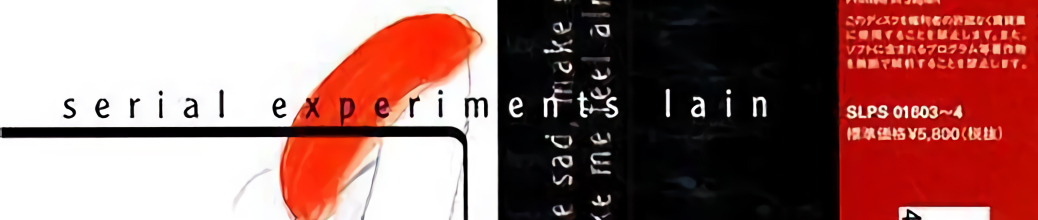
Note: this article serves as an addendum to my prior post Explaining Iwakura Lain, aiming to discuss the similar and differing aspects surrounding Lain’s existence within the alternate universe setting of the Japan-only 1998 Serial Experiments Lain game for the Playstation 1
When you speak of Serial Experiments Lain there are always two particular questions that pop up: 1 – what on earth just happened, and 2 – what’s this video game I’m hearing about? Considering myself a huge fan of the series and having already addressed the first question before, I’ve been meaning to make this for a long time, but as with all of my projects over the past couple years this script has just been in limbo from sheer laziness. I never intended to leave it this long, but I guess that’s just how it panned out. What is Serial Experiments Lain for the Playstation 1, and how does it relate to the TV anime? In contrast to the prior post where I tried to hone in on a whole slew of specific details, I’ll really only be addressing the game summarily, since at least in the context of this discussion there isn’t as much to unpack. It’s not nearly as abstract, instead taking a more down to earth approach.
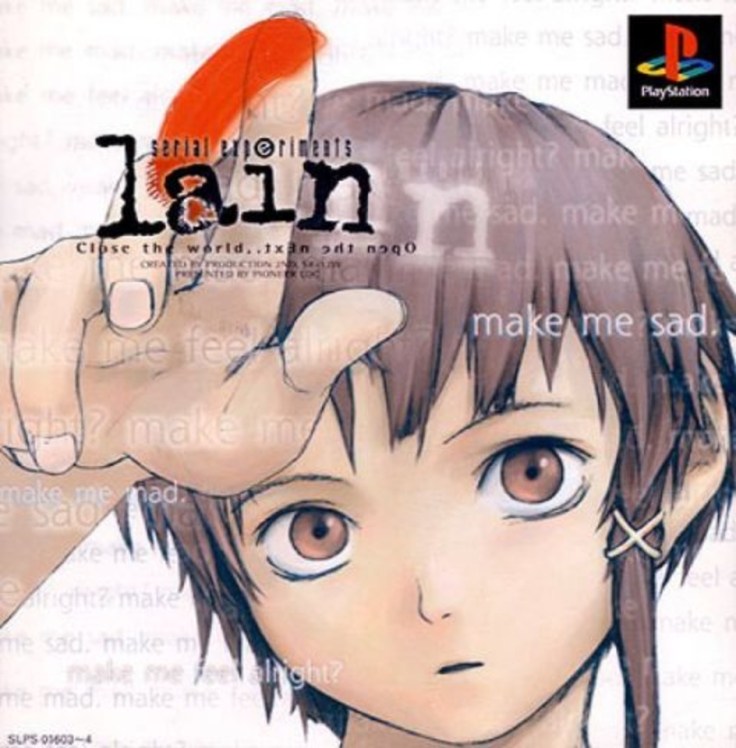
“Will and existence. The rest is mere data.”
The game was a Japan-only release in November of 1998, merely a few months after the first airing of the anime. Though calling it a game is probably a tad disingenuous, rather it’s an interactive experience where you listen to files arranged sporadically on Lain’s computer to piece together the story. It is for all intents and purposes an archaic visual novel. For someone that doesn’t understand Japanese the only real way to experience it is through an online resource called laingame.net, a website recreating the layout and content of the game in a far more intuitive manner. For the longest time it was nigh impossible to breach the more obscure half of the franchise, but this fantastic website provides a simple way in which to finally go through it. Having effectively run through the story three times before (once by reading the pdf scripts then watching the cutscenes on YouTube, once by working through the html version on laingame, and once by playing the raw PS1 game) I would highly recommend the option of actually attempting to play laingame. The multiple plot threads mean it can be confusing to read the standalone scripts since you have to reset your timeline when you move from the end of one segment to the start of the next, and although its enigmatic atmosphere makes the proper game sound appealing it’s ultimately far too clunky to be enjoyable in this day and age. You play the original for bragging rights, nothing more. Laingame is the perfect mix where it still somewhat emulates the presentation of the original game, while being an infinitely more fluid experience. There will occasionally be files out of order (mainly the videos), but for the most part you simply begin at the bottom in Site A Level 1, read everything from right to left in as close to order as you can, then move up to the next level. You do this until you reach the end of Site A, and then continue on to Site B where you proceed in the same way. Additionally partway through Site B you need to read the manga excerpt The Nightmare of Fabrication. It can be a bit difficult to place this, but personally I’d suggest reading it at around level 8 of Site B, since it depends on certain plot elements beforehand, and seems to influence a shift in Lain’s personality from that point on. This is the pathway I would recommend. Going through laingame keeps the chronology tighter than the other two options. Although it may sound confusing, this easily ends up being the most coherent way of experiencing the story.
Compared to its anime counterpart where Lain of the Wired leaps into the digital world to war with false god Deus in defense of the very fabric of reality, this story occurs on a much smaller scale. Rather than technology responding to Lain, this time around Lain responds to technology. Instead of enshrining the computer as some mystical apparition like the anime does, the game’s story focuses more on concrete concepts like robotics and AI. Similarly there is actually no mention of the Wired until the very end, until this point it’s simply referred to as the internet. Instead of Lain’s consciousness being pulled in different directions due to her unstable form, the game incarnation is presented as a much more clinical case of schizophrenia. Unlike the other universe where her computer quickly evolves into a fully-fledged cybernetic nest, this Lain just keeps a simple desktop. Etc, etc. This post will naturally contain spoilers, but even with said spoilers I think it is absolutely worth experiencing yourself. Serial Experiments Lain for the Playstation 1 is a beautifully haunting, extremely confronting story that I think will stay with you for a long time.
I must warn that this is not a story for the faint of heart. Its themes are depressing and its imagery is upsetting. Happiness does not exist here. Every light shines merely to be extinguished, and there is only suffering to be found amidst Lain’s horrific mental collapse.

The story more or less follows two plot streams across two major settings. You have records of Lain’s meetings with her therapist Touko, and her digital diary recounting the outside events feeding into her psychological breakdown and eventual rejection of humanity. To get straight to the point, I believe that Lain’s identity here is the same as before, a physical vessel for the Collective Unconscious, and an avatar of interpersonal communication. However for all the difficulty it took to arrive at this point in the previous version, her true identity is largely irrelevant to the events at hand. Despite being one of the most important questions before, it just doesn’t matter that much here. This time around the story is far more ambiguous about the question of Lain’s existence, and I believe that this is because the anime is considered the main Serial Experiments Lain work (see this interview where Ueda mentions the game started development after the anime had concluded). The game feels like more of an addendum than anything in that, to me at least, its themes and plot developments seem to assume the player is first familiar with the anime. You’re expected to have a handle on the TV series before approaching this complementary take on Lain. Even though the settings don’t directly correlate, it still primarily functions as an alternate route that explores what happens to Lain when placed in a scenario where she doesn’t have any kind of love or positive influence to tide her mental degradation. No friend to give her affirmation, no loving father, just Lain and her estranged mother. I would wager that this is actually what the “serial experiments” part of the title is referring to, and that the “serial experiments” are the key for contextualizing this incarnation of Lain. We’ve discussed who Lain is, and we know of Eiri’s experiment taking place in the TV series, but where does the “serial” part come from? Why “serial” rather than something arguably more appropriate like Self Experiments Lain or Ego Experiments Lain? The only thing I can think of is that when original creator Yasuyuki Ueda first drafted the concept for the series it was always planned to be a multimedia project, therefore comprising the “serial experiments”. They’re two sides of the same coin, exploring what both success and failure look like for Lain when placed in slightly altered environments. It focuses much less on actually tackling the origins of Lain’s existence, instead serving as a psychological case study that showcases what could have happened to her had she been dropped into an entirely loveless life. Indeed she did have a friend and did have a good relationship with her dad, but both are cruelly taken away from her in order to observe how this experiment plays out under different circumstances. The results are not pretty.
With the game itself giving no significant attention to Lain’s identity like the anime, it can be tempting to consider whether Lain is simply human in this case. Her home life seems to be, for the most part, more grounded than its anime counterpart. At first she acts like a normal girl her age. She worries about her awkward fashion sense and wishes she could be as stylish as Kyoko, she blushes at lewd stories told during PE, gets embarrassed when telling Touko she talks to her stuffed animals, and has a crush on a classmate named Tomo. She goes shopping with friends on the weekend, and is secretly happy when they visit her when she had a cold. Even the pivotal moment where Lain is introduced to the network bears no ill will. When her father gives her a computer it’s for the sake of participating in classes online on her sick days. In the anime version of this event Yasuo almost seems to be taunting his lonely daughter as he laughs with his chatroom right in front of her, but there’s seemingly none of that malicious intent present here. Neither is there any obvious indication of her family being surrogates, to the extent that when her father disappears it’s just presented as a regular divorce rather than malign intervention. Eiri is nowhere to be seen, nor are his men in black. The entire thing is much less fantastical, so on closer inspection isn’t this just a totally separate story of an unfortunate girl and her horrific mental decline?
![Serial Experiments Lain (PS1) All Cutscenes.mp4_snapshot_04.58_[2020.02.19_17.30.50]](https://skapbadoa.com/wp-content/uploads/2020/02/serial-experiments-lain-ps1-all-cutscenes.mp4_snapshot_04.58_2020.02.19_17.30.50.png?w=736)
Well, that option doesn’t really hold up. That’s not to say there’s anything wrong with that reading, but it’s missing the big picture. These are a pair of intertwined “serial experiments”, after all. On the surface it may appear to lack key actors from the anime version, but on closer inspection you can find them hidden away in the darkest corners of the text. When approaching this story it’s integral to remember that the majority of the content in this game is delivered through unreliable narrators. Lain is just a scared, confused little girl using her diary as a futile attempt to abate insanity, and Touko is a wholly unremarkable shrink who was not prepared for the mental barrage she was going to face by trying to diagnose her. Unlike her anime counterpart Lain never cracks past Tachibana’s front as an upstanding research company, so direct confirmation of her adoption never gets uncovered. What we do see however are diary entries noting her suspicions about not resembling her mother, and since we’re familiar with the anime already we know where this suspicion leads. Make no mistake – Eiri is not absent at all, as we’ll soon find out. This Lain never ends up breaking out his design, so there’s simply little need to take an active role.
There are traces of a conspiracy laced throughout the text, such as Lain accidentally spotting her supposedly divorced parents together with a Tachibana correspondent after their roles were finished, or Touko freaking out when finding the entirety of Lain’s personal history present in their database. But this version unfolds between the lines, never fully rearing its head. I believe that a significant part of this is as I originally stated about the game assuming you already know the anime, but there’s one more key factor – the single missing file which contains the most essential information needed to make sense of this madness: Dc1029. The way the game works is that you navigate through a matrix of data on Lain’s server reading information to get a glimpse into its complex, nonlinear story. Files are separated into numerous categories, such as Lda and Tda referring to Lain and Touko’s diaries respectively, or Cou for the records of their counseling sessions. The Dc prefix is attached to the video files for the cutscenes, and there’s a single one of them missing. A very important video file that directly leads into the endgame, might I add. While absent from the game itself, Dc1029 shows up as the manga oneshot The Nightmare of Fabrication. It is the only part to feature or make mention of Deus, and serves as the tipping point where Lain starts to willingly loosen her grip on sanity, by taunting her with the claim that she’s not as human as she thinks, and tempting her to erase all the bad feelings by rewriting her memories. His ambitions are still the same as ever, wanting to push Lain towards ego death as the sacrificial lamb christening his deification through Protocol 7, and this time around Lain has no bonds preventing her from being seduced by his promise of an easy way out.
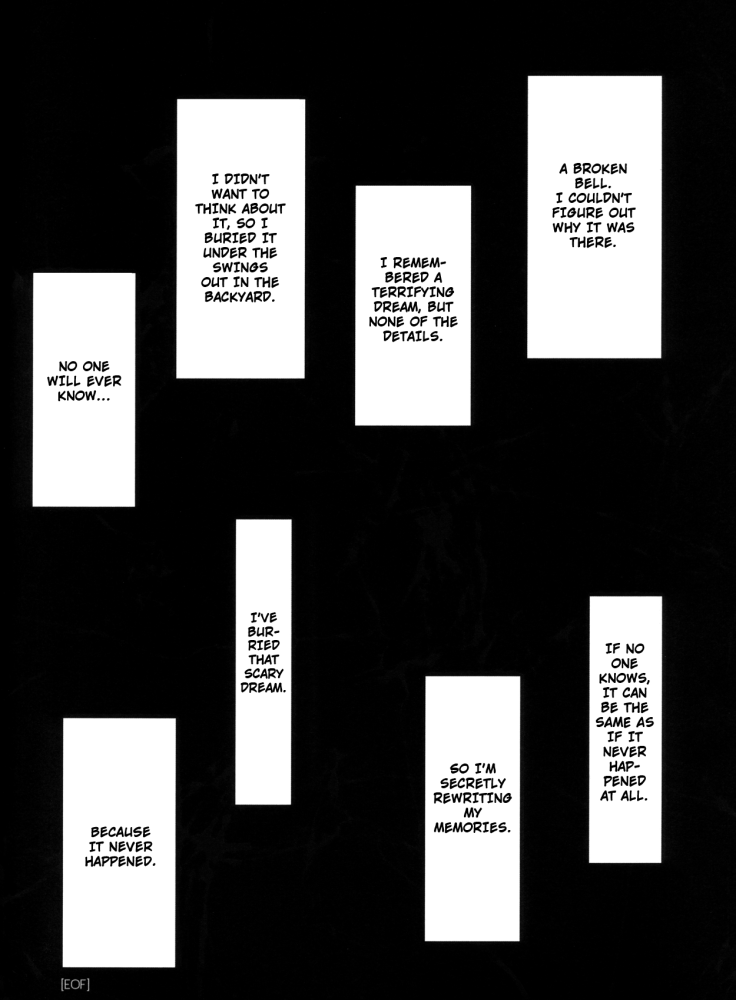
Although operating at a far more secretive degree, Deus, Tachibana Labs and the Knights are active behind the scenes of the game’s story. Their names are mentioned a mere handful of times, but they are mentioned. The Tachibana Labs are offhandedly revealed to be Touko’s employer, for example, and Lain later tries to solicit an accelerator from them. And again, while it might be tempting to say that Tachibana is just a healthy company sharing the same name in this alternate universe, that doesn’t hold up. Whether it’s the way they set Touko down the path of madness using the same headset that got the man seeking the Knights in the anime killed, or subsequently obfuscate the truth of her suicide, they’re as shady as they’ve ever been. By explicitly appearing in the oneshot it proves that Deus is still looming over Lain. His Protocol 7 is even mentioned exactly once in the entire script, and Lain knows that the company is behind it. This recontextualises this version of Tachibana, and subsequently the entire narrative, suggesting that they’re once again dancing to Eiri’s tune and are responsible for pushing Lain into despair when they remove her beloved father from the equation.
The scenario for the experiment unfolds in much the same manner and shares many key events with its counterpart. Both stories are orchestrated by Eiri behind the scenes, after all. To roughly summarise it, the method is as follows:
![[Reaktor] Serial Experiments Lain - E09 [1080p][x265][10-bit][Dual-Audio].mkv_snapshot_20.51_[2020.02.20_22.00.49]](https://skapbadoa.com/wp-content/uploads/2020/02/reaktor-serial-experiments-lain-e09-1080px26510-bitdual-audio.mkv_snapshot_20.51_2020.02.20_22.00.49.png?w=736)
- Provide her with a physical body, fake memories and a family to emulate being human.
- Connect her to the online network.
- She will inevitably begin seeking out connections on chatrooms.
- Expose her to death to establish the impermanence of the body.
- Start eroding her ego with Anti Lain.
- Deliver an upgraded PC.
- Involve her in a murder-suicide to galvanise its presence in her mind.
- Take away the father she loves most.
- Reveal yourself as Deus and tempt her to start abusing her powers.
- Wait for Lain to willingly give up her body and enter the Wired.
Gifted a body and placed under the management of a surrogate family that Tachibana prepared, Lain begins as a more or less normal primary schooler that you could find anywhere, though quite a bit more intelligent than any of her peers. She needs a little bit of psychiatric aid from Touko, but she was relatively stable. True enough, for much of Site A she seems to moving towards recovery. However she constantly relays a feeling of depersonalisation, and says she sees “that” in her hallucinations. “That” scarcely gets elaborated on, not until the tail end of the narrative in Site B level 9 where she finally mentions that she’s been seeing another version of herself haunting her vision, serving as the game’s analogue to Anti Lain. Since the game is more about the psychology of the events rather than the people pulling the strings the Lain mirage is treated as a side effect of her decaying mind. However as food for thought I will point out that in my previous analysis I suggested that the episode 5 scene of a young Lain engaging with various Tachibana members was a visual representation of them programming Anti Lain’s logic routing, due to not slotting in with the timeline of Iwakura Lain, and that episode’s big event being the debut of the evil doppelganger. With that in mind, perhaps it suggests some ties to this hallucinatory Lain, as she too is noted to begin as a child when Lain first notices her, growing up over the course of the game. Whether Touko is correct and it’s just a hallucination borne from her loneliness and paranoia or whether it is actually the Anti Lain program being run by the hidden god frankly doesn’t matter that much, because regardless of its identity it once again manages to corrode Lain’s sense of self with a terrifying efficiency. Her home life steadily falls apart from her mental illness, taking a particularly sharp dive after her parents’ divorce.
Although occurring at different points in the story, the part where Lain witnesses a murder-suicide is perhaps the best spot to illustrate the emotional difference between the game and the anime versions of the character, as in both cases Lain plays an active role in pushing the gunman to suicide. In the anime version the incident takes place only two episodes into the plot, and it disgusts Lain to the point she appears to willingly seal her own memory in order to escape it. Previously I noted how the glint in Lain’s eye hints at her controlling his mind through the frequencies of the Accela in his system. The game uses a similar idea. While walking to the offline meeting where an acquaintance named Shinji offered to give her some parts, it zooms in on Lain’s eyes, showing us an eery glow circling around her irises. She makes eye contact with a couple in an alleyway, who later show up to cause the incident as if under her spell. After committing the murder, both gunmen are compelled to kill themselves by Lain’s words. This Lain however, feels no remorse for her actions, having set this entire thing up solely in order to procure the gun that would be left behind afterwards, since it would be a vital piece in Eiri’s endgame. Heck, as if the couple from the incident weren’t enough she even goes on to intrude upon Shinji’s consciousness and push him towards suicide too.
In my piece on the anime I suggested that the unconditional love of Arisu and Yasuo were the only factors outside of Eiri’s control, and that they’re ultimately what’s responsible for enabling Lain to overcome his schemes and retain her human heart. It should then come as no surprise that their absence is the most important difference informing how the game plays out. If the planetary consciousness manifested as Lain in the anime because she loved humans, then having no one to love her back is the biggest pain she could receive.
In both cases Lain had a very good relationship with her dad. He was always nice to her so they got along well. Throughout their time together he performs his role perfectly, perhaps even spoiling her more than Yasuo did. However under Tachibana’s guidance this was always a temporary arrangement. Eventually the ruse reaches its climax and the two actors play out a violent breakup that shakes Lain to her core. Unlike the father in this experiment who vanishes as instructed, Yasuo had come to say goodbye. In his last act as her family he offers his apologies and affirms that she is strong enough to face whatever future she desired. This Lain gets no such love. Her father promptly abandons her, never attempting to get back in contact. The person she loved most didn’t even spare a thought for her. Her remaining parent quickly becomes abusive, throwing bottles at her while drunk and locking her under house arrest to ensure she can’t escape, eventually walking away from her traumatised daughter altogether. By nature, Lain wants to connect with others. But this was becoming increasingly difficult.
If her family had failed her, then what about her friends? There are none, obviously. No one is willing to stop her from barreling down the dangerous path she was rapidly finding herself on. With Eiri’s plan hitting every one of its marks she would never be allowed to have such happiness. The early segments of the story do feature numerous conversations with her childhood friend Kyoko, but the two have a falling out before the end of primary, and when they happen to reunite in middle school two years later Kyoko acts like she never knew her. Lain does however spend much of the game claiming to be best friends with a classmate named Misato, but it’s never determined whether that girl ever existed or not. We spend much of Site A hearing Lain rave about how proud she is of her friend. It’s only after three long years in counseling that Touko is tipped off that Misato doesn’t seem to exist, but Lain remains adamant she has memories of her. Yet at the same time, once The Nightmare of Fabrication rolls around she begins to doubt the integrity of her memory, which is the vulnerability that Deus capitalises on to manipulate her. Just a few months after her father left she has already begun to forget things about him, reiterating the unreliability of the memory record. We know that her dad existed, so what does that say about Misato? Did she exist after all? We even get to see what her appearance looks like at one point. Was she just another pawn in Eiri’s hand? Did he imply that Lain killed her and then erased the memory? No surely not, Lain swears she’s her best friend! She simply transferred away. Misato even sent an email to her hidden site, despite the time and date making no sense. But does she actually believe that herself? What if Lain was just insane. She has mentioned many times that she feels disconnected. But the memories mean so much to her! What did Misato look like again? Amid this vortex of confusion the final verdict is left unresolved in order to sympathise with Lain’s chaotic state of mind.
In the framework of Serial Experiments Lain her two main points of contact are supposed to be her loving father and best friend. But whether she existed or not at one point, the fact of the matter is she doesn’t anymore. Lain does not have a single friend looking out for her. And so due to the absence of an unconditionally positive influence like Arisu, this Lain has no one to anchor her in her humanity, as she starts to become increasingly frightened at the circumstances encroaching upon her. She sees someone that isn’t herself staring back in the mirror. She hears things whispering to her from the sky. She feels that she is not like everyone else. Her heart has all but fallen to ruin. Humanity? Just a mess of behavioural programming. The body? Just a temporary peripheral. Existence? It’s not real, everyone’s just been tricked into thinking it is. And no one is there to tell her differently. No one to help her and no one to hug her, no one to talk to or even smile at her. While Arisu was the one to reassure her of her humanity in the anime, this isolated version of Lain frequently resorts to self-harm in order to verify she still exists. Falling and fading, but no one around to help her breathe. Certainly that should have been the role of her therapist Touko, but she could never have been strong enough to save Lain. She was just a commoner caught up in all of this, never fully becoming privy to the sinister machinations of her employer. Despite thinking her sessions were helping during the first act, she eventually realises that she’s vastly underqualified to deal with Lain. By the end of it the client has completely usurped the role of practitioner, becoming the one interrogating Touko on the nature of human folly instead, and once again, ultimately driving her to suicide.
Burned by human interaction and weary of reality, Lain recedes into the deepest corners of the net. When her father was missing, her mother was refusing to tell her where he went, Misato’s validity had been called into question, and Touko hated her for hacking into her diary, the internet was a place where none of that mattered. At this point she believed that it was only through the network she could avoid being alone. Her physical world had lost all its light, but she could still connect to others online. Anonymity empowered her as she began to dive deeper into discussions of robotics and artificial intelligence, pondering whether these things were really different from biological life and consciousness at all. Having essentially given up on humans, this would soon lead Lain to begin development on her synthetic father. At first it was a simple AI simulation, but that wasn’t enough to appease her. So using some backdoor channel she commissions the refurbishment of a large warehouse, and over a period of months sets to work building his robotic replacement. For a time this make her happy. Everything was crumbling around her, but if she could at least embrace her father once more then that’d be enough. That connection is all she really needs. But one day it hits her. The epiphany she didn’t want. A machine is just a machine. It can never become a human to replace the father who abandoned her. No neural network or actuator motor would make it cross that barrier. And in a fit of loathing she violently smashes what she’d poured so much time, money and love into creating, intending to recover the pistol she’d stowed away inside its chest. This robot was just a bandaid slapped onto a much larger problem that required a much more drastic solution.
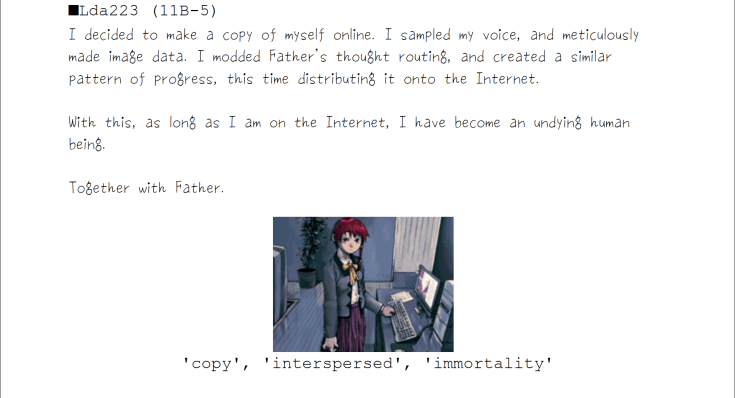
At this point Lain had well and truly gone crazy. Everyone she’d ever loved had abandoned her, and in a fit of rage she’d already pushed numerous of them into taking their own lives. If the digital cannot love a human, then why stay human? If she were digital herself then she could be together with father, and she wouldn’t have to worry about her inconvenient body and rapidly failing mind. Discard the finite flesh and live forever, for God is here. It is with these twisted feelings in her heart that Lain enters her final days.

Relentlessly driven insane by this incarnation of Anti Lain, drowned in despair by her father’s disappearance, betrayed by Touko who was too weak to help her, allowed to get drunk on robotics due to her mother’s negligence, and then successfully captured by the ideology of Deus. This is what the narrative looks like without the wildcard variables of Arisu and Yasuo. Eiri has won, and Lain rejects the flesh for the digital world, where she will undoubtedly become a tool at his disposal. After a final contradictory debate with the last remnant of her fractured ego, Lain holds the gun to her mouth. If we cross-reference with the anime we can discern that this was originally intended to be the final step of Eiri’s plan. Though obscured by the difference in aesthetic and slightly rearranged, the plot of the game basically follows the same script as the first 11 episodes of the anime. His ultimate goal is to have Lain awaken Protocol 7 and then swiftly lose her sense of self so he can use her as a control terminal for its perception-altering potential. We can observe that in both cases this is the point where Protocol 7 has finally awoken, as seen by the mysterious technological towers in the anime, and Lain projecting her consciousness around in the game. Awaken Protocol 7 and then have Lain abandon her body and conscious mind, this is the goal he had been steering her towards the entire time. But unlike the other experiment where she stops short after thinking about Arisu, this Lain has no friends, no connections to stop her, and no love left for the world that had tortured her so much. And so she shoots – closing one world, and opening the next.
 skapbadoa
thank you for explaining
LikeLike
funny that’s look i’m already on 1 jan in the comment, since i’m still in 31/12 in my PC haha so happy new year and thank you for delivering this very rich material to read. -B
LikeLike
I’m 29, SEL has been a part of me since I’m 15, shaping who I am and how I feel… Yet I never played the game, nor scratched the surface.
You are truly a God in the wired. Thank you.
LikeLike
hello, can I translate your analysis and post it with a note about your authorship?
LikeLike
Sure thing.
LikeLike