
No matter how messily, I guess I feel the need to write something about 2018’s Hugtto Precure as a sendoff since I’ve been engaging with it all year. This is only my second Precure, and the first one I’ve watched weekly. It just doesn’t feel right to say goodbye to this entry without having some kind of dialogue about it. I have mixed feelings on the show in its entirety, but on the merits of its stellar first half I will wholeheartedly recommend it to anybody who even remotely likes the magical girl genre.
Hugtto Precure began incredibly strong. The first episode pulled out all the stops with its insane fight choreography and impact-frame sakuga, then episode 4 was a masterclass of shot composition. As the season continued on this was something that showed no signs of stopping. The production values were supreme, and this extreme level of quality made it consistently engaging. No matter how mixed my feelings are on the show’s latter half, nothing can ever change the fact that the first 24 or so episodes are phenomenal and damn near unmatched within the mahou shoujo genre. For certain fundamental reasons such as art style and character design I don’t think Hugtto would have ever surpassed Heartcatch Precure for me, but at first it was making a very strong case to end up being my second favourite magical girl series. At its worst it’s about what you’d expect from a long-running annual mahou shoujo by Toei, but at its best – oh boy.
In my opinion the show’s biggest strength was its three most prominent plot threads. These are the aspects which really helped elevate the show beyond just an exceptionally good mahou shoujo into something truly special. These being:
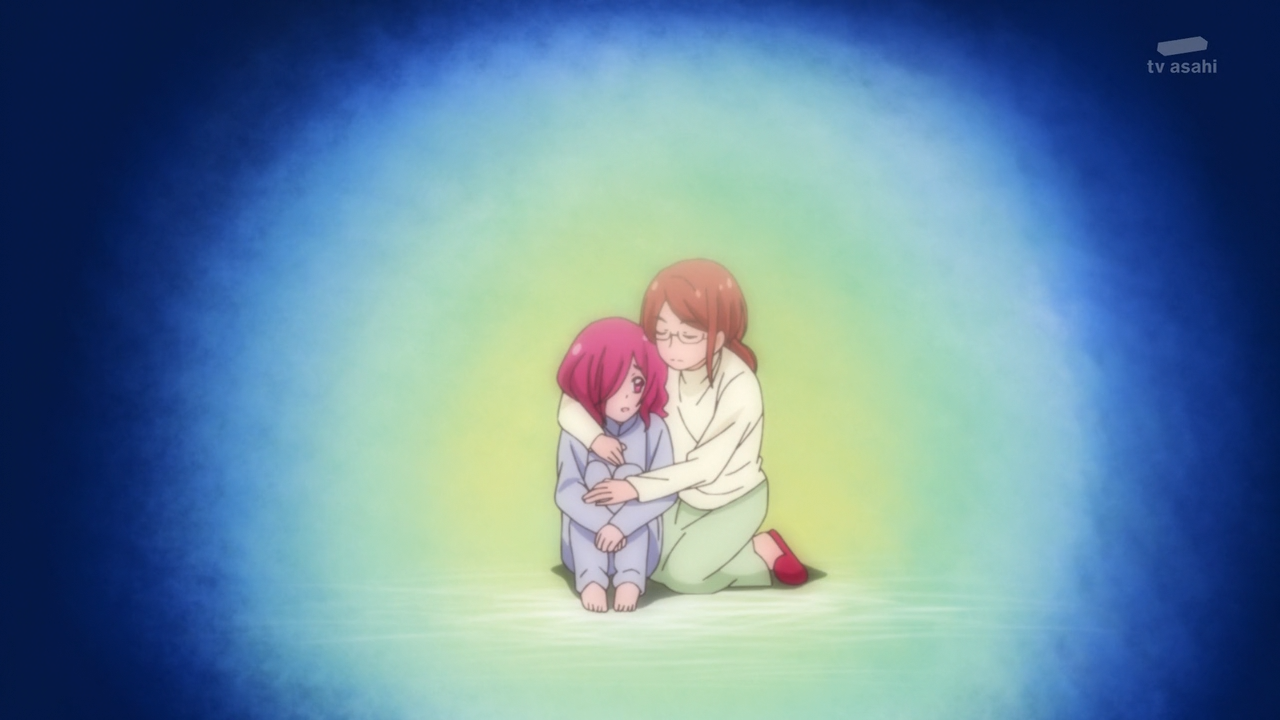
- Hana’s bullying trauma
- Lulu’s emotional growth as she starts to feel like she wants to abandon Criasu and become Emiru’s friend
- George’s identity being Hana’s future husband, with Hugtan as their daughter
The best piece of writing to be found in Hugtto was the character backdrop of Hana’s history with being bullied. We don’t know the full extent of it at first, but one of the most immediate things we learn of Hana is that she’s just transferred after her first year of middle school. This isn’t cause for concern by itself, but in the early series I very distinctly got the feeling that there was something hidden behind her happiness. Rather than simply being energetic and optimistic, it was more like she was running herself ragged. She was constantly moving and putting herself out for others without ever taking a moment’s rest for herself.


Additionally it always seemed like she took the villains’ talk about stopping time to prevent suffering a little too personally, as if every time they brought it up she had to try and convince herself that she didn’t actually agree with them. Episode 23 reveals the reason for this: Hana was bullied at her old school, and she’s still reeling from the effects of that. It was merely a year ago, after all. She viewed happiness as something infinitely fragile. Learning this retroactively adds new depth to her character in everything prior – those little insecurities of hers you thought you were noticing were real after all. This serves as the central underlying motivation informing all of her actions. The despair she felt back then was constantly lying in wait to consume her the moment she let her guard down. It messed her up bad, and being a Precure only exacerbated this problem. Despite chasing the illustrious “Nono Hana I want to be” there wasn’t actually anything she dreamed of, leading her to use her Precure obligations as a vice in order to avoid thinking about it – fighting to support the dreams of her friends so she didn’t have time to confront herself about the fact that she herself was empty. She could say she was trying her best, because duh she was a Precure. It was her own way of avoiding the future. There’s a brilliant emotional complexity to Hana’s character that you can trace through to tangibly see how her troubled history has influenced her current personality, forcing happiness to try and keep the bad memories away and cheering for herself because no one else would do it for her in the past. Hana’s characterisation is the jewel atop the already incredible early Hugtto.


This all comes to a head in episode 24’s night pool, a very intimate, introspective, understated piece primarily focused on what happens when Hana is left alone with her thoughts. The meat of the episode is simply Hana moving around the pool talking to people and contemplating the things they say to her. The shock of discovering that the George she admired was actually the CEO of Criasu let loose unpleasant memories of when her friend betrayed her during the days she was bullied. His words ring out in her head, bringing her to tears because it reminds her of the pain she felt when her own time was stopped. However, while wading around Hana receives some much-needed positive reinforcement from her loved ones. While the others were all chasing extravagant dreams of becoming actors and athletes, being a Precure was all that Hana had. Yell was the Cure of genki, and not much else. Throughout the episode she spends more time looking around to make sure everyone else is smiling than she does actually enjoying the pool herself. Their happiness was how she judged her own merit, unhealthy as that may be.
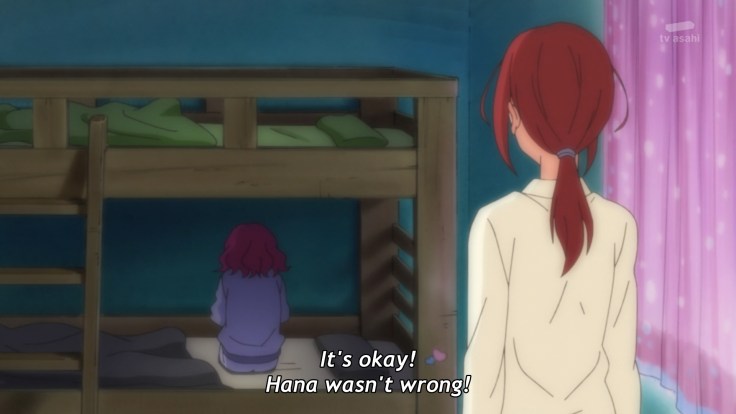
This neurotic behaviour finds its roots in her trauma. Episode 23’s flashback shows her mother comforting the depressed Hana her by saying “It’s okay Hana! You weren’t wrong!“, with this being the first small glimpse into what form her bullying actually took. It’s later in episode 31 where we finally learn the nature of her torment. The story of her troubles goes as follows: her friend Eri was repeatedly a target of intense ridicule by the clique of popular girls, so Hana stuck up for her. Then the perpetrators set their sights on Hana instead and isolated her, with the friend being too scared to associate with her any longer. This isolation continued up until she eventually transferred away to escape it.

As a result of this event she has a toxic relationship with heroism. Defending others is part of her nature, but doing so brings up bad feelings within her. Her mother had reassured her that sticking up for Eri wasn’t the wrong thing to do, but was that really what Hana needed to hear? It may have backfired. She wasn’t necessarily feeling the joy of helping others, but that it was something she had to do in order to validate her existence. It was always about stopping Criasu from stealing their futures, never about her own. She didn’t have a clear-cut passion like the others, so the only path she saw before her was to be a stepping stone by protecting them as Precure. From her isolation Hana knew what it was like to feel as if time was frozen so she wanted to ensure nobody within her reach had to ever experience that – acting out of fear and desperation if nothing else. It was the only thing she could do, even if she was spreading herself thin to do it. This in turn gave rise to her quiet little inferiority complex: if being a Precure was all she had, then where did it leave her when the others were just as adept while also having ambitions elsewhere? Was there really any point to her being around? Did they really need her? She finally gets the answer to that question: Yes. There is a reason for Hana to be there. It may have come from a damaging place, but her friends reveal they are incredibly thankful to Hana for her constant support – that they could only pursue their passion because of her. With the help of everyone precious to her, she comes to the realisation that it wasn’t just her lopsidedly protecting the public, but that ‘their smiles also give us strength’. Despite being born from her most vulnerable feelings, there was meaning in the support she had given. To love and protect was not a mistake. This bout of introspection isn’t some miracle cure for her trauma, but at the very least it helps her to realise that her actions as Precure weren’t hollow after all, and as a result she lets out her first genuine smile in years.
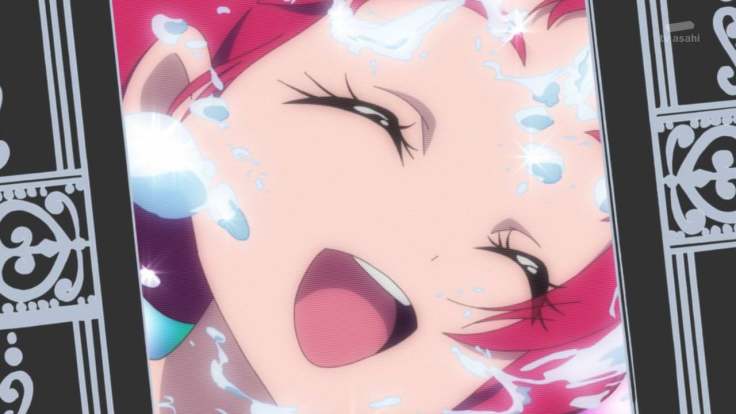
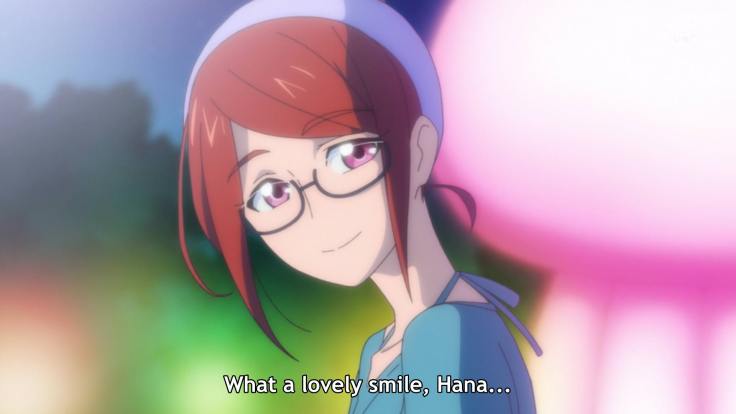
I hope I’ve illustrated how much I adore this plot thread, because consequently it also becomes the biggest mark against Hugtto to me. By all means this was the single most important component of the protagonist’s character, and one would expect the show itself to treat it as such. Unfortunately this isn’t the case. If 24 is my favourite episode for how it handled Hana’s inner turmoil, then episode 31 is my least favourite for the exact same reason. In this episode Hana runs into Eri and suddenly all of her suppressed memories of being bullied are dredged back up. As much as she was trying to avoid thinking about them, Hana’s wounds were still fresh. She tries to play it off with a forced smile but Hana was not okay to see Eri again. Yet rather than the previously displayed subtlety and emotional complexity, the episode treats it brusquely – making it feel low-stake just like any of the other surrounding episodes, and nonchalantly handwaving away her entire trauma with the power of friendship. All wrapped up in what was arguably Hugtto’s worst episode in terms of art and animation, of course. It baffles me. Not only was it the conclusion to this integral chapter of Hana’s story, but it was also the episode introducing the Cheerful Style form upgrades. No matter how you look at it the episode was clearly a big deal plot-wise. What kind of unprecedented production mishap had to have occurred in order for episode 31 to end up like this? It was by all means supposed to be the big conclusion that closes out the bullying arc, but it was handled so poorly that it directly soured my opinion on the overall show. What this arc deserved was a two-episode conclusion displaying the same degree of introspection as 24, but instead it was a production mess where the extent of the drama was just the other main characters telling Hana to be brave and face her. It felt hollow, and frankly quite insulting to the rest of the plot thread that came beforehand. I don’t know if I’ll ever forgive Hugtto for squandering episode 31 in the wake of its previously fantastic writing for Hana.
![[anon] hugtto! precure - 16 [8598a0a4].mkv_snapshot_15.02_[2019.01.22_09.43.13]](https://skapbadoa.com/wp-content/uploads/2019/01/anon-hugtto-precure-16-8598a0a4.mkv_snapshot_15.02_2019.01.22_09.43.13.png?w=736)
Unsurprisingly, I consider the second most praiseworthy part of the show to be enemy android Lulu’s redemption arc spanning from episodes 13-20. Of the three big plot threads this was the one that occupied the shortest span of episodes and received the most timely resolution. Once she infiltrated Hana’s home it was quite obvious that Lulu would inevitably come to the good side, yet the development still felt rewarding in spite of its predictability. Episode 15 and 16 illustrate the warring duality within Lulu’s psyche. The former is the first appearance of Emiru and Lulu’s friendship. While out fetching groceries Lulu stumbles upon Emiru pretending to be a Precure. After scanning ‘Cure Emi-ru’ and finding no presence of a mirai crystal, she attempts to leave but is caught by the energetic young girl. It’s one of Hugtto’s strongest comedy episodes, owing entirely to its great reaction faces and the duo’s surprisingly fantastic chemistry. You’d be forgiven for forgetting Lulu was one of their enemies entirely.


However the following episode is drastically different. After her enjoyable detour the week before, Lulu is given a harsh reminder of her circumstances. Criasu doubles their surveillance efforts, hovering over her out of impatience. Both her and the company knew she had already figured out their identities, so they give the order to stop messing around and eliminate the Precure already. This causes Lulu great distress.


The shot composition during her talk with Papple has Lulu standing in the sun, while everywhere around her is in shadow. As the conversation progresses the shadows increasingly creep up on her. Right as they’re about to touch her feet Lulu pulls back to avoid them. This is symbolic of her inner conflict. Exposure to the excessive familial love within Hana’s household has begun to make her lose faith in her parent company. She hasn’t quite developed a heart at this point, but she feels it starting to stir within her. Lulu didn’t want to hurt Hana and ruin the spot she had carved out for herself among the group. Sadly, the cruel reality is that she was powerless to escape the crushing grip of her corporate masters. If she disobeyed them any further she would be branded a traitor and likely scrapped. With as grim an expression as a robot can muster, Lulu silently steps into the darkness.
![[anon] hugtto! precure - 16 [8598a0a4].mkv_snapshot_08.10_[2019.01.23_18.36.39]](https://skapbadoa.com/wp-content/uploads/2019/01/anon-hugtto-precure-16-8598a0a4.mkv_snapshot_08.10_2019.01.23_18.36.39.png?w=736)
Lulu moves behind the scenes to steal Homare’s PreHeart, eliminating her from the equation entirely by taking away her ability to transform. In the ensuing battle the remaining two Precure struggle considerably due to their missing member. But the heart that was forming inside Lulu wouldn’t stop whispering to her. Knowing full well that it would both jeopardize her safety within Criasu and destroy her place within the Nono family, Lulu exposes her identity by returning the PreHeart to Homare. As expected, this doesn’t escape the company’s ever-watching eye. Before she has a chance to explain herself to Hana, Papple brutally attacks Lulu and retrieves her for reprogramming. A few days later the modified Lulu finally breaks free of Criasu during what would prove to be her final battle as an enemy of the Precure, and from this point on her appearances focus on her emotional exploration while growing closer together with Emiru. It’s a very compelling character arc centred on the bond shared between Hugtto’s most unlikely pair, and Lulu only continues to become more endearing as the series runs on, such as gaining new expressions and a cute relationship with her awkward ‘father’ Dr Traum.


As for the ‘Hana and George’ subplot, I had my suspicions about this quite early into the story. From his first mysterious appearance it wasn’t difficult to pin George as the leader of the antagonist’s Criasu Corporation, so I inherently associated him as the character who most fundamentally represented the future time period. But what we also know is that the president of Criasu was absent from the company during the first half of Hugtto Precure, as Listol was shown to be secretly projecting a fake hologram in his stead. So if he was the enemy leader, why was he constantly taking time off to seek out Hana? Why was he so genuinely nice to her whenever they met? George was someone who always seemed to be looking straight through people, ignoring their words in favour of his own philosophies. Everyone and everything was a pawn to his ideals. Except one person. The only character he properly engaged with was Hana during their sporadic meetings, with their discussions always hinting at some great melancholy plaguing him. It seemed though, that this melancholy was specifically centred on Hana herself. Talking with her appeared to be his only reprieve. For that reason their interactions always gave me the impression that there had to have been some kind of unknown relationship between them in the time period that he was from.

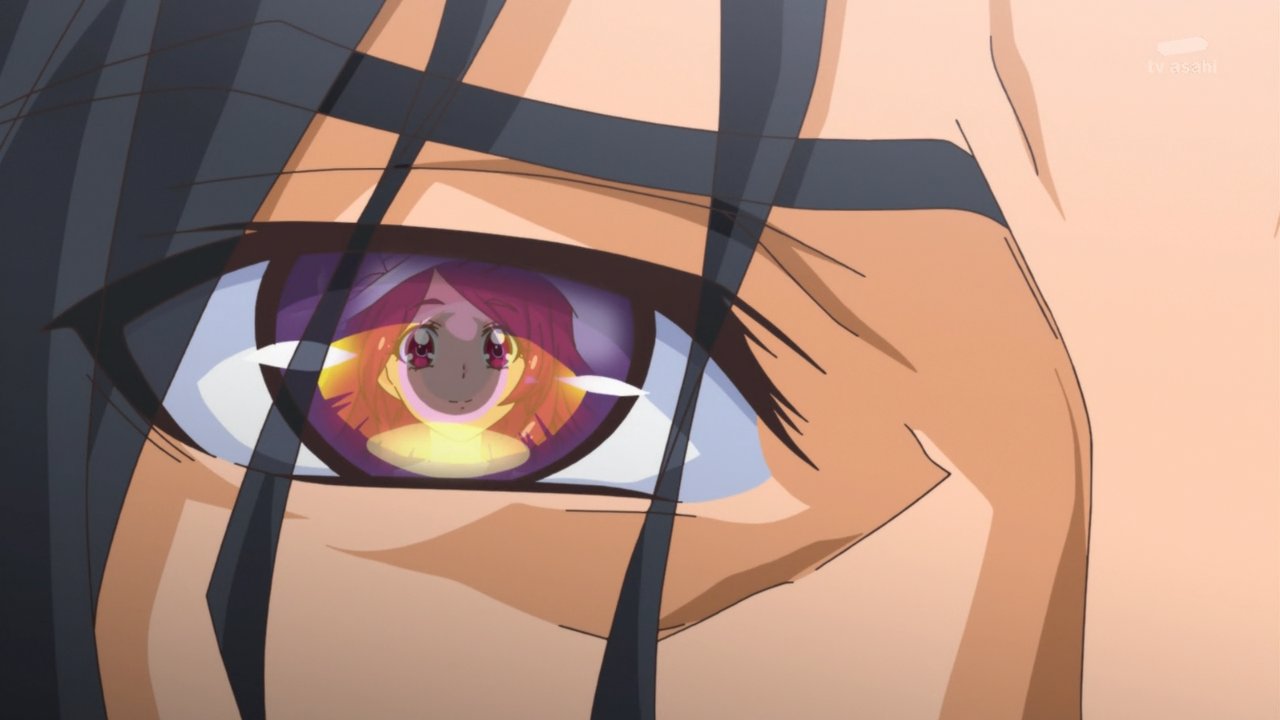
I latched onto this theory pretty much as immediately as I thought of it, from there it wasn’t long until the above shot in the opening made me think that Hugtan might be their future daughter too. It seemed noteworthy to me that Hugtan was reaching out to the enemy compassionately rather than displaying any kind of hostility. She didn’t look like she wanted to defeat him, but to bring him over to her side. This idea was further cemented by the dramatic moment when Hugtan starts calling Hana “mama”. Once Hugtan becomes capable of rudimentary speech the girls all try and prompt her to say their names, but Hana’s is the only one she won’t say. It’s not until she’s about to be kidnapped by George that she finally cries out for “mama!” and Hana bursts out of the frozen time to save her. From this point on Hugtan refers to her as “mama” whenever she calls for her, rather than reverting to “Hana” instead.
![[anon] hugtto! precure - 39.mkv_snapshot_20.18_[2019.01.24_11.14.10]](https://skapbadoa.com/wp-content/uploads/2019/01/anon-hugtto-precure-39.mkv_snapshot_20.18_2019.01.24_11.14.10.png?w=736)
It doesn’t end there though. Not only is she their daughter, but Hugtan’s true identity is revealed to be Cure Tomorrow, the leader of the future’s band of Precure – something that essentially makes her Hana’s successor. Thanks to time-warp trickery their family is spread across the ages. We follow Hana as a teenager, fighting against her depressed future husband George who seems to have come from a time where she is dead, and the only reason she’s able to fight as Precure is thanks to the aid of her future daughter who has regressed to a baby as a result of asu-power weirdness. It makes for a very fascinating story watching this family slowly come together against all odds.
The exact nature of George’s melancholy is left open to interpretation, but I believe there’s enough context clues in the show to make some kind of guess. From what we know of his character he appears to be an extremely devoted husband that quite literally loves his wife more than anything else in the world. My guess then is that the catastrophe which threw him into despair probably had to have been her death. There’s no direct evidence in the show so this is all speculation, but taking into consideration the show’s overarching themes on motherhood I can imagine a pretty feasible scenario wherein future Hana passed away during childbirth, and then George (who we see was running late to the hospital in the final episode’s good future) was so stricken with grief upon receiving the bad news that he overloaded on toge-toge-power and never even ended up making it to the hospital, which would then be why he never makes any indication he recognises Hugtan as his daughter. With the finale’s epilogue revealing Hugtan’s birth to be in the year 2030, Criasu seems to come from 2043 when Cure Tomorrow is around 13 years old like Cure Yell was. So by the time he made the decision to invade the past he would have been drowning in all-consuming despair for nearly a decade and a half.


![[anon] hugtto! precure - 48.mkv_snapshot_20.38_[2019.01.24_11.37.52]](https://i0.wp.com/skapbadoa.com/wp-content/uploads/2019/01/anon-hugtto-precure-48.mkv_snapshot_20.38_2019.01.24_11.37.52.png?w=364&h=205&ssl=1 "[anon] hugtto! precure - 48.mkv_snapshot_20.38_[2019.01.24_11.37.52]")

After the Precure defeat George in the final battle, Hana rushes in to rescue him from the collapsing Criasu building. Here they have one final consolation. Even if she wasn’t aware of the connection between them, she still helps him to finally start believing in the future once more. As the opening says – take your shining future and embrace it; For “the man who does nothing” all he needed to alleviate his languor was to be hugged tightly by his wife one more time, and at last he decided to try believing in the future the Precure were promising him. Not planning to disappoint him, the girls dedicate their efforts to spreading hope amongst all people, erasing the dark Criasu future and instead paving the way towards a shining new future in which Hana, George and their daughter Hagumi (Hugtan) can be reunited once more as a healthy, loving family. Where the bullying plot thread met a wholly unsatisfying resolution in episode 31 and I was almost disillusioned on the Twin Love story because of how inorganically they kept stealing the spotlight to sing the exact same repeating insert song, it was truly cathartic to see the Hana and George story reach a proper, satisfying conclusion. Having this arc come through more strongly in the show’s last episodes made for a strong finale, even if it was not enough to redeem Hugtto Precure’s subpar second act.

I don’t know exactly what happened, but something went wrong in the second half. The blood-pumping sakuga from the beginning became increasingly sparse, the cinematography was rarely as impressive, and most episodes began to feel phoned in. There was a very notable problem for me with episodes feeling incoherent, having a main episodic plot as the focus of the episode, then a completely unrelated Oshimaida shoehorned in at the end to keep the status quo. The bold creativity and passion radiating from the first half were very evidently gone. Even something that should have been monumental, the first example of Cures crossing over into each others’ worlds in a canon TV series, felt aggressively bland. There were occasionally some episodes where it got better, but ultimately I don’t think it ever managed to return to the same heights it was at in the beginning. Though I will say that if Dragon Ball Super: Broly is what was stealing all of Hugtto’s production resources and sakuga during the second half then honestly I’ll forgive Toei in a heartbeat and say it was worth neglecting Hugtto because my goodness that movie was mindbogglingly good. And at the end of the day, the latter half (despite its flaws) does not negate the former. On the surface level Hugtto Precure appears mostly like your standard Precure fare. But when you read into it there are some very skillfully written emotional arcs toiling away beneath the surface, and I think this is where the true appeal of Hugtto is found. The first half was one of the most solid 10/10s I’d ever given, but unfortunately the second felt like a 6/10 to me, so my final overall score is 8/10. Taking the entire run into consideration Hugtto Precure is still an incredibly worthwhile watch, even if the later episodes continually trend downward.
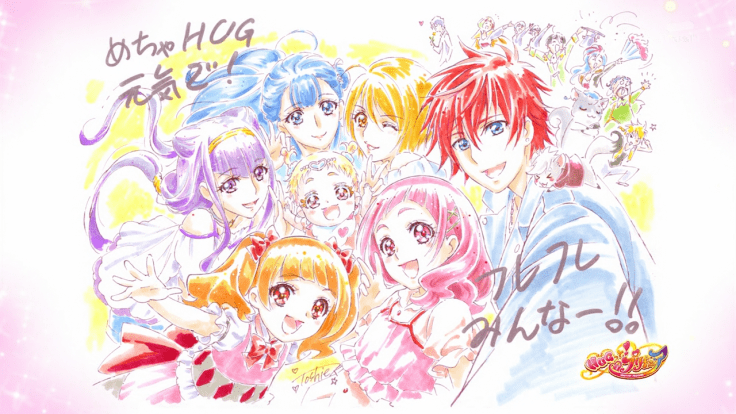
Just a little tidbit: I find it interesting that my favourite episode was 24 and in r/anime’s discussion threads that ended up being the lowest scored one overall at a mere 5.5. I felt episode 24 was the most emotionally complex and subtly written episode in the series and tbh I guess it’s a shame people weren’t getting the same thing out of it as I did. Episode 24 was the only time I can remember where I’ve watched an episode of anime and gone “that was so outstanding I need to watch it again immediately.”
 skapbadoa
Hi! Was browsing through reddit (particularly checking out Hugtto threads because I recently finished rewatching it hah) and saw your review. I really enjoyed reading your thoughts and found myself agreeing with your points, particularly about episode 31. I only disagree about the animation part though because that episode’s Animation Director is Nishiki Itaoka who is one of the top precure animators.
But yeah, I also think that the way they handled the conclusion of Hana’s bullying arc was pretty weird and just not good. Thankfully, her overall character arc didn’t end there because the last 4 episodes exist. I wish you talked more about Ruru in the latter half though because I loved her character, even more, when Traum arrived in the picture. As much as I loved Twin Love, I think that Ruru and Traum have one of the best relationships in Hugtto. I was also curious about your thoughts on the other cures but anyways. Great review!
LikeLike