
mfw I’ve fallen so far into idoru hell I actually make this its own blog post since it was too long to post as a single r/anime comment
The Love Live franchise is something that has always been impressive to me for its ability to write such endearing characters despite its large cast size, but it wasn’t until recently that it hit me how invested I am in it. On that note, I sincerely believe that Love Live Sunshine is an improvement in nearly every way. It takes everything that was good about School Idol Project and doubles down on it. I will preface this by saying – I do like School Idol Project. Quite a lot actually. While I’m raving about Sunshine being better in every facet it could be easily misconstrued that I think School Idol Project was bad but don’t be fooled – I do think that School Idol Project is really quite good. It’s just that Sunshine is even more good. Do also take note that I am predominantly discussing the anime adaptation in particular, not the broader ‘µ’s vs Aqours’ debate. Why I feel this way ultimately boils down to three reasons: its more prominent cast chemistry, the lessons learned from µ’s, and its shift in setting.
The absolute biggest advantage Sunshine has over School Idol Project is cast chemistry. If there is one single reason why I will put Sunshine on top every time this is it. Love Live is something I’ve always found incredibly impressive because of the way it manages to have nine main characters while still letting each one feel compelling and not starved for screentime – an achievement which many things cannot accomplish even with the traditional size of only 3-4 main characters. By all means a cast that large should have been unwieldy, yet Love Live pulls it off smoothly. With that in mind, I think the major part of where Sunshine pulls ahead is in how it then weaves these characters together in their chemistry. School Idol Project gives us nine lovable and distinct personalities, but Sunshine takes this a level further by adding varied relationships into the mix. In the former the members are all rather static in their interaction, but in the latter you get unique dynamics based on different combinations, with those dynamics actually being dependent on engagement with the unique individual in front of them.
A handful of examples include:
- Hanamaru and Ruby act sassy towards Yohane despite usually being reserved towards the senpai.
Yoshikofallen angel Yohane andRikolittle demon Lili.- Mari and Yohane both have similar chuuni cooking sense.
- In general Yohane and Mari can occasionally be spotted goofing off together because of their similar chuuni senses – Yohane’s first reaction to passing the prelims being to call out to Mari and pose with her for example.
- Mari is light-hearted around the kouhai, but discusses things more seriously with Kanan/Dia. Her engrish is often an intentional act to try and mitigate some of the harsh things she says, such as when she calls Aqours first PV “wretched”, or sings about You’s “fires of jealousy”.
- Mari not being afraid to confront You about her jealousy towards Riko and Chika, paralleling You’s self-deceit to her own inability to be honest with Kanan and Dia in the past.
- After You opens up to Riko about her insecurities over the phone, Riko and You can be seen pairing up more often because it results in them becoming closer friends
- You often taunts Chika to provoke her into action. Also of note – this is used for an emotional moment after their first Tokyo failure where You once again presses her with “are you giving up?” but Chika simply remains silent and leaves.
- You teases the others occasionally as well, such as saying yoshiko~ instead of yousoro, and flashing Riko a smug face when suggesting she should do her “Rubesty” (ganbaruby) at getting used to Shiitake.
- Dia fawns over Ruby despite usually being stern with the rest of the group, and Ruby responds by happily letting Dia spoil her.
- Hanamaru being surprisingly chuuni while messing around with Yohane about “nothingness” in S2E2.
- Hanamaru interrupting Yohane’s little demon act because they were at a Buddhist temple.
- Chika agreeing with Hanamaru’s silly idea of putting in extra detergent to clean dishes quicker.
- Mari being extra excited for Saint Snow’s performance because of her love for metal.
There’s a larger amount of links running throughout their relationship web. The cast comes together as a group in a stronger way than School Idol Project’s portrayal did. There’s no mistaking that School Idol Project does have an incredibly strong cast, but Sunshine gives Aqours more layers.
![[HorribleSubs] Love Live! Sunshine!! S2 - 02 [1080p].mkv_snapshot_15.04_[2018.11.27_13.55.47].png](https://skapbadoa.com/wp-content/uploads/2018/12/horriblesubs-love-live-sunshine-s2-02-1080p-mkv_snapshot_15-04_2018-11-27_13-55-47.png?w=736)
And this more or less exemplifies the main reason I like Sunshine better: Aqours feels like friends first, members second. It gives us multi-faceted interactions based on specific friendships. Once it seemed clear that Riko and Ruby wouldn’t budge in declining Chika’s request to be a school idol, she accepted it and was still interested in being their friend beyond that. The group actually engage with each other in meaningful ways, because the way they converse feels like it comes from actually understanding the person they’re talking to. It’s still predominantly driven by the idol group, but we get much more downtime of them outside the clubroom simply talking or hanging out. Their relationship is much more laid-back. Whereas in School Idol Project every interaction is driven by the overhanging banner of µ’s without much individual acknowledgement of the other personality, it doesn’t definitively convince me that the members would all still talk to one another if they didn’t have school idol responsibilities connecting them.
School Idol Project gives the occasional glimpse of this unique chemistry such as Rin & Honoka pairing up as the energetic duo, Nico & Hanayo being more excitable when discussing idols together, or that one time Eli got surprisingly playful towards Maki in the pillow fight. But by and large they deviate from their set character quirks much less than Sunshine’s cast. In every situation Umi is always the easily embarrassed one, and Maki is always just a big tsundere tomato. Nico and Nozomi have emotionally complex backstories, but in the present their main portrayal more or less boils down to Nico Nico Nii~ and Washi Washi~ whenever spoken to. Its presentation of cast synergy is comparatively less of a focus and as such leaves less of an impact than its successor. In contrast to what I mentioned before, the portrayal of µ’s gives the impression that the cast comes together primarily as group members, and that any bits of friendship are just secondary to that. The main foundation of their relationship is just practice-practice-practice-PERFORM, then rinse and repeat. For the most part School Idol Project never goes beyond that. I’m not saying I don’t believe that they’re friends, but that the anime adaptation never dedicates enough time to properly displaying that they are. It’s laser focused on the Love Live – every single thing they do and every interaction they have is for the sake of improving as a school idol. And for a series where the bond between the nine members is presented as such an important part of their motivation I feel like it’s a bit of a missed opportunity that it doesn’t get the screentime it deserves.
Though in light of this I do think it warrants mentioning that µ’s had a more complex showing in the School Idol Diary novella/manga with multi-layered chemistry reminiscent of what I praise so highly in Sunshine, and that them being comparatively one-note in School Idol Project was moreso a limitation of the adaptation rather than a limitation of the characters themselves. The School Idol Diary is a fantastic addition to the characters that provides an avenue for µ’s to receive some much needed emotional exploration. Being a diary it’s all very introspective and gives a lot of insight into each member’s psychology, expanding on their characters in subtle ways that the anime’s breakneck pacing simply couldn’t accommodate. Each character gets their own dedicated volume exploring their inner thoughts and elaborating on why µ’s was such a blessing for each of them. Unlike School Idol Project the Diary does portray µ’s in a way that highlights their friendship, being centred solely around disconnected slice-of-life events rather than school idol performances. Instead of “µ’s practices” you get “Nico and Maki go to a fireworks festival“. Instead of “µ’s practices again” you get “µ’s has a Christmas party in the clubroom“. Instead of “µ’s holds a concert” you get “Honoka tricks Nozomi, Umi and Kotori into helping out at her family’s shop“. The added breathing room allows for the cast’s synergy to be explored in more depth.


The second reason I am of the opinion that Sunshine beats out School Idol Project is simultaneously the most obvious reason and the most boring reason: the producers had already been working on µ’s for years and because of this they were able to feed what they’d learned directly into Sunshine. Ironically enough for their catchphrase, where µ’s had to start from zero, Aqours had the technical knowledge backing them to be able to confidently strut right onto their first stage with better art, smoother cgi and livelier choreography. Love Live Sunshine and Aqours are simply a more cohesive craft than School Idol Project and µ’s were, owing much to the predecessors who laid the groundwork for them.
The biggest way that it benefits from the previous anime is most definitely in its story. One of the strongest underlying forces in the show is about exploring how Aqours is influenced and yet unique from the μ’s legacy. Sunshine follows a different group but is still very much a sequel to School Idol Project that critically engages with the entirety of its plot and themes. It expects the viewer to have knowledge of µ’s as a finished product in order to properly understand the context that Aqours finds themselves within and what it means for them to live in a post-μ’s world. μ’s was an unknown school idol group that burst out of nowhere and shone brighter than anyone else, then they vanished just as suddenly as they appeared, burning out upon the stage like the most brilliant supernova and leaving behind naught but a legend. What began simply as nine girls singing and dancing to save their school in Akiba snowballed into an unprecedented movement inspiring hope and passion in girls nation-wide, and μ’s is transformed into this depersonalised mythos hanging over the entire franchise – the nine goddesses, as it were.
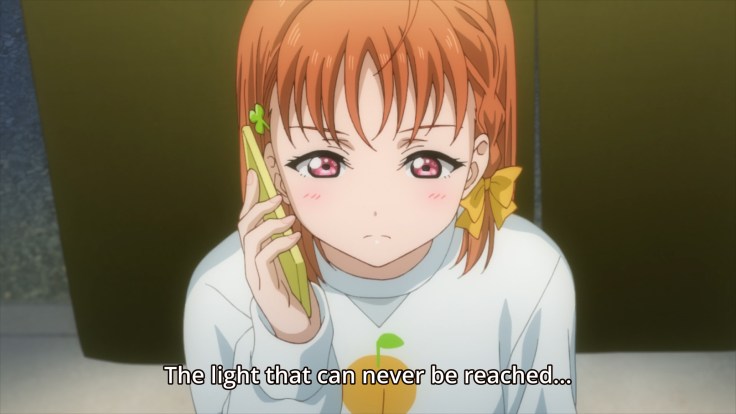
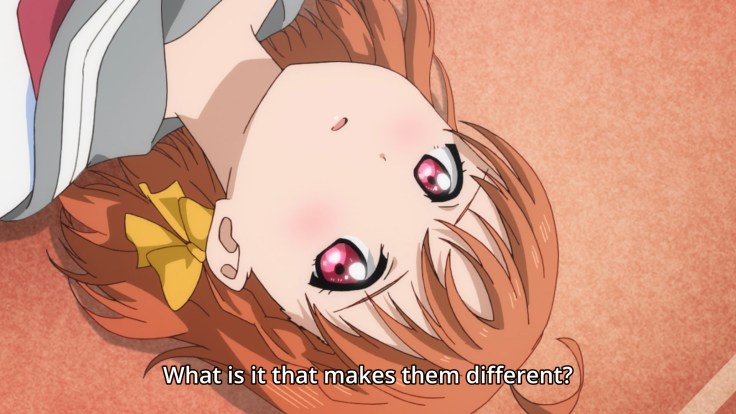
Aqours is a product of this school idol legend. Its first generation was born from Dia’s adoration of μ’s, and the next from Chika’s. μ’s is the ideal they all aspire to. But this obsession isn’t necessarily a good thing. Rather than ‘how do we become the best Aqours we can be‘, Chika was more interested in asking ‘how do we become like μ’s’. Uranohoshi’s future comes under fire, and instead of being troubled Chika is ecstatic because she believes this event will help her get closer to the members of μ’s she admires so deeply. But when their small successes lead them to be invited to an event in Tokyo, Aqours is dramatically outclassed to the point Saint Snow remarks that they were insulting the Love Live with their shoddy performance – that they were insulting the stage μ’s created. In a later meeting Chika even has the gall to ask Saint Snow if they wanted to win the Love Live. The answer should have been obvious, but this reveals that up to this point the Love Live had just been a method of reaching μ’s rather than something she was personally invested in. She didn’t want to win, she just wanted to stand in the same place that μ’s once did. Yet it wasn’t enough. She could tell that no matter how hard they were trying Aqours wasn’t even beginning to approach the level of μ’s, so what is it that made them different? In a rut Chika realises that the only reason μ’s were so successful is because they loved each other and, above all, wanted to have fun on the stage together. They weren’t chasing after A-RISE, they were performing for their own sake simply because they wanted to let their bond flourish. As much as it pains her she has no choice but to accept that Aqours can never become μ’s, and that her initial motivation was the very thing holding them back. Frustrating as it might be, Saint Snow was right – Chika and her Aqours were just messing around and treating the Love Live like a game. By interacting with the μ’s legacy she’s forced to confront her own shortcomings and eventually emerges stronger for it. In a symbolic move as they head into the first season’s Love Live qualifiers, Chika takes down the μ’s poster from her bedroom wall to declare that Aqours will begin anew in its own unique way.
Things seem to be on the upturn again as Aqours increasingly pursues its own identity, but that isn’t enough to prevent their school’s closure. While μ’s had already saved their school by the end of season 1, Aqours’ struggles continue on midway into season 2 where they eventually lose the battle. With even their best efforts failing, the cast is at a loss. Stuck motionless in despair, the other school members eventually have to intervene. They pick them back off the ground by requesting their help in fulfilling their new dream – to immortalise the Uranohoshi name within the ranks of Love Live’s winners. Not to be like μ’s, but to preserve Aqours forever. To write their own legend. With renewed fervour the members accept their plea to blaze the stage, shining brighter than ever before through their ultimate performance at the Love Live finals. It’s narratively and thematically more complex than School Idol Project’s straightforward story. But this setup only works because we already have the triumphant tale of μ’s as juxtaposition. It’s all too easy and far too common for viewers to decry Sunshine retreading the same waters as an example of poor writing, but that simply is not the case. I think Chika’s character arc is a very bold move by the writers of the show. Instead of Sunshine simply glorifying µ’s as the almighty life-giving “light that can never be reached”, it actually dares to frame Chika’s obsession with them as a bad thing. Her development throughout the show’s run is all about moving away from her idolisation of µ’s and towards finding her own radiance instead (rather than just buying into the µ’s radiance), and I really respect Love Live Sunshine for being willing to step on the toes of its predecessor like that. It’s by no mistake or oversight that Sunshine S1 parallels School Idol Project so heavily, the Aqours-μ’s comparison is a very deliberate plot vehicle serving as one integral step for the Uranohoshi girls to find their footing in the school idol world. Sunshine benefits from its predecessor by pulling from it and expanding upon it. I fully acknowledge that Sunshine can only exist as a result of μ’s, but at the end of the day that doesn’t change my claim that Sunshine is just better.
![[HorribleSubs] Love Live! Sunshine!! - 12 [1080p].mkv_snapshot_07.55_[2018.11.26_19.24.06]](https://skapbadoa.com/wp-content/uploads/2018/12/HorribleSubs-Love-Live-Sunshine-12-1080p.mkv_snapshot_07.55_2018.11.26_19.24.06.png?w=736)
Stepping away from the writing and into the production values then, musically I think Aqours is quite obviously better in most examples. Pick any Aqours single at random, be it My Mai Tonight, Water Blue New World or Koi ni Naritai Aquarium, and it’ll be better than any µ’s single other than the obvious Bokutachi wa Hitotsu no Hikari. When you look further into the B-sides and subgroups of µ’s I do think they get much stronger, but in response if you also look at Aqours B-sides and subgroups then they still come out on top. Look at Anemone Heart against Torikoriko Please, at Wild Stars against Innocent Bird, or After School Navigators unfairly matched up against Strawberry Trapper for what are in my opinion relatively similar comparisons. The Aqours tracks feature cleaner, more striking composition, and the vocals are used in such a way that they play to the members’ strengths more. Aqours packs a bigger punch. One need only compare ultra bland early µ’s to totally jammin endgame µ’s to see how much they grew over the course of their six years, so it should come as no surprise that a completely fresh group with all that prior knowledge behind them could be such an improvement right from the start line.
Perhaps the easiest place to really see this gained expertise come through is in the solos. µ’s was in the unfortunate position where the producers seemed intent that the seiyuu sing in-character, and the resulting performances end up sounding accordingly limited – see Nicopuri or Daring as examples. Aqours songs in general sound like they’re composed more for the voices of the people singing them than for the voices of the characters. Dia’s White First Love is gorgeous. Yohane’s In This Unstable World lets her show off in ways that the group tracks usually don’t have time for. Even Kanan’s Sakana ka Nanda ka manages to be incredibly fun despite her being one of Love Live’s weaker singers. New Winding Road, One More Sunshine Story, Pianoforte Monologue, Beginner’s Sailing – each solo track complements its vocalist’s style. I think the ones that took me by surprise the most were Ruby’s Red Gem Wink and Hanamaru’s Oyasuminasan, both of which completely blew away my initial concerns over whether those two would be able to carry a song by themselves. Hanamaru carries a thick accent so I’d have expected her solo to sound caricature-esque like Nozomi’s Junai Lens but instead it’s just a really solid performance; Ruby has a Hanayo-esque high-pitched squeaky voice (and Hanayo’s performances were not very good in my opinion) so I never could have foreseen her killing it so hard in her solo, and I think this exemplifies how Aqours uses its members better.
I do think µ’s has some good singers, in particular Eli, Umi and Maki. But of these three I feel like Eli was the only one whose potential they properly capitalised on with Arifureta Kanashimi no Hate. Umi’s actor somewhat shows off in the opening and choruses of Ano ne Ganbare, but in the verses it still feels like she was restraining herself in order to retain that key Umi inflection. Hear how energetic Setsuna’s performance was in the recently released “CHASE” by the new Perfect Dream Project school idol group. Setsuna’s sound is fundamentally different to Umi’s low, powerful voice, but even still I know Umi was capable of going wild like that – they just never gave her the chance to do it. Imagine how impressive Watashitachi wa Mirai no Hana would be if she was singing as dramatically as Setsuna did. And the only time it seemed Love Live really attempted to use Maki to the fullest extent was early on in her career for the solo Aishiteru Banzai, then never again. Pull nearly any track from Maki’s entire Love Live discography, and then compare it against Pile’s outstanding self-produced cover of Sorairo Days (Tengen Toppa Gurren Lagann) and it illustrates how the µ’s tracks were tailored to keeping the character’s voice recognisable rather than utilizing the vocalist’s full range.
![[Eng Sub] Love Live! School Idol Festival ALL STARS OP Movie.mp4_snapshot_03.21_[2018.11.25_14.59.28].png](https://skapbadoa.com/wp-content/uploads/2018/12/Eng-Sub-Love-Live-School-Idol-Festival-ALL-STARS-OP-Movie.mp4_snapshot_03.21_2018.11.25_14.59.28.png?w=736)
It’s not to say that I dislike µ’s songs, but rather that the equivalent Aqours tracks win the competition damn near every time. This is part of the reason I’m looking forwards to the upcoming School Idol Festival All Stars. Despite how brief it was, it was quite liberating seeing µ’s dance with such decidedly higher quality cgi in the game’s opening cinematic. As an alternate-universe side story with no regards to the timeline of the main series it has provided an avenue to revive the retired µ’s characters. Though it remains to be seen whether it will come to fruition, this at the very least means there is the chance they will start producing music again except at a level comparable to Aqours this time. That prospect is very exciting.
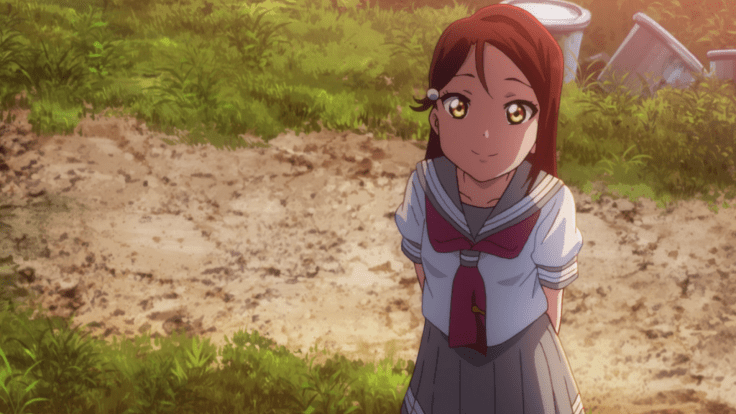
Though before you delve into character arcs and musical styles the most immediate difference that pops up between µ’s and Aqours is the place they each call home. Otonokizaka finds itself situated in a bustling metropolitan area with people swarming in droves everywhere you look. Quite the opposite of this, Uranohoshi is an obscure Catholic school hidden far out in the sticks. This shift in setting is the third component informing my preference. As someone who grew up in a rural town it’s much more relatable to me than School Idol Project’s Tokyo cityscape. This kind of greenery-filled setting is what’s natural to me. Seeing rural life and its surrounding environments portrayed so lovingly upon the screen is incredibly heartwarming. While the two reasons mentioned prior were artistic improvements, this is where my own personal connection to Sunshine comes into play. So many of these locales come alive for me by drawing upon my own experiences.
I spent my schooling years in the Dandenong Ranges, a rural region colloquially referred to as ‘the hills’. Based on the census information it appears to have an even smaller population than Love Live Sunshine’s setting of Numazu (150,000 vs 192,000) while occupying over double the amount of space (500km2 vs 187km2). Its largest suburb is around 10,000 residents (Ferntree Gully) while its smallest a mere 800 (The Patch), though the mean average calculates to be around 3,500. Any quick google image search will let you know that the Dandes are brimming with nature and wildlife, and while it seems most other members of the populace simply took that as ‘the place we live’ I was very much someone that went wild with it. Being a youth with abundant energy and no responsibilities, I spent much of my free time exploring around through the environment like a playground – go through that bush corridor just to see what’s there, follow that river as far as it goes just because I can, ditch school and go mess around in the nearby nature reserve because I may or may not have been a bad student. Every day off school was a new opportunity to walk somewhere and work on photographing as many bird species for my album as possible, or to sweep through new areas searching for animal skulls to add to my collection. Even though it was a far cry from the harshness of the central outback, I worked with what I had to live and breathe adventure. Nature was the seat of my soul.

One such tale was on a warm summer day where I was relaxing in a hidden glade down a steep incline on a roadside bank, when an echidna slowly waddled out right in front of me. Usually echidnas are rather shy, this is something I know from plenty of personal experience. When spotted their usual defensive manoeuvre is to find some kind of incline to lower themselves into and bend their back to flare out their spines. But this one simply did not mind my presence at all. There was a friend of mine in the area a few metres away from me and the echidna was wary of him, but even as I made direct eye contact with it the echidna continued to plod around in front of me rather than curling up defensively. It was a very magical little moment in time as I seemingly connected with this wild echidna.
I could also tell of the time one end-of-school-term-half-day where I went back to the school premises late in the afternoon to pick up something I’d forgotten, and when I was exiting back through a bush corridor near the rear fence I accidentally stumbled upon an entire flock of yellow-tailed black cockatoos. I’ll never forget the sight. It was the first time I’d ever actually seen any black cockatoos yet there must have been as many as thirty of them in that one small area, and as soon as I stepped into the clearing they all took off from the trees they were in and started swirling around the area like a tornado for a few minutes before flying away.

Another I could also mention would be the sheer adrenaline I experienced when I finally managed to get what I consider the best photo I’ve ever taken. Once upon a time me and a friend accidentally stumbled upon an isolated area of bushland housing emus, which we had never seen in the wild before and are not common in the area at all. I spent four years going to that place semi-frequently, and it was only on the final trip before moving away that I at last managed to get right up close enough to one in order to take the photo pictured above. That was the culmination of years of effort, and in all honesty it’s a photo I was never actually expecting to take.
Climbing a hillside to watch the massive mob of kangaroos at the top for as long as you can before they run away – Trying to sneak up on a black-shouldered kite for a photo – Resting in the shade of a tree – Having lunch while balancing on the lower beams of the Puffing Billy trestle bridge – Searching for yowies that don’t exist (and even if they did they obviously wouldn’t be in the Dandes) – Searching for panthers that have a higher chance of existing but still probably don’t – Having competitions throwing rocks as far as possible in a big dam – Filming crappily edited adventure videos to upload online – Spending seven whole hours walking along the Puffing Billy train line for what was ostensibly not a shortcut between towns after all; What I aim to convey by recounting these stories is just how much nature and the rural way of life mean to me. It’s a landscape and a community near and dear to my heart. Admittedly I no longer live in that area, but the rural aesthetic will always be precious to me. And that’s why when I watch Love Live Sunshine and see its rural locales painted so gorgeously it resonates with me at such a deep level. As cheesy as it sounds, in many ways Love Live Sunshine feels like home.
![[HorribleSubs] Love Live! Sunshine!! - 11 [1080p].mkv_snapshot_13.11_[2018.12.16_10.03.53]](https://skapbadoa.com/wp-content/uploads/2018/12/HorribleSubs-Love-Live-Sunshine-11-1080p.mkv_snapshot_13.11_2018.12.16_10.03.53.png?w=736)


It’s the little things that really get to me:
- Trees always being visible through windows, and as the backdrop whenever the girls are outside.
- The skyline being hills instead of buildings.
- Chika’s family owning a big dog that freely hangs around in their house, as opposed to the all too common ‘my apartment doesn’t allow pets’.
- The girls having to go the next town over to reach a more urban area (though still not nearly city-level).
- The few times you do actually go to the city having it feel like an entirely different, unfamiliar country in itself. I relate so hard to Dia freaking out about Tokyo.
- That one stereotypical hillside staircase that every rural area has.
- Having to actually take the bus or bike to get around because things aren’t always just in walking distance.
- Scrambling for the last bus.
- Needing to get home before dark because it becomes pitch black outside with sparse streetlights.
- Cutting through a bush block or stretch of farmland as a shortcut. It wasn’t really common to do but when I lived there I was someone that would cut through bush blocks as shortcuts all the time, so I’ve always thought it was a really fun little touch seeing Aqours do the same thing through the mikan orchard.
- The relaxed pacing with life moving much slower in the rural town of Uchiura than in the busy capital of Tokyo.
- The girls stepping into the water without being worried about getting their clothes or shoes wet
All these small bits of atmosphere come together and form something deeply special for me. In a way it feels like looking back upon my own younger years. The environment was fundamentally different since I was in landlocked Australia rather than a coastline town, but what really comes through in Sunshine is that rural life is the same wherever you go. There’s an attention to minor details and behaviours that really bring its world to life, such as walking in the middle of roads because cars don’t pass often, or hopping over the roadside boundary and running down the grassy bank. I can actually believe that these are girls living in a backwater town rather than anime cutouts arbitrarily dropped into it.
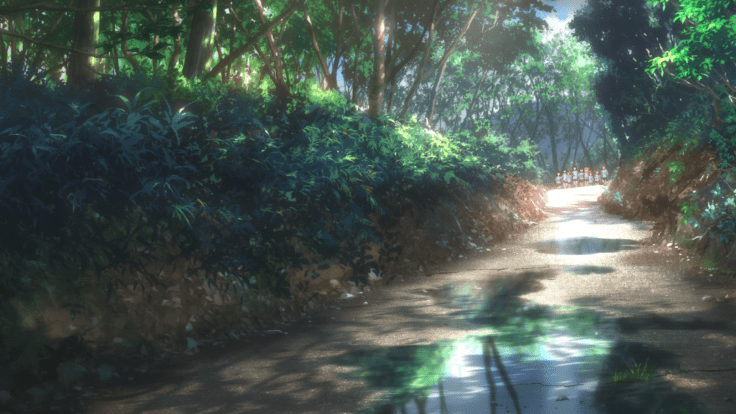


Based on its backgrounds alone Sunshine speaks to me in a way that few media productions are capable of. The epitome of this being the above shot from the third episode of season 2, which fiercely competes for my single favourite shot composition in the entire anime medium. You put that in an art gallery and I would stare at it for a solid hour just admiring all the little intricacies in its foliage. The lighting and the texturing in it are breathtakingly good. When I think of Love Live Sunshine, this frame is what comes to mind first. This shot is the one that appeals to my rural memories most vividly. It pulls me into it; I can feel the mud beneath my feet, taste the fresh air, smell the musk of leaves and soil after the rain. For all intents and purposes I may as well be stepping directly into that scene. I have seen other anime with rural settings before (the other big contender being One Off), but this series is the one with the most potent portrayal.
In pretty much every conceivable way I consider Sunshine and Aqours the better of the two. I will absolutely acknowledge that they can only work as well as they do because of their position as the successors to µ’s; they engage with their predecessors in an incredibly significant way and come out a sturdier product as a result. But there’s one single reason I cannot fully commit to saying that Sunshine is universally the superior work – Nico.
![[HorribleSubs] Love Live! The School Idol Movie - 00 [1080p].mkv_snapshot_01.35.43_[2018.11.23_14.44.44].png](https://skapbadoa.com/wp-content/uploads/2018/11/horriblesubs-love-live-the-school-idol-movie-00-1080p-mkv_snapshot_01-35-43_2018-11-23_14-44-44.png?w=736)
You either adore her or abhor her, with Nico there is no middle ground. I am very much in the camp that loves worships her. Nico is wildly the best character in Love Live, and by a large margin at that. On the surface level she’s just super entertaining to watch in the way that she so shamelessly tries to push this excessively cutesy idol image despite the fact she’s often more akin to a jaded, grumpy old man on the inside. For me Nico is incredible based on that contradictory character performance alone, and yet there is still much much more to her.
She’s not just ‘everyone’s sparkling super idol Nico-ni’, there’s a very earnest, very grounded reason for why she acts the way she does. She tries to keep it a secret, but Nico comes from a rather misfortunate background. With her father deceased and her mother therefore forced to work long hours in order to make ends meet, it falls to eldest sister Nico to take care of her three younger siblings. Nico pushes herself hard at school and idol practice, then when she gets home she often doesn’t even get time to change out of her uniform before she has to start working on dinner. You can imagine that this must be quite taxing. Not just physically as she has to essentially raise three young kids on her own while still high-school age, but also mentally since it means that Nico has to be the one worrying about family finances when grocery shopping. She would be the one feeling the worst on the inside when she’s forced to feed her siblings the cheapest food at the store rather than anything delicious or extravagant. She acknowledges that she’s not quite in poverty, but that still doesn’t stop her from wishing her life was just a little bit nicer so she could stop feeling insecure about being together with the people around her who have never had any kind of money struggles.
Alongside Nozomi, Nico is the character whose backstory get the most exploration in the School Idol Project anime. But if you factor in her School Idol Diary volume as well then she gets even more emotional depth added to her. It shows us that her Nico Nico nii~ catchphrase, rather than simply being self-centred, is actually inherited from a song her father made for her as a child before he passed away. Due to her upbringing Nico is incredibly family-oriented, and so she holds onto that tightly. We also get a glimpse into her past, seeing how she became so infatuated with idols as something that shone a ray of light into her difficult circumstances. Yet despite her noted aptitude for it she was repeatedly met with the inability to chase her dream due to her family’s poor financial situation. Every time she would go to auditions and advance to the final round, and every time she would be unable to continue for the simple fact that they couldn’t afford the cost of sending her any further. It’s very real, very down to earth.
![[HorribleSubs] Love Live! S2 - 04 [720p].mkv_snapshot_19.20_[2018.11.20_18.45.32].png](https://skapbadoa.com/wp-content/uploads/2018/12/horriblesubs-love-live-s2-04-720p-mkv_snapshot_19-20_2018-11-20_18-45-32.png?w=736)
And so it became Nico’s intimate little wish to shine. More than anything else she wanted to be a dazzling super star – to work hard and transform herself into someone capable of escaping her bleak lifestyle, to be a glimmer of hope for her family members. In middle school Nico had dreamt of attending UTX for their performing arts department, but these dreams were violently shattered when she took a flyer and saw course fees costing millions of yen per year – something she didn’t even know was possible. Dejected she turned to Otonokizaka for no reason other than it being cheap and close to home. Though she tried to make a school idol club, nobody could keep up with her passion and she was eventually left isolated with her lifelong aspirations dead in the water. She wanted to shine, but it seemed fate would just never give her room to breathe. Nico’s longing to become something more than this was repeatedly and harshly beaten down.
That’s why µ’s was her miracle. When she was finally just about ready to give up after years of fruitlessly trying, µ’s appeared and promised to take her to the stage she yearned for. When she was losing faith in herself and beginning to accept that she would never be able to escape her bad lot in life, Honoka showed up and took her by the hand saying that she was someone they needed. They were angels to Nico. Having this knowledge in mind adds extra weight to her portrayal throughout the franchise; For example this is why she tried to protect herself by shooing away µ’s when they first show up to her clubroom. Nico had been suffering from her inability to succeed for years at this point, and now some carefree girl was trying to become their school’s idol group on a random whim? Screw that. She had been emotionally wounded too many times in the past to the point she tried to keep out of harm’s way by rejecting their efforts entirely.
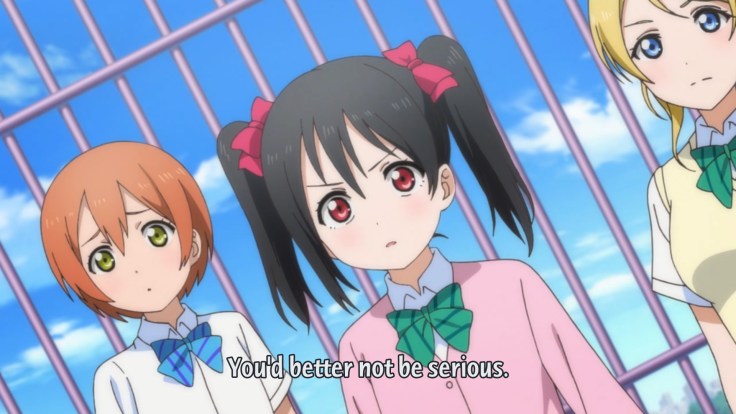
The Diary also further explains why Nico gets filled with such unbridled vitriol when Honoka suggests ending µ’s after they successfully save the school. After being hurt so many times Nico (despite her initial wariness) decided to let herself be pulled into Honoka’s promises, and when she was abruptly betrayed there was an entire childhood’s worth of emotional outrage rushing out, stemming from her history of being taunted by how close yet unreachable her desires had always been. When Nico lashes out screaming “I decided to put all my hopes into this!” it’s not because she was a spoiled kid who had her favourite toy taken away. It was because µ’s had finally carved a path in what was previously the biggest dead end of her life, and yet Honoka was trying to close it off once again on a short-sighted impulse. You gotta forgive the girl for getting mad, imagine how much sheer negativity must have been racing through her mind in that moment. Consequently this is also the reason why Nico is the one who most strongly wanted µ’s to continue even after her graduation. µ’s was what she had been dreaming of all her life, and she didn’t want that dream to end.

Emotional complexity in multitudes, a surprisingly fleshed out and melancholic backstory, an incredibly enjoyable character performance, one half of Love Live’s o b j e c t i v e l y best ship – even within a franchise already full of fantastic characters Nico manages to set herself apart. And while that is ultimately not enough for me to put School Idol Project above Sunshine, it is enough for me to say:
- Nico
- Aqours
- µ’s
![[HorribleSubs] Love Live! Sunshine!! S2 - 13 [1080p].mkv_snapshot_07.32_[2018.11.28_18.03.58].png](https://skapbadoa.com/wp-content/uploads/2018/12/horriblesubs-love-live-sunshine-s2-13-1080p-mkv_snapshot_07-32_2018-11-28_18-03-58.png?w=736)
This is where a conclusion would go if this was an actual essay but since it’s just me messily rambling about Love Live for too long with no rhyme, reason or coherence I won’t write one. Instead I’ll just close with this since it had to be done
- Nico
- Chika
- Ruby
- Hanamaru
- Nozomi
- Mari
- Kanan
- Dia
- Eli
- Maki
- Yohane
- Honoka
- Riko
- You
- Kotori
- Umi
- Hanayo
- Rin
 skapbadoa
nicomaki is your favorite µ’s ship, but what about your favorite aqours/nijigasaki ship?
LikeLike
I can’t say I’m particularly invested in any Aqours pairings tbh. I often like the flirtier pairings more in most anime and manga so probs just the basic Yohane/Riri. But story trumps everything in Sunshine for me, so the usual idol stuff like shipping gets mostly overlooked.
However, Nijigasaki is actually really awesome in this regard imo. Since they inject light harem elements into the way the girls all clamour over Yuu, it ends up making her relationship with Ayumu feel a bit more real than the others in the franchise do, to the point of being less idol yuri teasing and moreso just a genuine progressive romance in its blossoming stages. Yuu/Ayumu is great.
LikeLike
I love how you conveniently ignored the roller coaster through the mikan fields, even in your supposed atmospheric shots lmfao, sure as hell was relatable wasn’t it?
LikeLike