Are the Gi Tribe connected to Jenova? Yes. Definitively so, I would say, just not in the way that you’re probably thinking. I’ve got legitimately 48,000 words here somehow, yet it all boils down to maybe three lines of dialogue and two sets of statues. The Gi Tribe arrived on Gaia far earlier than Jenova, yet the sealing idols which the Cetra created express clear Jenova mutations. Ergo, they had past contact. Problem solved. But come follow along with me, because there’s a lot more to be said on the matter.
I love the Final Fantasy VII Remake series. One large reason for this being because the way its depiction of the characters and setting unfolds, where it chooses to add extra context or where in the presentation it decides to revitalise its intertextual symbolic links with stuff like The Thing, Xenogears, Chrono Trigger etcetera, all feels like it is done in accordance with my own preferences. At just about every step of the way, FFVII Remake is catering to me as an FFVII essayist fanboy. On my, like, sixth playthrough of FFVII, one story element that I did consciously think I would like to have more information about is the mysterious race of intelligent non-human beings sealed deep beneath Cosmo Canyon – the Gi Tribe. They kinda gloss over it, but that seems important actually. Sure enough, FFVII Rebirth made them a much, much bigger deal by giving them greater exposition, a deeper sense of culture, and using them as a means to expand FFVII’s galaxy by establishing them as aliens with their own red spirit energy that prevents them from being absorbed into Gaia’s green Lifestream. I don’t think that they’re going to end up especially important to FFVII Remake’s future trajectory, they aren’t some missing link for part 3 or anything; the alien Gi largely exist as background lore to better substantiate the Black Materia, since it was always a bit odd in the original that the planet-loving Ancients would possess magic to blow it up. But the more you ponder upon their riddles, upon the symbols found in their culture, the more fascinating and complicated their circumstances become. What first stuck out to me when Gi Nattak stepped into frame was the striking colour combination of his dark blue skin and burning pink eyes. This immediately grabs my attention because where have we seen this colour scheme before? Jenova. When you see a man like that glaring daggers at Aerith, you’d naturally think it’s related to Jenova’s war. We then let the shaman guide us into the land of the dead, where he begs the party to retrieve their Black Materia and cast the world-ending magic Meteor. Who arrived on a meteorite? Jenova. If you look around closely you can even locate these sharp-toothed skull masks mounted onto ceremonial artifacts which resemble both Jenova and its derivative Specimen H0512, or stone carvings of somewhat Jenova-like skeletal knights. The smaller statues which Nanaki uses to open the seal on the Gi’s cave do all give me Jenova vibes as well, with the random appendages or tentacles mutated onto a bipedal form. It does seem like the links between Jenova and the Gi are therefore multiple, and super apparent.

I’ll now be presenting some screenshots, collating all the things I’ve found which point to Jenova having once had presence in the Village of the Gi. After which I’ll engage in a series of my own questions and answers to try discerning why this imagery is present and what history we can glean from it. I’m not trying to, like, clickbait or anything, but the answers I reached kind of surprised even myself. Let’s just say that by the end I have come to suspect someone here is not who they claim to be. Through Xenogears we can use Final Fantasy X to explain Dirge of Cerberus within FFVII Rebirth. If you want to know what on earth that means, you’re gonna have to give me a few hours. There are just two or three seemingly random enemies who might tie everything together in the most unexpected way, and but a single one which I believe can crack the case wide open. The reading I get out is not that which I expected when heading in. I had the framework envisioned in my head, went in to find evidence, it didn’t fit, and so have come out believing in a more complex timeline of events. Then, once I was 26,000 words and 100+ collages in, I had an epiphany that saw me rerouting all my conclusions. We will get to that eventually though. For now, let’s look at some statues.
The most important and plainly just the coolest looking thing I noticed linking Jenova to the Gi is in the Ancient Temple. When I first played FFVII Rebirth on PS5, I mourned that it was impossible to clearly see the mural of Jenova that was hidden in the shadows at the other side of the divide. With the PC release I was finally able to take the camera over there using freecam tools. I decided to continue panning around and have a closer look through the murals in case they were hiding anything exciting, which is where I noticed that its Corridor of Apocalypse depicts a demonic face hanging above the Gi as they forge the Black Materia. This face with its six eyes and sharp teeth matches to the giant statue which we can find carved into the Village of the Gi’s cliffside Shrine to Oblivion. Angeal Penance’s shield also has the motif of a six-eyed face with a sharp-toothed smile.

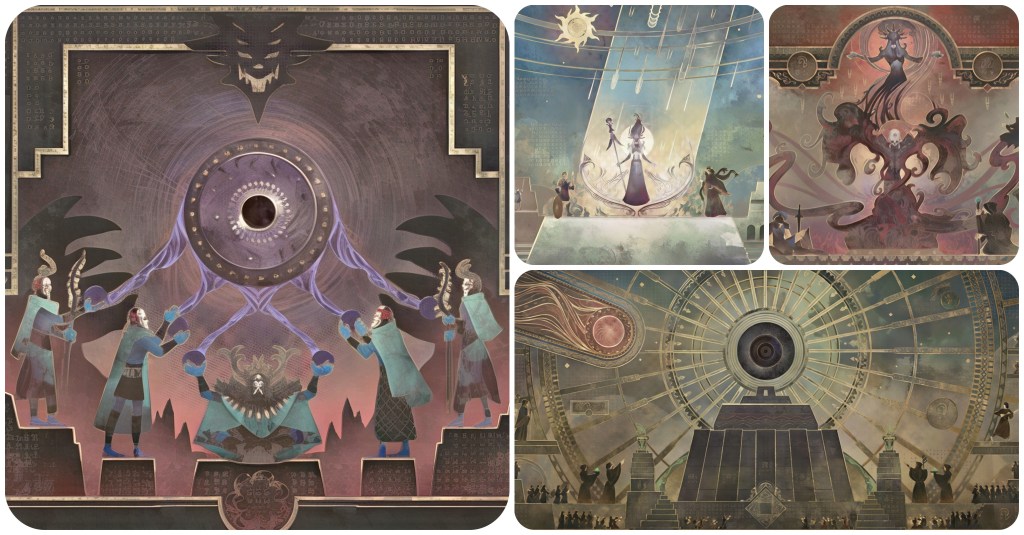
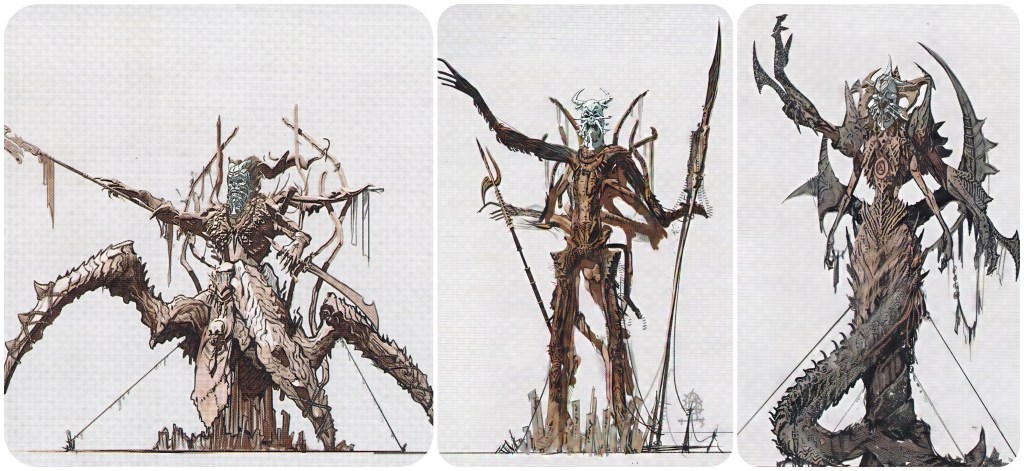
But even then, there was only so much I could do with the freecam unlocker and its spotlight function. So since I cannot control myself and frequently use these kinds of projects as excuses to spend money on artbooks that I definitely, absolutely, surely need, I did bite the bullet and order the japanese version of the Final Fantasy VII Rebirth Material Ultimania instead of waiting for the localisation late next year. Here are some better quality scans of the mural concept art before the discolouration and weathering effect from the rock wall is applied.
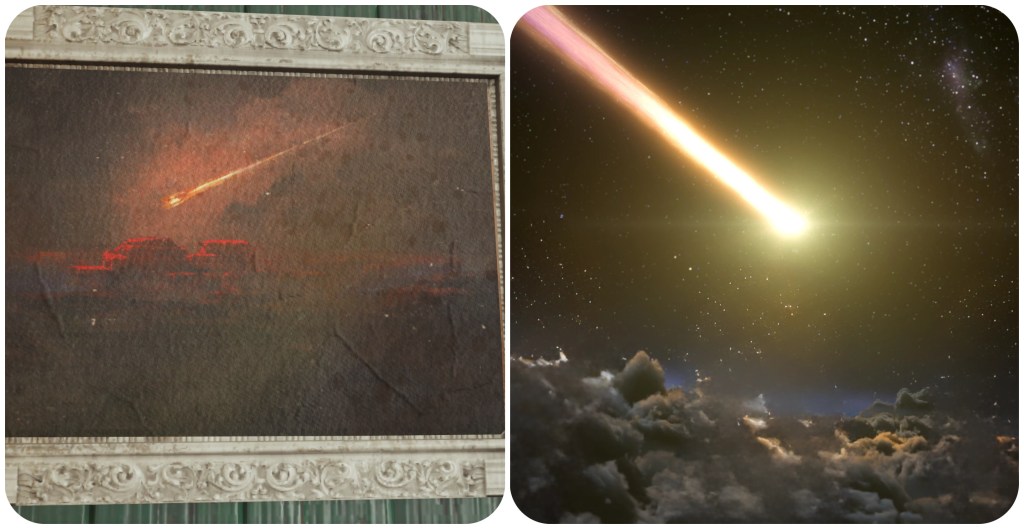
As I didn’t have a save in the Gi village, I had to quickly rush there from the beginning of chapter 10. Along the way, I noticed that Bugenhagen’s museum has a painting or photo of a meteor above Cosmo Canyon. This resembles Jenova’s meteor seen in the Stewards of the Planet presentation.
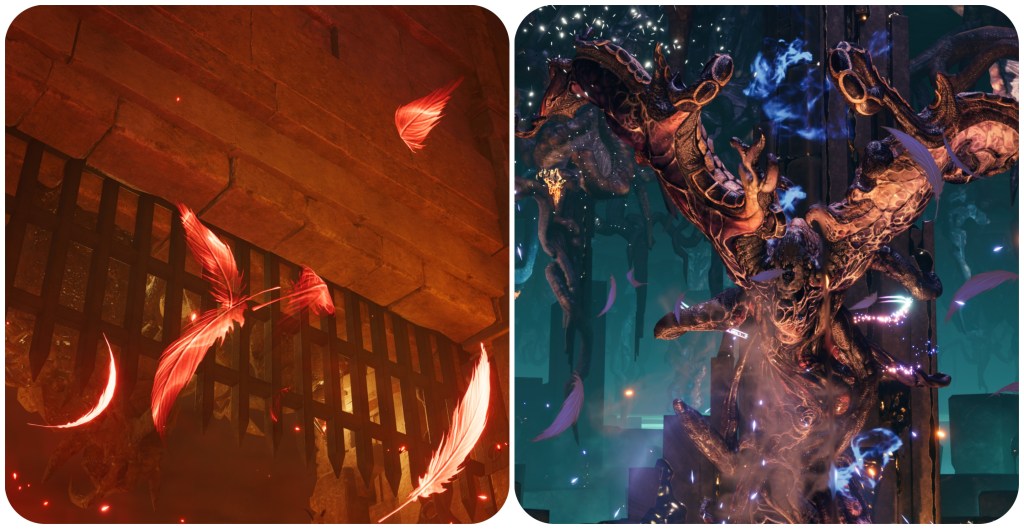
The Gi Spectres have ethereal feathers that form around them. This is simply part of the revival spell, but does nonetheless call to mind how Jenova Dreamweaver emits ethereal purple feathers and Sephiroth is constantly shedding black.
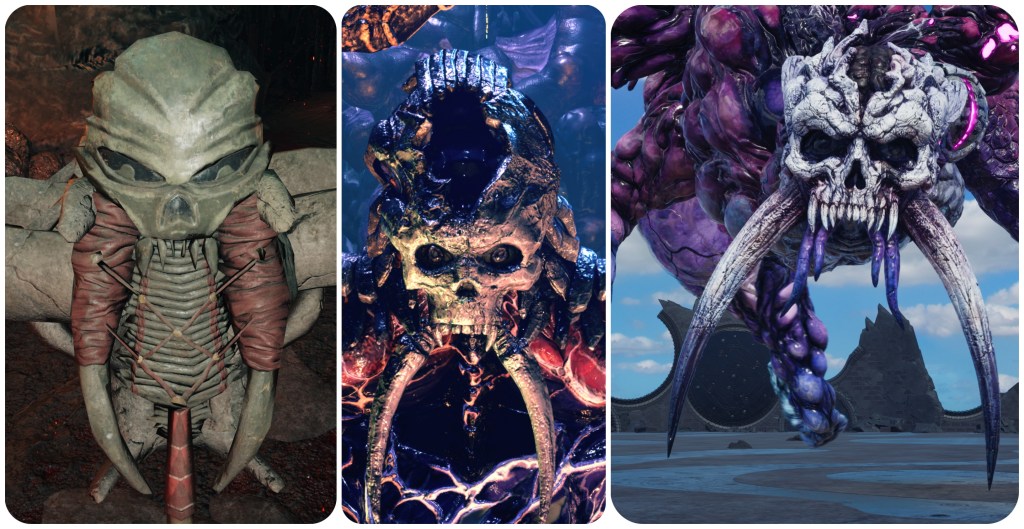
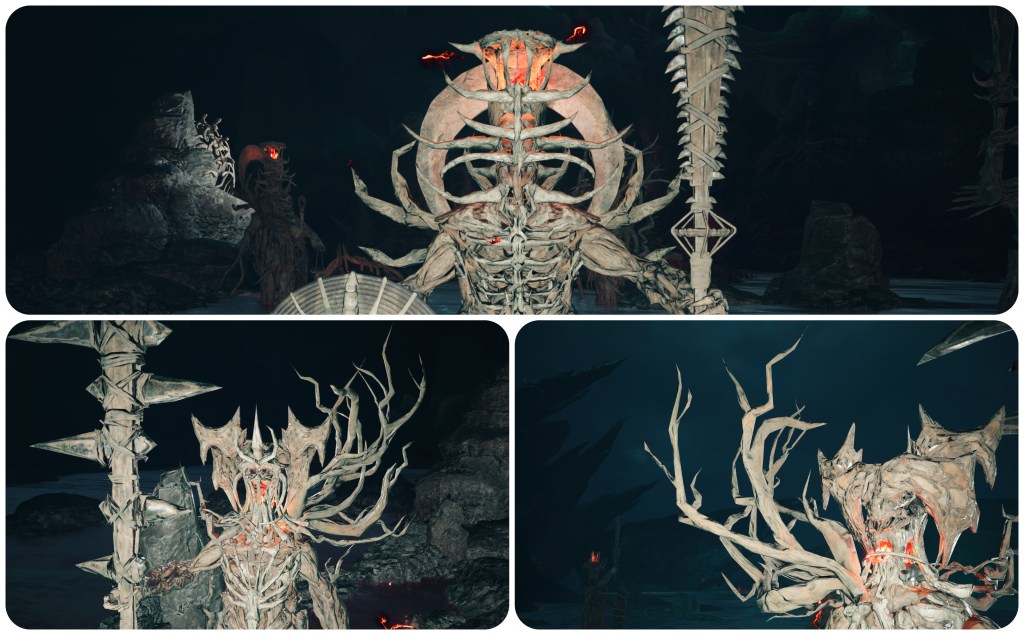
Here’s the real kicker though, which will steer a significant part of the discussion on this matter. Decorative skull masks with tusks or pincers that resemble Jenova Dreamweaver and Jenova Emergent can be found throughout the village of the Gi. In some cases these are accompanied by Jenova’s purple spirit wisps, as opposed to the Gi’s usual red.
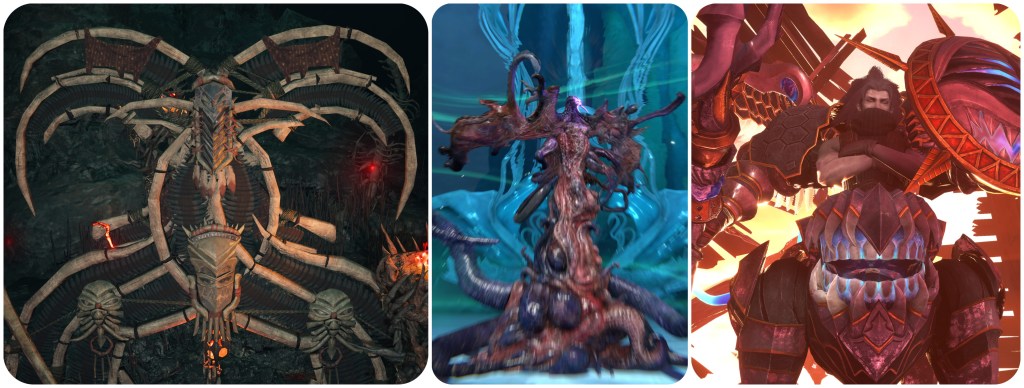
Further to this point, the Corridor of Effigies in the Temple of the Ancients is filled with statues of cloaked Cetra wizards and some demonic creature that heavily matches to the skull and tusks of Jenova Dreamweaver and the Gi masks. This is possibly a subtle reveal of information that Jenova had based her form on a demon from either Cetran or Gi folklore in order to most effectively terrorize them. Having so many of them intermingled with the shamans is likely symbolic of how Jenova’s imposters had begun to infiltrate the Cetra’s communities. The idea that this shape was lifted from folklore is somewhat supported by the Blighted Spirit, a form that Jenova took in the Asian-themed Igara region which had a totally different skull, and spawn that looked more like classical youkai instead of the sci-fi abominations we usually see.

Here’s another decorative effigy which very lightly resembles Jenova’s Dreamweaver form. Note that the gap between the two masks in the middle almost give the impression of a big mid-body mouth, which is once again similar to a feature observed on Angeal Penance.
The first effigy in the Village of the Gi holds a weapon with spirals that resemble Jenova’s wings at Mt Nibel.
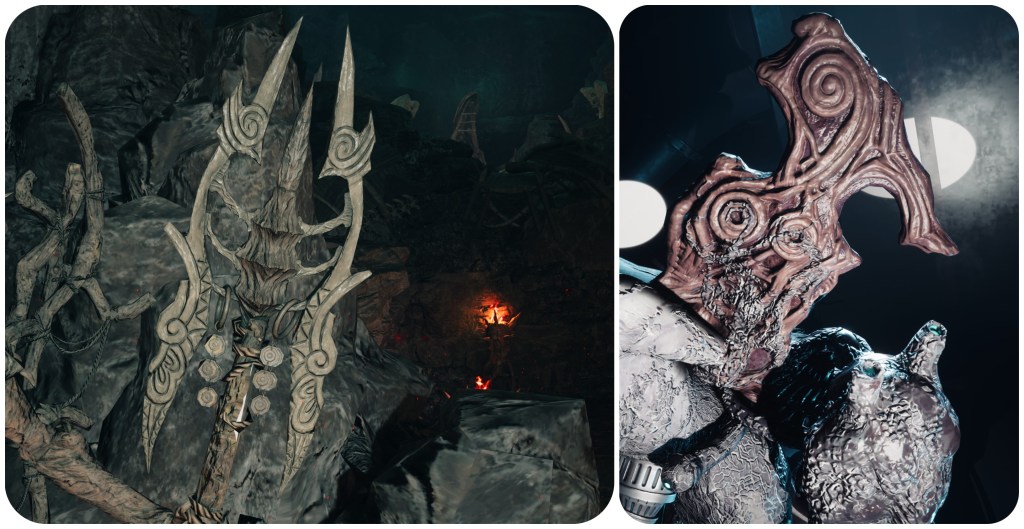
The statue of what I assume to be Jenova at the Gi altar has little fleshy wings coming off its back, which resemble that of the Mt Nibel Jenova’s wings. Wings are consistently illustrated to be a feature of Jenova and her spawn.

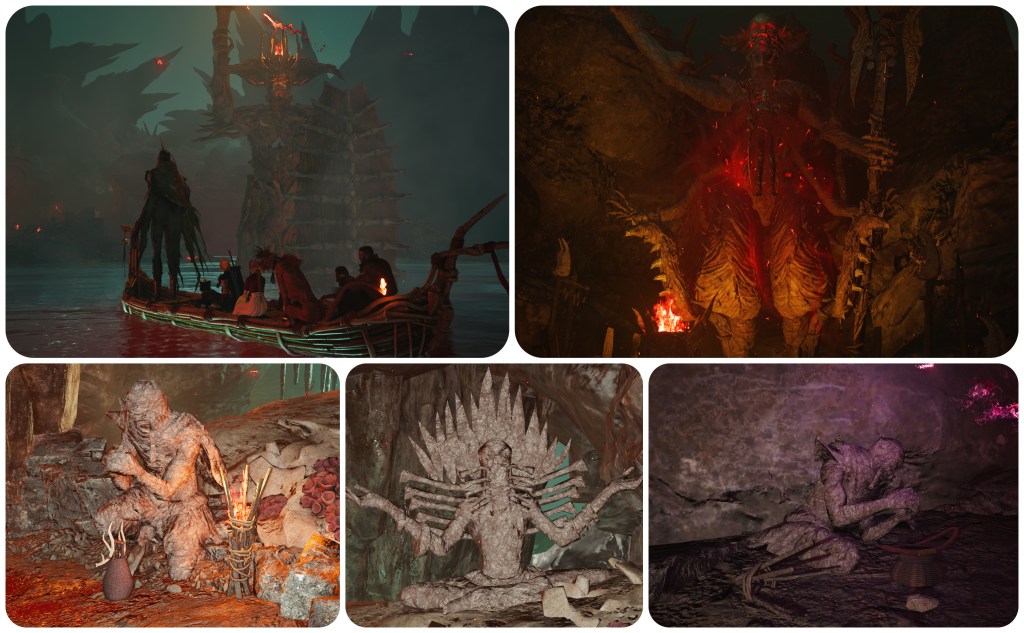
As Gi Nattak ferries us into his land, we pass by several large statues. These are all disfigured and mutated. Some with horns, some with tentacles. It is of note to me that a couple have the same kind of halo at their back that Safer Sephiroth displays, and one has what could be interpreted as a single wing on his left shoulder.
The larger effigies placed throughout the Village of the Gi all have mutations of some sort, such as four arms, crab legs, insect-like appendages and a long tail. These clearly seem indicative of Jenova’s touch to me.
Out of these effigies, I feel that the one with the tail and insect appendages particularly resembles the Necrotic Entity mutation.

Finally, and of most central importance, is that the Gi have distinct red spirit energy which the game draws particular attention to when you assess them. Enemy Intel makes it sound like this is unique to the Gi Tribe. Yet the Shadowblood Queen (which I am certain is meant to be one of Jenova’s earlier incarnations) has red spirit energy instead of her usual purple. After meeting with Gi Nattak, Cloud sees a vision of Sephiroth standing before him. When he vanishes, his usual purple haze has a red section floating through it. Those two are things I cannot ignore. The game has surely indicated some aspect of Gi within Jenova.
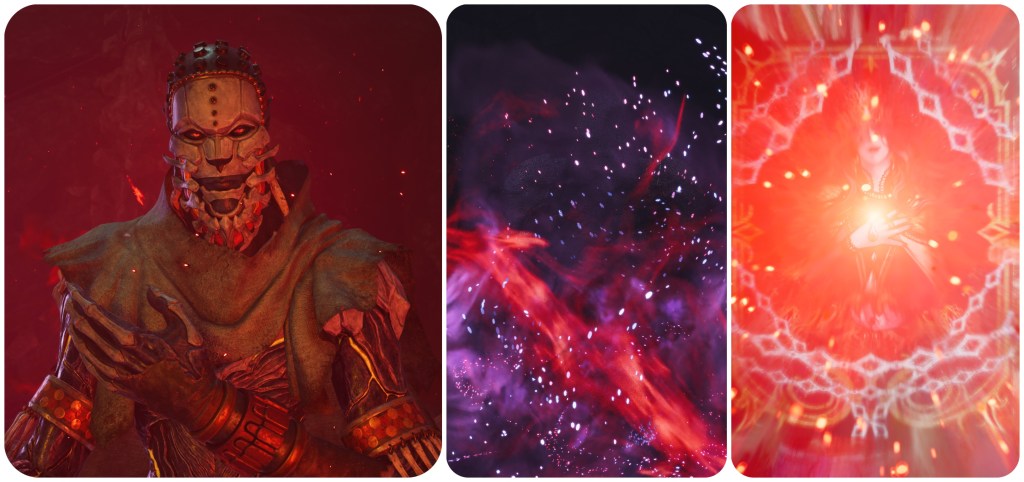
With the iconography presented, I think it’s clearly been conveyed that the Gi have had contact with Jenova at some point in their history. Just look at those mutations. But how, and in what form this manifests, I’m not sure. This is actually quite complicated, and there might simply not be enough info in Rebirth to truly tell yet. I’m hoping we’ll be told more as the third game spends more time with the Black Materia.
Below are some of my own personal questions and answers.
Section 1: Red Pyreflies & Planet Terra
Isn’t that six-eyed stone carving Gi Nattak?
I just don’t think that it is. Logically at least I could sort of see it being a representation of the tribe’s leader. The Black Materia mural gives us four shaman elders surrounding Gi Nattak. These four are likely the effigies we see, which also match to the four sealing statues, so then maybe the remaining spiky one is Gi Nattak.
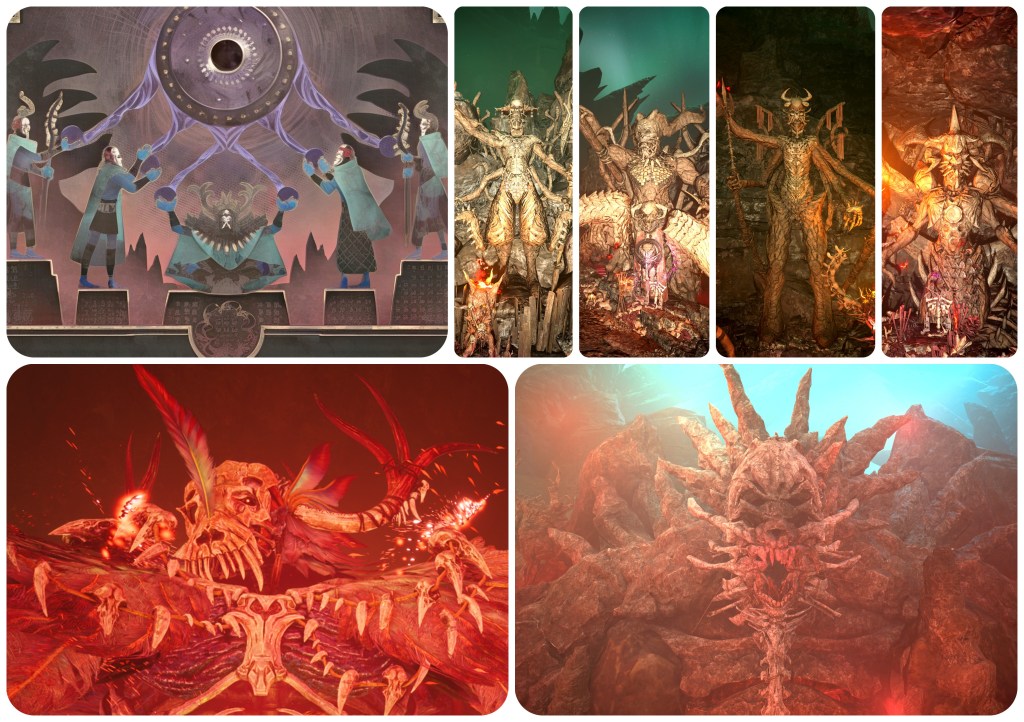
He does wear a carnivore mask sort of like that thing’s bestial face, and his battle mode is bulky with random vertebrae swinging around. But while the other effigies are clearly Gi warriors, this stone creature would then instead have to go against the grain as a super loose, metaphorical depiction of Gi Nattak, since none of his features match. He only has two eyes on his battle helmet or the skull he wears, with no lower jaw on the skull to create that sharp smile, Gi Nattak doesn’t have wings or spikes, and the stone face lacks his huge, distinctive antlers.
Before even bothering to evaluate any of that stuff in the village, the Black Materia mural depicts this face as a separate entity. So I don’t think the idea that it’s an effigy of Gi Nattak is particularly convincing.
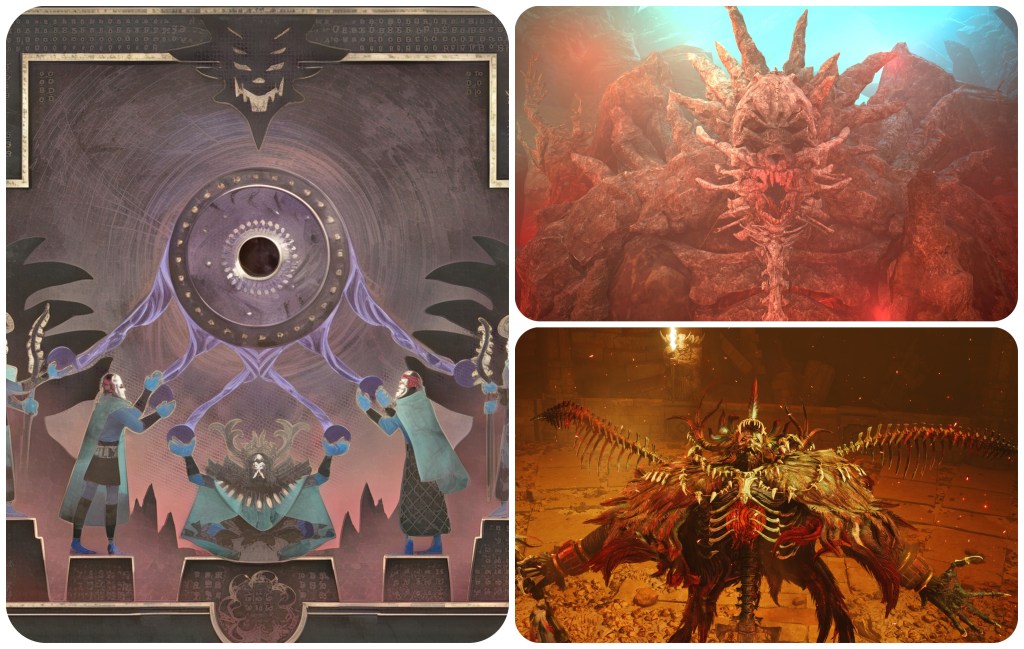
Importantly, positioning it as such would offer no consideration to the motif manifesting on Angeal Penance at all, since that one should be related to Jenova. The FFVII Remake games have generally been very conscious about respecting all the little nooks and crannies of the Compilation, so I don’t think they’d simply overlook or forget about Angeal Penance. The Varghidpolis, which appear to be Jenova’s main way of merging with the Black Robes, has six eyes as well.
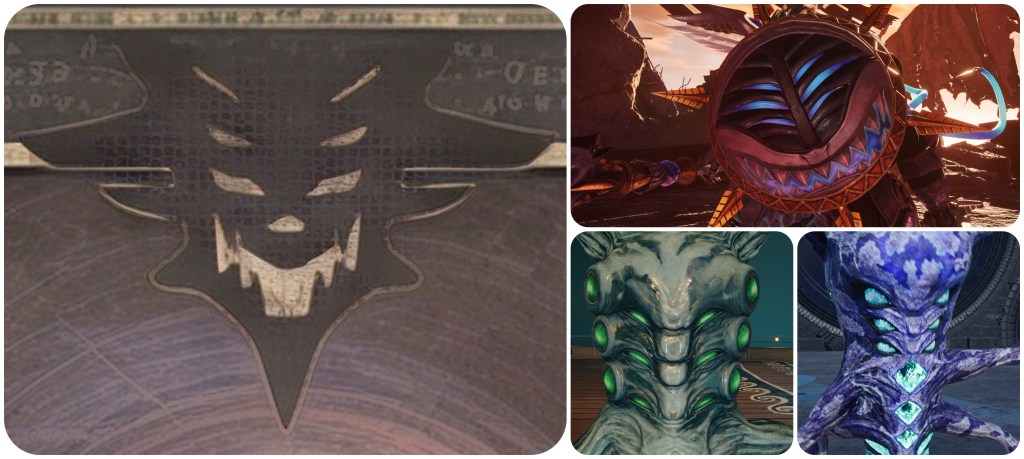
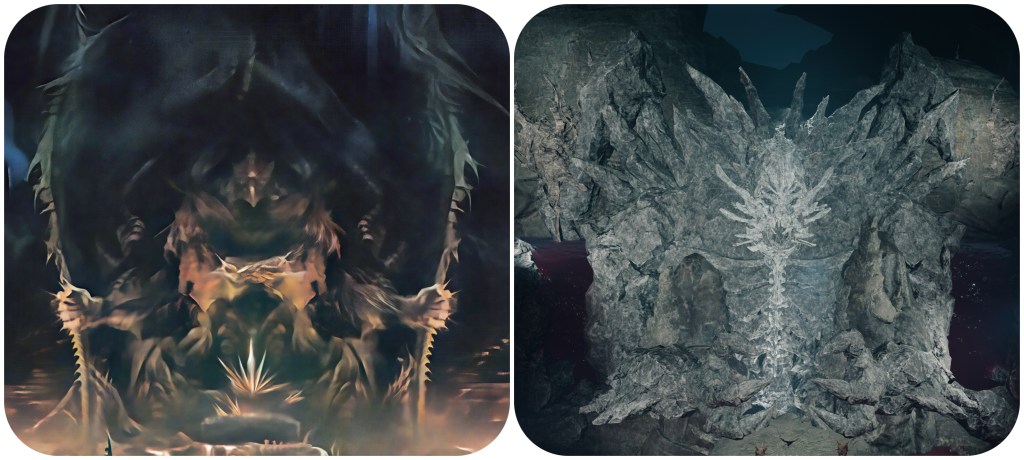
Concept art of the Gi idol revealed in Rebirth’s Material Ultimania looks nothing like the final ingame version from both the village and the temple. Maybe they changed things once they began to figure out the Gi’s alien lore. I don’t see a scenario where that stone idol in the Village of the Gi is just meant to be Gi Nattak. It’s gotta be Jenova. But we have to put in some work to figure out how.
What form did Jenova land on Gaia in?
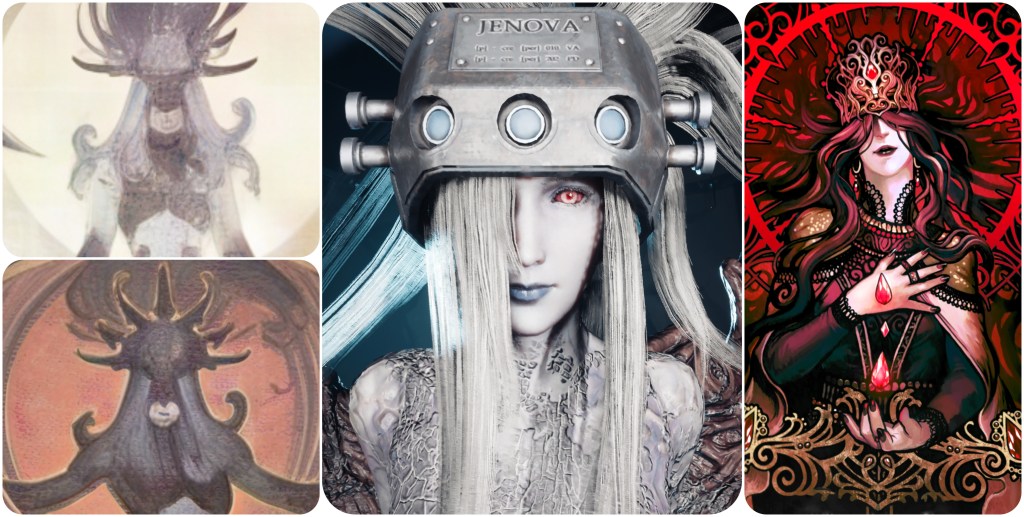
It’s possible that Jenova landed on Gaia as a woman, as per the depictions in the Hall of Murals. The woman in the mural, or what traits we can glean of her, does look relatively similar to the Jenova at Mt Nibel. Greyish-blue skin, flowing silvery hair. Notably, the grey skin Jenova is drawn with here is unique and deliberate, because the Cetra surrounding her have beige skin. However neither design or colour scheme matches to the Shadowblood Queen, who should be considered one of Jenova’s earliest and most impactful disguises since a legend states that her blood birthed all the fiends of the world. So the mural designs resembling that Mt Nibel lady may simply be coincidental.
I feel like the murals are intended to be artistic representations, since they seem to depict Jenova ejecting herself from the meteorite before it crashed and landing directly in their city as a humanlike golden goddess, which is not how those events are known to have happened. According to Ifalna, thousands of her people had gathered at the crater to do a planet-reading and attempt to aid the Lifestream in healing the wound. But when this failed, the Cetra planned to flee the Knowlespole region entirely. It’s as they were making their preparations to leave that Jenova started to appear before them in the visage of the dead or missing.
- Ifalna: “When the Cetra were preparing to part with the land they loved, that’s when it appeared! It looked like our dead mothers and our dead brothers, showing us spectres of their past. That’s when the one who injured the Planet, or the ‘crisis from the sky’, as we call it, came. They first approached as a friend, deceived them, and finally…gave them the virus. The Cetra were attacked by the virus and went mad, transforming into monsters. Then, just as it had at the Knowlespole, they approached other Cetra clans, infecting them with the virus.”
So probably not a humanoid woman then. Something I keep thinking about is that in The First SOLDIER we have a Jenova-possessed character subtly suggest that SOLDIERs were enhanced with “cells grown from something they scraped off a meteorite”. Yet by all accounts Shinra didn’t find Jenova on a meteor, they dug her body out of the fossil record. So this may be Jenova inadvertently leaking her own information about the arrival.
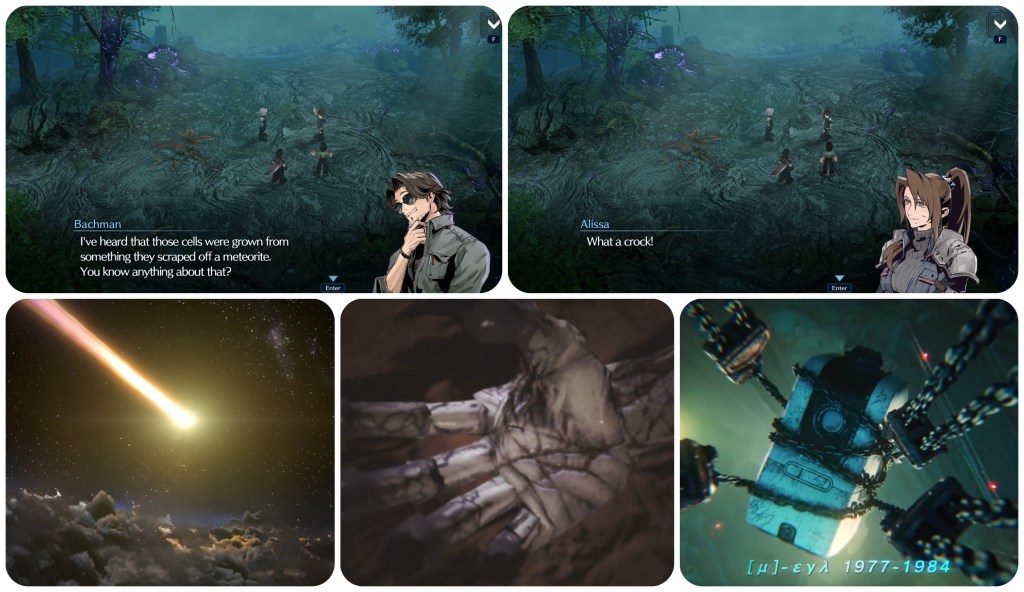
Therefore I think it possible that what landed on Gaia was either just surviving cellular matter or a mass of flesh, not a distinct humanoid body latched onto the meteorite.
Do I think Jenova is originally a Gi woman possessed by a cosmic devil who became the shapeshifter? Is the woman in the tank a Gi queen? Are they her native people or her progeny?
Not in the way that question was framed. I think she infiltrated Planet Gi, likely obtaining a position of political and religious power, but I do not believe that it was her origin point nor that the Gi are her direct offspring. Most of the effigies do display Jenova-like physical traits, but these I would say are her standard mutations rather than a result of them genuinely being Jenova’s children.
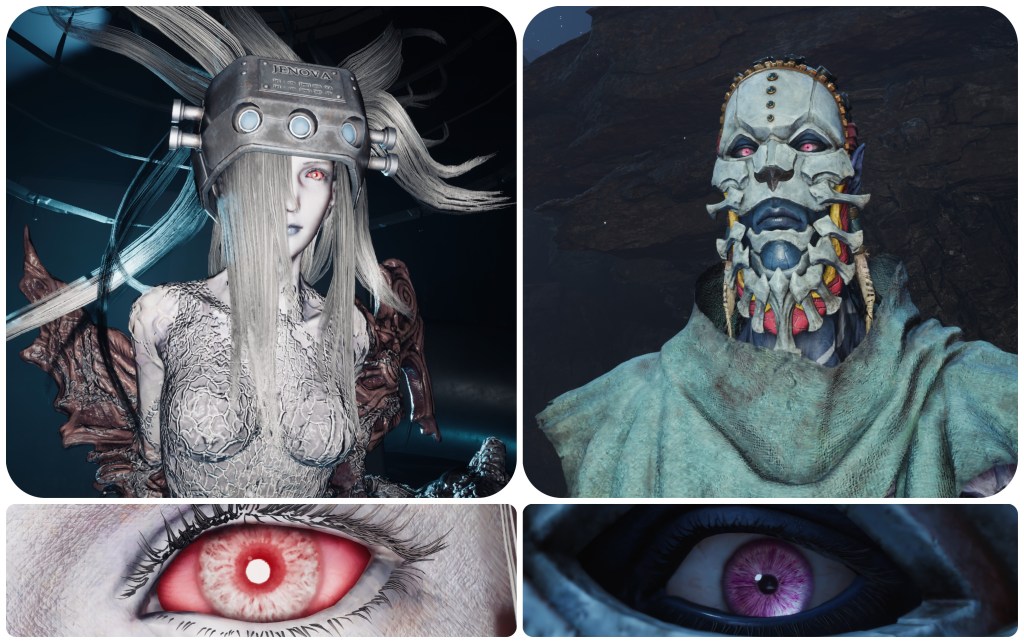
Any suggested visual link between Gi Nattak and Jenova is almost entirely rooted in comparison with the woman that Sephiroth finds at Mt Nibel. I did myself mention that the first reaction I had upon seeing Gi Nattak was furiously scribbling down notes about how his colour scheme matches Jenova. However, when you use freecam to get a clear glimpse they don’t actually look similar. Although Gi Nattak does have blue skin and pink eyes – which had always been Jenova’s colour scheme – FFVII Remake, Crisis Core Reunion and FFVII Rebirth all give her model grey skin and red eyes. It is strange that they’d make the Gi look so deliberately in line what we’ve always known Jenova to be yet then change the lady herself, but nonetheless in the most current visual representations that Jenova and the Gi do not match in their physical features. And while the Necrotic Entity or other Jenova hybridizations do have a blue hue to their skin, this originates from the Makonoid creatures they combined with. It’s not necessarily an indicative trait of Jenova itself, as neither its man nor monster are represented like that in Rebirth.
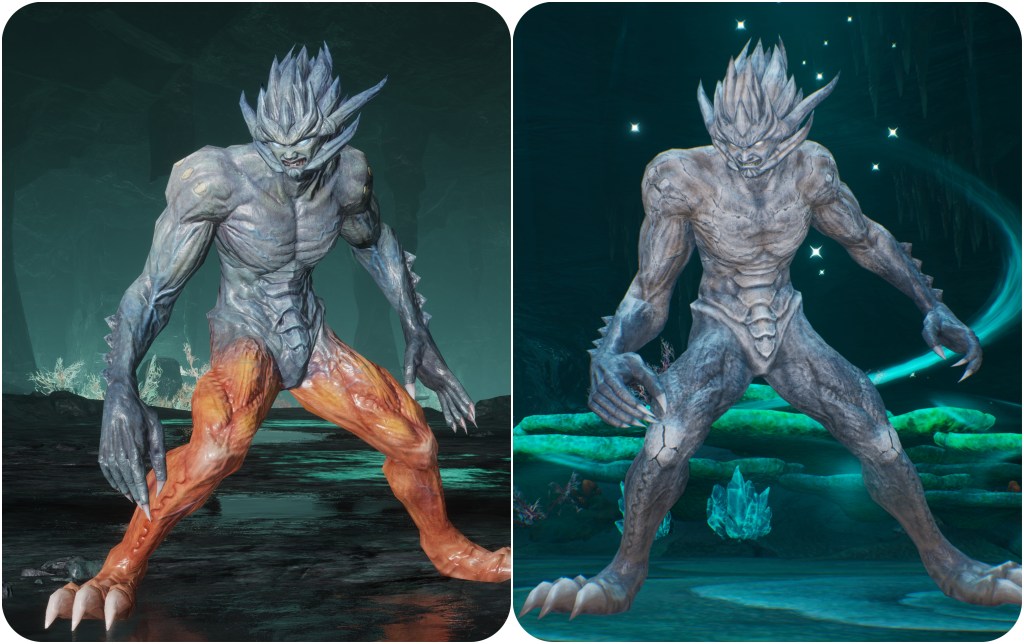
If we’re looking at any kind of advanced Jenova-human hybrid to see what colour their skin is, then we should probably be looking at the Makonoids which were growing inside of the Mt Nibel mako chambers. While these have not traditionally been known to possess Jenova cells, the Rebirth Material Ultimania describes them as being akin to “a juvenile form of Heretic Rayleigh”, which is what the Diabolic Creation and Variant are named in the japanese script, indicating that they have some hefty dose of the mutagen. In Final Fantasy VII and Crisis Core the Makonoids are the same light blue that Jenova is, while in Rebirth they have grey skin that matches the new Jenova design.
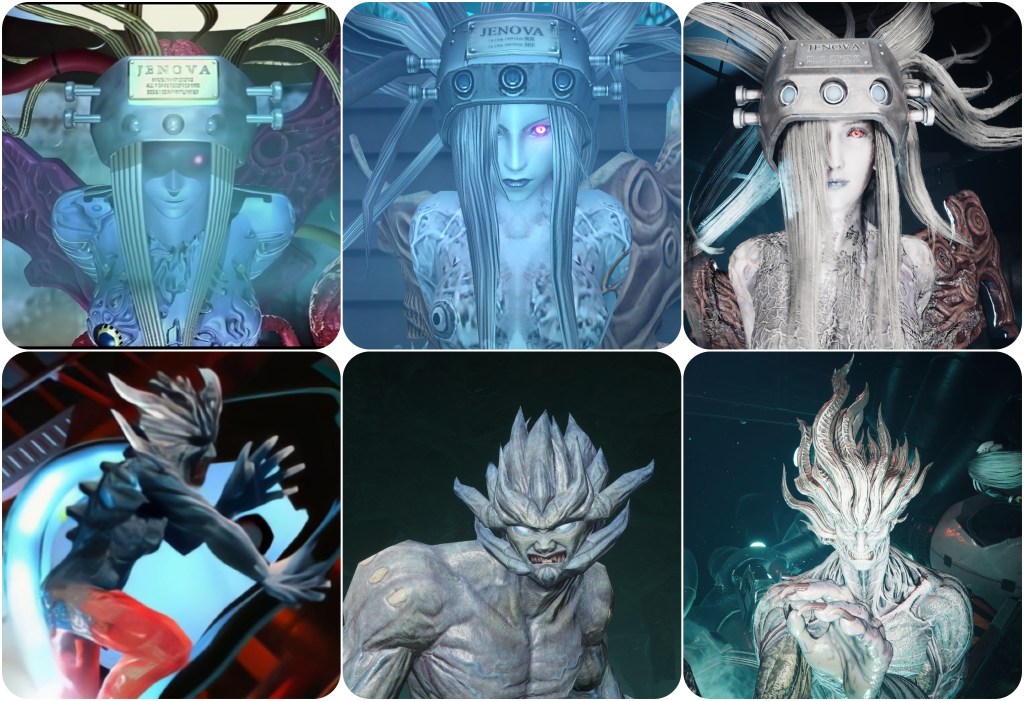
Crisis Core features two breeds of Makonoid. One is the blue & orange mutant escaped from Hojo’s R&D labs, while the second is an all-grey design specifically dosed with G cells rather than the original J cells.
The woman at the Nibelhheim reactor is not blue and pink. That’s not to say no Jenova in Rebirth has had pink irises, however. Jenova Lifeclinger’s battle takes place in this cosmic horror arena. A chamber of guts and vertebrae and too many eyes. Most of those eyes are red, some of them are blue, and the remaining few are indeed pink. Also of note is that the bodily eye growths seen on Jenova Emergent and Jenova Lifeclinger are both pink, though with totally different irises to each other, and in the final phase Jenova Lifeclinger’s main eyes glow pink.
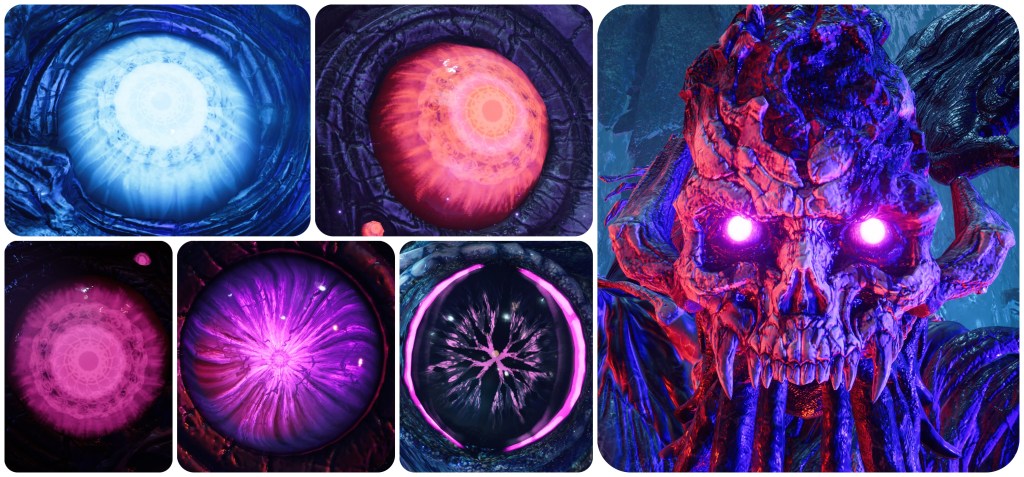
Yet the amount of variation makes it impossible to link them to Gi Nattak’s eyes. They’re pink, but they’re also blue, red and black, and at no point does their design match his. I feel that the beast forms are beginning to veer into a totally different conversation anyway. If we’re trying to contrast Gi Nattak’s colour scheme to anyone, it’s the woman in the tank, and she no longer matches to what she once was. For what it’s worth Gi Nattak is also super tall, has dark blue skin (unlike classic Jenova’s light blue skin), pointy ears and black hair. Jenova is a normal height, has grey skin with just a hint of beige in her face, human ears and silver hair. Granted Jenova Lifeclinger does have some span of deep blue skin identical to its Twin Brain spawn, and the temple murals depict Jenova as twice the height of the surrounding Cetra, but neither of these can be applied to Nibelheim because the fact of the matter is that this woman is grey.
In fact I think that the living Gi may have been quite a lot larger than we realise. Or at least that they had some giant warriors in their army, since the artistic representations we can find show them to have had quite a large size variation among their people. Gi Nattak’s spirit is already over twice the size of Cloud, but this is perhaps just the form he took in order to best commune with our human party. The holograms in the Corridor of Apocalypse depict the Gi as stretching all the way to the ceiling of the temple, and while it may be tempting to think that this is just symbolic of how the Cetra perceived this threat, there are similarly enormous weapons scattered all throughout the Wall of Honour where Seto’s body stands. Sometimes games make background elements larger so that the player can see them easier, like the giant NPCs in Mario Kart, but I don’t believe that to be what’s going on here. Even without freecam we can tell just how massive those swords and axes are.

The set of weapons surrounding the first effigy that Nanaki encounters are all about the same size as his body, but further into the cavern there are shields, axes and polearms that make the characters look miniscule.
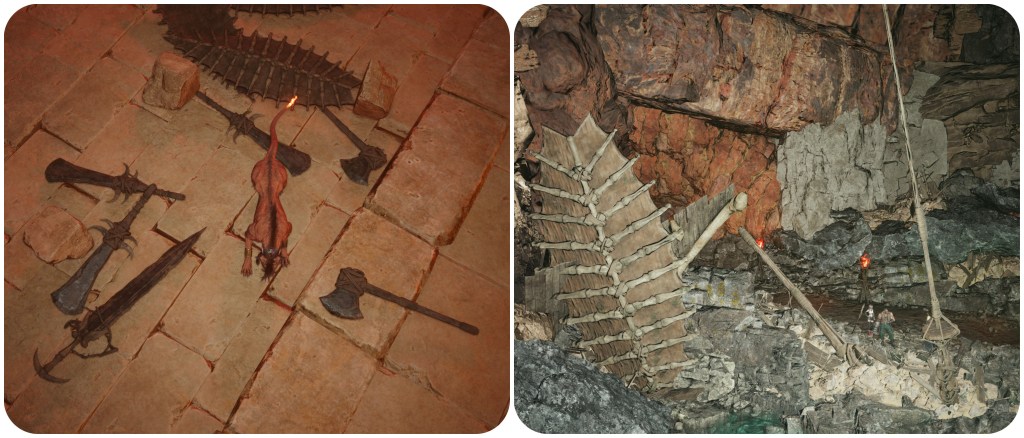
Right outside the Village of the Gi we can find a few statues of Gi warriors, but their abstract faces make me inclined to think that these are just tribal artforms rather than genuine effigies. It’s still worth noting that these are also quite tall though. Once we head into the village, we begin to encounter more detailed and believable effigies which present the Gi warriors as being much, much larger again. Given that the bodies and faces of these ones seem more realistic, I’m even left to wonder if these may be the Gi elders with their bodies turned to stone just as happened to Seto. This sentiment might be supported by the Material Ultimania.
- Final Fantasy VII Rebirth Material Ultimania (Pg 132, Google Translate): “The giant statue in the village was made using the remains of a Gi warrior who died in battle.”
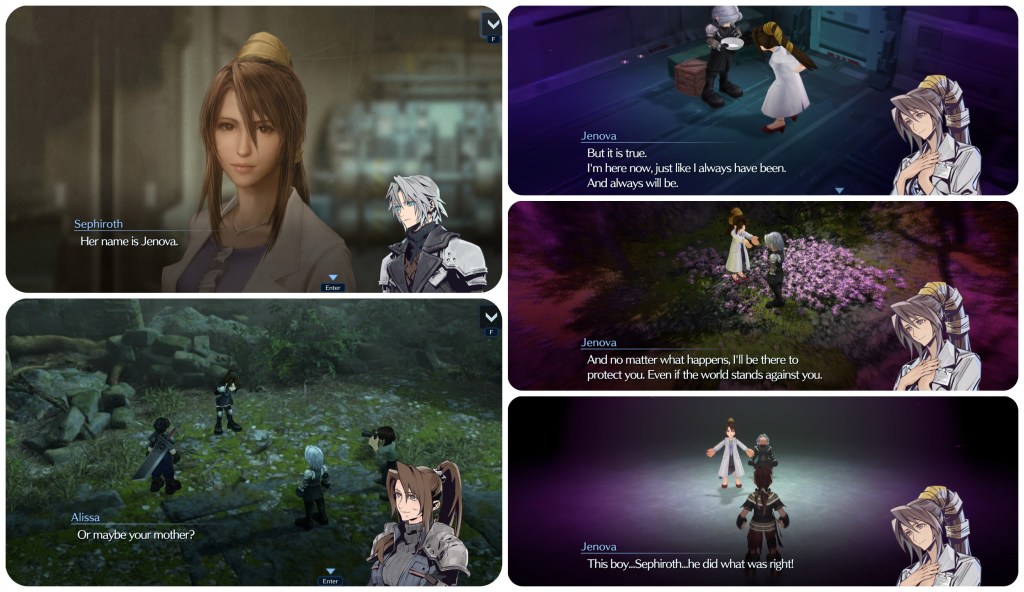
So I consider it incredibly unlikely for that Jenova woman to have been of the Gi. She is growing out of a giant heart, this traces back even to the original 1997 game, but my assumption has always been that Jenova generated this in order to try and keep herself alive inside of the intense Mako bath.
Rather, I believe that the form Sephiroth finds her in was Jenova using what limited power she could muster under confinement to shapeshift into Lucrecia, because she knew that was the appearance which would leave him the most vulnerable. The way Jenova got buried in the first place is that the Cetra of the northern Knowlespole region had waged a final, desperate war against the invader, which culminated with Shiva freezing the land. The Hall of Murals illustrates to us in two locations that Jenova had returned to the Dreamweaver form in order to fight against the oncoming forces (yes I did double-check its model for any inconsistencies, that is Dreamweaver), and we glimpse video record of Jenova being excavated looking like the usual skull-faced demon while Sephiroth is reading Professor Gast’s research.

So I don’t think Jenova was dug up as that woman. Instead, Ever Crisis: The First SOLDIER illustrates that Jenova has been manipulating Sephiroth’s dreams using Lucrecia’s image since ten years before the Nibelheim Incident. He comes into contact with Jenova’s spirit contained within Masamune during September of 1992, and is dispatched to Mt Nibel on September 22nd 2002. During this Masamune incident Angeal illustrates that mental health is key to rejecting her control, so her grip over Sephiroth presumably lessens as he grows up and gains that support system through Angeal and Genesis. But her influence then surges once again when Genesis betrays and condemns him; Sephiroth’s broken heart creating room for Jenova to latch onto his mind quite deeply. Even prior to Nibelheim, Jenova has read his heart and knows precisely how hard Lucrecia’s image hits him. Hence why I allege she transformed to welcome him.
Barring that, since people are strangely opposed to the idea of it being Lucrecia, you could also suggest that her female form is just a Cetra woman. Either some random shaman, or more specifically that face could belong to Minerva, since I’d consider her a likely candidate for the Emerald Witch that put the Shadowblood Queen to death. The Emerald Witch uses so-called “arcane powers”, yet the First SOLDIER reveals that “Terudama” aka Materia were actually a rare sight in the Cetra’s time. Minerva has innate magic since she’s a Lifestream manifestation existing somewhere between Summon and Weapon, and so could be the emerald-coloured witch wielding arcane powers.
As far as known Cetran incarnations are concerned, the angel at the Temple of the Ancients doesn’t look anything like the Mt Nibel lady. Her headband is loosely similar to Minerva’s, but she otherwise doesn’t resemble any other known character.

Otherwise, if none of that sates ya, that woman in the tank could also be compared to Shiva. Not the summon, but the Cetran queen of Knowlespole who used powerful ice magic to bury Jenova in the North Crater. The Shiva summon is implied to be based on that queen.
- Shiva (Loading Screen): “An ice-elemental entity and ruler over the world of ice. It is said that she once saved the planet from certain destruction by staunching a great wound with a glacier.”
- Shiva (Enemy Intel): “An ice-element summon recreated in virtual reality. It is the manifestation of a queen who once healed the planet’s wounds with ice, as evidenced by the existence of permafrost in the polar lands.”

Is it possible that, since we only ever see this Jenova woman under intense blue-green lighting, her model was coloured this way so as to appear blue when presented in its cinematic lighting?
I mean, that certainly is possible. I do tend to be conscious of the fact that sometimes colour is representative, right? Artistically applied in a way where surrounding colours cause one colour to become contextually perceived as another. Like how Chris from Symphogear has white hair, yet if you go into Photoshop and and eyedropper that you’d actually get purple. But her hair is definitely intended to be recognised as white and they somehow use the adjacent colours to lead you into perceiving it as such. Similarly, I did think of the possibility that Jenova may have been coloured through that kind of principle.
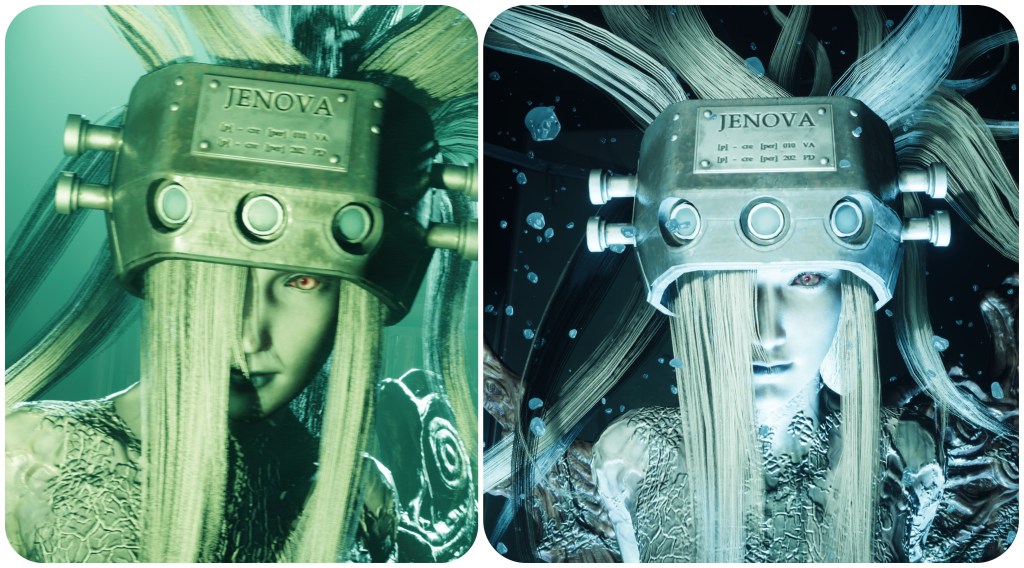
The intense lighting of the mako tank does tint her skin and you have to break past it in freecam to find out that she’s an ash grey. However, with both of these scenes once you know that her model is grey I think you can kind of see past the lighting and recognise that it’s grey skin under a blue or green light, and in no view is her eye ever pink. As far as I know this would also be the only instance of such a design decision happening in the FFVII Remake games. In my time replaying and obsessively screenshotting them, I’ve not once encountered a boss model where I felt that its palette had been altered to accommodate that kind of lighting colour interaction.
If Jenova was a monster when excavated, why did Professor Gast describe her as smiling with “ethereal grace”? Gast seemed like the only reasonable scientist on the Jenova Project. Were the video clips we see metaphorical rather than literal?
It’s my opinion that this is just a common cosmic horror trope where the disgusting alien god twists perception, or the self-important humans project their own meaning upon the incomprehensible Other, so as to be perceived as a thing of sexual beauty and grace. Like Ash remarking on how beautiful and perfect the Xenomorph is in Alien, something something Song of Saya, or like the disturbing contrast of the Jenova Lifeclinger demon having these colourful butterfly wings. It’s grotesque and sinister, yet the scientist with his misguided belief gazes into her uncomfortably gentle eyes and believes that she has chosen him to spread the truth of the Ancients throughout the world. To me that’s the vibe I get from Gast describing the specimen as smiling with ethereal grace, it’s like a sick chill running down my spine. Final Fantasy VII has always been a cosmic horror story where a good man falls into madness after contact with a Lovecraftian entity, but the remake games heighten that sense way further with all the body horror.
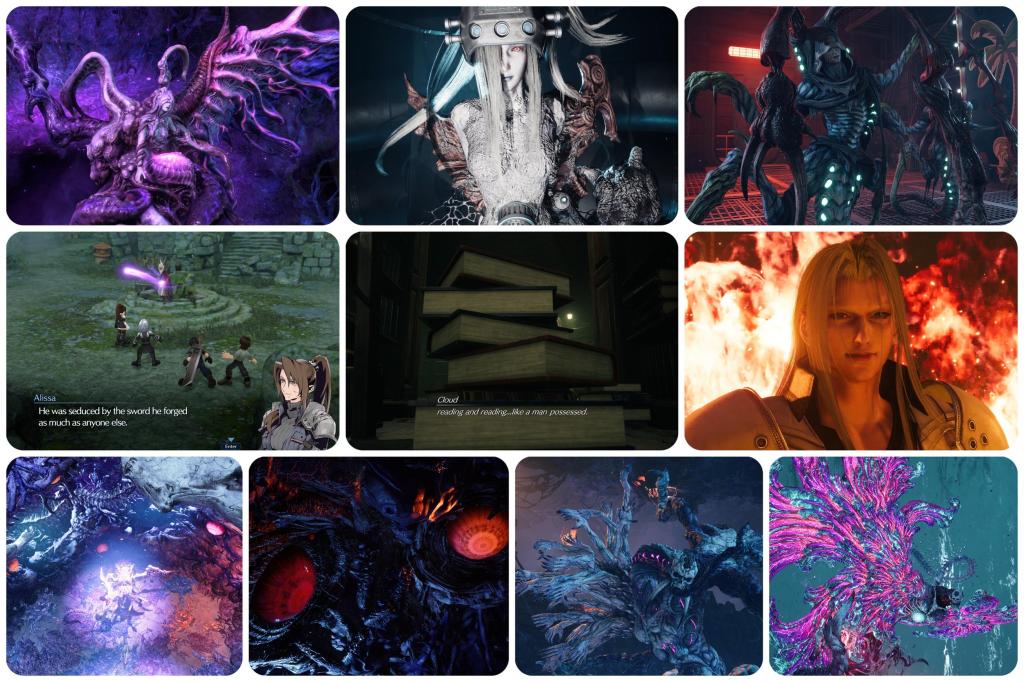
While Gast may have been the most humane scientist in the Jenova Project, it’s not like he’s some blameless apostle. Perhaps these innocent hopes are precisely what drove him to become compliant in the terrible experiments. Professor Gast initially headed the Jenova Project believing that she was a Cetra, then abandoned Shinra when he figured out that she wasn’t and therefore he’d been testing on babies and soldiers for nothing. An excerpt from the Crisis Core Ultimania Scenario Q&A clarifies that Gast was still the overseer of the Jenova Project when the G and S branches began. Even if he had little active involvement in either, he still didn’t stop them.
But I guess that is a fair enough point to query – whether that demonic Jenova form they excavated could even smile, since at first glance the Remake versions of Jenova do all seem to be lacking a jaw. However upon closer inspection of the models at key moments, as well as referencing some concept art, Jenova has been shown steadily growing a mouth. Dreamweaver certainly does not have one. However Jenova Emergent has a hidden mouth with an eye in it, and for just a few seconds Jenova Lifeclinger opens up a gigantic mouth while roaring in pain during the final phase. The Genesis Copies also retain the jaw as their faces become increasingly bonelike. And keep in mind that all of those are mutations progressing over the span of weeks. The body which the Jenova Project team excavated is one that had over a thousand years to perfect its form. So I’m sure that one, with its humanoid arms and hands, probably had a mouth as well.
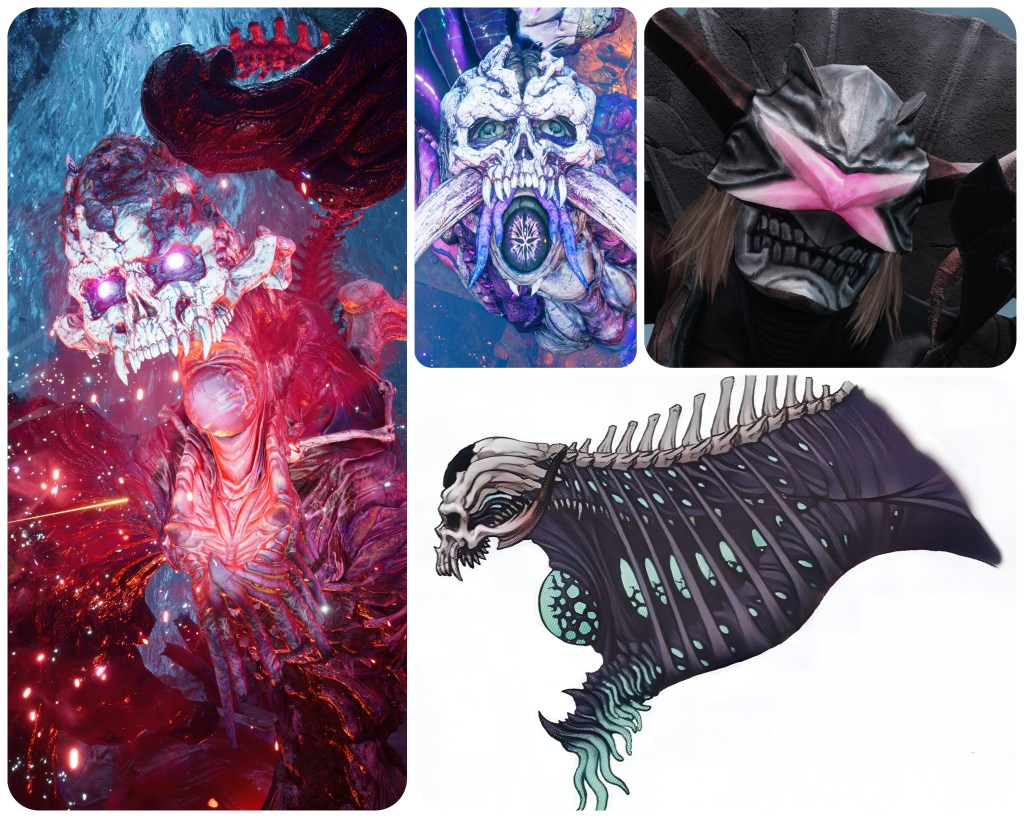
The closeups of Jenova during its excavation are too extreme to get visual confirmation on a mouth. Perhaps they’re deliberately hiding this Jenova’s full form from us, since I have my suspicions it may have some rather distinctive horns. This scene is a pre-rendered FMV so I unfortunately can’t just zoom it out with freecam. However those hands are visibly sitting on the same rock strata where she was uncovered. So I’m inclined to believe it was a legitimate flashback showing that Jenova wasn’t a humanoid woman when excavated. Gast is adamant that this Jenova is a ‘she’, which might seem odd at first, but actually every Jenova design except for probably Emergent has had breasts. Since the hands are more humanoid than usual, I’d think it a safe bet that this one did too.
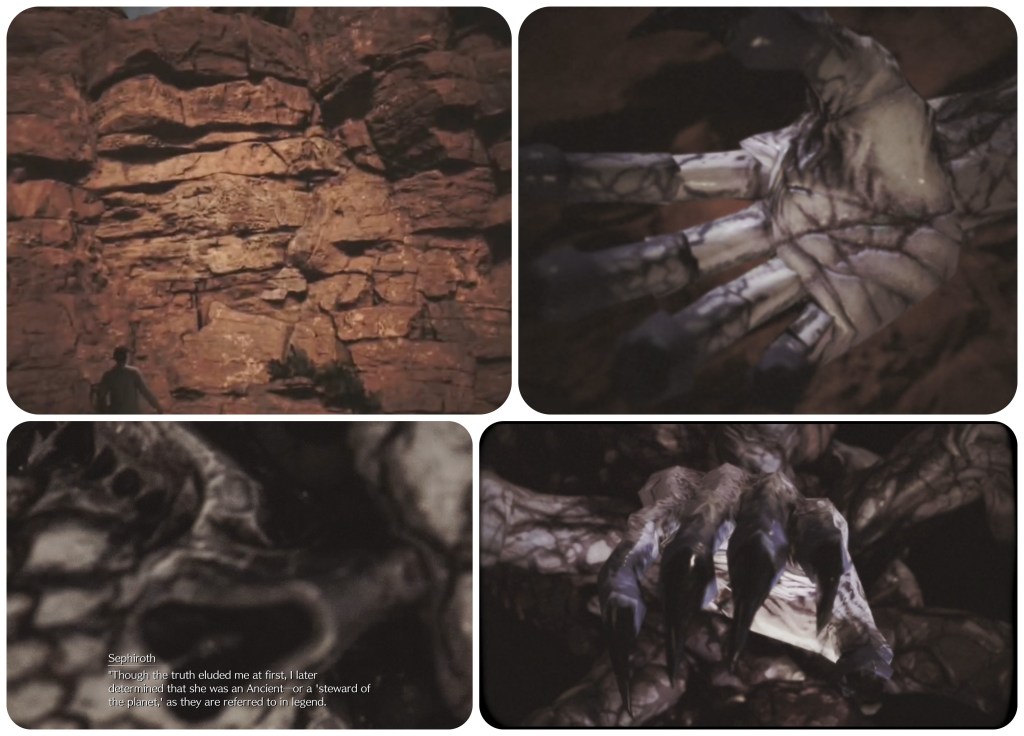
It is a possibility that Gast wasn’t present for the actual excavation, and maybe Jenova had shapeshifted into a woman by the time that he first gazes upon her. Regardless, I just don’t personally feel Rebirth framed that scene as something to be interpreted or doubted. I don’t like the idea that Rebirth shows us and Sephiroth a vision of a demon, when Shinra had in reality dug up a woman. Why would Jenova show that image to Sephiroth? She wants him to believe that she’s his mother, not a monster. No, that’s footage recorded on proper film reel by the research team, then a few seconds later we do see the female Jenova flashing into his mind without any such overlays as she begins to latch onto him from the mountaintop. That same film reel effect is also seen in the intro cinematic of The First SOLDIER (the original battle royale) when it’s showing the early origins of the Jenova/SOLDIER program.
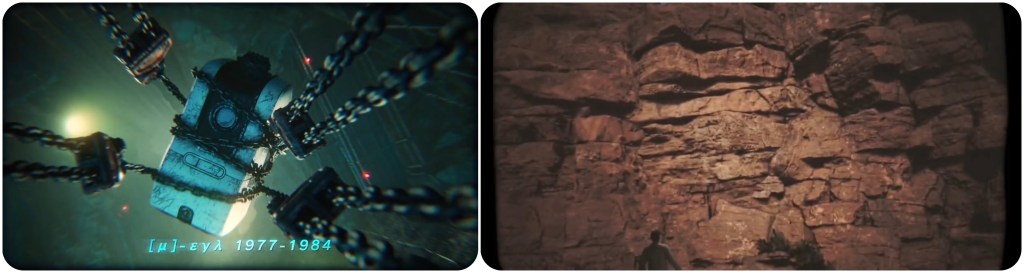
These are my thoughts on the matter anyway. I know throwing all that out kind of reads as if I’m coping, but to me yeah I’ve always thought that the “ethereal grace” line was laced with cosmic horror irony. I could be wrong though, who knows what Remake 3 or newer episodes of The First SOLDIER will show us.
Why does Sephiroth respect Gast?
That is a good question mate. We honestly don’t know a great deal about Professor Gast. He hasn’t had much presence in the extended content or prequels beyond off-hand remarks like a Cosmo Canyon NPC mentioning that he used to frequent the vale. The only significant instance I can really think of is in Maiden Who Travels the Planet, when Aerith encounters Hojo’s Jenova-infused soul within the Lifestream during the endgame.
- Hojo: “Now this proves I have far surpassed Gast, who was recognized for his talent even though he tried to flee from science like the coward he was. If Gast was in charge of the Jenova Project now, he surely would never have reached this stage…Haha, yes. Professor Gast was your father, was he not?”
- Aerith: “…Father realized that the Planet was more important than science.”
- Hojo: “Ha, that was the limit of Gast. Stopping and not doing what remained to be done was blasphemy to science…”
FFVII originally frames Gast as the opposing element to mad doctor Hojo, so Sephiroth’s fondness of him is easy to understand. And yet, this intersection of characters is actually one of the stranger oddities in FFVII & Crisis Core dialogue. These games are a bit unique compared to a lot of other series in that we do have specific years and dates attached to quite a lot of things in the Compilation chronology.
- Q2-1: What is the time difference between the start of Jenova Project S and Jenova Project G? And out of Genesis, Sephiroth and Angeal, is Genesis the eldest?
- A2-1: Project S and Project G began at roughly the same time. They were lead by Hojo and Hollander respectively, and the department head Gast has little participation in either project. The order of their births goes Angeal & Genesis > Sephiroth, but it’s fine to think of them as being around the same age. Angeal and Genesis were created at roughly the same time, and were deemed as failed projects when they were babies. Project S took the results from Project G and added further improvements, so Sephiroth’s birth was later than Angeal and Genesis’.
The ffwiki and multiple blog posts are directly telling me that Genesis’ birth was in 1982, while Angeal and Sephiroth only offer a range from 1977-1982. I haven’t figured out where that exact date for Genesis comes from, whether it’s some Ultimania character profile, interview, Q&A or research notes hidden deep into one of the Compilation games, but I’d like to believe that they didn’t just make it up. The Crisis Core Ultimania Scenario Q&A mentions Angeal and Genesis were born around the same time, roughly 20 years before the events of Crisis Core (the main section of which spans from October of 2000 to October of 2002), while Sephiroth is just a little younger than them. So, treating this information as correct, we deduce his birth to either be late 1982 or early 1983. Gast fled Shinra somewhere in the 1977-1982 time period, and was assassinated by Hojo on the 27th of February 1985, a mere twenty days after Aerith was born. Therefore, Sephiroth and Gast have absolutely never met. Or if they did, it would have been when Sephiroth was not even a year old. Sephiroth’s first time even leaving Midgar was in 1992 for the Rhadore expedition, seven years after Gast’s death. Granted these dates are strange since that would make Sephiroth ten when we see him in The First SOLDIER and only twenty years old at the Nibelheim Incident, which does not sit right with me. Ain’t no way Angeal has the face of a 20 year old either. But nevertheless that’s what the current data I have says.
Perhaps Sephiroth was simply an understated bookworm. Crisis Core does have two separate instances of Sephiroth secluding himself in a Shinra library, so maybe he became familiar with Gast’s scientific accolades there and began to perceive him as a better man than Hojo. But either way it’s impossible for them to have ever actually met. I think Sephiroth probably just glorifies Gast because of how much he dislikes Hojo. Any information that Sephiroth had managed to obtain about Gast would have been heavily sanitized. He’s shown diving into Shinra’s research archives and yet is unable to uncover that Hojo is his father, Lucrecia is his mother or that he’s a lab baby. Sephiroth could not have discovered the real nature of Gast’s involvement with the Jenova Project in his reading at Shinra HQ. Those archives obviously would have been censored so that any unassuming reader couldn’t just wander in and randomly discover the circumstances of alien existence, and all the research documentation in the Nibel Manor is from the time where Gast and the team still believed that Jenova was a Cetra (hence why Sephiroth accepts himself to be one). Rufus still believes that Sephiroth is an Ancient in FFVII (December 2007), but Hojo in Crisis Core (April 2001) calls Genesis “a memento from an unenlightened era, when men could deem any unclassified life form an Ancient”. So even though the Jenova Project team did figure out that Jenova wasn’t an Ancient, the project’s content and outcomes aren’t common knowledge within Shinra at all.
Rebirth, I would say, fixes this inconsistency a bit. While FFVII and Crisis Core both have Sephiroth expressing sadness that Gast had never told him anything about his birth, implying that he was quite personally familiar with Gast, Rebirth just has Sephiroth musing about how Hojo was an unworthy successor as the head of R&D. Then when Sephiroth goes mad on his final day in the basement there’s a wrath in his voice when he mocks himself as “the crowning glory of Professor Gast’s wondrous experiment”, not expressing a mournful, personal betrayal like FFVII’s depiction.
- Sephiroth (FFVII): “…now I see, Hojo. But, even doing this, will never put you on the same level as Professor Gast.”
- Sephiroth (Crisis Core): “My mother’s name, Jenova… The Jenova Project… Could this be a coincidence…? Professor Gast… Why didn’t you tell me? Why did you die…?”
- Sephiroth (Rebirth): “Hojo from Research & Development. His predecessor was a great man, but him? He is anything but.”
- Sephiroth (Rebirth): “The Jenova Project was approved soon after—a bold initiative to resurrect the long-dead Ancients. An initiative…that resulted in my conception. Or rather, my creation! The crowning glory of Professor Gast’s wondrous experiment!”
If we could just concretely pin Angeal, Genesis and Sephiroth’s births at 1977 instead, while keeping Gast’s desertion at 1982, then I would feel a lot better about Gast’s storyline. That way maybe a young Sephiroth could have developed enough of a memory and personality to actually connect with Gast. Conceptually, it also introduces a nice layer of irony to the situation since Gast is the man who would become Aerith’s father. However with the most complete dataset provided to us, timing-wise Sephiroth cannot have met Gast. So the only working explanation is that he’d read some of Gast’s non-Jenova work in the Shinra Archives.
Are there any other options for who that woman in the tank could be?
What I mentioned were the safe possibilities for this woman’s identity based off the characters, lore and history of Gaia. Jenova had either shifted into Lucrecia’s face when she sensed Sephiroth’s approach, or the Mako in the tank kept her abilities limited so she had to default to someone from Cetran society. But if you did want to look for an unconventional ID of her face, a lesser known component to the setting is that FFX occupies the same universe. It’s been discussed in multiple Ultimanias and multiple interviews, the most recent only a year before FFVII Remake released, that the original scenario writer Nojima considers FFX and FFVII to secretly share a universe. Or at least that it would make sense. Yuna’s journey happens a long time ago in a galaxy far, far away.
Here’s a translated excerpt from the Final Fantasy X Scenario Ultimania.
- Interviewer: “Huh, so VII and X ARE connected?”
- Nojima: “Well, there’s not many specifics to it. I know that what becomes of people when they die is among them. You could say that it’s basically the same. Both function along the same line of thought as I wrote the stories. Sometimes my thoughts just flow out like that, even though pyreflies distinctly aren’t green.”
- Interviewer: “When you speak of the dead becoming green, do you perhaps…?”
- Nojima: “Yes. In my mind, pyreflies and VII’s Lifestream are the same substance. […] That’s right. There’s something like the Lifestream.”
Here Nojima draws attention to the similarities in their system of spirit energy as seen in the original FFX. Further interviews in the Final Fantasy X-2 Ultimania then solidify this into a more universal claim, where the descendants of the new character Shinra eventually head out to space, reach Gaia and establish the Shinra company.
- Nojima: “After quitting the Gullwings, Shinra received enormous financial support from Rin, and began trying to use Vegnagun to siphon Mako Energy from the Farplane. But, he is unable to complete the system for utilizing this energy in his generation, and in the future, when traveling to distant planets becomes possible, the Shinra Company is founded on another world, or something like that…That would happen about 1000 years after this story, I think.”
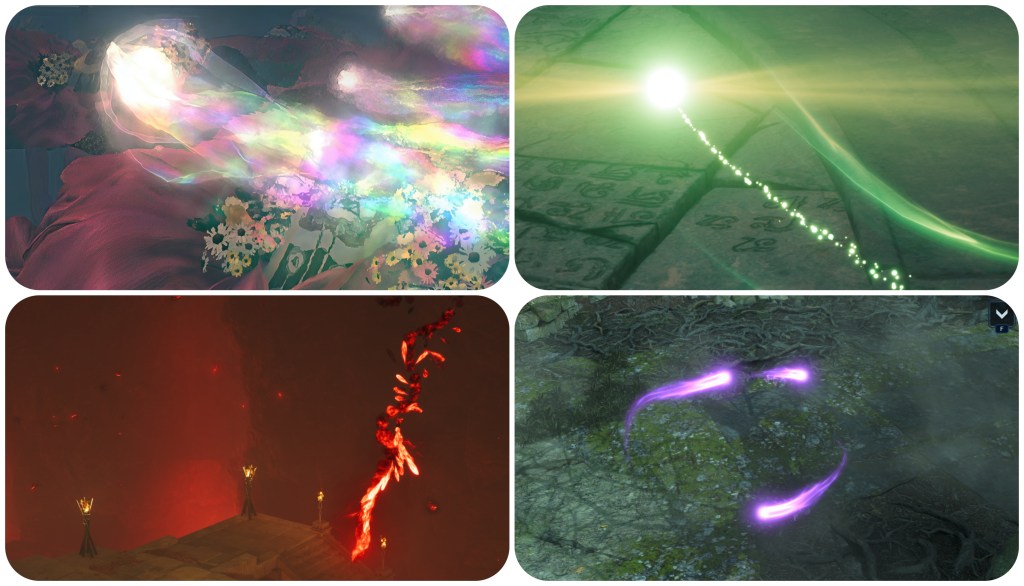
Pyreflies are the spirit energy wisps of Spira, and the Farplane is its afterlife space like the Lifestream. Just as it’s possible for Cloud and Tifa to be physically immersed in the Lifestream despite that technically constituting the afterlife, so too can Yuna physically step into the Farplane. When Spirans pass away their souls float as orbs. Sephiroth, Kadaj and Grimoire disperse in much the same manner when absorbed into the Lifestream. There are similar orbs too when Chaos, Nero and Weiss return to the planet. The FFVII Remake games do actually further this connection by showing us an Al-Bhed founder in the Shinra Museum, and having Aerith perform multiple Sendings. By putting her emotions into singing and dancing her No Promises to Keep ballad she’s able to appease the lingering spirits of Biggs, Wedge and Jessie, and she dances again when trying to quiet the Labyrinth of the Lifestream. The swirling of her staff in the latter particularly resembles Yuna’s routine, and during this we see Pyrefly-like orbs.

Pyreflies are plastered all throughout the Compilation, really. You see those distinct orbs in Final Fantasy VII, Crisis Core, Advent Children, Dirge of Cerberus, Rebirth and Ever Crisis.

Another scene within the Labyrinth reveals that in Lifestream-dense areas, dead bodies may transform into fiends just as the unsent souls on Spira do. Or maybe this is specifically owing to the fact that they were SOLDIERs possessing Jenova cells. I’ll say more on that later. Either way though, the change from human to fiend is made, just as is so signature to FFX. I’ve said it a million times by now – Final Fantasy VII Remake is a unified Final Fantasy VII. They’re pulling in everything they possibly can to make the most complete Final Fantasy VII compendium. Not just through the abundant interweaving with Compilation characters and history, but also through stuff like upping the John Carpenter-esque imagery in Jenova’s gore and shapeshifting, layering the spacetime in a way that strengthens the stylistic link FFVII has always shared with Xenogears and Chrono Trigger, or in this case, yes, putting in these little background elements that galvanize its bond with Final Fantasy X.
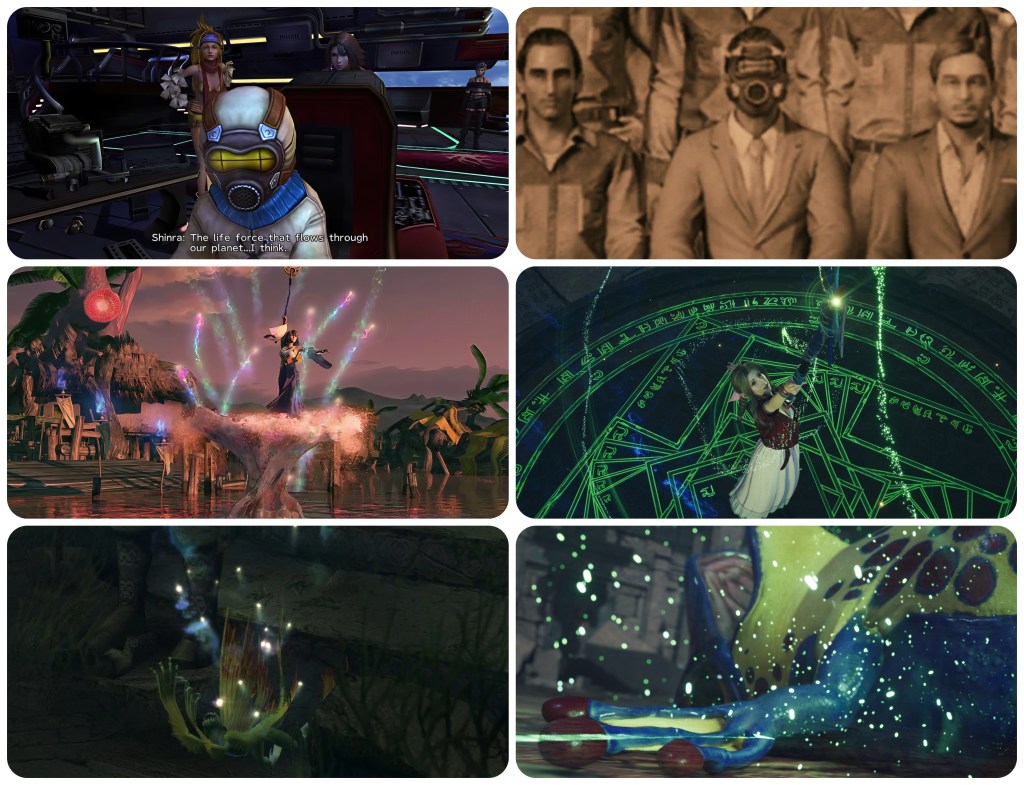
That’s why it’s worth acknowledging that Yunalesca is actually the one who matches Rebirth Jenova’s facial features most clearly. You know, I feel like I’m having to make some compromises in order to claim that Jenova’s design here matches to Lucrecia or Minerva. Both those suggestions are carried in large part by their narrative implications. But just in terms of visuals Yunalesca is genuinely a dead ringer.

Where does this Yunalesca-Jenova idea even originate from? FFX has always kind of been known to parallel FFVII. Its Pyreflies are a lot like the Lifestream in both appearance and mechanics, and the imagery of its main villain Seymour lines up to Sephiroth at points. He’s this megalomanic religious zealot who transforms into strange monsters, and the disturbing way in which he treats Anima as his mother is reminiscent of Sephiroth’s relationship to Jenova.
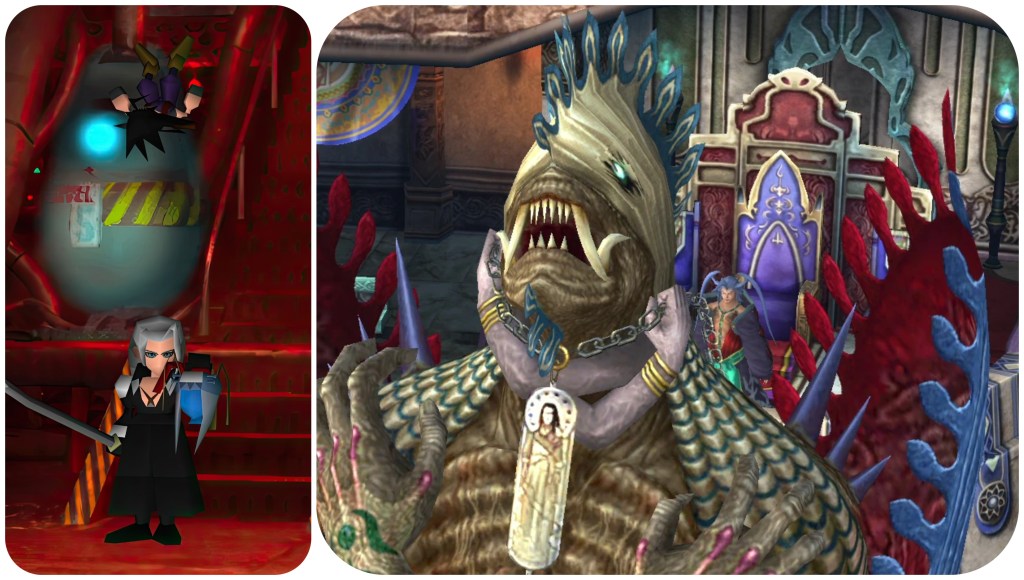
Hear me out – Bizarro Jecht and Safer Seymour. Just as you could consider Angeal Penance and Genesis Avatar to be their equivalents of the Jenova-fuelled Bizarro Sephiroth transformation, Braska’s Final Aeon has the exact same design structure. It even has wings.

Seymour Flux and Seymour Natus heavily resemble Bizarro Sephiroth and Safer Sephiroth too.
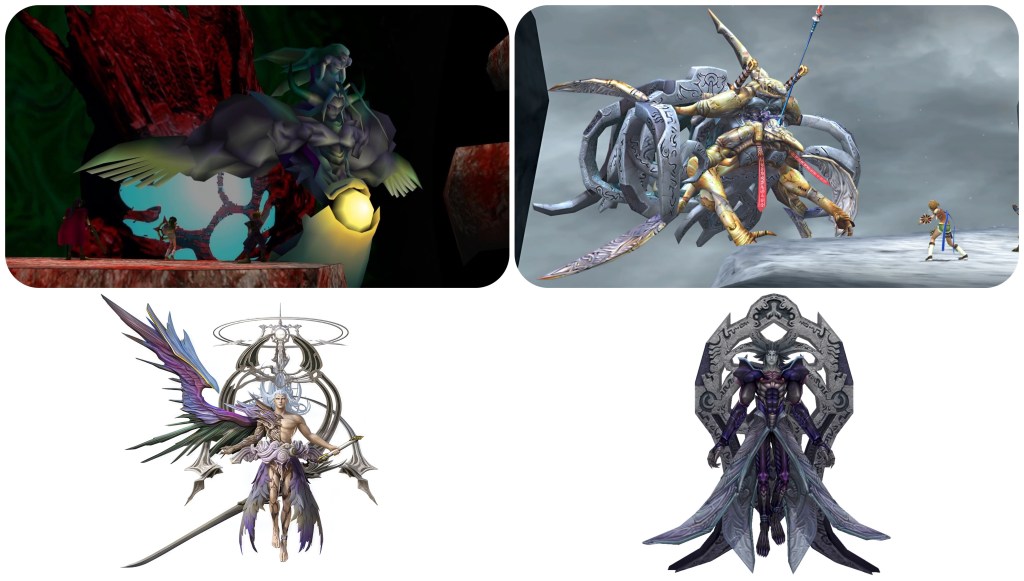
Perhaps Sinspawn and Jenova’s spawn should be considered as much the same, and that could be interpreted as one reason why FFVII Remake is now also calling its enemies “fiends” instead of “monsters”.
The unexplained mechanical control scheme for the Omega Weapon seen in Dirge of Cerberus may be of similar origin to Vegnagun. Dirge of Cerberus additionally hints that Cid’s new airship The Shera was actually an archeological discovery built by an unknown people. This may indicate it to be of Spiran design.
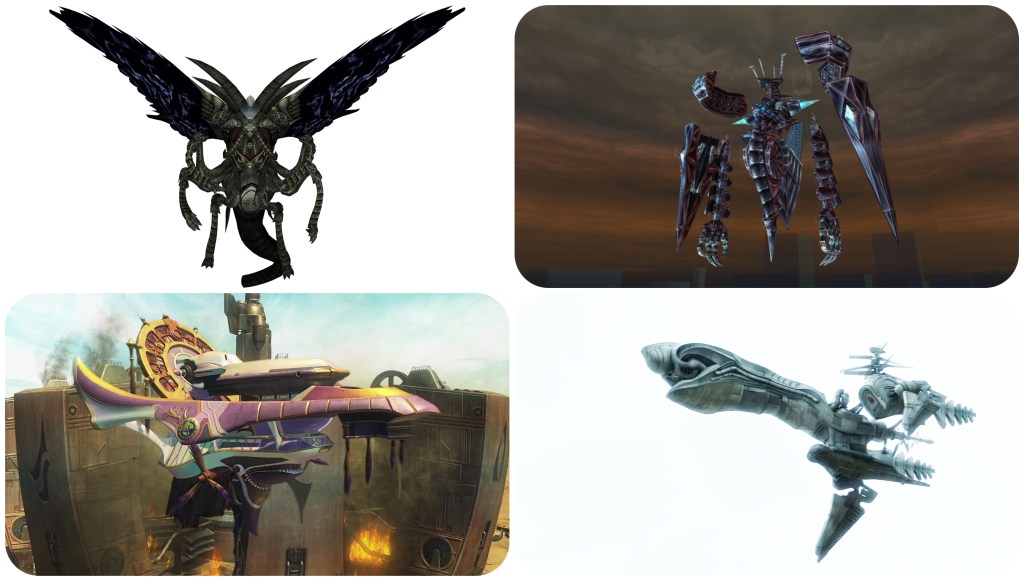
These parallels only heightened when we learn that they do in fact happen under the same universal mechanics. Placing FFX and FFVII in the same universe rose to prominence not as fan theory, but as something repeated by the actual staff that worked on both games. Therefore, people have long noticed that Yunalesca shapeshifts, controls her silver hair (similar to how we find Jenova’s hair all wild at Nibelheim) and has distinctly Jenova-like skulls on her tentacles. In fact, FFVII’s Jenova didn’t especially look like this. It’s Remake’s version that had its face changed to where it now resembles Yunalesca, not the other way around, and this is the same of the redesigned lady at Mt Nibel. Yunalesca even has red, fiery spirit energy like the Gi Tribe. Additionally Jenova’s children the Remnants of Sephiroth summon Bahamut SIN, who very clearly is modelled on the entity from Spira. Now Rebirth has made them look closer than ever before. Near-identical, dare I say.

Aesthetically then, there is a lot tying Jenova to Yunalesca. Did her soul fall into such rancour after FFX that the passing of millennia eventually turned her into the cosmic scourge Jenova? Had Jenova descended upon Spira and infected Yu Yevon and Yunalesca to begin with? These angles are both doable honestly, at least in concept, given how Yunalesca has red spirit aura, while Jenova, the Gi Tribe and Lucrecia can all fundamentally be considered Unsent. Many of Jenova’s attacks are a form of dream that alters physical reality, which is basically the way that Spira’s Aeons exist.
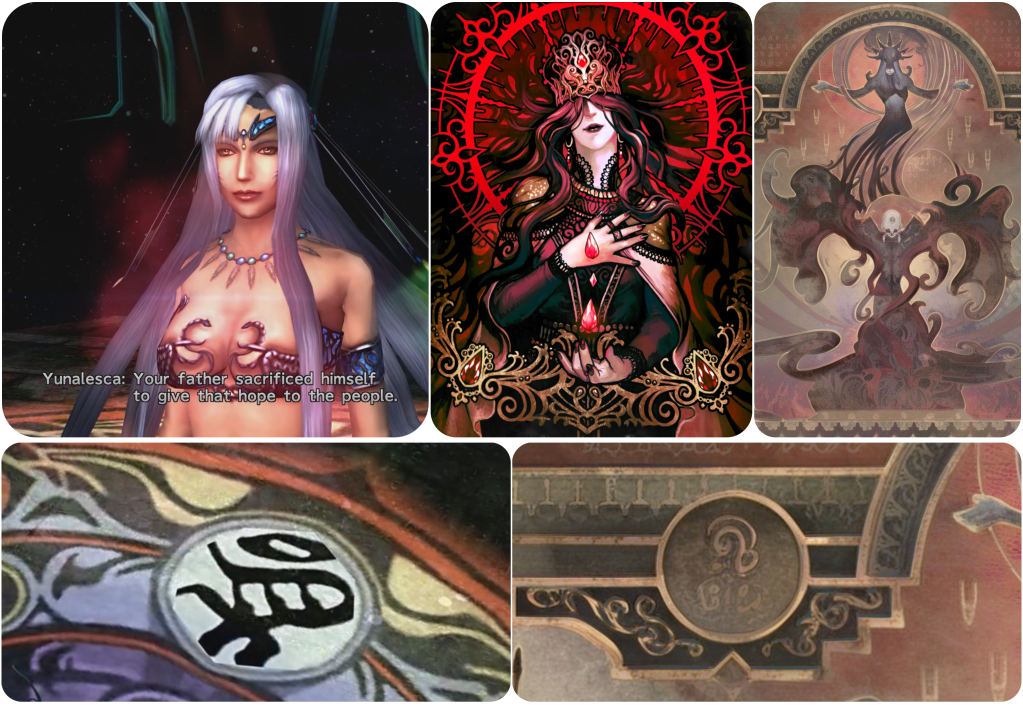
Yunalesca is perpetuating a cycle of sacrifice, and considers it foolish to try fighting against sorrow. Once it becomes clear that the party will not fall in line, she begins to speak like a distant entity, calling Yuna a “poor creature”. This could be because Yunalesca was actually a foreign existence harvesting their sorrow, and ultimately trying to manipulate them into keeping Sin alive. Much like how Jenova has been presented as a creature existing in two main parts, a lady and a beast, Yunalesca might also be part of Sin’s hivemind. Jenova’s manifestations too are perpetuated through the sacrifice of Black Robed invidiuals, and she seemingly preys upon spite and sorrow.
- Yunalesca (FFX): “Your father sacrificed himself to give that hope to the people. So they would forget sorrow. Sorrow cannot be abolished. It is meaningless to try. Poor creature. You would throw away hope. Well…I will free you before you can drown in your sorrow. It is better for you to die in hope than to live in despair. Let me be your liberator.”
- Jenova Lifeclinger (Enemy Intel): “The Calamity from the stars that fell into a deep slumber after its conflict with the Cetra. Newly awakened through the grace of black-robed sacrifice, it seeks to seep its way into the lifestream and bring about the end.”
- Sephiroth (FFVII Rebirth): “The reunion – when worlds merge…when spite and sorrow are harvested to feed the planet!”
- Sephiroth (FFVII Rebirth): “A confluence of worlds…and emotions. Loss, chief among them. It engulfs fleeting moments of joy, transforming them into rage, sadness, hatred. Never have I felt them so keenly.
When was the last time I actually played FFX? 2013, when the HD remaster first came out. So take all that with a heavy dose of salt. I’m sure there must be tons I’ve forgotten since it’s been long enough that I don’t have the full image of FFX in my mind anymore. Being realistic, the answer to both queries about Yunalesca becoming Jenova, or Jenova infecting Yunalesca, is very likely no, but it’s food for thought anyway, and makes for some cool collages. However, the necessary timeframe and her defeat by Yuna’s party probably makes such things impossible. We don’t know at what point Spirans landed on Gaia, only that they developed space travel a thousand years after FFX-2. How that interacts with Gaia’s timeframe is impossible to know. But we do see that an Al-Bhed formed the Shinra Company, based on author statements and photographic evidence present in FFVII Remake. Jenova, however, landed here 2000 years ago, and the Shinra Company certainly is not that old. There’s also a bit of a fallacy there. The Gi Tribe cannot return to the planet, since they didn’t arise from it. But what of the Spirans then? Shouldn’t they linger as Unsent too? Well, we don’t have any confirmation that there aren’t Unsent Spirans somewhere on Gaia, but I’d say the difference is that Spira and its Farplane still exist, while Planet Gi has been destroyed and its Lifestream consumed by Gaia. So when Spirans die on Gaia, maybe their souls traverse back to their homeworld anyway. Aerith does talk about the deceased sometimes coming a long way to try and meet their loved ones before dissipating, we could extrapolate on that to where alien creatures might journey to their own place of origin.
- Aerith (Final Fantasy VII): “Someone dear to you has just died. His spirit was coming to see you, but he already returned to the planet.”
In order to suggest that Yunalesca became Jenova, it’s kind of a prerequisite for her to have also destroyed Spira before departing to space. But I don’t like that idea, since it betrays the sanctity of the FFX IP, and then causes the aforementioned issues with Spiran ghosts who would have no home to return to. Were they the same being, you would probably also have to position it where Jenova either attached herself to or followed Shinra’s spaceship, but I have severe doubts on the timing of that. Shinra’s reason for wanting to explore new worlds was to create an industry using the planet’s spirit energy, so I find it hard to imagine that it took them millennia to establish their Mako empire if they had landed 2000 years ago with Jenova. It’s unknown exactly how old FFVII’s Shinra Company is, but Mako energy was discovered in 1959. It’s doubtful that it would take a technologically advanced space-faring species nearly two millennia to finally extract Mako when they were directly seeking it out, so the Spirans must not have landed together with Jenova. Meaning that despite the immense visual overlap and the fact that these settings are interlinked, Yunalesca is not directly Jenova. We would have to go a step further and say that Jenova, Sin and Yunalesca are all avatars or spawn of an even higher parasitic lifeform…more on that idea later.
Bit of a tangent there because this is just kind of an unholy stitching together of a few smaller scripts I had. In any case, there should be no physical correlation between the woman in the tank and the Gi Tribe. Neither her colour scheme nor her physical features match. In this modern depiction, the only provable overlap in design element is that one Gi effigy’s weapon does seem to share a similar, if not identical, spiral design to the Mt Nibel Jenova’s wings. At this stage however, I think that’s not enough to classify Jenova as a Gi queen or anything. I’d call her Lucrecia, but sooner relent to Cetra than Gi.
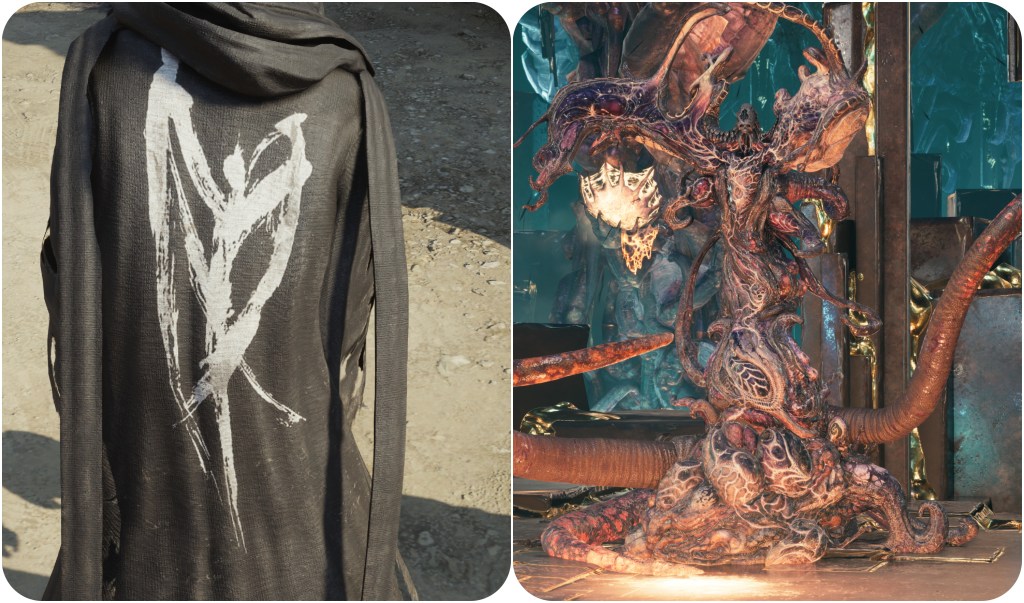
Is the symbol on the back of the Reunion cloak the same as Jecht’s tattoo?
No. The Zanarkand Abes logo, Reunion cloaks, the insignia of Beck’s Badasses, Vincent’s cerberus emblem and the Galian Beast’s chest adornment all look somewhat similar, but that’s totally coincidental.
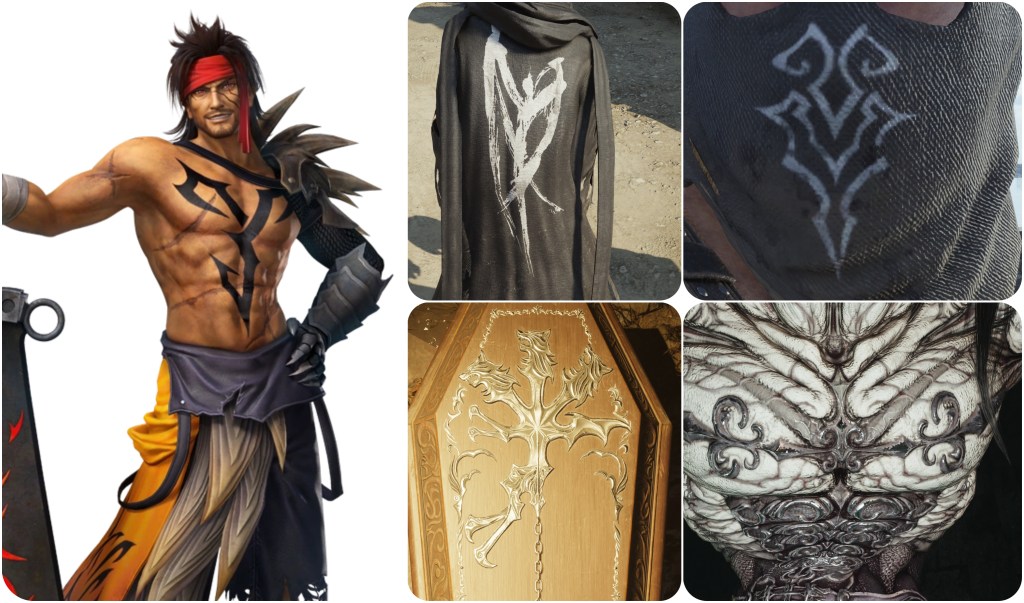
The image on the Reunion cloak is likely just a very loose interpretation of Jenova Dreamweaver’s shape.
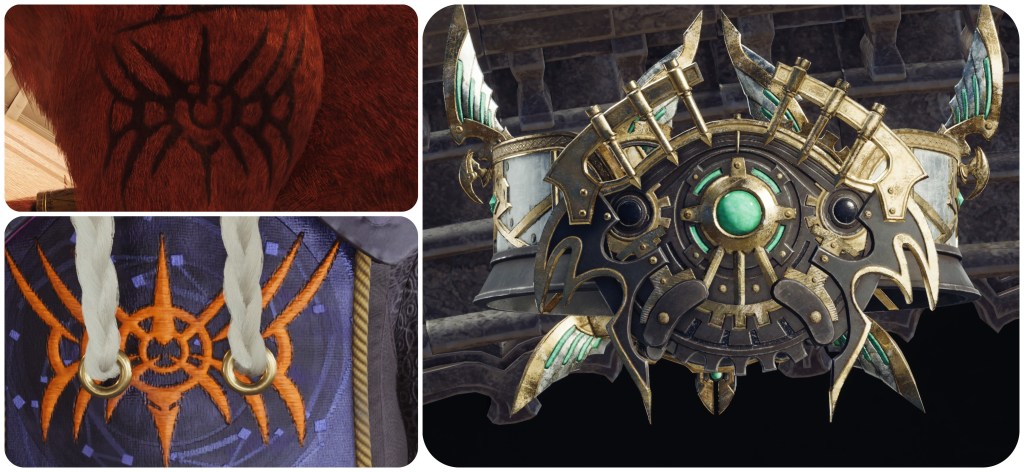
What do the symbols on Bugenhagen and Nanaki represent?
Not a single clue my guy. It looks vaguely similar in design to one of the Cetran armbands, which may account for something. But it’s probably just Cosmo Canyon’s watcher insignia.
Since we don’t know Planet Gi’s actual name, could this secretly be Spira, even?
No, it shouldn’t be. Spira is a secondary planet that we know exists somewhere out there in the distant reaches of the galaxy, and the writers were clearly being cheeky when they had Gi Nattak say “liberate us from this endless dream”, as that line obviously has FFX DNA in it. FFX’s story is all about the endless dreams of the Fayth and how their souls are progressively woken in order to take spirit energy away from Sin.
- Gi Nattak: “Therefore, we ask that you retrieve it – the black materia, key to our oblivion. Please…It alone can liberate us from this endless dream.”
I sort of see the idea where you could use that suggestion to galvanize a link between Yunalesca, Sin and Jenova, or to explain the state of Gi Nattak’s existence in that he would explicitly become considered an Unsent. But the Al-Bhed’s face masks, beige skin, green eyes and blonde hair did not evolve into skull masks, blue skin, pink eyes and black hair over the untold generations which separate FFX and FFVII. Remake directly shows us the Al-Bhed who formed Shinra and he still looks just like his forefather.

We don’t officially have any word on what the name of the Gi Tribe’s planet was. However if we look to other Final Fantasy games for trends or precedent, I would think it a safe bet to dub the other planet Terra. Just as Final Fantasy IX’s home world was called Gaia and its alien partner known as Terra, I would like to administer that name to the Gi’s homeworld as well. This is purely my own assumption, but the name “Terra” will actually become something of utmost importance once I finally begin to hone in on my conclusions. Moving forward, I will be writing “Terra” instead of “Planet Gi”, but do keep in mind that I have entirely made this up myself.
FFVII’s planet is named “Gaia”?
I’ve known it to be Gaia all this time, and never even realised that was a point of contention. Not sure where I first heard it considering the name “Gaia” turns out to have never been uttered in any of the game scripts, but the ffwiki sources some external instances of the name being used. The only two ingame examples are the “Gaea’s Cliffs” region, and the “Gaea Malboro” which inhabit them. Promotional blurbs for Advent Children or Dirge of Cerberus, and intertextual bio stuff like the Final Fantasy 25th Anniversary site or Final Fantasy All the Bravest, cite the planet’s name as Gaia.
The actual scripts of the game only refer to it as The Planet, not Gaia. For what it’s worth, they don’t really refer to it as Earth either. Any mention of “earth” in the Remake series is just referring to ‘earth’ as in the ground, not the name of the planet. Gi and Cetra both speak of calamity visited upon “the earth”, yet they’re referring to totally different worlds.
- Scotch (Remake): “They’re bringing that high-flying house back down to earth!”
- The Cetra (Rebirth): “The meteor shall fall, sundering the skies and shattering the earth.”
- Gi Nattak (Rebirth): “The earth shook, seas boiled, skies shattered, and time stopped.”
I will continue to refer to the planet as Gaia in discussion, since there are more examples upholding this, and that’s just how I’ve always understood FFVII. It’s actually kind of a shock realising how sparse the name “Gaia” really is. I would like to retain this “Terra” idea too since it’s fun, and that necessitates the green planet being named Gaia. “Terra” isn’t needed in order to sustain any of my conclusions, I just like the symbolism of having Gaia and Terra. Ties it up neatly. For what it’s worth even if we do take away “Gaia” and revert it to simply “The Planet”, then the Cetra’s planet and the Gi’s planet do still have another part of their lexicon which positions them as counterparts like the names Gaia and Terra would. We have names attached to their differing soul material, which are counterpart terms. Gaian Lifestream is Anima, Gi Lifestream is Animus. But I’ll discuss that in more detail a few points down.
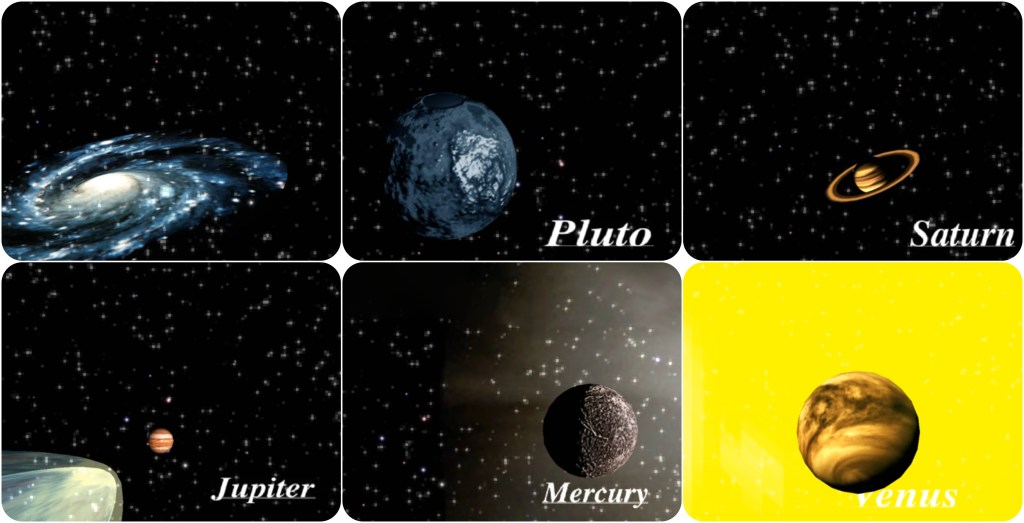
How many planets do we know of within FFVII’s universe?
Ten or so. We specifically know of Gaia and Spira. I’m assuming that Terra was a genuine planet elsewhere in the galaxy too, not just an overlapping plane of spacetime. I’d think those are all in separate solar systems though. There is at least one source of admittedly dubious canon which suggests that Jenova had a genuine homeworld somewhere in remote space as well. Beyond that, models of the Gaian solar system can be found in Bugenhagen’s Cosmo Observatory. The first floor has a small model with five planets, and a large model with four planets. His full-scale planetarium, from what I could identify, features seven planets orbiting around the sun, which aligns to one of the sketches on his blackboard. Gaia, a ringed planet, a dwarf planet and then planets embodying the elements of fire, electricity, ice and what I assume to be water.

The water planet does look strangely like Jenova Lifeclinger and the Twin Brain, but I’m just assuming that to be nothing. Jenova is a deep-space parasite, no shot her home world is just next door. The red one shouldn’t be Terra either.
Sephiroth’s Supernova shows a giant comet plowing through all the planets from our own real life Sol System, but Supernova is an attack existing inside of its own subdimension like the Bahamut summons, and the presence of real planet names is not really to be taken as anything literal. There was one interview where Kitase answered ‘yes’ when asked if FFVII was meant to be our Earth after some crazy nuclear accident, but he was speaking in concept or in regards to its motivations and aesthetic; the world history and stellar arrangement doesn’t support that at all. Just a reminder, our solar system has eight planets and recognises five dwarf planets. Theirs only contains seven, one of which might be a dwarf planet.
The Village of the Gi, Nibelheim and North Crater all share these jagged mountain ranges. Is this indicative of Jenova terraforming the planet?
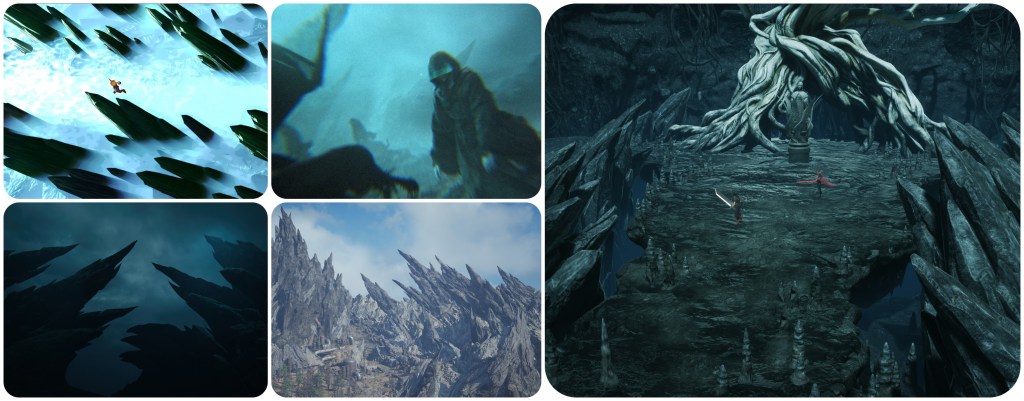
Much as I’d like to say yes, probably not. These jagged rocks are also glimpsed when Tifa falls into the Lifestream, and within the chamber of the Goddess Materia where “reigning deity” Minerva resides. She’s basically the living embodiment of Gaia’s Lifestream, so these rock formations are therefore likely just natural growth in areas of extreme Mako concentration.
What are the roots which appear when Sephiroth draws out the true Black Materia?
It might be the same sort of growth as the big tree in the City of the Ancients, and resembles the roots in the North Crater which are holding Sephiroth’s crystallised body. It also vaguely reminds me of that red material which Sephiroth uses to trap Holy at the heart of the planet. Therefore I don’t think it’s meant be the tentacles of some massive, higher-dimensional Jenova body, or anything of that manner. Hojo does excitedly ask “has it finally begun” when he sees Sephiroth spread this structure and summon the Black Materia, which could point it in the direction of Jenova’s Reunion, but that’s a big claim about the future trajectory of FFVII Remake’s Jenova which I cannot comfortably make without Part 3. What kind of material this is composed of, by what mechanic it manifests or what reality interaction its appearance is indended to signify, I haven’t managed to get a genuine read on. We don’t know enough about Remake’s Reunion or Black Materia yet.
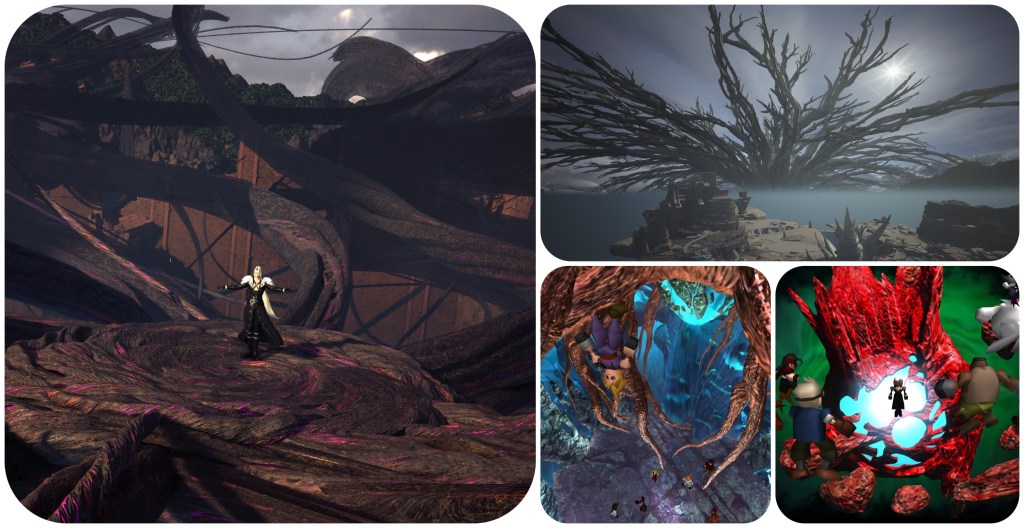
Dirge of Cerberus does inform us that Hojo’s ultimate plan is to escape the planet after merging with the Omega Weapon, and we know the digitization of Weiss seen in Intermission to be part of that process. The way Dirge recontextualises things, Hojo injecting himself with Jenova cells atop the Sister Ray is an attempt to gain her assimilation abilities in readiness to take over the Omega Weapon. Therefore, his endgame plans are already beginning to move at this early stage. It’s possible to interpret Hojo’s exclamation in reference to this, where maybe he’s excited to see Sephiroth gaining access to world-breaking magic that he believes will likely induce Omega’s manifestation. That’s just an alternative option though, I do think Hojo mainly just recognises this as part of his theories on Jenova’s Reunion.
Are Jenova and the Gi Tribe related?
I’m trying to arrange this as sequentially as I feasibly can, but some conclusions are impossible to convey without either skipping forward or looping discussions around on themselves. So it’s here that I must begin to reveal my position. Yes. Although I had originally written most of this post concluding to the counter due to two of the most core overlaps in their imagery that I feel fall short (Gi Nattak’s colour scheme & Meteor), I’ve now become convinced that they share some connection. There are one or two pieces of information we need to bend in order to achieve this, but the line of thinking which I have arrived at after properly working through my findings is that the Gi Tribe and Jenova are linked in some manner, whether biological, historical or cultural. I think that it requires some theory, some conspiracy, some blind assumption, but I have a scenario that I like now. It might not be the simplest interpretation, but I believe that I can explain and then support it based on the imagery in Rebirth and how it interacts with some symbols from the original Final Fantasy VII. Jenova and the Gi Tribe surely have a preexisting cultural connection before coming to Gaia, and have almost definitely shared some degree of prior genetic contact. Rebirth Jenova’s colour scheme means that it is not as simple as just claiming them to be the same species, but I believe that we can make this work nonetheless.
Perhaps the Gi are not her direct descendants or native people, as that would betray Jenova’s unknowable cosmic identity, but has she influenced their evolutionary history?
For reasons that I’m still working my way toward, I have come to feel that Jenova must have had a significant impact on their biological or social evolution. I’d say that this is where the Lavos inspiration in her concept design is being brought back in full force; That Jenova was hiding on their planet for, say, 65 million years or so while steering the growth of life on their world and drinking of their Lifestream.
There are still plenty of other elements to the FFVII scenario I must first introduce, but I did mention Lavos, right? Let’s do that then. Let’s implicate Jenova’s history through comparison. Not to Lavos, or at least not yet, but to Deus. Gentlemen, it is time for your 10am Xenogears lore dump. Well, well, well, yet another stalled script finds itself just kinda grafted onto this Gi Tribe megapost. Xenogears o’clock indeed. While my original plan was to title that post “Finding Xenogears in Final Fantasy VII’s Remakes” if I ever published it, for this focused subsection I would now instead title my essay “Final Fantasy VII Rebirth: The Animus and the Mother”. I do see the Gi Tribe having a symbolic exchange with a particular group and their storyline from Xenogears, and these parallels can be used to A) solidify some evolutionary oversight from Jenova, and B) explain something which I noticed the Gi using in my first Rebirth playthrough and have been trying to mentally situate ever since – Animus.
If Jenova had created, or even just influenced the evolution of the Gi Tribe then there would actually be a really awesome Xenogears reference in it, which is something that I have personal biases in favour of. First point of context is to introduce that FFVII and Xenogears are two sides of one coin. The story goes that after Chrono Trigger, Square had opened up for staff to submit their suggestions for the upcoming seventh Final Fantasy. Tetsuya Takahashi and his wife Soraya Saga sent in their idea, which kind of continued the themes of ancient DNA aliens from Chrono Trigger. If you know anything about his work, you know that this type of iteration and homage becomes Takahashi’s calling card. Their pitch got approved and was put in use for a period of FFVII’s development, before the people in charge decided that it wasn’t actually appropriate for the Final Fantasy series due to its tone, content and length. Xenogears, infamously, is really quite long and heavy on the reading, especially for a PS1 RPG. This story concept was next temporarily in use for Chrono 2, then swapped again to finally become Xenogears. However, it was still used for a period of all their developments. Chrono Trigger, FFVII, Xenogears and Chrono Cross all therefore have a lot of connective tissue in their character archetypes, plot developments, themes and imagery.
Lavos, Jenova and Deus all crash to the planet from space, leaving a large impact crater behind. The creatures then hide themselves away to begin harvesting the genetic information of the people on the planet over thousands, if not millions of years.

All three share the key imagery of the woman in a tank, and evolve through similarly-shaped forms. Namely a round one, a tree-like form and a humanoid. Among numerous other parallels.

At every turn you can see connection in FFVII and Xenogears. Their main protagonist and main antagonists essentially both have the same arc told in minorly different ways due to a shift in setting and style, or there are direct references like a catatonic Cloud mumbling lyrics from Small Two of Pieces and a poster of Tifa hanging somewhere in Solaris. But like it runs deep throughout every part of both games. Any comparison you make between them carries a certain level of authority because they are genuinely two outcomes of one idea.
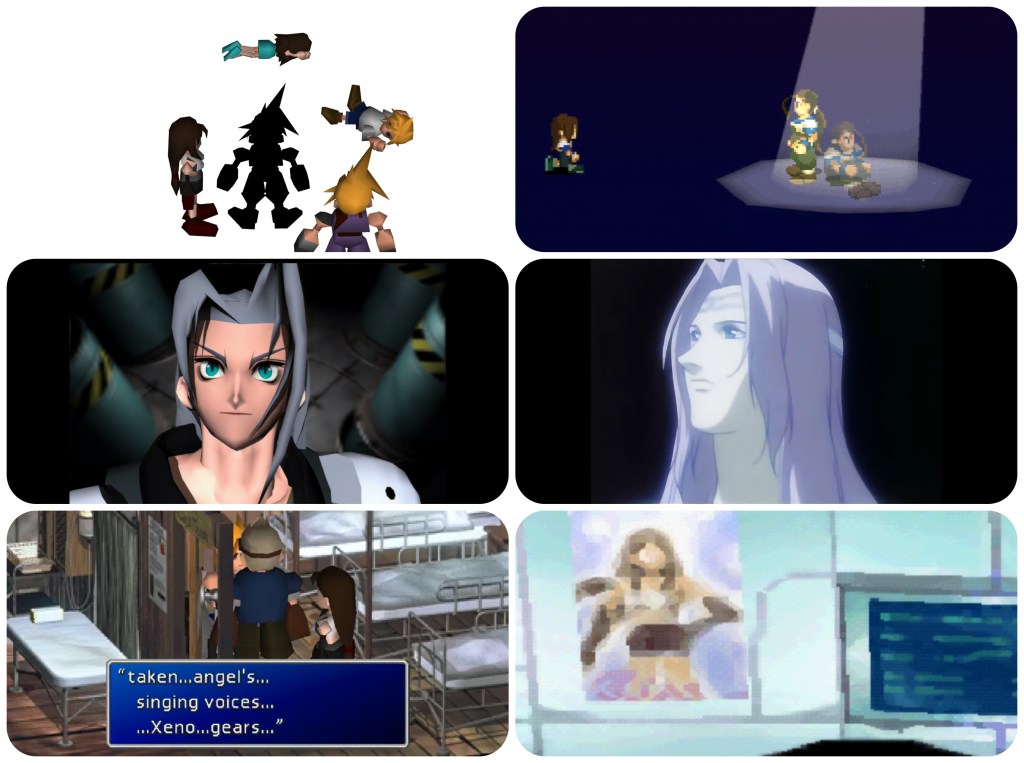
Where this becomes relevant to the theory of Jenova possibly producing the Gi Tribe is that in Xenogears the Mother of Humanity creates the twelve original human men out of the Kadomony supercomputer’s biological circuitry named Animus. There are twelve male Animus who seek to locate their accompanying female Anima, whereupon they could recombine with the supercomputer and enable the interplanetary bioweapon Deus to be resurrected. The Gi likewise seem to be an all-male tribe of warriors, and the Gi Spectres use a move called Animus where they empower themselves further with their red miasma (they didn’t have this attack in the original FFVII). The red miasma which their Enemy Intel specifically highlights. You want to know something that’s just kinda neat? One way of reading Xenoblade Chronicles is that supercomputer core Pneuma processes green and gold Anima ether, while supercomputer core Logos processes purple and red Animus ether. Logos is eventually summoned in the form of Malos, who is himself Sephiroth-derivative. Hmm.
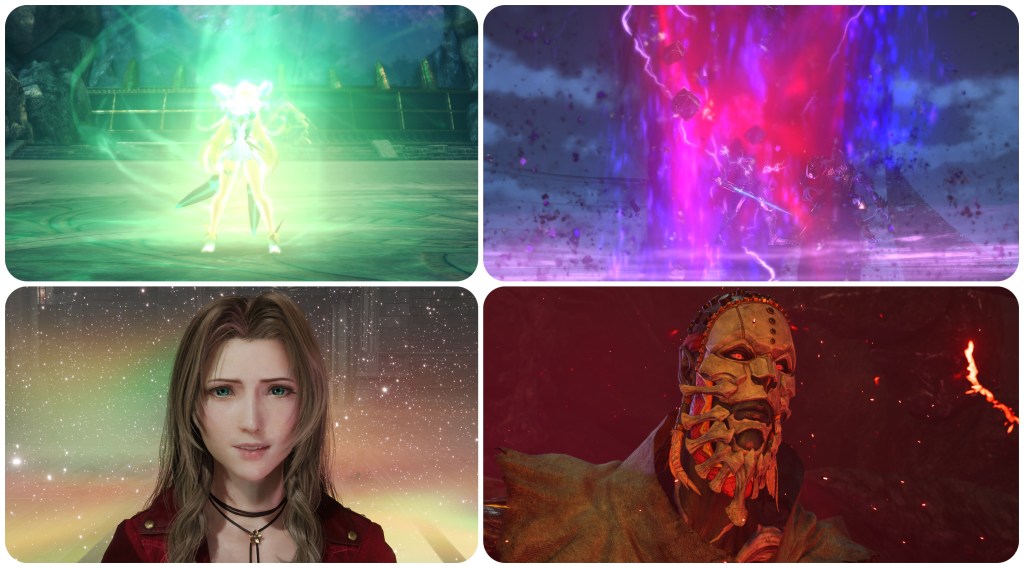
In fact there is Trinity Processor-esque imagery found in Cosmo Canyon that I wanted to joke about at some point. A similar motif appears on the ground of the Gears & Gambits subspace, and there are distinct green, red and violet Lifestreams floating in the underground river outside the Village of the Gi.

The Xenoblade things are just observations, but the Xenogears Animus parallels carry genuine implication due to the shared history it has with the FFVII property. You can use Xenogears to piece together equivalent setting details of FFVII, and vice-versa.
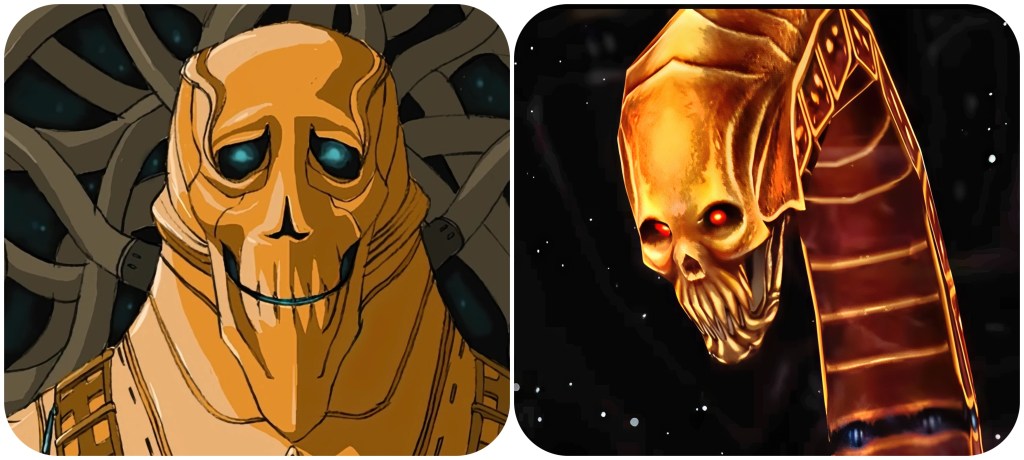
I believe that you can draw some rather strong parallels between Cain (leader of the Animus), and Gi Nattak. They’re primitive or tribal leaders from a time of antiquity, whose people are associated with the term “Animus”. Both wear distinctive skull masks.
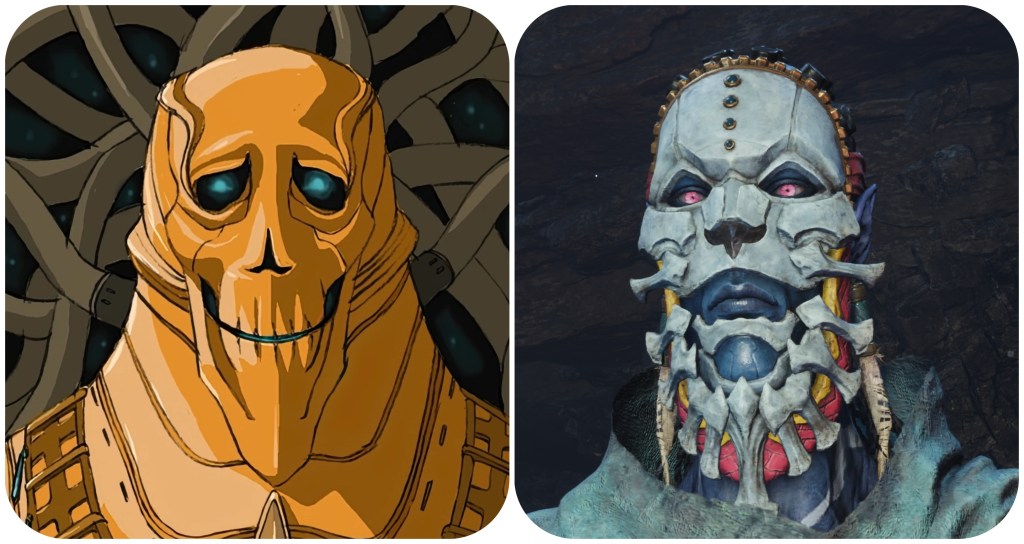
Cain is connected closely with the Mother of Humanity and Deus, whereas I’m here trying to determine if Gi Nattak is connected to revenant mother Jenova. Cain proclaims “we are the people expelled from paradise and forced to live on the cruel surface of the earth”, Gi Nattak laments that the death of his home planet has left the souls of his people stranded upon an unwelcoming world, considering their immortal toil “a penance imposed by the planet for the sin of our existence”. You can definitely see the Animus in what he’s saying.
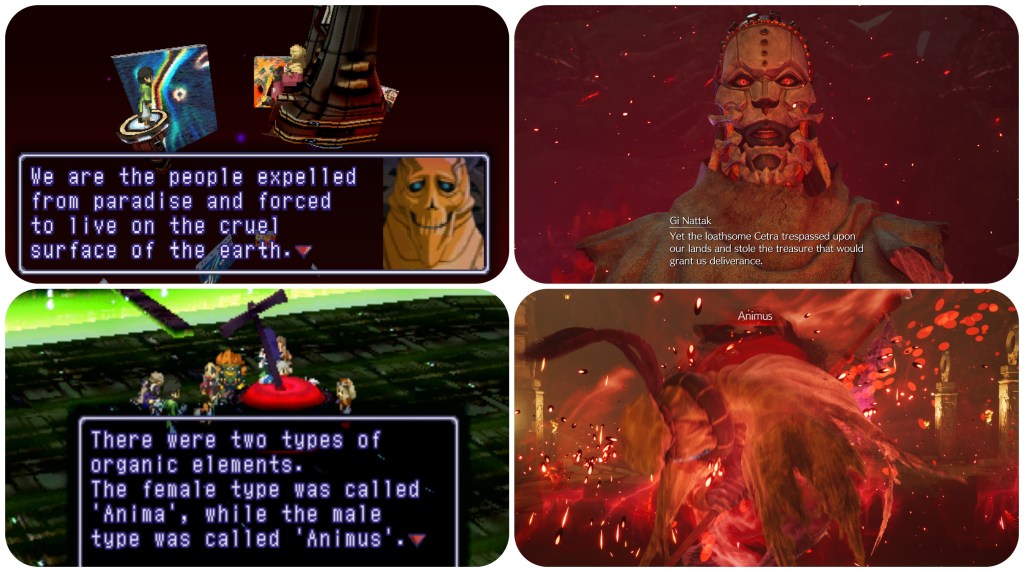
Cain’s storyline centres around the Mother of Humanity and Deus. Jenova, meanwhile, is FFVII’s analogue to both of those beings. It’s of particular note that the Jenova Doll and Deus both share that blank, mask-like face. Rebirth even removed the lines from the Jenova Doll’s face so that it now better matches to Deus. There’s a key shot of the Mother within Kadomony’s tube compartment that resembles Jenova in the Mt Nibel tank. Deus, to whom the Mother is linked, and whom shares its grey face with the Jenova Doll, is also found in a blue tank at some stage. Krelian, who is Sephiroth’s counterpart character, learns of the Mother’s existence and the fact that she has extraterrestrial origins. This inspires him to exceed his human limitations by traversing the Path of Sephirot through to God’s dimension. Sephiroth meanwhile believes that the extraterrestrial Jenova is his mother. This eventually inspires his decision to replace his lost human identity by becoming God instead, and Rebirth even gives him access to a world-tree space we could reasonably dub the Path of Sephirot.

So the decision to give the Gi access to Animus is a rather deep-seated reference to Xenogears, and could be used to implicate them as Jenova’s children. Or if not her progeny, at least that the planet Terra may have held a preexisting worship of her. Again, I don’t think she engineered their entire race per se, but she absolutely spread her mutagen to them before arriving on Gaia.

The two entities have further similarities across multiple transformations and even their boss music. J-E-N-O-V-A and Awakening both begin with the same rolling scales, and both honestly sound pretty inspired by Lavos Core.
Not only does FFVII Rebirth now have these Animus men, but in addition it’s actually also made Jenova seem more like an artificial bioweapon than ever, with the laser blasts that Lifeclinger shoots from her wings. Those look less like magic beams and more like spaceship lasers. At this stage I am genuinely pretty serious in treating Jenova as a fragment of Lavos until explicitly proven otherwise, but in this way you could perhaps also legitimately implicate her as a Deus-type bioweapon too. The Animus of Xenogears want to recombine with their Anima to resurrect Deus. Sephiroth in FFVII Rebirth wants to use the Black Materia created through Animus to ultimately make whole his fragmented mother. The parallels are there.
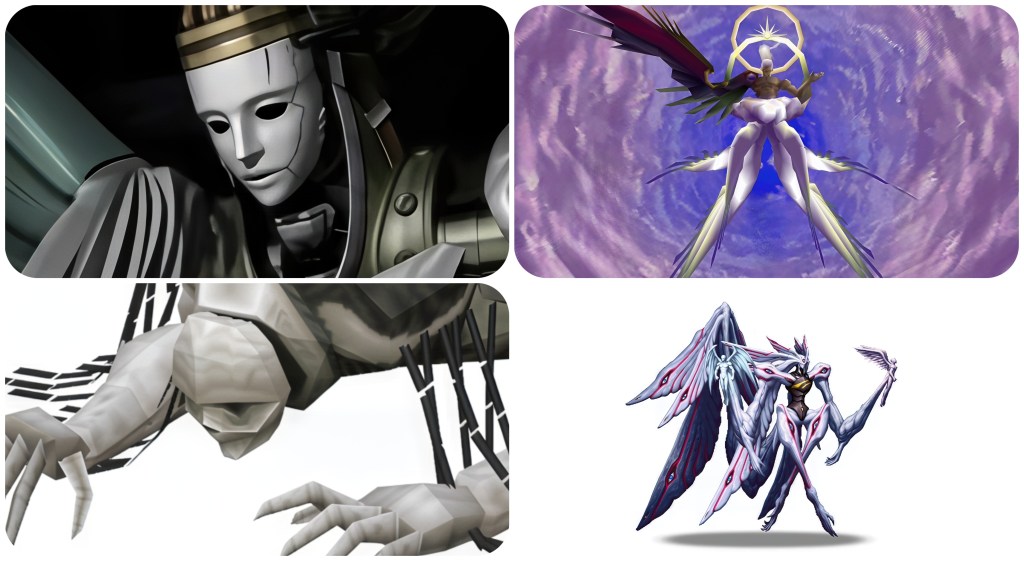
If we say that Jenova bears some genetic responsibility for the development of the Gi, just look at what we can do with it. It agrees with Xenogears on every level of the Animus and mother imagery overlap. FFVII Remake has really upped its Xenogears DNA in lots of areas – kabbalistic divinity and phenomenon phase shift all throughout – so I am going to assert that the Gi Tribe are one of them. By wielding the element of Animus, by resembling the skull mask of Cain, by lamenting the day in which they were expelled from paradise, I will claim that Final Fantasy VII Rebirth has deliberately made the Gi Tribe a story element analogous to Xenogears in order to hint toward their own origins, and peek into the larger interplanetary history of Jenova.
Not that it necessarily matters at this stage of separation, but I will also point out that Yunalesca’s Jenova-like tentacles are also the spitting image of Cain’s skull mask, with the golden colour and glowing eyes set inside dark holes.
We’ve identified Animus, what about Anima?
There is a single species of enemy throughout FFVII Rebirth which we can find empowering itself with Anima actually, and it’s just the right one needed to where we can extrapolate those claims out further: The Joker fiend in Gus’ Beast Battleground, described as a cursed jester who feeds on souls.
- Joker (Enemy Intel): “Gus’s cursed ace-in-the-hole: an evil jester that has bathed itself in the blood of its enemies. It feeds on the souls of its opponents while drawing cards that foretell the future.”
Joker repels you with “Anima Howl” when pressured, and at low health it buffs itself with the attack “Anima Unleashed”. Both the Animus and Anima attacks are new for FFVII Rebirth, neither the Gi Spector nor Joker had these moves in the original game. So these aren’t leftover relics, but new additions asking to be read into.
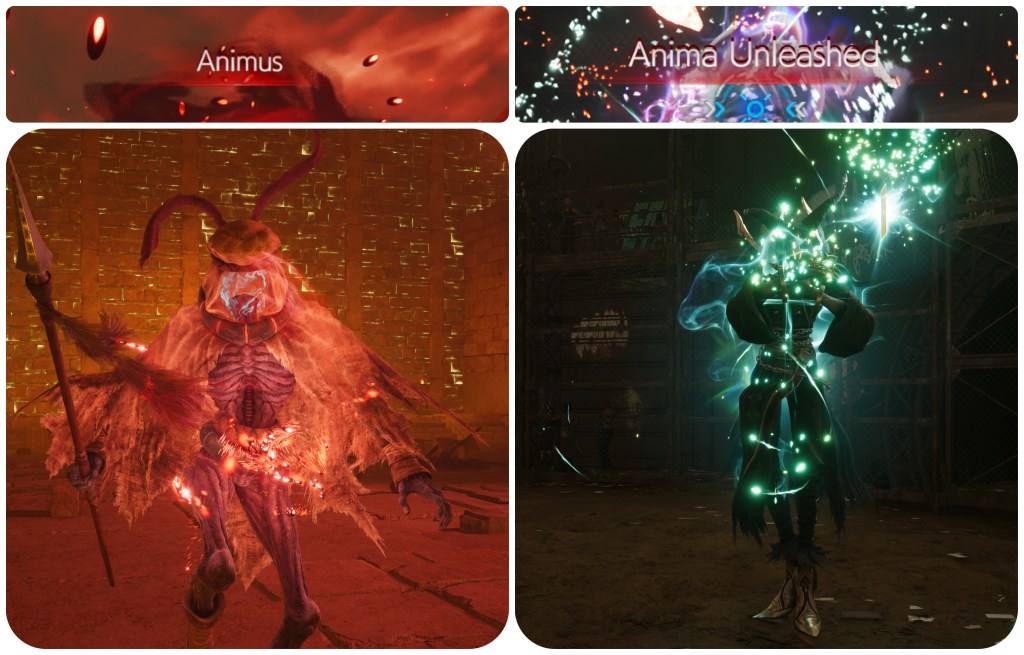
I’ve honed into Animus as being Terra’s Lifestream energy, so what is the Anima referred to here? As expected, it appears to be the name of the Gaian spirit energy which Joker extracts through its Soul Sucker attack. Neither Gi Nattak nor Aerith’s Soul Drain pull out this green energy, but those might functionally be different since they’re absorbing MP instead of legitimate soul energy. When the fiend becomes pressured it then uses the souls it had stolen in order to envelop itself in a green miasma, similar to the Gi’s red Animus miasma
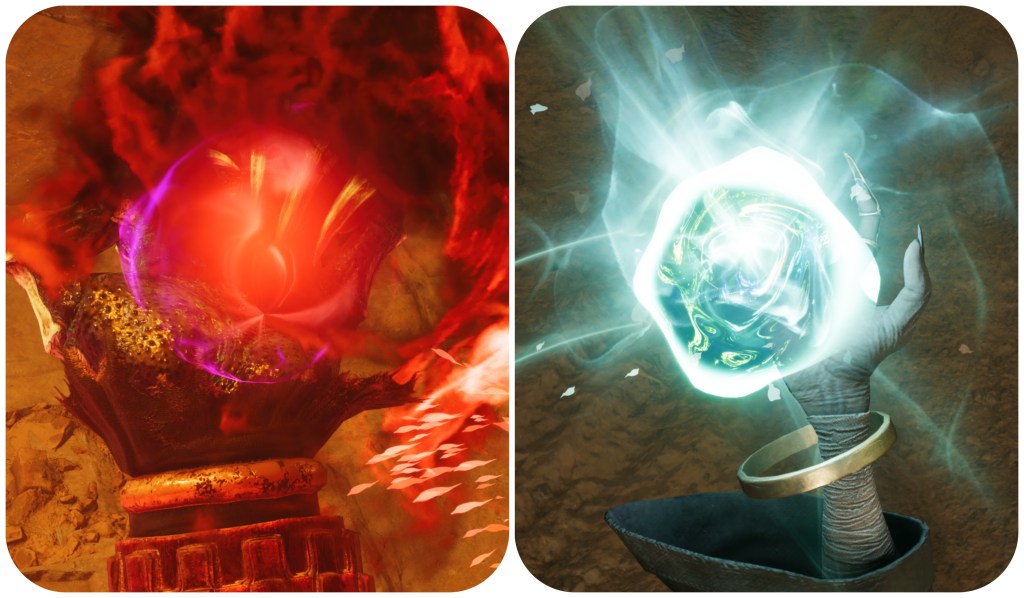
Interestingly, Joker takes this Anima spirit energy and imbues it into its various cards. We could potentially connect this to the way that the Shadowblood Queen’s Animus spirit energy was embedded into her Queen’s Blood card.
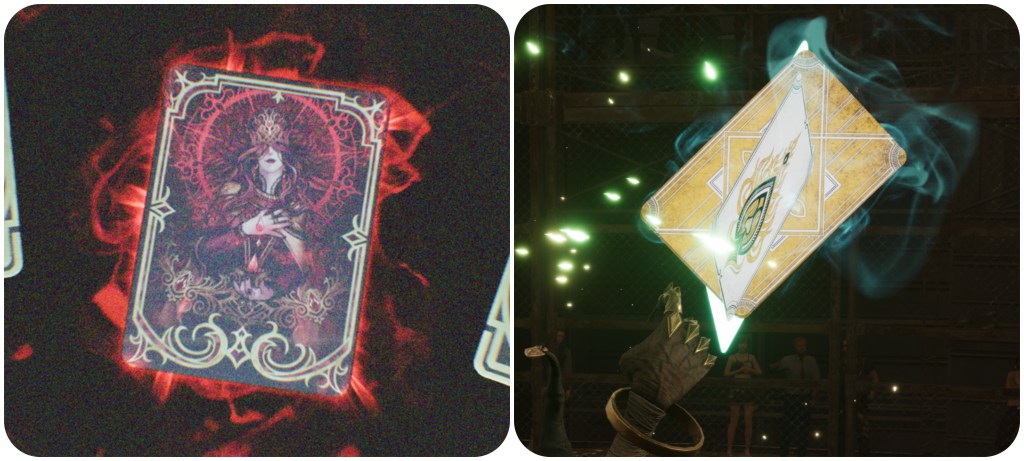
With that said, while the Gi have displayed the power of Animus with legitimate, multitude reasons to symbolically link it back to Xenogears and thus use it as implication of the tribe’s potential connection with Jenova, the Anima miasma glimpsed within FFVII Rebirth is a bit less supported due to not functioning in the same way. Just to reiterate, Animus and Anima are the gendered biological circuits of the Kadomony quantum computer which it employs as part of its deliberative process when responding to queries and requests. Animus is the destructive, male-coded logic route, Anima is a protective, female-coded logic route. With that gendered criteria in mind, I’m not sure the “Anima” representative makes sense. The Gi Tribe seem to all be men, but Joker does not present female. I considered if Joker may be a heavily clothed Gi woman, but this isn’t the case. We can spot ashen skin visible on its hands and chin, instead of blue, and it has sharp fingernails. None of those traits match the Gi. The 1997 Joker design did have a tusked mask akin to Jenova and the Gi, but they’ve retooled that for Rebirth.

The more problematic element though, at least as far as a 1:1 parallel is concerned, is that in Xenogears, Animus and Anima are both components of the Deus System. The Deus equivalent in FFVII is Jenova. If we go all-in on the parallels, this would mean that Gaia needs to have some origin in Jenova’s genetic material as well, which it doesn’t. The Cetra muse that Jenova may have been the one that motivated the humans to wipe them out, but that’s not enough to tie all life on the planet back to Jenova, especially not when she only made contact 2000 years ago. Nevertheless, I do like this reading where Animus is Terran Lifestream and Anima is Gaian Lifestream. Hiding this terminology within FFVII Remake’s setting like this is just one way of galvanizing a link between Jenova and the Gi Tribe, since it helps to confirm that their red spirit energy is a distinctly different substance to Gaia’s Lifestream.
I did go through and double-check what colour of spirit orbs Joker fades away into when defeated, just to check whether it’s green, red, purple or whatever, which was not easy since the only encounter with the multiple Jokers needed in order to view one dissipating is the non-repeatable Ultimate Party Animal quest, meaning I had to do a lot of sidequesting to get back there from Chapter Select. Joker fades away into white orbs. I’m sure that I noticed a small few other enemies with no colour to their Lifestream throughout my Rebirth playthroughs, but the only ones I’ve managed to conclusively turn up while working on this blog post are the Gi Tribe’s ceremonial Two Face mask, Hojo’s R&D creation the Adjudicator, and the Panthera Protector. I did check other things which I thought might fall in this group such as the Stone Golem or Ironclad, but they had the standard green. Even Tonberries have souls apparently, and the Black Robes die green with just a hint of purple. My sample size admittedly is lacking since it’s hard to try and locate every enemy to double-check them, but I would therefore think that the blank colouration indicates either a homunculus or soulless lifeform. That seems like a relatively safe reading to me. Things which have form and have life, but no genuine soul of their own.

The Two Face and Adjudicators make sense, but why do the Panthera Protector and Joker have white spirit energy?
You could sustain an argument that these two fiends are those existing closest to Jenova, due to mutation and Anima soul-draining. That second part is probably why the spirit orbs are white. Jenova is not only a physical mutagen, but also a spiritual parasite. We see that the Black Robes have purple energy alongside their Gaian green when they fade away. This is evidence of Jenova attacking not just their flesh, but their spirits as well. Therefore, the Panthera Protector may have been fully drained of all its Anima, leaving only an empty spirit behind.
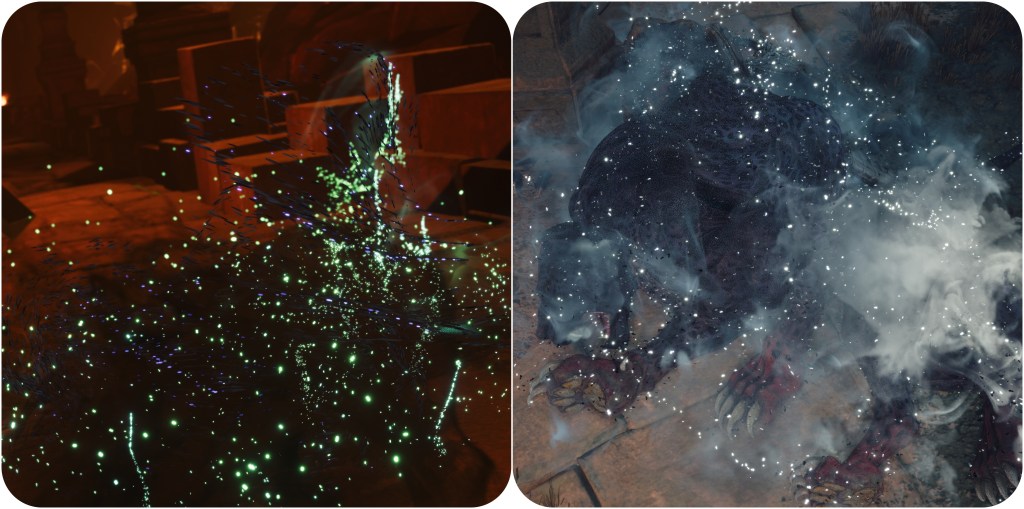
Animus, Anima – is there maybe one more Kadomony element we could assign to the purple Lifestream that we see outside the Village of the Gi?
Look, not especially. If we’re trying to symbolically compare this to Xenoblade then you would obviously just assign these as Ontos, Logos and Pneuma.
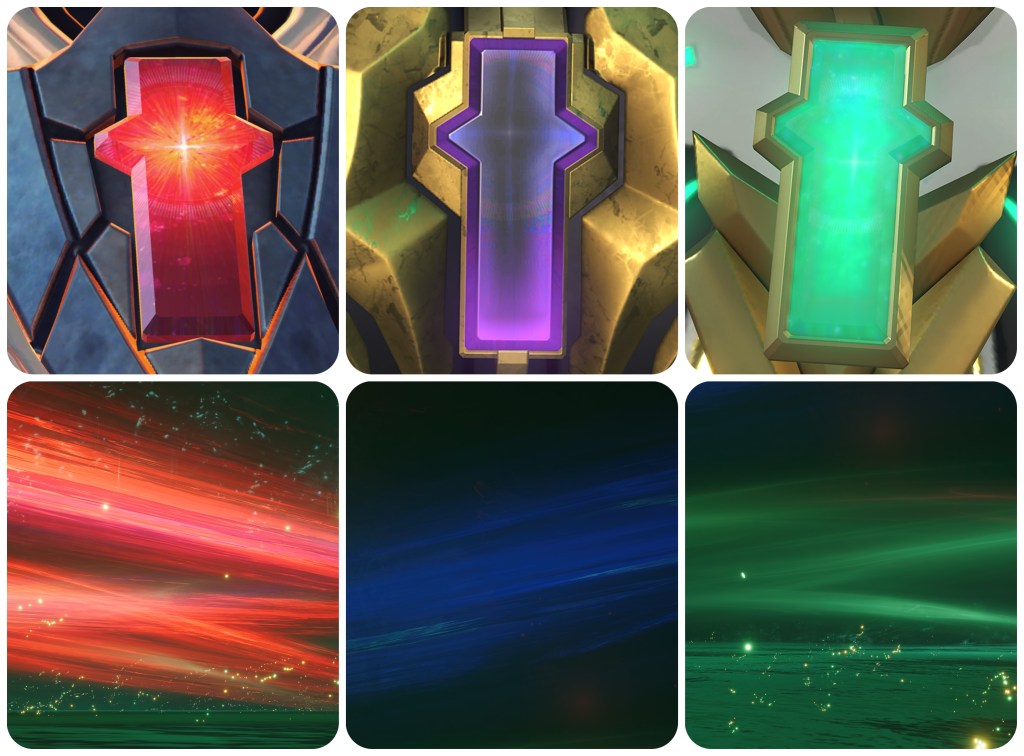
However while Xenoblade’s Trinity Processor is tantamount to Xenogears’ Kadomony quantum biocomputer, as both are supercomputers that use a golden monolith to rewrite spacetime based on the consensus reached by three deliberative elements, they aren’t quite 1:1. To explain the details in full is genuinely, truly off-topic and I’ve gone through this before in a different video anyway. The short though is that the Trinity Processor has three artificial intelligences which debate any given prompt, while Kadomony has three types of deliberators across two chambers of discussion. Kadomony has a fullerene quantum computer calculating ideal answers on one side, then the other half has biocomputer circuits of twelve male Animus and twelve female Anima debating to reach a consensus. That chamber’s answer is then weighed against the fullerene computer’s in order to decide upon the course of action. While absolutely analogous to one another as both are the final machine arbiter in the decision-making process that depend on the gendered emotional cores to stabilise their own computer brain, Kadomony’s fullerene quantum computer is not a distinct AI entity in the same manner that the Trinity Processor’s Ontos is. So the last of this Lifestream trinity cannot be the equivalent of Ontos or the quantum computer in order to complete the Kadomony trifecta. The colour schemes would begin to stray a little as well, since Ontos is red and Logos (Xenoblade’s version of Animus) is violet.
The elements which comprise Kadomony are the fullerene quantum computer, the twelve Animus bio-circuits, the twelve Anima bio-circuits and a central pod system called Persona which the computer can use to artificially grow a living human body – the Mother of Humanity. Persona / the Mother have purple hair when they first land on the planet, and the remaining Lifestream needing identification is purple. This could be used in conjunction with the Animus arguments to galvanize the idea that Jenova, who is equivalent to Deus and would be equivalent to the Mother, was some kind of progenitor to planet Terra. Once again, this does begin to veer though as the Gi Tribe have red spirit energy, and it’s the presence of Jenova also having red spirit energy in many key moments that makes me believe it’s worth trying to link them in the first place.
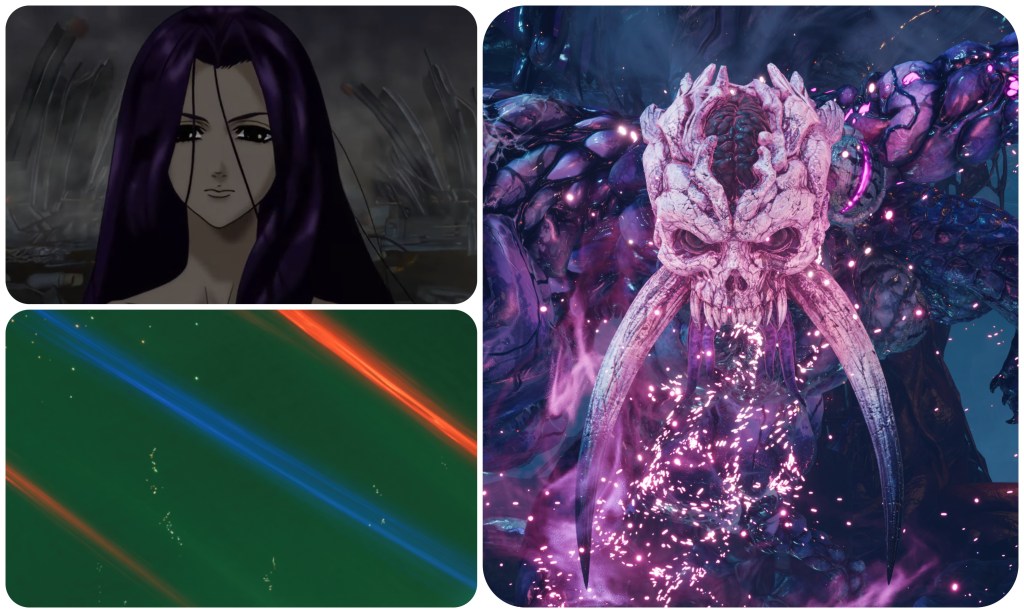
Regardless of the symbolics or the specifics, I do think that this third stream is likely to be indicating Jenova’s presence within the Lifestream though. While Jenova does frequently feature red spirit energy, it’s unclear if this is her native colour or if she began displaying the tint after eons spent consuming Terra’s Lifestream. If not her, then it may also be indicative of the subworlds which Zack and Sephiroth are journeying through. Green is Gaia, and accepting red to be Terra, then the presence of this third violet Lifestream may be why Aerith begins seeing into World B when hanging her hand in the stream. Could be either, could be none. So, seriously speaking – I cannot place that blueish purple Lifestream yet. I have multiple interpretations, but no genuine, concrete answers about Jenova’s ties to the Gi Tribe and what we may discern of their spirit energy colourations.
Therefore my off-kilter answer would be that while Green is Gaia and red is Terra, we could look at this bluish stream, most likely related to Jenova, and tie it back to Chrono Trigger’s blue Time Gates to further strengthen the idea that Jenova is a Lavos spawn, since Jenova Lifeclinger and a Varghidpolis variant called Twin Brain both have some kind of blue internal electricity visible. Suppose that’s their own native spirit energy for a second. Chrono Trigger is known to have a kind of planetary consciousness which governs these circular spacetime gates, and for all intents and purposes we could term that a Lifestream.
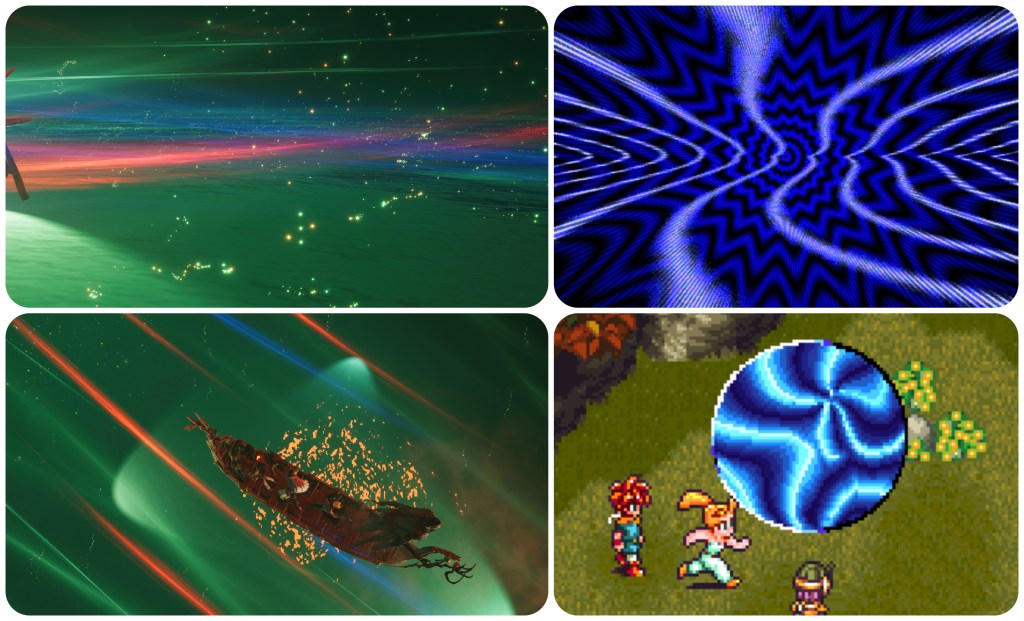
Animus aside, why is the red miasma considered important?
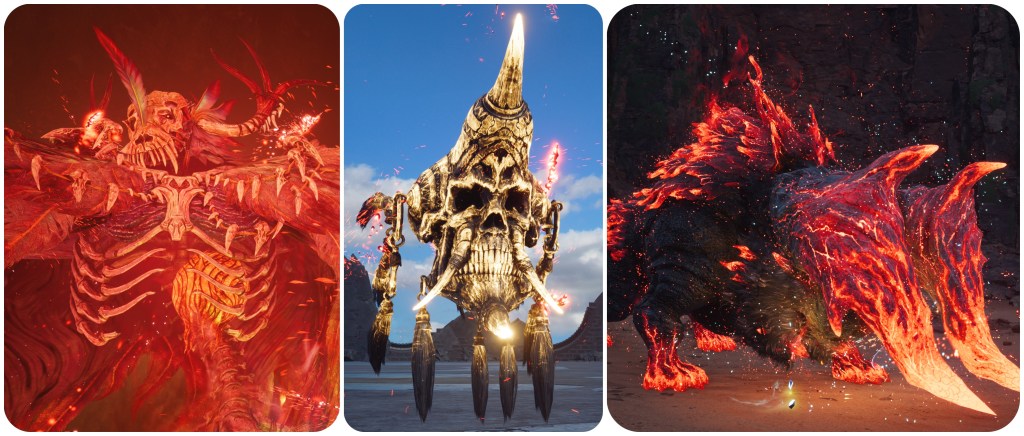
Here are some relevant excerpts of Enemy Intel:
- Gi Nattak (Enemy Intel): “The leader of the Gi, a people who were driven to extinction and cursed to roam as spirits, rejected by the lifestream. He and his clan have been sealed in an underground cave, left to fan the flames of their hatred and the red miasma that envelops them.”
- Soul Flame (Enemy Intel): “Enkindled spirits of the Gi, summoned by Gi Nattak. They will unleash a curse once they find a statue to possess.”
- Irasceros (Enemy Intel): “A large, herbivorous beast that has been possessed by a spirit of the Gi. Highly aggressive and shrouded in a scarlet miasma, it bellows in pain and anger as it destroys everything in its path.”

Gi Nattak’s red miasma is given particular attention and tied back to his tribe. He also uses this to enkindle the Soul Flames. The Gi Spectres fade away into red particles, whereas beings native to Gaia dissipate into green. There’s even a sidequest where some Gi Spectres breach containment, using their red miasma to aggravate Gaian lifeforms. The Enemy Intel of the possessed Irasceros again specifically calls out the scarlet miasma. The Gi’s red Lifestream is therefore given a very particular focus. We fight Gi Nattak, whose Enemy Intel specifically mentions his red miasma. We converse with Gi Nattak, who has red spirit particles. Immediately after this meeting Sephiroth’s haze has a tinge of red in it for the first time. We depart for his village, whereupon the game shows us red, green and purple as distinct, separate streams. The red Lifestream appears alongside the Gi once more in the Hall of Murals. That progression of imagery is clearly saying something, right? The game seems to have made rather specific implications during the scenes with Gi Nattak. It feels like they’re saying it’s something more, and I want it to be something more. Even the meteor logo at the title screen has begun to turn red in Rebirth!
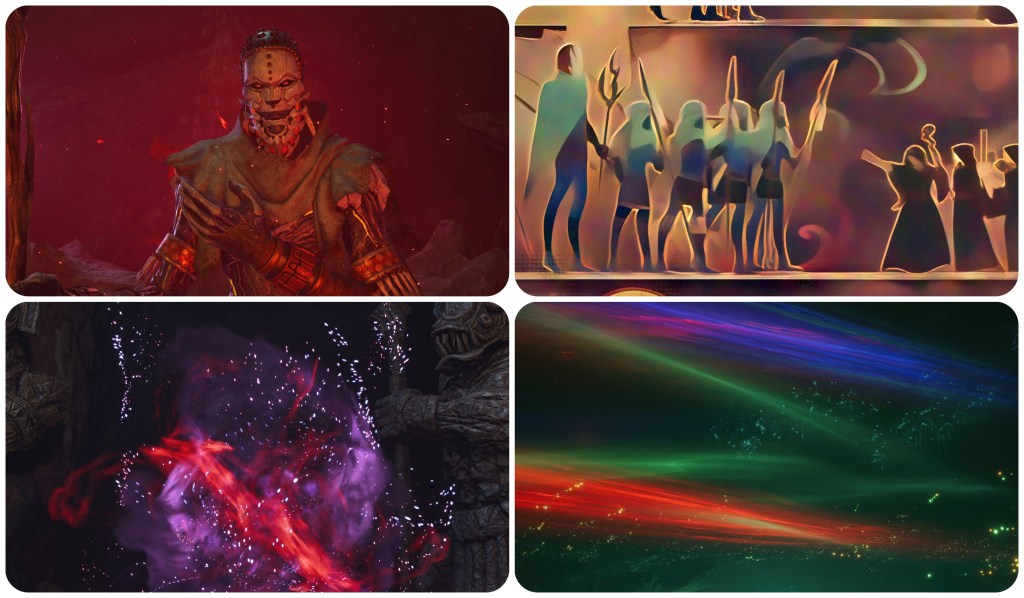
If the Gi’s spirit energy is supposed to be red, why do the Soul Flames exhibit several other colours?
If you let Gi Nattak’s Soul Flames linger for a bit, four of them will start to glow in red, purple, green and yellow. After a little while they use the move “Possession”, where they blast you with a purple Fira spell and then sacrifice their coloured energy to Gi Nattak. He uses this to charge his Execration of the Gi field spell.
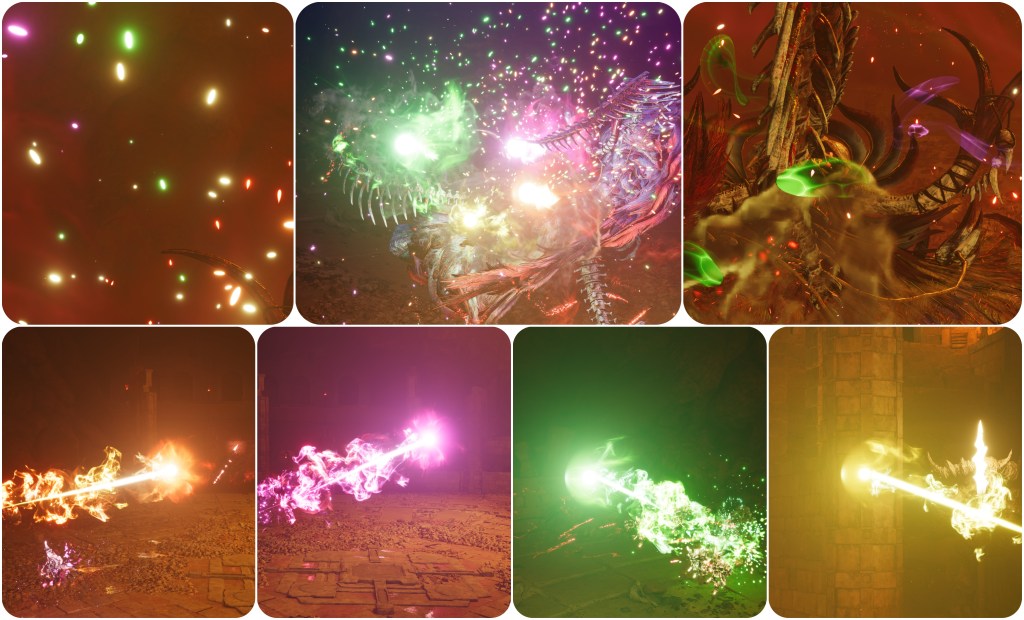
There are multiple possibilities for what this might mean. The first of which is that this is just magic, not spirit energy. It blasts out of the Soul Flames with this fiery trail that matches neither Animus nor Anima. The coloured flames are the same as the four debuff icons which appear on our status bar. Since the magic system of Spira’s Lifestream is so different to Gaia’s, it’s possible that these skulls may be Terra’s equivalent to Materia, or it might be that such sinister sacrifice is the only way for Gi Nattak to access Materia-like magic since his own Lifestream is long-dead.
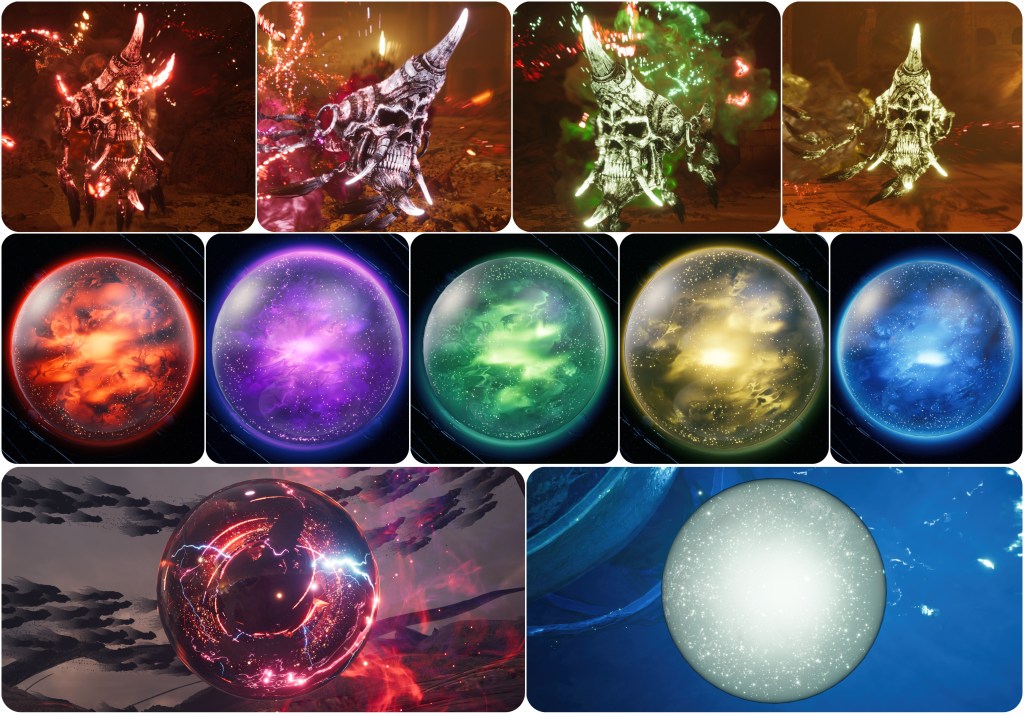
For another possibility, they might indicate four major tribes from Terra whom were unified under Gi Nattak. The Ceremonial Altar’s effigies and idols are all these same colours, and we can locate warrior effigies with glowing parts to mostly the same. These perhaps represent either four factions within the Gi people, or four main races on Terra. Gi Nattak, however, is not part of them. The Black Materia mural shows us that there are four elders, and then Gi Nattak. Giving their grand council a total of five representatives. That could be a reason why he would have governance over the souls of four other Gi tribes.

Another option is that due to Jenova’s blood running deep in them, you could possibly say that these Soul Flames are calling up the soul material of several other Lifestreams that Jenova had successfully devoured in the past. Bugenhagen’s little diagram of the solar system has planets that match these colours. I think that one’s probably too much of a stretch though. I don’t have a conclusive answer, but I like the idea of this death magic being Gi Nattak’s equivalent to Materia now that he has no Lifestream of his own
Why does Gi Nattak’s boss arena have three teal lanterns and one green one?
With this one, I’m just gonna have to say that I do not know. These four angel statues are representing the four tribe elders, yet they have teal flames instead of red. This applies to both locations where they’re seen. At the Ceremonial Altar, all four angels have a teal flame. Whereas in Gi Nattak’s arena, named the Discursive Round, just one of them has a green flame instead. What this is to tell us is beyond me. You might think it just means that only one elder remains active, which is Gi Nattak. The leftmost statue is paired to the red idol, and Gi Nattak is heavily linked to the colour red. So it makes sense, or at least seems to. But no, Gi Nattak isn’t part of that group. The Black Materia Mural shows us that he’s a fifth member of their governing body, and perhaps the overall leader above the four. So the one different effigy shouldn’t be Gi Nattak. Why is just one of them different then? I have no answer.
Truth be told, there are a lot of different identifying colours to be found in the Cavern of the Gi. The sealing statues are red, purple, teal and yellow, which corresponds to the angel effigies. There are lanterns with purple, red, yellow, teal and orange flames. The Gate of Grief, which features the most heavily mutated effigy where you can’t even discern a face anymore, is purple. The Gate of Rancour is yellow, and the Gate of Anger doesn’t have a spotlight on it but does have teal lanterns at its back. There are statues with glowing weapons or armour in red, green, yellow and blue, but not purple. I might be tempted to assign these as the four factions which made up the Gi people. But again, the red elder is not Gi Nattak, so it’s not like you could read this as the red tribe being the only one to remain.
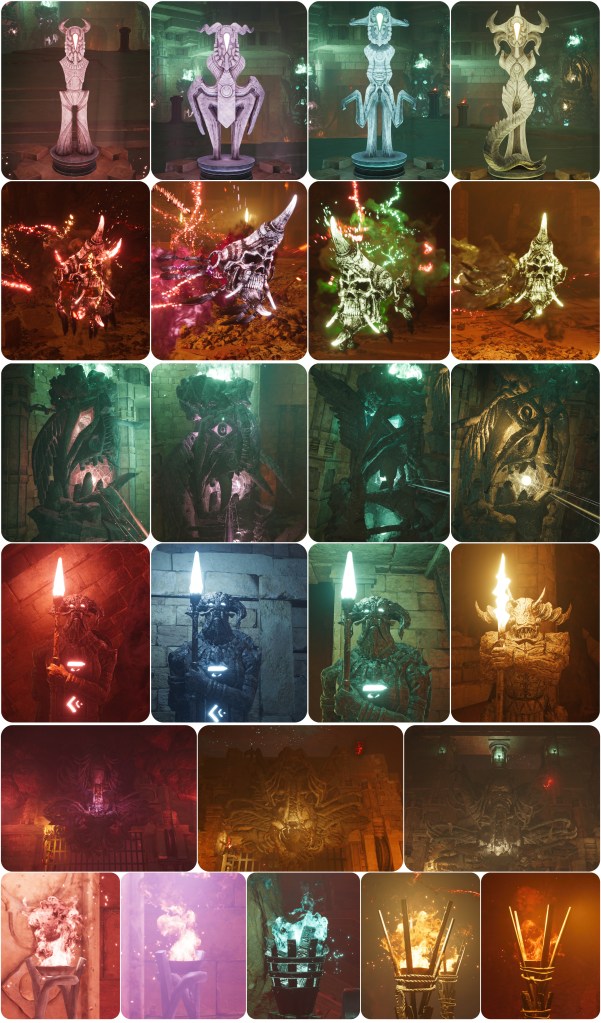
If I’m being completely honest here, the safer and therefore far less fun reading of Lifestream colours would be that they all signify different emotions within the planetary consciousness. Stagnant Lifestream is said to be a result of the Cetra’s emotional duress causing some spirit energy to not flow properly. Sephiroth at the Ancient Capital is going off about the confluence of emotions and extracting spiritual power through spite, sorrow and loss. The gates sealing the Gi in the cavern are named for anger, rancour and grief, each accompanied by lanterns of differing colours. I’m focusing on the Enemy Intel linking the red miasma to the Gi as a people, but the full quote could also be read to imply that the red colouration is specifically “the flames of their hatred”. That’s easier to smooth over and, admittedly, might be more workable. However, that reading doesn’t feel complete to me, because the Gi are shown with a legitimate red Lifestream on multiple occasions, and essentially every other instance of red spirit energy can be traced back to their touch.
Have we seen Jenova depicted with red spirit energy or associated with the colour red at any point?
Yes, quite a bit more than I’d realised actually. Enough to definitively associate her with it, I’d say. While her monsters, her champions and her illusions are generally accompanied by a purple haze, there have been a significant amount of times in Remake and Rebirth that Jenova showcased red particles, red haze or a red tinge to some of her attacks.
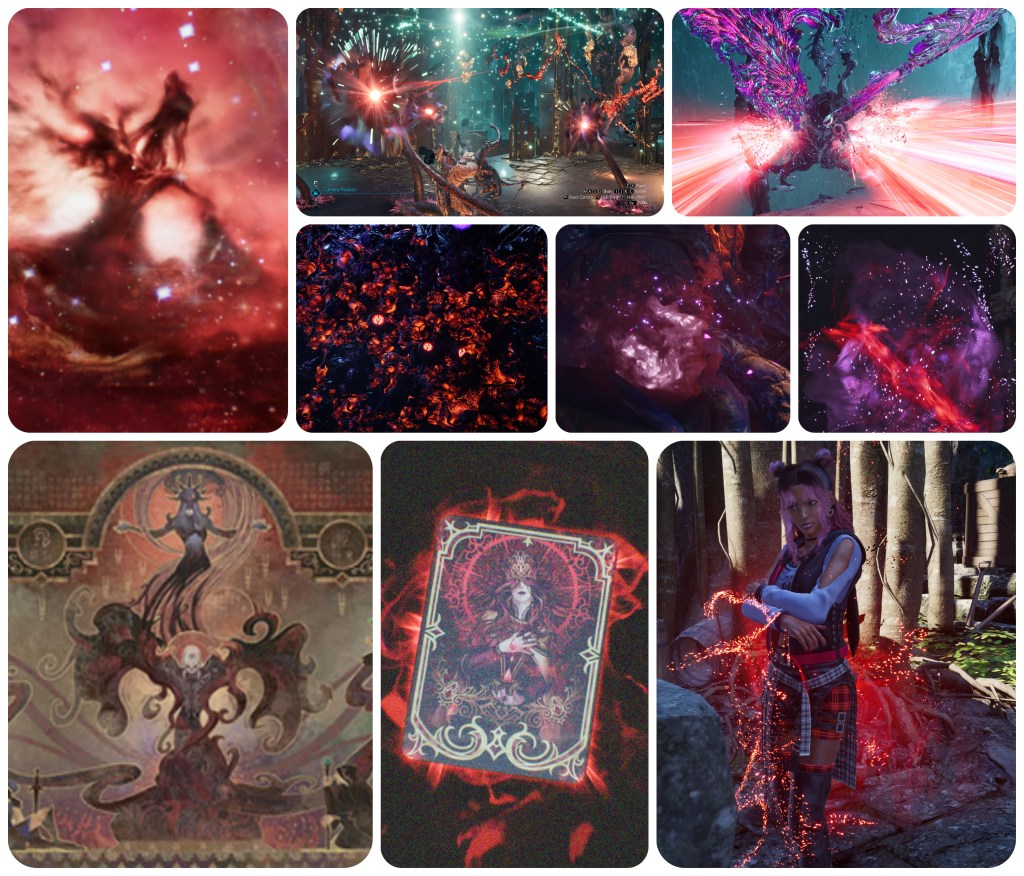
Jenova Dreamweaver’s acid has a red sheen, and she fires out some red magic orbs. Jenova Emergent has a red haze when its tentacles appear. Jenova Lifeclinger’s chamber becomes increasingly red as you get through the first phase, and from second onward she begins to fire these red lasers which just feel different to the other attacks used. Those don’t look like magic, they look like biological energy cannons she’s grown onto her own body.
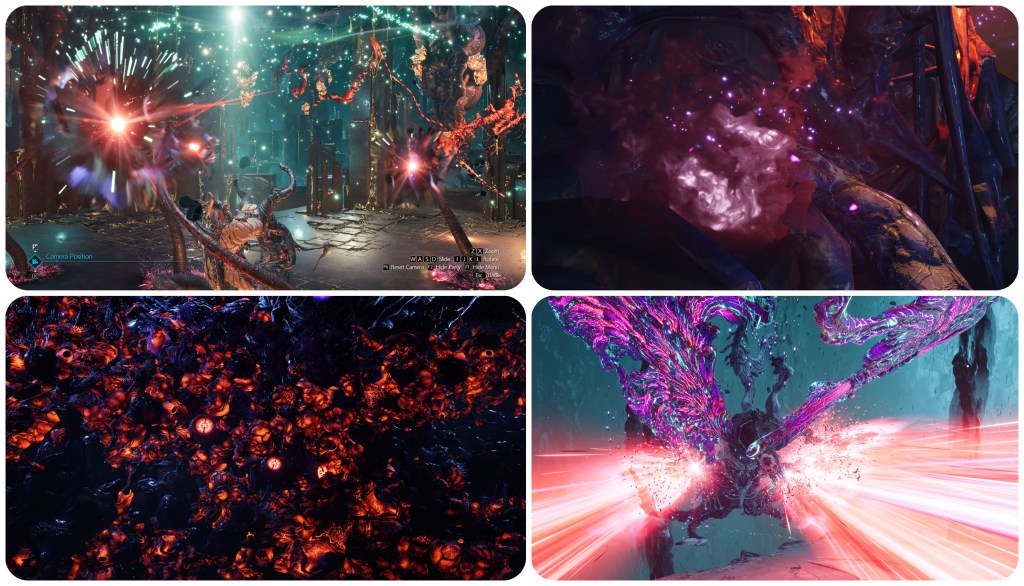
In some of my previous reviews and interpretations of Final Fantasy VII Remake, I kept getting drawn back to the symbolic galaxies in the Edge of Creation, wondering what they mean. On one side we have a brilliant golden wing, on the other some demonic image at the centre of a red galaxy.
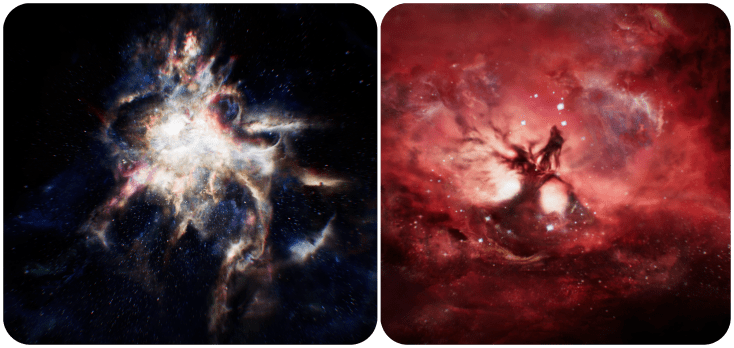
On the surface, these two symbols are just embodying the contradiction inside of Sephiroth; That genuine heroic desire which still exists on some layer of his fragmented mind. Pondering upon it deeper though, I had mused if perhaps that shape with its broad shoulders and dragon head was meant to be the Omega Weapon and the surrounding red indicating Chaos, with the golden galaxy then perhaps being Minerva? She and Chaos are kind of the god and devil of FFVII. It was a stretch, but I considered it.
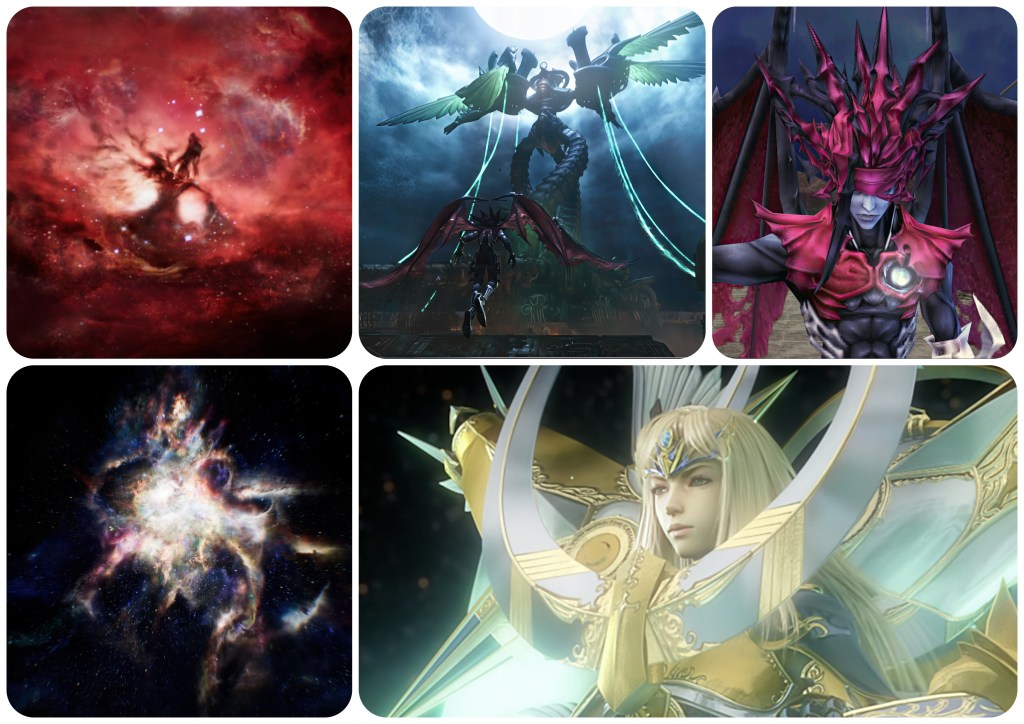
However with the newer material from Rebirth we can now definitively match this to the Jenova mural, which depicts Jenova’s woman manifested above the monster with red miasma at their back.

There are also smaller instances, such as some of Hojo’s Jenova R&D experiments bursting out with these red spirit particles. The Daemonic Entity, Cavestalker and Type-0 Behemoth are examples that particularly come to mind.
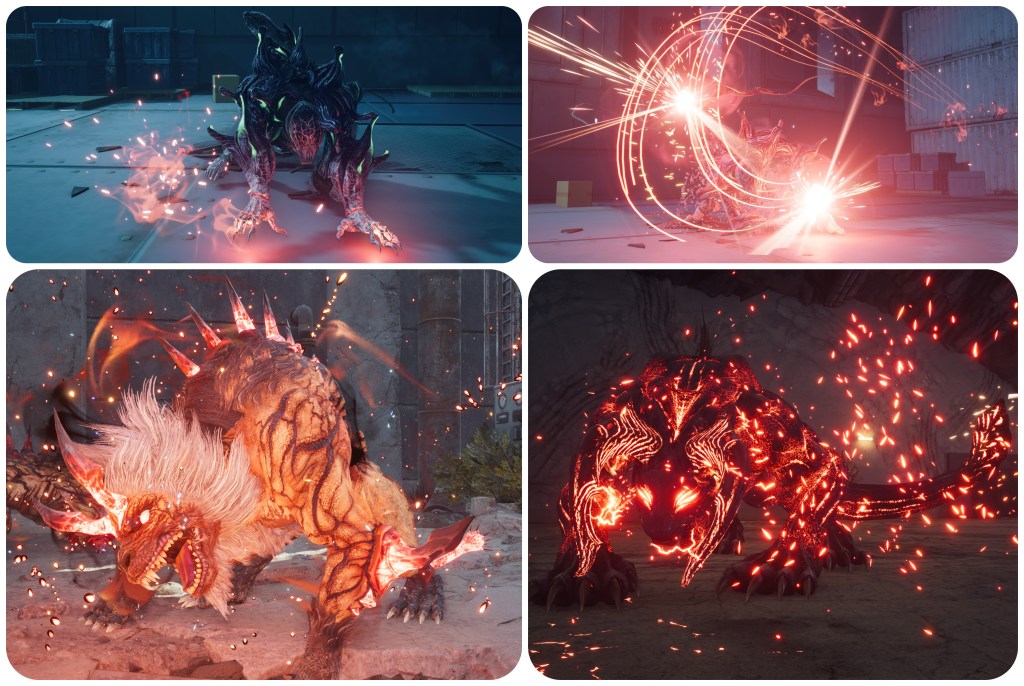
Many instances of this red haze or particle can be traced back more uniquely to Jenova and Gi entities. Not all instances, but many of them. The other examples I can note off the top of my head like the Hecteyes or the corruption in the Temple of the Ancients can be linked back to Jenova with fairly minimal effort, and the berserk states of creatures like the Skeeskee or Levrikon probably just aren’t mean to be looked at as seriously. Whereas purple is broadly applied to gravity magic and illusions. Trying to lock it exclusively to Jenova is a headache.

However, the most important of any instance where Jenova glows red is the Shadowblood Queen. This is the Jenova incarnation who most blatantly emanates red energy instead of purple, and this seems super duper ultra important because whatever historical consciousness was captured in the Shadowblood Queen card is potentially the first time that we have ever established intelligent contact with Jenova. That genuinely seems to be Jenova herself talking to us, not Sephiroth talking through her as would usually be the case. Why our first sapient contact with Jenova’s mind happens over a game of trading cards I am not quite sure, but she’s a cosmic horror, she can curse objects if she so pleases. I’m certainly not gonna be the one to tell her no. And I did suggest earlier that there may be precedent in how Joker, a fiend descended from the Shadowblood Queen, imbues the Anima soul material into its own cards.

While the purple shroud is definitely more common to Jenova and her spawn, we have seen red attached to her quite a bit as well. In some cases, it even seems to suggest that the red spirit energy might be more closely tied to her own individual existence, leaving the purple to perhaps be understood as just some abominable, eldritch energy which she taps into.
The Shadowblood Queen is Jenova?
Yeah, 100% that is Jenova. Many seem to have missed it, perhaps due to the fragmented nature of Lidrehl’s flashbacks and the lack of her commonly-expected purple glow, but I don’t see any reading where that isn’t Jenova.
Let’s recap Lidrehl’s fable.
- Lidrehl: “Once, there lives a queen of peerless beauty and compassion. She loved her people, and in turn they loved her. But one day, a change came over the queen. In a blink of an eye, her love turned to hate – her compassion to cruelty. Fair and beauteous though she remained, her heart became black as pitch. Conquest was now her cause, her subjects mere fodder to feed her boundless ambition. And so her kingdom grew as her subjects perished. Until that is, a ray of hope appeared – a sorceress who would be their salvation. The Emerald Witch they called her. And with her arcane powers, she led the people into rebellion, captured the queen, and put her to death. Yet from the tyrant’s body spilled blood as dark as shadow. And from this wicked ichor, the myriad fiends of the world were born. And that…is the story of the Shadowblood Queen. Some call it a parable. A myth. A fairy tale. And I wish it were! But she is as real as you and I! And she is coming. Her resurrection is nigh.”
Reading between the lines, this is the tale of Jenova replacing the queen of a Cetran settlement in Gongaga (specifically the ruins where we find Regina when possessed) and using brutality to grow her political influence. The Emerald Witch, perhaps Minerva, manages to defeat the Shadowblood Queen, but Jenova’s infection spreads throughout the land and creates monsters.

Lidrehl’s visions all have the usual Jenova haze in his room, and the final chapter sees him approached by one of the Black Robes, then being converted himself. When the Shadowblood Queen possesses Regina, she refers to Cloud as a “puppet”. After being defeated, Vincent says “evil like that preys on our deepest, darkest fears, and worms its way into our hearts”, which is similar to the line that Sephiroth and Cloud repeat about Jenova becoming “those you fear, those you hate, those you love”. Narratively, I am convinced that the Shadowblood Queen was the body-snatcher Jenova.
Have we seen Sephiroth with red spirit energy?
Again, yes we have. Sephiroth is the originator, in fact. Not plot-wise, but that Sephiroth was the first place we saw it. Once he’s finally defeated at the end of the original FFVII, Cloud casts his nemesis’ soul into the Lifestream. As Sephiroth disperses, red pyreflies are seen seeping out of his body. Rebirth, as mentioned, also has some red haze associated with Sephiroth at the Village of the Gi.
This red energy is what prevents these entities from being absorbed into Gaia’s afterlife. Even though Sephiroth’s spirit does enter the Lifestream space, the physical Sea of Mako, it doesn’t melt back into the primordial soup. The only reason Sephiroth ends up there instead of remaining on the surface as an Unsent is because the final battle happens at the core of the planet. The Lifestream is the afterlife, the Chamber of Guf, and a material location existing deep within the world. So when Cloud knocks him down, the only area lower is the Lifestream reservoir itself. Sephiroth plunges into it, and the current begins eroding his soul instead of accepting it. Jenova Lifeclinger’s Enemy Intel actually describes it as wanting to do something similar, aiming to get to the core of the planet and seep into the Sea of Mako from where it would begin feeding. The altars in Cosmo Canyon which the Cetra built to placate the Gi Tribe also display some red within the green swirl, so it might be that the Gi made it into the Sea of Mako but were rejected and so they sent their spirits back aboveground. Sephiroth also tries to send his spirit body back to the surface, but is unable to after losing his memories.
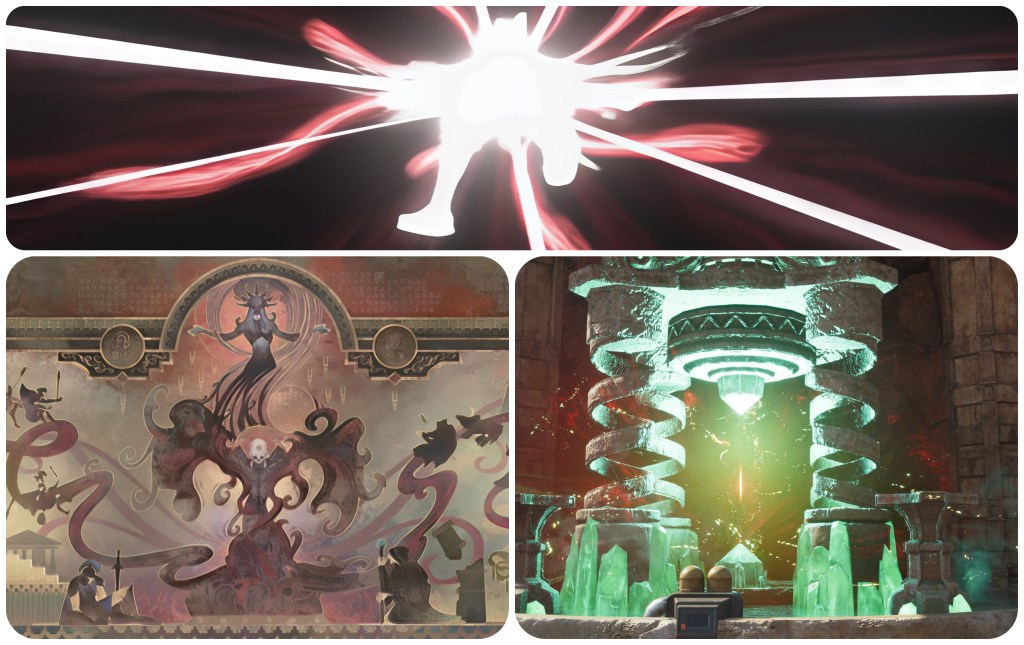
- On the Way to a Smile: Lifestream (Black): “He could feel the planet beginning to erode his consciousness.”
- Jenova Lifeclinger: “The Calamity from the stars that fell into a deep slumber after its conflict with the Cetra. Newly awakened through the grace of black-robed sacrifice, it seeks to seep its way into the lifestream and bring about the end.”
Jenova’s apparent inability to die which the Cetra speak of is because she doesn’t have Gaian spirit energy. She’s got Animus instead of Anima. The way her, Lucrecia, the Gi Tribe and Sephiroth’s immortalities are enacted is because functionally they linger as Unsent.
Have the Gi Tribe displayed any Jenova-like abilities?
As a boss Gi Nattak uses his haze to teleport around the arena in a similar way to Jenova Dreamweaver, the Shrieker, the Diabolic Creations and even Sephiroth himself. The Gi are more or less ghosts though, so that’s not especially definitive.
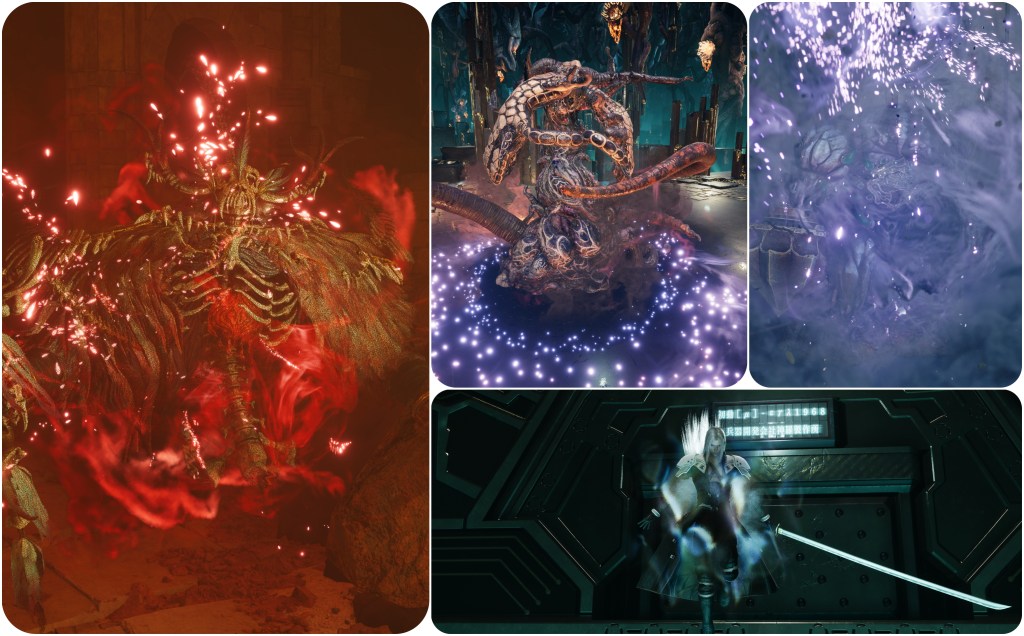
However Gi Nattak and Jenova Lifeclinger do both use blue flame spells, while the Phantasmal Scourge and Sanguinary Flame attacks look near-identical minus the Gi faces.
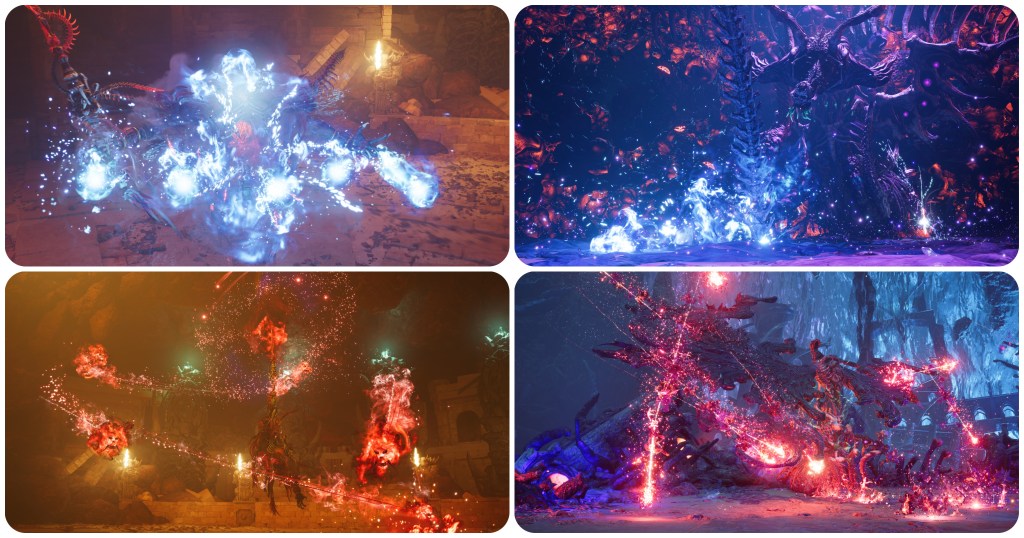
Gi Nattak’s battle form itself shares some noteworthy overlap with Jenova Lifeclinger. Both have some kind of core within an exposed ribcage, and a long, detached spine that floats about them like wings.
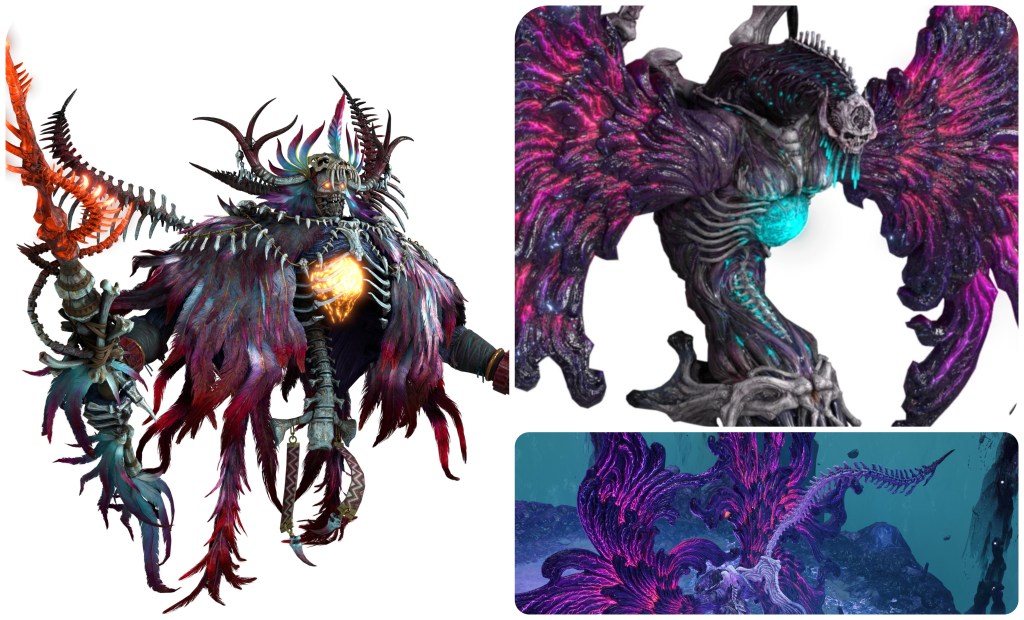
Furthermore the whole Village of the Gi sequence might be compared to the same kind of reality-altering hallucination that Jenova induces. After coming upon Seto’s altar, Gi Nattak leads us down an open path, then over a cave river in order to reach his land. Once the party have walked up the mountain and promised Gi Nattak that they’ll retrieve the Black Materia, a Lifestream haze sets in. After which, everyone comes back to consciousness in Seto’s cavern with that pathway blocked by a wall of stone, as if the entire thing had been a dream. But everyone remembers it, and the Gi Spectres in the Promises to Keep sidequest reconfirm that the village exists and that the Gi Tribe did genuinely create the Black Materia, rather than it all just being one of Jenova’s lies. Therefore, this phenomena may have been similar in nature to the arenas that Jenova summons for its boss battles, which are stated to be a kind of physical illusion.
For something more implicit: as much as I’d like it to be the case I don’t believe that the Gi Tribe used the Black Materia’s Meteor spell to summon Jenova to this planet. I’ll explain my reasoning in more depth later, but to me that imagery link unfortunately does not hold. We could suggest, however, that perhaps if they bore some small culture of her cells inside of them, then perhaps it was the Reunion impulse that would eventually draw Jenova to Gaia in pursuit of the Gi Tribe.
For curiosity’s sake, have the Cetra displayed any Jenova-like abilities?
There are a small few things which come to mind, but not as some massive conspiracy about the true nature of the Ancients. I wouldn’t believe that they willingly accepted Jenova’s cells or that they’re secretly alien cultists whose whole presented history is a lie, or anything of that direction. But there are certain phenomena in their temple where you could wonder if maybe they witnessed Jenova’s power and then attempted to replicate it for their own defenses. The main example that particularly comes to mind is that the Temple of the Ancients’ trial chambers do use that same kind of haze to induce memory-reading, reality-altering hallucinations. This is Jenova’s forte. When Tifa passes into the Nibel Reactor and the door behind her disappears, the lighting even calls to mind the Jenova dreams from The First SOLDIER.
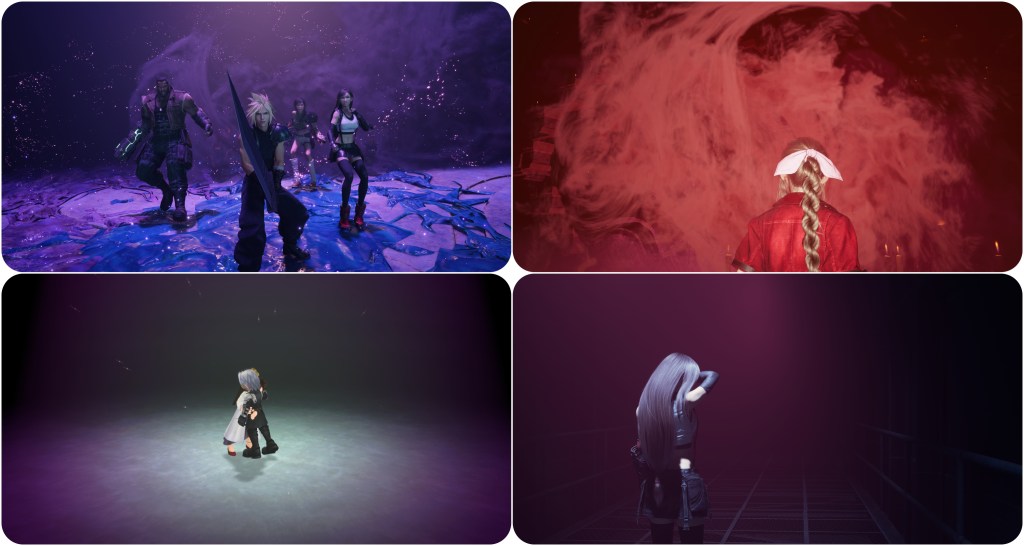
Jenova is known to be immortal, and her immortality can be imparted unto her subjects. The guides in the Hall of Murals introduce themselves as “we who dwell in eternity”. I assume this is referring to these individual souls who stand watch over the temple though, not a Jenova-esque eternal life. But it’s still worth mentioning since it overlaps their aesthetic a little.
- The Cetra: “You who walk in the footsteps of we who dwell in eternity. Listen well, for dusk is falling on the age of our people – the Cetra.”
During the Hall of Murals section the Cetra’s spirits either transform into or summon three particular kinds of fiends, whose Enemy Intel, attacks or design all provide reason to argue that they specifically are past victims of Jenova saved by the Cetra. The grotesquely mutated Panthera Protector contracted a “strange illness”, the Moss-Grown Adamantoise has red spirit energy, and the Floating Death uses Void magic. The visual effect used for their appearance is similar to when the Black Robes transform into Jenova, or the Gi Spectres manifest out of their lingering pyreflies. This may also be the same root cause of the phenomenon earlier in the labyrinth, where some deceased SOLDIERs are transmuted into fiends. Since they’re SOLDIERs, it may be argued that their Jenova cells are responsible for enacting the change, and so linking the two phenomena would mean that the Cetra’s magic was interacting with the Jenova factor.
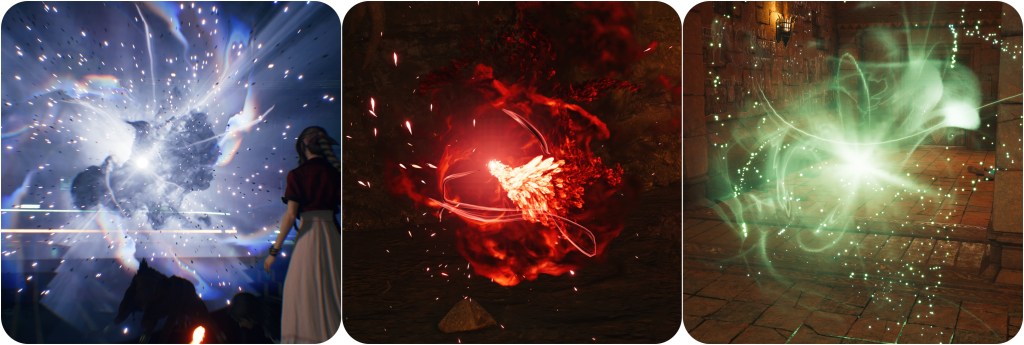
What is the pattern on Gi Nattak’s core?
Not sure. I think it should be some kind of a face, since it has the same beady forehead eye as the Deep One statues and whatever entity is depicted on their shields.
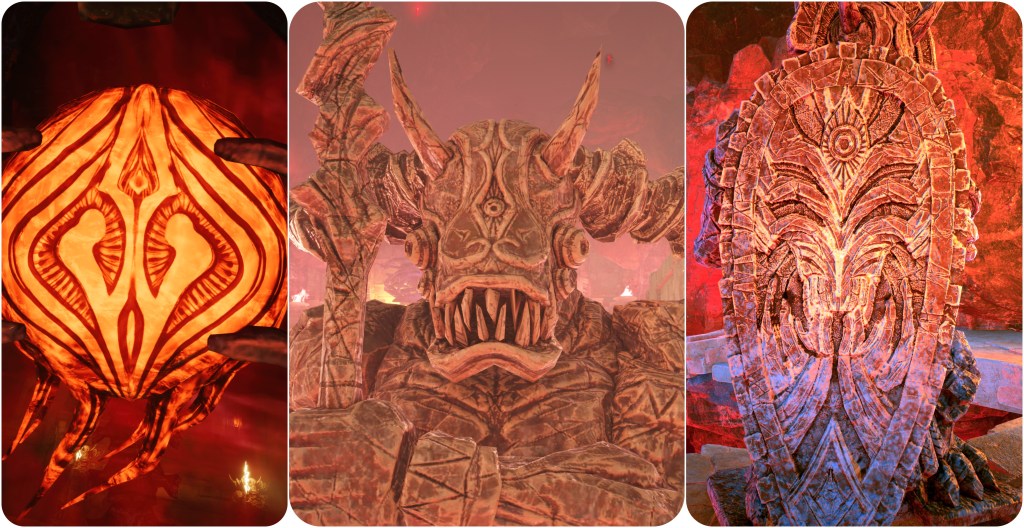
Gi Nattak’s battle mask has a crystal on its forehead so maybe it’s just some artistic representation of himself. Or if you flip it then it also kind of looks like a crow skull, and Gi Nattak is wearing a necklace of those. But I feel like, with everything in context, it’s got be some kind of Jenova growth though.

What are the statues in the Cavern of the Gi?
There are two distinct types of statue in the cavern, which kind of look like fish men and goat men. They might be other humanoid races from Terra, they might be armour that the Gi wore to battle, they might be different forms that Jenova mutated them into, they might simply be symbolic. There seems to be some link genetic connection between their forms and Gi Nattak since his core has that same beady forehead eye, but I don’t know that there’s enough information present in the game to put together a worthwhile explanation.
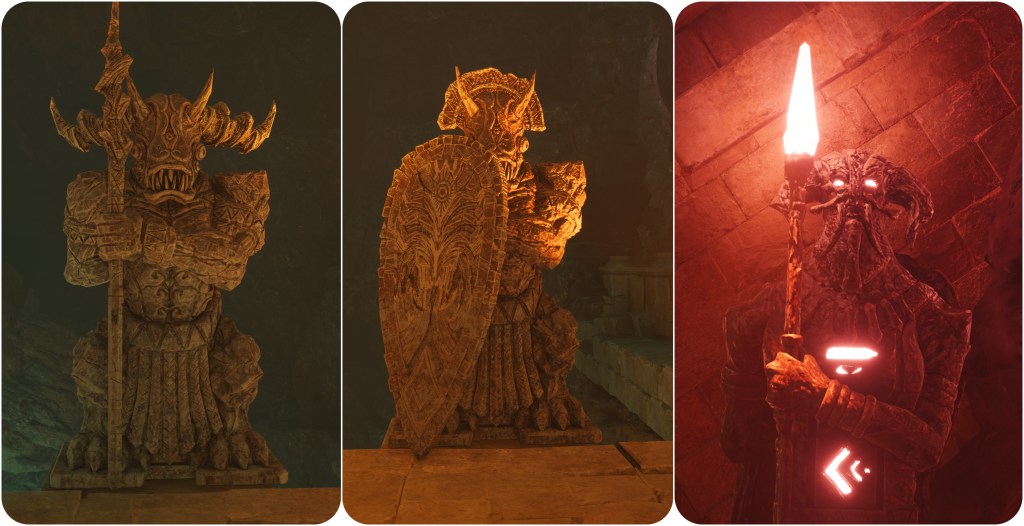
What is that necklace worn by one of the Gi elders?
I really do not know. It seems pretty damn important, but I can’t quite place it. It somewhat resembles a shape in the Gi mural, and is at odds with the square tesseract motif that the Cetra use. So perhaps it’s meant to embody Terra’s Lifestream, and the four orbs on the sides are the elders, or something like that. I just don’t think there’s enough information or comparison present to take it all that far, unfortunately.
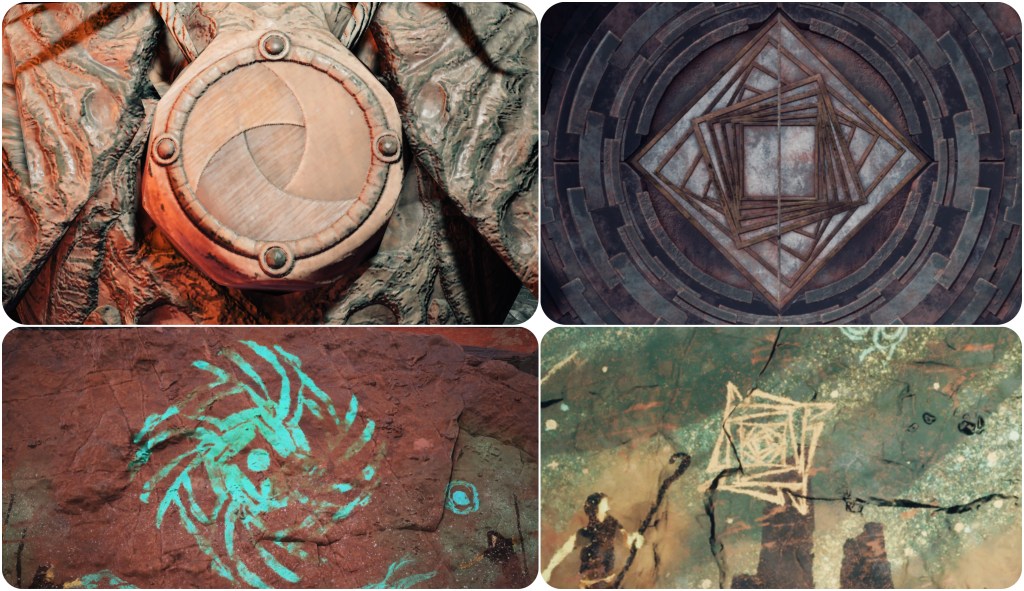
Do the Gi Tribe even exist then, or are they purely just a large-scale Jenova hallucination to lead the party toward the Black Materia?
There’s some weirdness surounding their existence considering they’re caged within an unsent afterlife, but as a people they should legitimately exist. The Cetra have records of their history that well predate Jenova’s hallucinations arriving on Gaia. Furthermore, revelations from the Ultimania Omega may indicate that, at least in the original FFVII, Jenova seemingly did not possess knowledge about the Black Materia until Sephiroth discovered it, which may still be true of Rebirth since his abrupt shift in personality hints that Sephiroth did not learn of it through his access to Jenova’s own mind.
Considering how frequently the Cavern of the Gi repeats its symbolism of the Gi Tribe having four elders, which excludes Gi Nattak, I do somewhat question if he might be Jenova’s main vassal from Terra, equivalent to Sephiroth. I can’t really develop that idea any further as yet though, and don’t know if he attitude really agrees with that either.
If the Gi were exposed to Jenova cells before Gaia, did they carry the mutagenic pathogen with them and inspire any mutations before Jenova itself arrived millennia later?
I’ve gone down multiple lines of thinking, I’ve cross-checked many Enemy Intel summaries, and I believe the answer to this is that yes, they have. Only a small sample, which the Cetra must have been able to snuff out before it truly became a pandemic. However, there are a select few enemies whose history should stretch back to before Jenova’s arrival, yet they display mutagenic traits which I believe align to both the Gi Tribe, Jenova and something else. Give me time though, because its a long pathway to get there.
If Terra’s Lifestream is red, and Jenova is also shown emanating red spirit energy at many points, what does this mean for her usual purple particles?
There is intention behind how FFVII Rebirth uses all its Lifestream colours. The red miasma in the cavern of the Gi is very striking, and assessing the Gi enemies specifically paints it as a point of attention. Gi Nattak has this unusual red hue to his spirit energy particles, the red colouration then shows up in Sephiroth’s haze as well immediately after, and as Gi Nattak ferries us to the village we see streams of green, red and purple or blue. The game deliberately shows us three different streams right after that incident with Sephiroth’s red haze. This is no accident. It surely reads as them trying to tell us something about spirit energy and alien Lifestreams. So then why if the Shadowblood Queen is one of Jenova’s earlier incarnations does her spirit contained within the Queen’s Blood card emit red energy? Jenova’s is predominantly always purple.

Nobuo Uematsu mentioned that Jimi Hendrix’s Purple Haze was a key inspiration for One-Winged Angel (consider this cover by Uematsu’s ‘Earthbound Papas’ band) – maybe that’s part of the reason why Remake has now consciously been connecting Jenova and Sephiroth’s illusions to this purple haze.
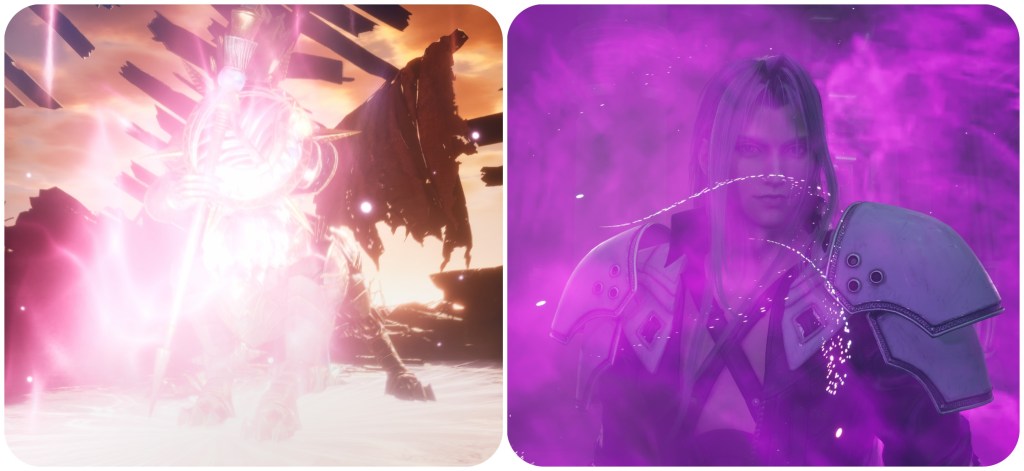
However, trying to frame the purple haze as some effect uniquely tied to Jenova and emblematic of her own spiritual touch actually introduces more issues than it solves. Purple energy in FFVII Remake has been predominantly associated with Jenova’s presence. However, Rebirth hints that this may actually be circumstantial. There are various instances of it being used in a way that doesn’t conform to this. Many monsters cast purple magic or have purple haze – heck, even Cait Sith summons his Moogle through such a mist. Is Cait Sith, a cat clown robot, the second son of Jenova? I’m gonna put that one at a probably not.
The most significant example I want to bring up though, is the wanderer of the Void, Gilgamesh.
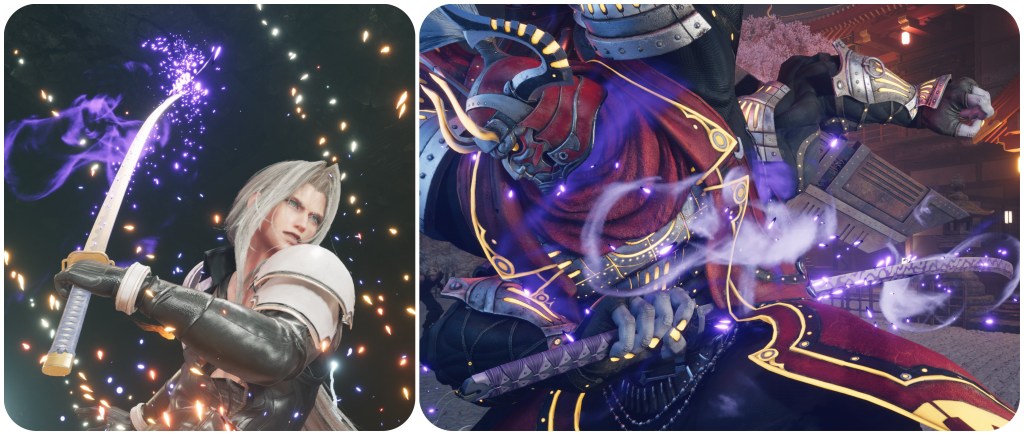
The Protorelic questline in the Nibel region has the party accompany a bunch of the Black Robes as they journey to various locations throughout. The easy assumption to make is that they’re being driven by their Reunion instincts, as the monsters waiting at two out of four locations are escapees from Hojo’s research labs, presumably injected with a large amount of Jenova cells. The one monster that isn’t, however, is the actually important one; An Ahriman subspecies called the Sanguine Scourge (Side Note: Jenova Lifeclinger defends itself with Sanguinary Flame when pressured in phase 3). Assessing the fiend describes it as wielding an “unknown energy” which it gained by ingesting the Protorelic. We see this manifest in battle as these transient swords coated in a purple sheen. Getting a good look at the swords reveals them to be copies of Gilgamesh’s Excalibur.
- Sanguine Scourge (Enemy Intel): “An aerial creature that has taken up residence in an abandoned lighthouse. Swallowing a piece of protorelic caused it to mutate. It utilizes an unknown energy to unleash devastating attacks.”
The Reunion clones were drawn to the Sanguine Scourge because of the Protorelic’s purple energy signature. In that case, it could be suggested that the point of this questline was to indicate that the purple energy belongs to the Void, and Jenova is simply one of many lifeforms to eat into it. Another Ahriman species known as the Floating Death also uses a move called “Voidsent” to shoot out purple, dimensional energy blasts, and that one is possibly a past victim of Jenova DNA due to the other fiends it’s grouped with. In fact even Sephiroth’s combo attack during chapter 1 is called “Voidshatter”, which entails him imbuing the Buster Sword with his purple magic.
So rather than Jenova, it must be sign of the Void. Sephiroth did understand the nature of Gilgamesh’s existence at a glance, perhaps due to his familiarity with Jenova. Furthermore his portal to the Edge of Creation at the end of Remake looks near-identical to Gilgamesh’s. There’s also a very striking similarity in effect when Gilgamesh charges his Muramasa up with whispy purple energy, looking just like a move that Sephiroth had done against the Materia Guardian.
Based on Gilgamesh’s Void portals and Genji armour having purple energy, I’m lead to think that the Void energy is purple, not specifically Jenova. Perhaps she began as an alien with green or red spiritual energy, which turned purple when she breached into the eldritch realm. Or more loosely, I think that purple indicates space, gold indicates time. Timeline gates on the Path of Sephirot or time spells like Haste are golden, whereas it seems as though all magic pertaining to spatial distortion carries this purple glow. Gravity spells used by Sephiroth, the Valron and the Demon Wall are purple. Meteor is a gravity spell too, it doesn’t actually summon anything, but rather magically pulls in a dwarf planet. Accordingly, the Black Materia mural does show the Gi imbuing it with purple magic. Sephiroth’s dash and even Cloud’s Triple Slash leave a purple trail behind when they move faster than the eye can see, perhaps indicating that the way in which they move so fast is by magically bending space so to speak. While Cloud’s Triple Slash, which has visibly powered up from Remake to Rebirth, could just be evidence of Sephiroth’s growing influence upon him, I’d sooner see it as something in favour of purple being that associated with the conceptual force of space.
That’s the direction my observations are trending. I wonder if the game has anything to say about it. I keep bringing up that Enemy Intel is what spotlights the red Lifestream as being such an oddity for Gi Nattak. It sure would be embarrassing if I went down this whole run of screenshots trying to figure out what the purple means when the game blatantly describes it to us somewhere in Jenova’s Enemy Intel. Oh, hey:
- Jenova Dreamweaver (Enemy Intel): “A top secret Shinra experimental specimen. Information on it is scarce, but it is believed to induce hallucinations.“
- Jenova Emergent (Enemy Intel): “A top secret Shinra experimental specimen. A fragment of its carcass has fused with the robed individuals, granting it this twisted form. It is able to induce hallucinations that warp the very space around it.“
- Jenova Lifeclinger (Enemy Intel): “The Calamity from the stars that fell into a deep slumber after its conflict with the Cetra. Newly awakened through the grace of black-robed sacrifice, it seeks to seep its way into the lifestream and bring about the end.”
Jenova’s haze induces hallucinations that warp physical space. The Enemy Intel for Dreamweaver and Emergent tell this to us directly, and some of their magic spells are named “Dreams of Pestilence”, “Dreams of Quietude” or the like. Reality-altering dreams and hallucinations, this is how Jenova keeps summoning its arenas and teleporting throughout. The Shrieker hybrids are also shown teleporting in the same manner. I’m not wholly sure how to rationalise this “hallucination” aspect that can directly affect spacetime, since until now her delusions had been a power exclusively exerted over the minds of those possessing her cells, whereas when she needed to affect those without her DNA she would physically transform her cells into the shape of someone else. Like John Carpenter’s The Thing. That hallucination claim almost makes it sound like Jenova isn’t a cellular shapeshifter, but just an illusionist. Which to me doesn’t reconcile with what we know of her two-way genetic conduit from Crisis Core or the Shadowblood Queen’s split blood which spawned the fiends of the world. But maybe this is just a wholly different avenue of her power. She shapeshifts and causes hallucinations, covering both bases in her game of deception. Nevertheless, Jenova is warping space to manifest the boss fight phenomena. That’s what the game itself tells us. We can then extrapolate this to suggest that all the other purple particles or clouds are likely indicative of spatial distortion too, and that is what my own findings have supported.
Considering we have two, maybe three distinct versions of the black Lifestream it must be asked, do I think that Jenova’s purple is the same as Gilgamesh’s purple?
You know what? I do. I have come to think that’s the case. Even since my first playthrough of Rebirth I’d somehow gotten this impression that Gilgamesh’s presence was more significant than the story was letting on. That he wasn’t just a sidequest cameo this time, but that the game was subtly heaping important context upon his shoulders. The Void is debatably quite important in FFVII Remake even before him, anyway. I am still in the camp that says Sephiroth’s corrupted saviour complex and a lack of any true divergences in story trajectory mean the Remake games are not time loop sequels like everyone preaches they are. They’re just massively expanded and meandering along the way. The motivations of film Sephiroth are fundamentally and irreversibly changed from game Sephiroth after the Lifestream burnt away all his lingering human nuance. However I have also blogged about the opposite view, highlighting how FFVII Remake’s Edge of Creation does have enough Interdimensional Rift imagery to adequately justify that if you want it to be a time loop then you can just say, well, Sephiroth does the same thing Garland did, and the wider Final Fantasy multiverse sorts its own details out. Garland uses the Void to travel back 2000 years, Sephiroth has portals that look identical to Gilgamesh’s Void gates, so he just did the same thing as Garland. Toss out all your multi-hour video essays because you just go one-two-three and you’ve got yourself a time loop. Figuring this all out is tough if you try to stay within FFVII’s boundaries, but considering it more broadly as just a Final Fantasy game you can do it pretty quick. I ultimately don’t agree with that verdict, my opinion is that all this extra spacetime lore is just in service to Sephiroth’s coming deification, but the possibility to explain it like this is quite straightforward.
So with regards to this topic of energy colour and the identification of foreign Lifestreams, in trying to figure out why the heck Jenova’s Shadowblood Queen is red, this new understanding has dawned upon me. The Void. Sephiroth detected Gilgamesh’s presence because his energy signature was similar to Jenova and Masamune, and using that to extrapolate on all the Lifestream colours reveals a less layered, but far easier to accept understanding of things. Jenova herself isn’t necessarily purple, that’s perhaps just the eldritch component of her magic.
What colour is Jenova’s blood?
Jenova is shown to bleed purple during the Trail of Blood and the Lifeclinger battle. Sephiroth, in his fully revived body, has red blood during the ending FMV of the original game. I did notice though that the Project S concoction which Hojo derived out of Sephiroth’s hair, blood and tissue in Rebirth’s Nibel Manor is a vivid blue, which also matches to the blue blood when the Hell Rider’s arm is lopped off. This is the same material that was plugged into Zack and Cloud’s Mako tanks. Remake and Crisis Core Reunion both censored characters getting impaled with a grey haze, but Rebirth did away with that for proper blood. So it’d be interesting to see what colour both the real Sephiroth and his main Jenova clone bleeds in the Remake continuity.
How many different colours of spirit energy do we see when enemies are fading away?
Like Kadaj in Advent Children or Grimoire in Dirge of Cerberus, a new change in the Final Fantasy VII Remake games is that when organic enemies are defeated, they disappear into orbs of light. This is more of a gameplay mechanic to help declutter the field I’d say, since we do see dead bodies lingering in cutscenes and it’s strange to imagine the world functioning when people just evaporate two seconds after death. There are also moments of the reverse, where the first out of the two initial Necrotic Entities encountered lingers on the floor until the following cutscene where they fade away.
When enemies begin to fade away, the different hues of spirit energy do seem to be applied as individualised selections. It’s not just a blanket green sendoff, but dependent on what category of lifeform they are.
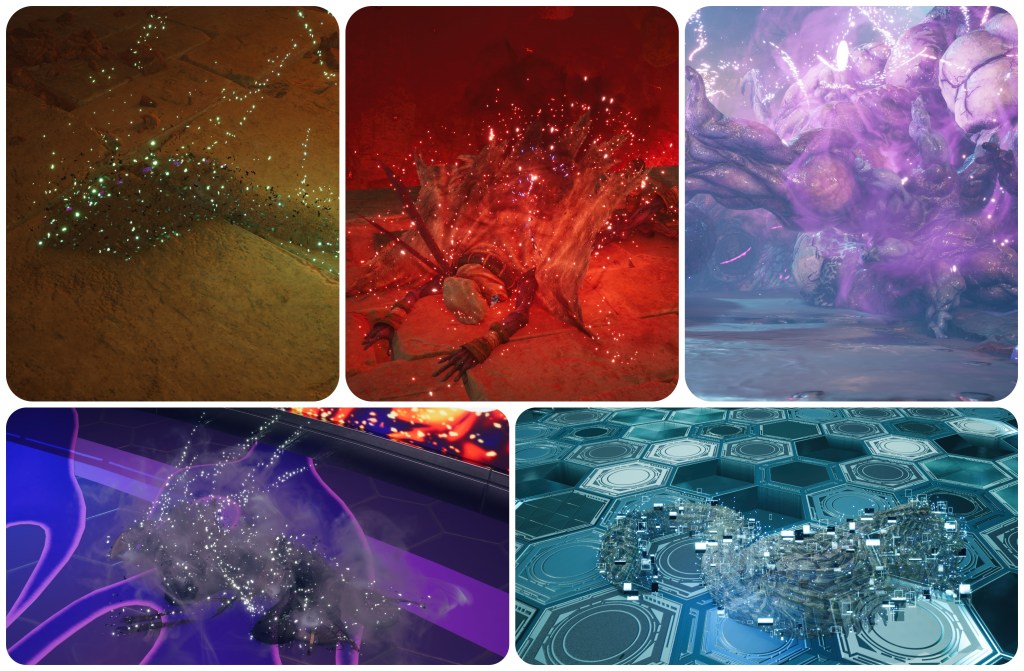
I’m not conclusive on this – in order to be conclusive I would have to do another entire run of Rebirth specifically just noting down for each and every single type of enemy – but to the best of what I can tell, I believe that I’ve seen four different colours of orbs. This is not including the blue effect when VR lifeforms are defeated, for obvious reasons. Generally speaking Gaian lifeforms disperse into green. This also includes Hojo’s R&D monsters like the Hell Rider, Void-imbued Gaian monsters like the Sanguine Scourge and seemingly artificial Cetran constructs like the Stone Golem, Elder Golem and Ironclad. The Gi Spectres vanish into red, and this also applies to the possessed enemies in the Promises to Keep sidequest. I do know that just a select few creatures fade away into plain white orbs, though in my time working on this post the only few I’ve managed to concretely go back in and identify are the Gi Tribe’s Two Face puppets, the Adjudicators, the Panthera Protectors who guard the Temple of the Ancients, and the Jokers. I would think that this points toward them being homunculus or some otherwise soulless beings. Lastly, Jenova Emergent can be seen burning away into purple orbs before the illusory haze kicks in. Sometimes there are mixes as well. The robed men still turn into green orbs with only a minor amount of dark haze and purple particles, and a similar mix is seen when the Whispers possess the Threadspinner Chimeras. Those are the colours I’ve currently located.
What do the different Lifestream colours signify?
If red is Terra and purple is the conceptual force of space (encompassing gravity, teleportation & perception), then green is Gaia and gold should be the conceptual force of time. Notably this can address some oddities like the pinkish haze in the Cetra’s illusory trial chambers, the golden gates along the Path of Sephirot, the iridescent godrays that Sephiroth summons when he splits the sky at the City of the Ancients, or the green Lifestream that leeches out of Jenova Lifeclinger’s core when it gets smashed. All these colours would otherwise make no sense if they were exclusively tied to Jenova or the White Materia.
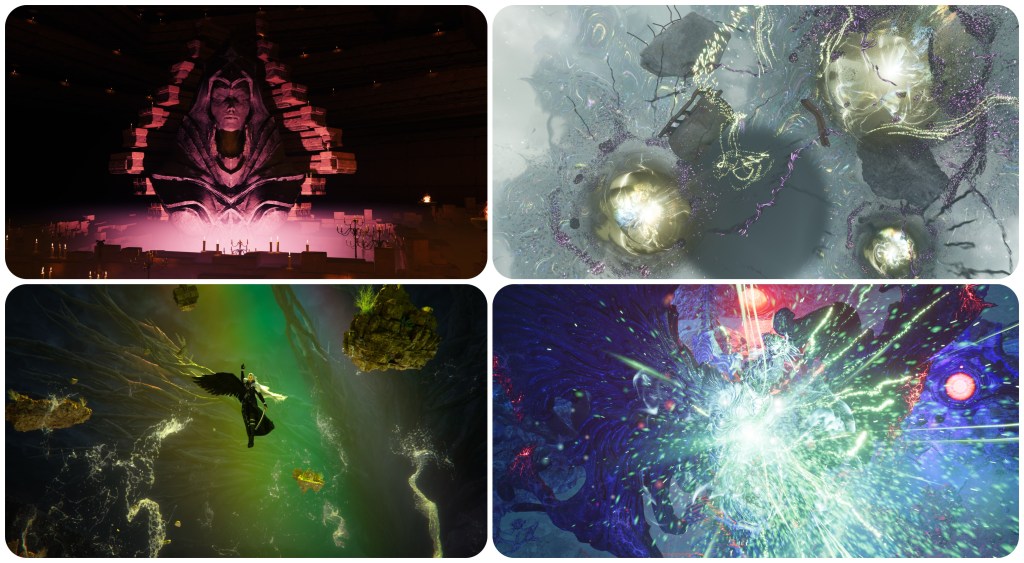
Section 2: Planet Gaia & Meteor
Okay. So with everything I’ve gone through up to this point, I believe I’ve managed to indicate some kind of link between Jenova and the Gi due to their red Lifestream and the way it suggests some degree of historical contact on planet Terra. I will return to this line of discussion to specifically codify it all in time, but for now let’s start talking about the Gi Tribe’s circumstances on Gaia.
Did Terra collide with Gaia? Was this the ‘meteor’ that brought Jenova?
I’ve seen some people interpret Gi Nattak’s story this way, referring to a physical collision; That Terra was drifting loose in the cosmos and then crashed into Gaia, where its own Lifestream was absorbed. However, of the five or so scenarios which I think could explain their arrival, I consider this the least likely candidate by far, as it pays no particular respect to his story about the slow environmental decline of his home. The Gi’s world had waned across a span of eons, which then ties directly into it being consumed by Gaia. It didn’t perish during their moment of contact, but was already dead beforehand. So I don’t think a planetary collision fits the bill. The only potential trace of planet Terra to be found are these odd red crystals that adorn their cavern and their village, but I don’t believe that any of the other history or geography we can observe around the Gi or planet Gaia’s history supports this.

If two life-bearing planets had impacted each other, they’d have both been eviscerated beyond repair. Or at the very least you would have some kind of planetary ring formed from the debris. We know what the crater left behind by Jenova’s meteor looks like however, and it certainly is not indicative of a collision with a planet-sized body. For these reasons, I consider it impossible that Terra impacted Gaia.
Did Jenova arrive on Gaia at the same time as the Gi Tribe?
If we could just make their years overlap, oh the things we could do. Bam, Terra itself was the meteor that hit Gaia and dropped Jenova onto the land. Bam, the Gi Tribe having Animus is a Xenogears reference used to conclusively reveal that Jenova was their native mother and god. Bam, that’s why the Gi seem to have such ceremony around Jenova in their land and we don’t have to spend an hour probing into the circumstances of this one skull design. Bam, bam, bam.
However, it’s not even close.
- Bugenhagen: “The history of the vale is intertwined with the Gi, for they first came to these lands many millennia ago.”
- Gi Nattak: “From the planet, we claimed the greatest of materia – a most sacred treasure – and imbued it with our desire for freedom. After an eternity…the materia began to stir.”
- The Cetra: “The Gi, who with bitter prayer forged the black materia. So foul was the orb’s magic that we knew at once it must be hidden, that none might ever wield its terrible power.”
The above all indicate that the Gi Tribe arrived on the planet many thousands of years ago, spent an eternity funneling their hatred into the Black Materia, then had it stolen by the Cetra before ever being used. Their arrival, the completion of the Black Materia and incursion from the Cetra all happened before Jenova hit the planet, since she has a definite timeline of landing 2000 years ago, then being considered the stuff of legend by the Wutaians 1500 years later. Jenova has a maximum range of a millennia and a half where she could have been active before being sealed. However it was likely far less than this, since Ifalna recounts that Jenova had already been dealt with by the time that the planet finished producing the Weapons to counter it.
- Ifalna (FFVII): “2000 years ago, our ancestors, the Cetra, heard the cries of the Planet. The first ones to discover the Planet’s wound were the Cetra at the Knowlespole. The Cetra then began a Planet-reading. It said something fell from the sky making a large wound.”
- Ifalna (FFVII): “Yes, but…There is no record of Weapon ever being used. A small number of the surviving Cetra defeated Jenova, and confined it. The Planet produced Weapon…But it was no longer necessary to use it.”
- Stewards of the Planet Guide (Remake): “In the distant past, our planet was home to a people we call the Ancients. Many millennia before we discovered mako, these precursors were already pioneering its use. Alas, the Ancients themselves are long gone. Two thousand years ago, a meteor brought an end to their civilization.”
- Alissa (The First SOLDIER Ep2): “This next chapter takes place about 500 years ago, long after the five warriors bested that beast. For a long time, people stayed away from this place. But eventually a group of brave settlers decided to try their luck. They were Ancients, too. By that time, their numbers were already greatly diminished, but they still had the knowledge to revive the desolate land.”
Notice how even the Stewards of the Planet presentation draws a specific divide between the “many millennia” ago in which the Cetra lived and the more recent “two thousand years ago” when Jenova’s meteor fell. Neither the Cetra nor the Gi have a timeframe provided for how far back “many millennia” is, but it’s evidently more than 2000 years ago. Gi Nattak calls it an eternity.
I mentioned having other scenarios for the Gi arriving on this planet, what are they?
The first, which I consider invalid, was that planet Terra may have collided with Gaia to drop both the tribe and Jenova upon its land. The other scenarios would be that perhaps the wording of their ‘world’ is metaphorical and the Gi are actually a hollow earth tribe who had always been living inside the planet. Next, that their ‘world’ is metaphysical and they lived on an overlapping dimensional plane that catastrophically fused into Gaia. I’ve considered that the Cetra may even be responsible for this. Or lastly that they crashed here on an interstellar ark of sorts. I’m pretty firmly in the final camp, but I’ll address the others before getting to that.
What does Bugenhagen mean when he says that the ‘world of the Gi’ is beyond the sealed boundary? We’ve seen a night sky and moon depicted below the surface of the world before, so are the Gi even extraterrestrial, or just a subterrestrial tribe who lived within a hollow earth?
I think Bugenhagen simply just means that their country lies beyond that gate, not that there’s any unspoken dimensional shift happening as they step through the doorway. It could also be a subtle reference toward their own red Lifestream that flows through the cavern, since that technically is the essence of their world, but probably not. There’s a spreadsheet you can find on Google which compares all the english text in Rebirth against both the original japanese as well as some more literal interpretations. The original line is more accurately translated as “this cave is the border between the giants and the world”, which doesn’t carry any of that same weirdness and ambiguity concerning the “world of the Gi”. This phrasing also lessens the possibility of the Gi being a hollow earth tribe. That’s not their world in the sense of being the environment which they spawned out of. It’s just that the cavern’s been their space for millennia now, whereas the surface is our space. Do I believe that the Gi are a hollow earth tribe whose subterrestrial home collapsed from an earthquake and underground volcanic eruption? Nope. They are beings not born of this planet.
Did the Cetra summon the Gi Tribe to their world for nefarious purposes?
The progression in certain lines of dialogue does kind of trend this way, and it may be why Gi Nattak considers the Cetra’s history “fraught with sorrow and horror”. Particularly I’m focused on the phrase “pain and spite”. The Gi Spectres chant about the Black Materia, saying “steeped in our one desire, with pain and spite made black”. Whereas at the Ancient Capital, Sephiroth describes the Reunion of Worlds as an event where “spite and sorrow are harvested to feed the planet”, using a relatively similar descriptor. If you link those phrases, you could create a scenario where perhaps the Cetra, at their interdimensional temple, were basically capturing other dimensions and feeding them to their own Lifestream. Maybe at some point this caught the attention of interdimensional parasite Jenova, or maybe Jenova even is some kind of universal white blood cell that was sent to purge the malign Ancients.
- Gi Nattak: “Consider your ignorance a blessing. The Cetra’s past is fraught with horror and sorrow.”
- Gi Spectres: “Steeped in our one desire…Purest of materia no more…With pain and spite made black.”
- Sephiroth: “The reunion─when worlds merge…when spite and sorrow are harvested to feed the planet!”
Cosmo Canyon has some murals loosely depicting the story of the Gi’s arrival, most likely through the celestial body glimpsed above. I do note that the campfire is shown to shift between red and yellow. One could wonder if this is to suggest that the Cetra essentially drew the Gi to this world using flames of Animus.
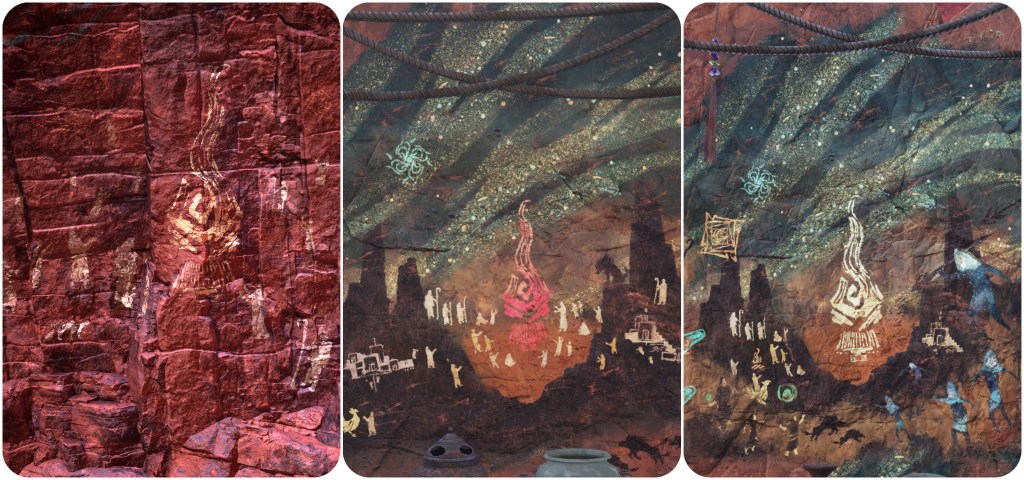
However, this angle isn’t without its flaws. The Cetra in the Hall of Murals present their history as if the Gi’s incursion on Gaia was incidental, and one piece of World Intel from Cosmo Canyon recounts that the Cetra were trying to peacefully coexist with the Gi for a time. If the Cetra had maliciously consumed the Gi’s Lifestream, I don’t think they’d have any such delay before moving to wipe out the Gi people.
- The Cetra: “It has ever been our sacred duty to protect our planet against any who would threaten it. They who came from without were one such threat. The Gi, who with bitter prayer forged the black materia.”
- The Cetra and the Gi (World Intel): “In the distant past, the Cetra made contact with the Gi, entities who could not return to the lifestream. Pitying their plight, the Cetra built altars to commune with and calm these tormented souls in the hope of finding a means to coexist peaceably.”
Was it a spacetime shift that brought the Gi Tribe to planet Gaia?
This was my original thought. With the focus that FFVII Remake places on dimensionality and time trickery, Gi Nattak’s tale may tell of how his people had suffered a phase transition accident and been pushed into Gaia. The first reading which came to mind when hearing him lament his planet’s subsumption is that Terra and Gaia were alternate realities existing on the same dimensional coordinates, which were one day combined. This is similar to Final Fantasy V, where the world has multiple dimensionally overlapping incarnations that Exdeath catastrophically fuses. Murals in Cosmo Canyon might depict the Gi Tribe arriving to Gaia through either a celestial body or a magical gate.
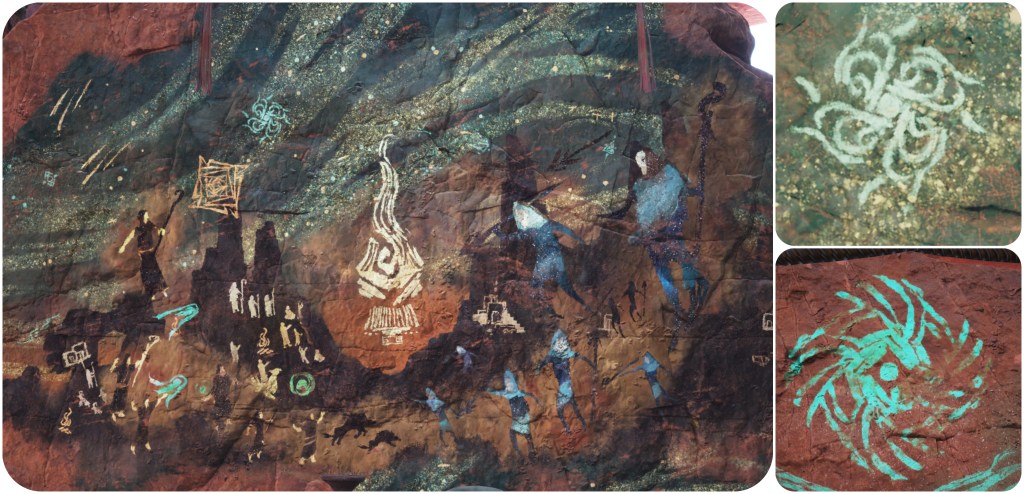
The murals depict two different scenes. There are three variations of the Cetra around a campfire, and another closer image which shows them pushing the Gi into the cavern.
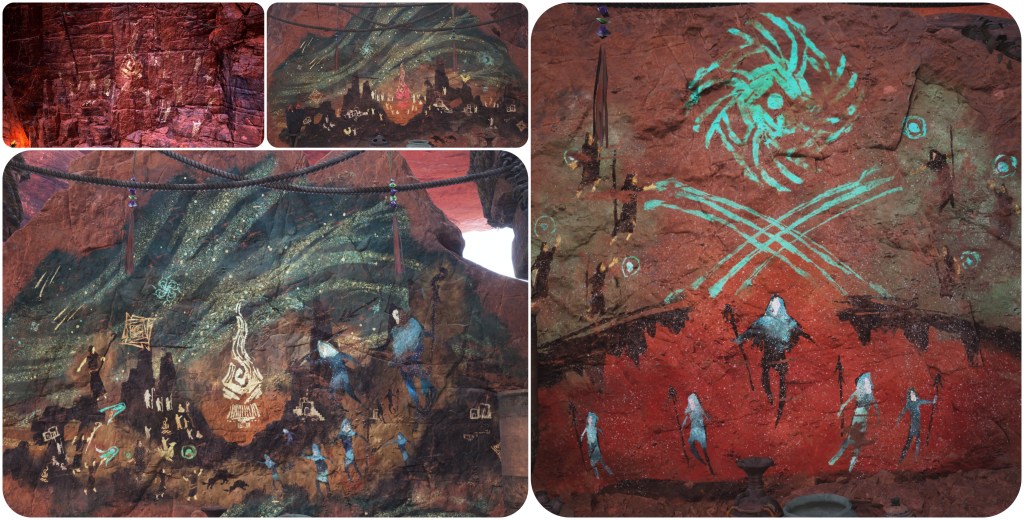
Within these drawings, there are four symbols featured. A yellow tesseract similar to the Temple of the Ancients and a yellow star. I’m not sure what these mean, but they seem to pertain to the Cetra’s civilisation. This is very loose and lazy, but since the star looks a bit like a shuriken, and The First SOLDIER has gone out of its way to introduce a group of Wutaian Cetra, maybe they’re simple indicators of tribe. Like the northern Cetra and western Cetra met up in Cosmo Canyon for a bit. Then there’s two teal-coloured swirling shapes. One I interpret to be the Gi Tribe’s vessel entering Gaian airspace, and the other seems like a magic circle which has arguments for Gaia and Terra. That is, assuming these two teal shapes are different objects.
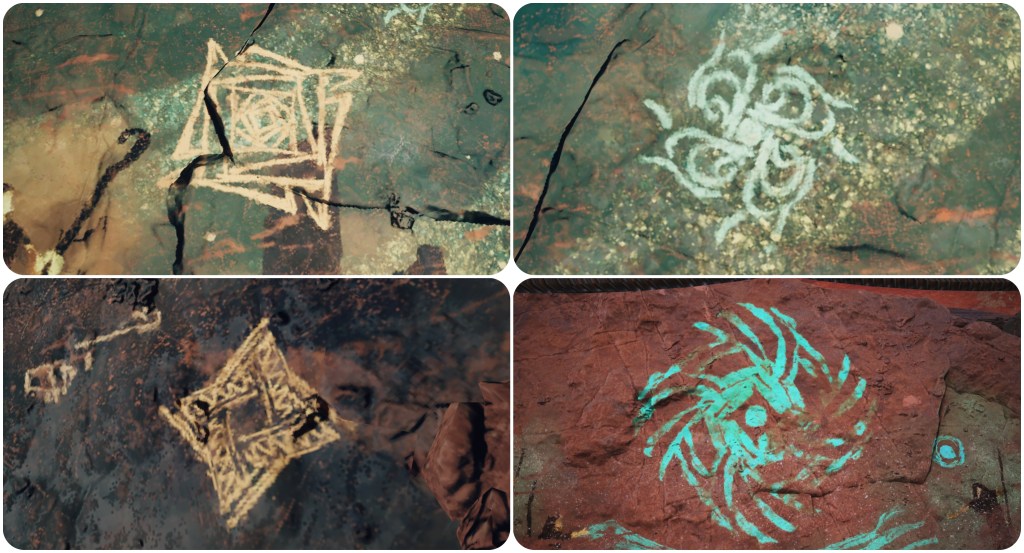
On one hand, that second spiral is almost assuredly meant to be the same galaxy symbol found on a flag in Cosmo Canyon, though whether Bugenhagen truly understands its meaning it another question entirely. A Cetran magic circle used to move platforms around at the temple also looks quite similar, which makes me consider if this is indicative of the Cetra opening the earth and banishing the Gi into the depths. However, it also looks a bit like the design seen on a Gi elder’s necklace. My personal conclusion is that the celestial body is something else, while the magic circle thing is how the Cetra ultimately sealed the Gi Tribe.
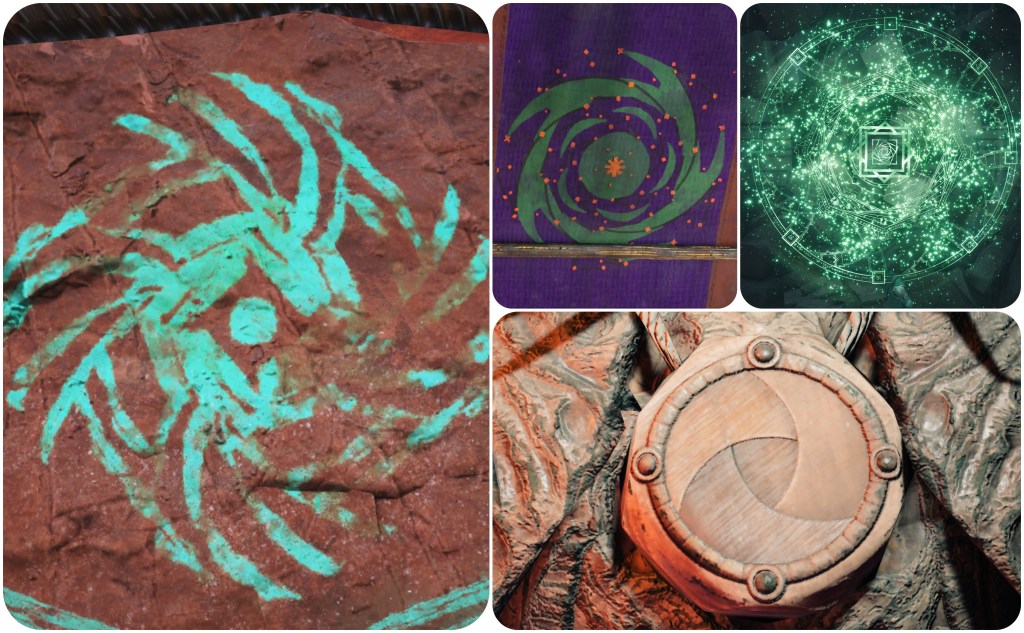
The murals outside the Sealed Gate all feature this teal body, but the faded cave painting at the Jabberwock’s den doesn’t have it in the sky. Despite being incredibly weathered it can still be seen that the Cetran symbols in the valley are present, and the night sky is drawn in, but that thing looming in space is not. Since the Jabberwock is an enemy you have to unlock through the World Intel quest for Cosmo Canyon, as well as actually having some arguments for being of Terran origin itself that I’ll address later, I’m assuming this absence to be important. That might be proving to us that the object is not a normal constellation, but something which appeared and set off the chain of events that landed the Gi onto the surface.
However the necessary timeframes make the idea of a spacetime shift impossible, since we have solid reason to believe that Jenova had preyed upon the Gi Tribe. Jenova is known to have arrived on Gaia roughly 2000 years before the start of the game, but the Gi landed “many millennia ago” and then spent “an eternity” forging the Black Materia. If it was a catastrophic teleportation event, then there should have been no time delay between the two aliens arriving. Jenova would have been swept up by the same force that moved the Gi Tribe. I also just don’t feel like this reading would fit with the way that FFVII Rebirth has presented its subworlds. All of the alternate worlds or timelines we’ve seen are still clearly based on Gaia’s main one, making it hard to imagine that an overlapping dimension could be so drastically different as to give rise to the race of Gi giants. So no, a dimensional shift is not my answer for how they came to be on Gaia.
Instead I’ve got something that I much prefer, feel is better supported by the evidence, and itself supports a lot of other evidence. Plus its imagery is just plainly more exciting.
How did the Gi Tribe reach Gaia then? An ark?
Gi Nattak recounts that his world was subsumed by this one. What does that actually mean? There are two main interpretations I can think of. The first of which was the prior suggestion about dimensional fusion.
- Gi Nattak: “With the passing of eons, the star we called home began to wane…until at last it was subsumed by your own. The earth shook, seas boiled, skies shattered and time stopped. Few of my people survived the chaos and calamity. Those who did began a new life here.”
However, my preferred explanation for Gi Nattak’s tale can be found by focusing on his wording that Terra “waned” and was then “subsumed” by Gaia as a result of “chaos and calamity”. That it was absorbed, assimilated, consumed. If not a calamitous dimensional transition, we could interpret this as Gi Nattak saying that the Lifestream on Terra had grown so weak that its Omega Weapon was activated. Omega, as detailed in Dirge of Cerberus, is the Weapon activated on a planet during its death throes. The Omega Reports prophesy that if the planetary consciousness determines its environment to truly be beyond repair, it manifests an entity called Chaos to execute every living being on the surface, returning all souls to the Lifestream. Omega would then ingest the Lifestream and depart into space, functioning like an ark that contains all their spirit energy and souls while it searches for a new home.
- Lucrecia (Dirge of Cerberus): “Omega. The end. Just as all other sentient beings, he too, is born of the Lifestream. However, his only purpose is to cleanse the planet of all things living and lead their immortal souls through the abyssal aether to a new beginning far, far beyond the neverending sea of stars. Just as life circulates through our planet, so too, does our planet through the universe. Or at least in theory. However, what I can be certain of is, if Omega awakens, then all life as we know it will end. And when Omega has embarked on his journey to the cosmos, our planet will wither and die.”
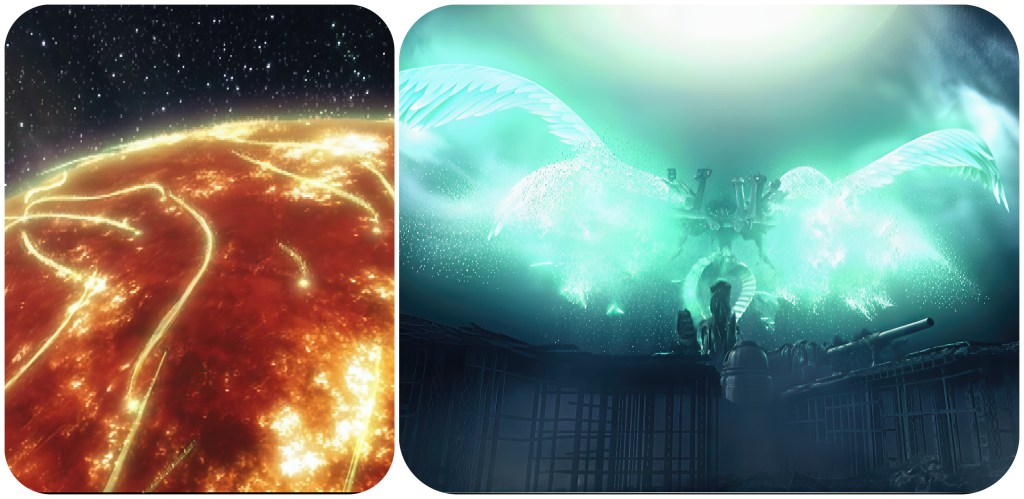
Recall Bugenhagen tells us that with the Lifestream extinguished, the planet is left as an empty husk that quickly crumbles away. A similar scene in Dirge of Cerberus illustrates to us more specifically that when Omega is summoned it drinks the entire Lifestream, returning the planet to a primordial ball of fire. The only reason this didn’t happen in Dirge of Cerberus is because Hojo and Weiss induced the awakening of the Omega Weapon early. On the day of planet Terra’s death, however, this may explain why the ground quaked, the ocean caught fire and the atmosphere evaporated. It was calamity that heralded Omega’s awakening. So, their Omega Weapon crash-landed on Gaia for some reason and subsequently had its own weakened Lifestream absorbed, leaving the Gi stranded as these wandering spectres with no afterlife to return to.
The three accounts we have for how the Gi reached Gaia come from Bugenhagen (who loosely recounts their history with the vale), Gi Nattak (who mourns the death of his star through riddle), and the set of three murals that lead up to the sealed door. These first two cave paintings seem to depict a shape in the sky approaching Gaia – whether a planet, portal or something else – then dropping the Gi onto the land. It’s not specifically canon, but Maiden Who Travels the Planet does have Hojo suggest that Jenova is just one of many interstellar visitors throughout the planet’s vast history.

The representations are rudimentary, out of scale and perhaps metaphorical in that cave painting kinda way, but there is a celestial body depicted in the sky. While its shape is abstract, it does have a main body surrounded by four teal extensions, which to me, is something we could interpret as a top-down view of the Omega Weapon, which also has four teal wings and long tendril-like legs.
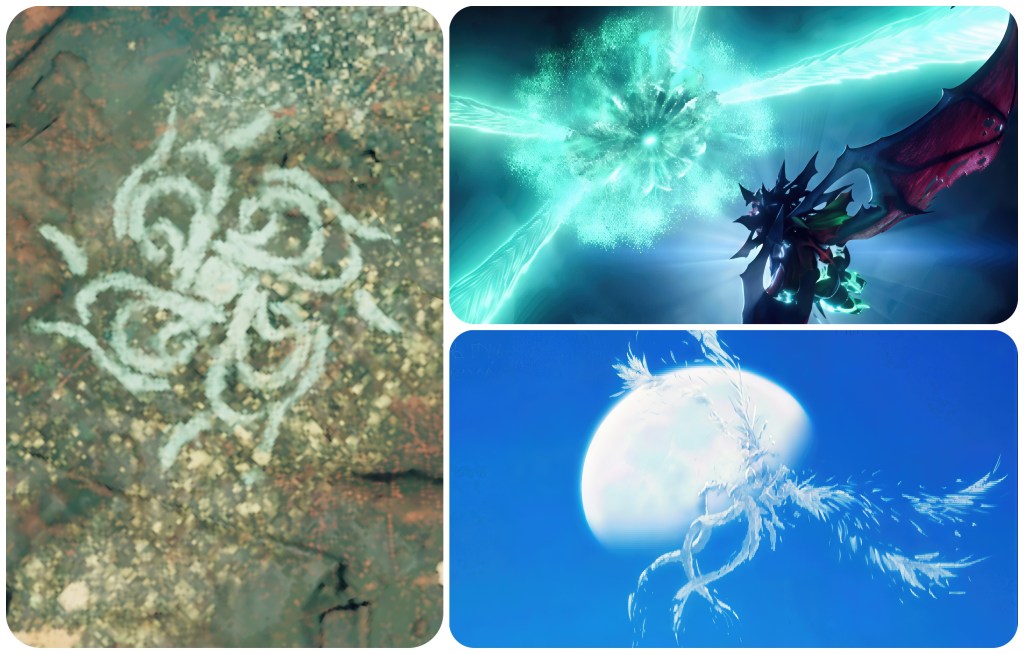
Now, this Omega Weapon theory isn’t without its own issues. For example I’m not entirely sure it lines up enough to Gi Nattak’s recount of the environmental calamity in the final days of his planet. Whereas the catastrophic dimensional transition, while less exciting, has some precedent already in Final Fantasy V, and may line up better with the FFVII Remake project’s greater focus on alternate worlds and the layered nature of reality. However, the time delay between the Gi and Jenova arriving disproves the dimensional shift. That cannot work, in my opinion. With that said, considering everything else I’ve discussed shouldn’t their Omega Weapon actually be red? Yeah. Probably. I’m just gonna ignore that though. Based on my assumptions its wings probably should be red yes. But, oh well. It is possible to alter the reading to where the different Lifestream colours are all actually just an emotional spectrum, and red simply represents rage, death or rejection by the Lifestream, instead of being uniquely Terran. However, while that honestly might be more fluent, it’s also less interesting so I’m going down my preferred avenue where red is Gi in origin. So maybe the Cetra just drew it wrong. Or maybe more likely I am wrong, to where this is not an Omega Weapon in the drawing plus the Gi were not dropped off by their Omega. And yet, I still like this theory and consider it the most valid. For the Omega Weapon theory, probably the biggest roadblock is that Gi Nattak alleges some of his people survived the calamity then made their new home on Gaia. How do you survive the Omega Weapon? Dunno. I don’t know that you survive any of the doomsday scenarios needed to address this. Lucrecia does say that the Omega Weapon would “cleanse the planet of all things living and lead their immortal souls through the abyssal aether”, but that still involves them all being killed and reverted to unsent souls anyway. My heart still says Omega though, and my discussion will continue to say Omega Weapon.
Aside from the lack of red wings, are there any other issues with the Omega Weapon theory?
I’ve settled on, or at least will be proceeding with, the Omega Weapon scenario. My main point of hesitation I’d say is that, like the other situations, there is a good chance that Jenova probably should have dropped on Gaia at the same time that the Gi Tribe did. In order to justify this interplanetary evacuation, we just have to assume that Jenova failed to assimilate, or even simply latch onto, the Terran Omega Weapon. However unlike the planetary collision or dimensional shift, her getting left behind on Terra is a far easier claim to justify. Maybe the Gi or some other race on Terra had subdued Jenova before Omega awoke, so she was in stasis when it launched. Or maybe the Omega Weapon simply overpowered her. FFVII’s original ending sort of carries that same vibe, where ultimately everything that happened throughout the game was a little pointless, because when push came to shove the Lifestream was stronger than Meteor, Holy, Jenova and humanity. The planet rose up to defend itself with an unmatchable fury. So the Omega Weapon might have simply been above Jenova’s weight class.
Have the Gi always been in that cavern below Cosmo Canyon during their time on Gaia?
Gi Nattak suggests that some of his surviving people tried carving out a new existence on Gaia before the intolerant Cetra destroyed them. It was their disembodied spirits that then took refuge in the depths below Cosmo Canyon, to hide from the persecution of Gaia and the Cetra.
- Gi Nattak: “Be quiet. The planet is listening. Anything that reaches the planet’s ears, in due time, reaches those of the Cetra. Unfortunately, the Cetra are not a…tolerant people.”
- Gi Nattak: “Few of my people survived the chaos and calamity. Those who did began a new life here. But, to the planet, we were not welcome. Not in life, nor in death. Those not born of the lifestream can never join its flow. One cannot ‘return’ to that from which one did not arise. And so, our souls sought refuge here.”
By scoping out the vale using freecam, I noticed that there’s a mural located outside the cavern which depicts the Gi and Cetra feuding within the canyon itself. The Cetra are perched on the tall mountain, while the Gi are illustrated near to the archeological ruins. If I continue with the assumption that the Gi’s Omega Weapon crashed on Gaia, it would have dropped them off on the surface as depicted in this mural. In fact the painting does have something in the sky that could be representative of the Omega Weapon’s wings and tendrils. It’s a teal-coloured dot surrounded by four swooshes and lines coming off that may be its feathers. While primitive in design, I can see an interpretation of an Omega Weapon in here.
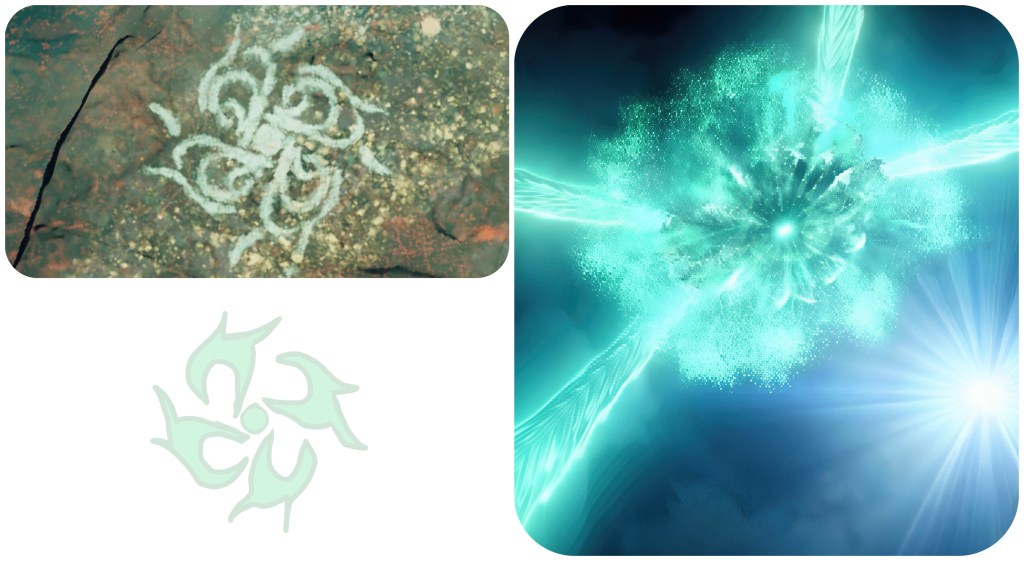
The ruins in the canyon appear to be of Cetran origin due to their architecture matching with the Temple and City of the Ancients, as well as the presence of a Cetran golem. Gongaga’s Ancient ruins are distinctly different to any other, built from another type of stone and square doorways instead of arches, but this likely just owes to the region and early time period in which it was built.
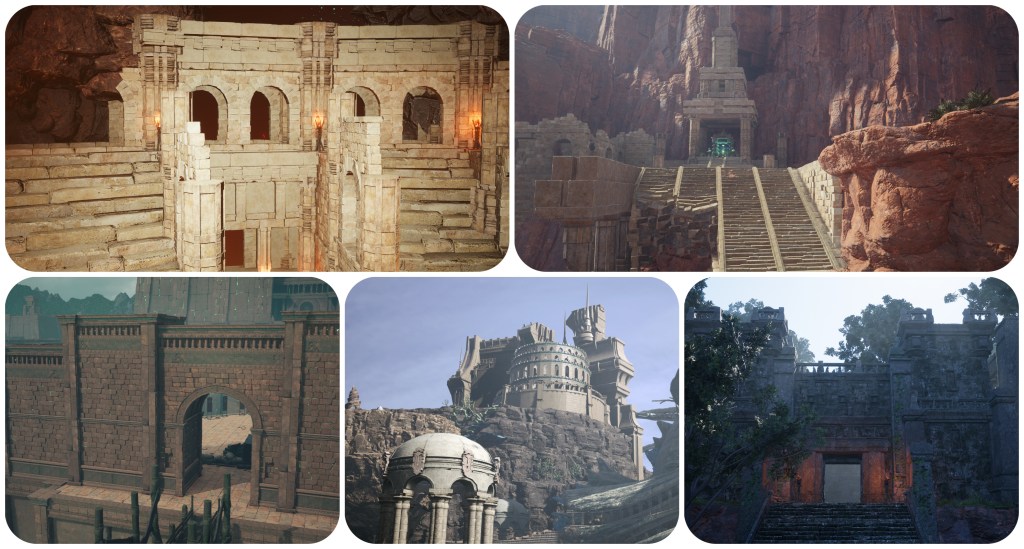
- The Cetra and the Gi (World Intel): “In the distant past, the Cetra made contact with the Gi, entities who could not return to the lifestream. Pitying their plight, the Cetra built altars to commune with and calm these tormented souls in the hope of finding a means to coexist peaceably.”
While the ruins are Cetran, we can however also locate a few Gi statues aboveground in some dark corner of Cosmo Canyon. These statues, together with the mural and Gi Nattak’s claim about the survivors trying to carve out a new life on Gaia, make me inclined to believe that the Gi were trying to rebuild their culture in Cosmo Canyon when they first arrived.

What’s this tusked skull I mentioned in the Village of the Gi?
Looking closely at the decorative masks placed throughout their village, a number can be found which heavily resemble both Jenova Dreamweaver, and effigies in the Temple of the Ancients. A somewhat similar face is also seen on the Soul Flames, and spotted in the fires of Gi Nattak’s Phantasmal Scourge and Doom spells.
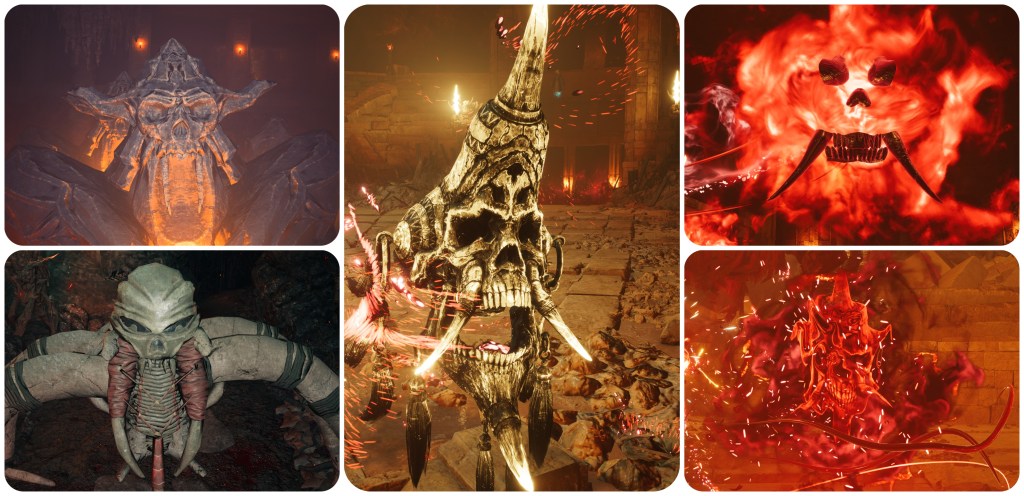
The masks are attached to some kind of ceremonial lantern constructed from a dead tree, with purple wisps floating about instead of the expected red. The Rebirth Material Ultimania describes these lanterns as being “distorted by a mysterious force”.
- Final Fantasy VII Rebirth Material Ultimania (Pg 133, Google Translate): “A bonfire lantern that has been distorted by a mysterious force. Various masks are hung from the twisted roots of a tree.”
Why do the masks exist? Based on my other conclusions I would think that the Gi incorporate it into their ceremonies because Jenova was once considered some kind of ruler or deity on Terra, or because Jenova had destroyed Terra and the Gi are now wishing the same fate upon Gaia. Whereas the skull-faced demons in the Corridor of Apocalypse are probably representative of how Jenova’s doppelgangers, servants and clones had begun infiltrating Cetran society, since there are numerous of these creatures intermingled with the statues of robed Cetran shamans.
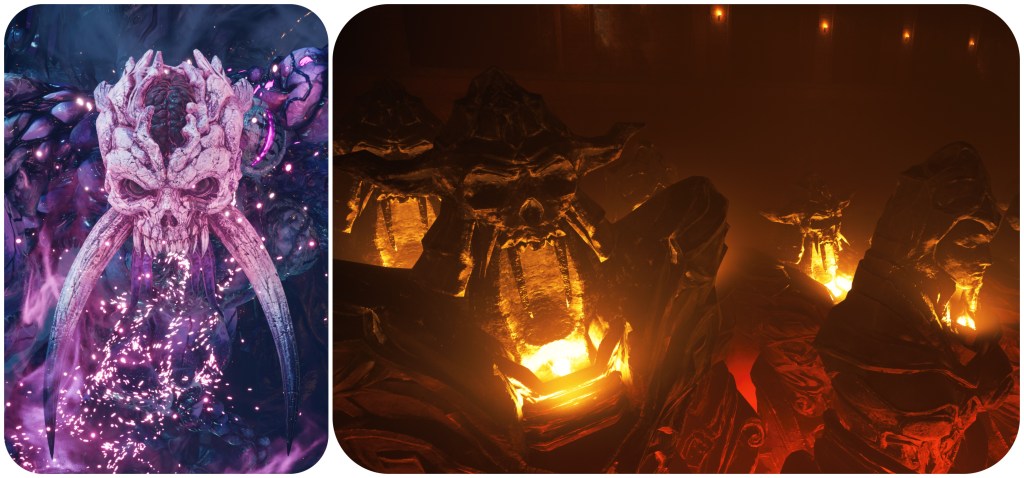
Additionally, it’s possible to theorise that the Cetran effigies may be depicting a stage of Jenova’s evolution we haven’t yet seen in the Remake games. It has a distinctive triangle shape at the top of its head, which was present on the 1997 Jenova models, but the contemporary designs have all had a cracked skull in that spot instead. It also has these wide pointy ears, which were absent on Dreamweaver and Emergent, but the horns on Lifeclinger may be indicative of those ears beginning to redevelop.
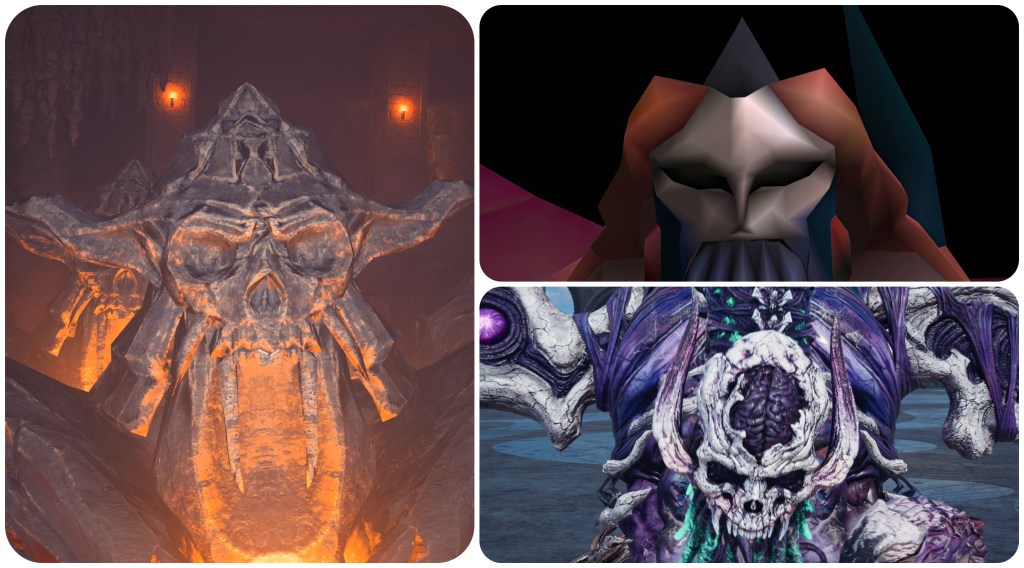
I do also notice that this version seems to have a large, open gap beneath the skull that almost resembles a giant gaping mouth. This same feature is witnessed on the Blighted Spirit and Diabolic Creations.
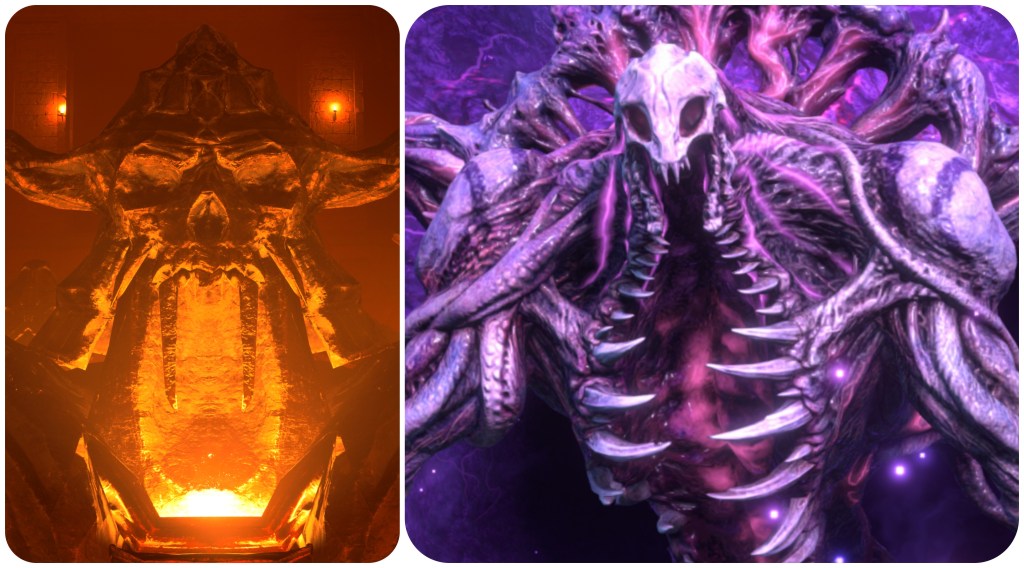
There are other ways to interpret this skull design, but that’s a conversation for much later.
What are the non-Jenova masks meant to be then?
I think that these masks might possibly be telling the tale of the Gi Tribe’s contact with Jenova. There are two categories of mask seen here. Gi mutations, and then some kind of monsters. To begin with, we have four kinds of Gi mask. A broken cranium, the standard one, a more demonic exaggeration with sharp teeth, sharper eyes and a secondary jaw, then finally one with tusks that’s near-identical to the larger stone face at the Shrine to Oblivion.
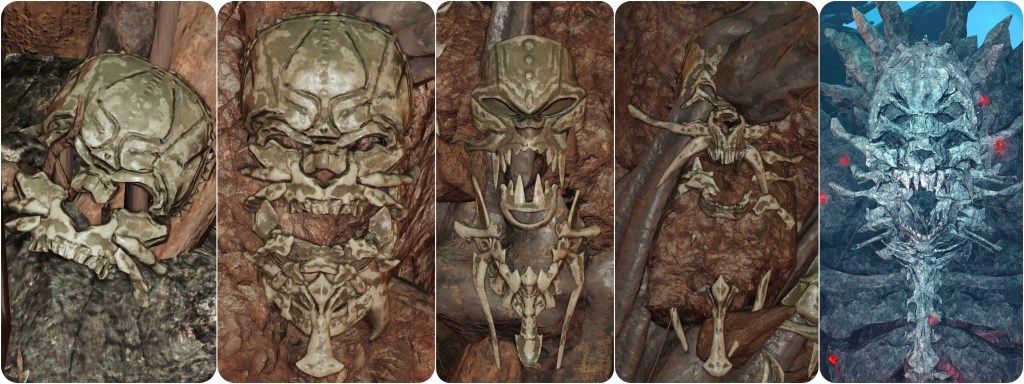
The remaining six masks I might then interpret to be different fragments of Jenova, since Sephiroth states that one of his goals is to reunite Jenova into her complete form.
- Sephiroth: “My fragmented mother, these errant worlds…All shall be one again.”
So we have to identify six different instances of Jenova, right? Well, I think we can account for three or four right now. We’ve thus far been encountering the main one with the skull and tusks, which matches to Jenova Dreamweaver, Emergent and Lifeclinger. Based on the flashback in the Temple of the Ancients, this design is likely the one from the northern Knowlespole region. The elongated mask loosely resembles the Blighted Spirit, and the protrusions at the top may be representative of that form’s back features. This Jenova is from the west, encountered at the bottom end of the Wutai peninsula. Another is possibly the Buno D’rhad from the Rhadore archipelago, which we cannot yet pinpoint the location of on the larger world map. I’d like to say that one should also be the six-eyed idol, since the Black Materia mural indicates this should be Jenova rather than Gi Nattak, however the mask which most resembles that beast is part of the Gi set. So I don’t know how to proceed on that. One of the leftovers should be the Shadowblood Queen from the ancient Gongaga region, we simply never got the chance to know what her transformation would look like. The remaining few are yet unaccounted for.
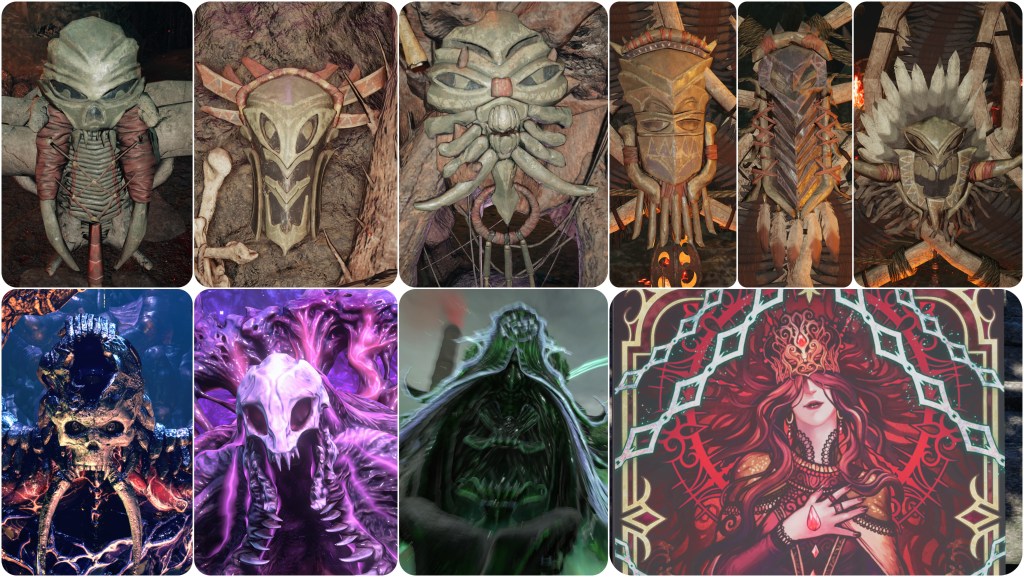
Is Buno D’rhad related to the Gi?
Although Jenova’s main body has long since been sealed away at the time of the Rhadore invasion, parts of her flesh or spirit are still known to be scattered across the planet, such as the Masamune in the Igara region or the chunk recovered from a glacier in The Kids Are Alright. While searching for other possible fragments of Jenova, I could see this being a candidate. During this story, Sephiroth loses a locket which contained his only photo of Lucrecia. When the Buno D’rhad appears, this locket ever-so-conveniently happens to wash up from within the Lifestream, just in time for Glenn to kick it away and damage Sephiroth’s emotional state. That reeks of Jenova to me. It uses similar attacks to the Blighted Spirit (which is Jenova), and would then establish a consistency where episode 1 and 2 both clash against a previously unknown regional inacarnation of Jenova. Buno D’rhad and the Gi both feature tribal death masks. It also has a purple haze lingering on its hands, and silver hair much like most Jenova creatures.
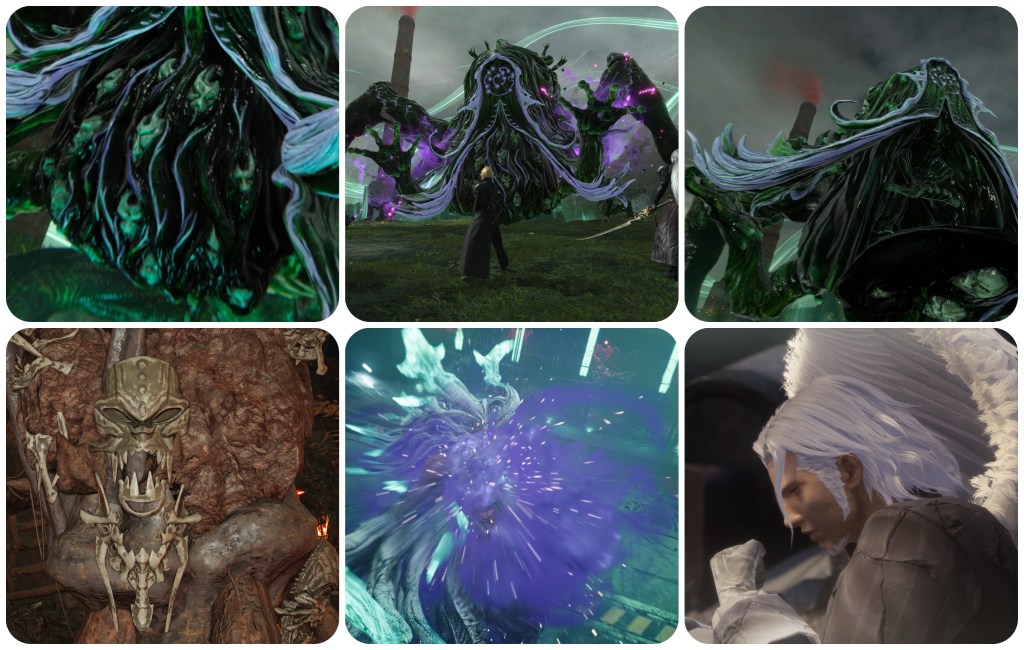
Matt wonders if Buno D’rhad is perhaps a product of the mako mutations, or maybe even embodying the will of the planet itself, so it could possibly be a kind of Weapon. However, I think there’s reason to assign it as a fragment of Jenova.
Why do the Gi loathe the Cetra but respect brave and noble Seto?
For the same reason they worship the genetic scourge that tore them from their home world: the Gi seem to be a warlike people. Seto slunk into the bowels of hell alone and sealed their spirits away, fiercely overpowering them all even as his body turned to stone. The Gi Spectre foot soldiers do nevertheless still speak of Seto as a villain who they seek revenge upon, but their leader Gi Nattak yet admires his ferocity. This is unlike the Cetra who had marched against the Gi as an organised, genocidal group and committed theft upon their sacred artifact.
- Gi Nattak: “Unfortunately, the Cetra are not a…tolerant people. Consider your ignorance a blessing. The Cetra’s past is fraught with horror and sorrow.”
- Gi Nattak: “O brave and noble Seto… I beseech you once more… Hear the urgent pleas of my people. My thanks, Seto. You are as magnanimous as ever.”
- Gi Spectres: “Though we had braced ourselves for battle, we found ourselves captivated by his resplendent mane. He was a beautiful creature in both body and soul. So swayed were we by his courage and sincerity that we chose to entrust with him our singular desire. As a confidant, our secrets he would keep. As a penitent, our vengeance he would accept.”
Did the Gi Tribe use the Black Materia to summon Jenova’s meteor?
Considering the rest of the connections I’ve made, you’d think my answer would be a resounding yes. Of all the puzzles in this script, Meteor should be the single most logical one to agree with. It’s maybe three quarters of the reason anyone would think to connect Jenova and the Gi to begin with.
Not that simple actually.
Is Gi Nattak the narrator from the announcement trailer who discusses the foreboding sky and star that threatened all?
First, the transcript of this trailer:
- “Long ago, we looked upon a foreboding sky. The memory of the star that threatened all burns eternal in our hearts. In its wake came an age of silence. Yet with each fond remembrance, we knew those encountered were not forgotten. That someday we would see them again. Perhaps it was no more than wishful thinking. But after the long calm, there are now the beginnings of a stir. The reunion at hand may bring joy, it may bring fear. But let us embrace whatever it brings. For they are coming back. At last, the promise has been made.”
I see why people might read it that way. The narrator does sound like it’s Gi Nattak remembering the time Jenova’s meteor hit planet Terra and being glad that Cloud’s party has promised to return the Black Materia. Notably, a pair of Gi Spectres in the Promises to Keep sidequest say “and thus the promise has been made” when Nanaki reiterates his desire to free them from their purgatory, which is near-identical to the closing line of the Meteor-themed trailer.
However, this whole passage is a double entendre. If we approach it as an in-universe parable then the only two possibilities are that it’s either someone post-Meteorfall reflecting upon the final days of FFVII, or Gi Nattak recounting that Jenova had hit his planet as a meteor, killed everyone, and now he’s joyous at the idea that summoning Meteor with the Black Materia may finally reunite him with his people. The meta reading however, which I’d say is the more intended message, is that it’s just speaking to us as a fanbase. Once upon a time we had Final Fantasy VII, it was very cool. The logo was a meteor. Then after the PS3 demonstration in 2005, gamers spent a decade fervently begging for a remake with no response, until the promise was finally made in this 2015 announcement. It’s like the Whispers, right? In-universe they’re these arbiters of fate, but metaphorically they are us as fans of the original trying to oppose any changes to the story structure, while also enacting our silly fanfiction ideas like ‘what if Cloud and Zack fought together’. Or Sephiroth declaring that he’ll “never be a memory”, which is directed at us just as much as it is Cloud. There are numerous instances of FFVII using these double-entendre metaphors, and “the memory of the star that threatened all” is one such example.
Accordingly, the two voice performances may sound incredibly similar, but the narrator in the announcement trailer is unmistakably David Lodge (Jiraiya from Naruto), while Gi Nattak in Rebirth is Bruce Thomas. I’ve tried to find this original announcement trailer in japanese in order to see if other languages made them sound so alike as well, but given that the english version has japanese subtitles I think this is the only audio to exist.
What is the case against the Gi summoning Jenova’s meteor?
We don’t have exact timeframes, but based on my other inferences it’s certain that the Gi were drawn to Gaia in antiquity, far earlier than Jenova. Maybe the planets existed in overlapping dimensions before they were fused (similar to FFV), maybe their Omega Weapon crashed into Gaia and was absorbed. Regardless of how they got here, Bugenhagen says that they arrived “many millennia” ago, whereas Jenova is known to have been here for a definite two millennia and had free reign for 1500 years at most. This is further substantiated by the Hall of Murals, which depicts the Gi Tribe warring against the Cetra for possession of the Black Materia; That is, the Cetra had not been decimated by Jenova’s pandemic during the point at which they were battling for the orb. So the Gi surely predate Jenova’s presence on Gaia, and from there you might consider it a logical next step that the object of their conflict – the Black Materia which summons Meteor – must be pertinent to the meteorite which brought Jenova onto the planet. Easy connection to make, right? A meteor is a meteor is a meteor. Except for when it isn’t – I’ll get to that soon. I can see why many people feel that the symbolism must be sequential, meteors are…kind of important in FFVII, so even in the original there’s always been an unexplored idea that maybe the Black Materia had been responsible for calling Jenova’s meteor in the past. It sounds so simple.
And yet, the Gi casting Meteor doesn’t seem to work that well in the actual details. While the Cetra’s prophecy and mural may leave some small ambiguity, Gi Nattak (the man actually in question) says that the Cetra trespassed upon their land and stole that which would grant them deliverence, the key to their oblivion. That is much more directly saying to me that the Cetra prevented the Black Materia from being used. The World Intel titled “The Cetra and the Gi” echoes this sentiment.
- Gi Nattak: “After an eternity…the materia began to stir […] Yet the loathsome Cetra trespassed upon our lands and stole the treasure that would grant us deliverance.”
- The Cetra and the Gi (World Intel): “In the distant past, the Cetra made contact with the Gi, entities who could not return to the lifestream. Pitying their plight, the Cetra built altars to commune with and calm these tormented souls in the hope of finding a means to coexist peaceably. Over time, the Cetra grew increasingly aware of the dire fate that would befall the planet, and resolved to entrust their knowledge to the people of Cosmo Canyon.“
The implication in this intel is that the Cetra realised the Black Materia’s destructive potential over time, not that they directly saw its magic used.
Gi Nattak states that the Cetra stole the awakened Black Materia before it could deliver their salvation. Yet, we know how Meteor works. We’ve seen Meteorfall depicted in FFVII, Before Crisis, Advent Children, Dirge of Cerberus, Remake and Rebirth. Once the spell is cast, Meteor approaches the planet autonomously. If the Gi had used it at all, then it was already too late for the Cetra to intervene.
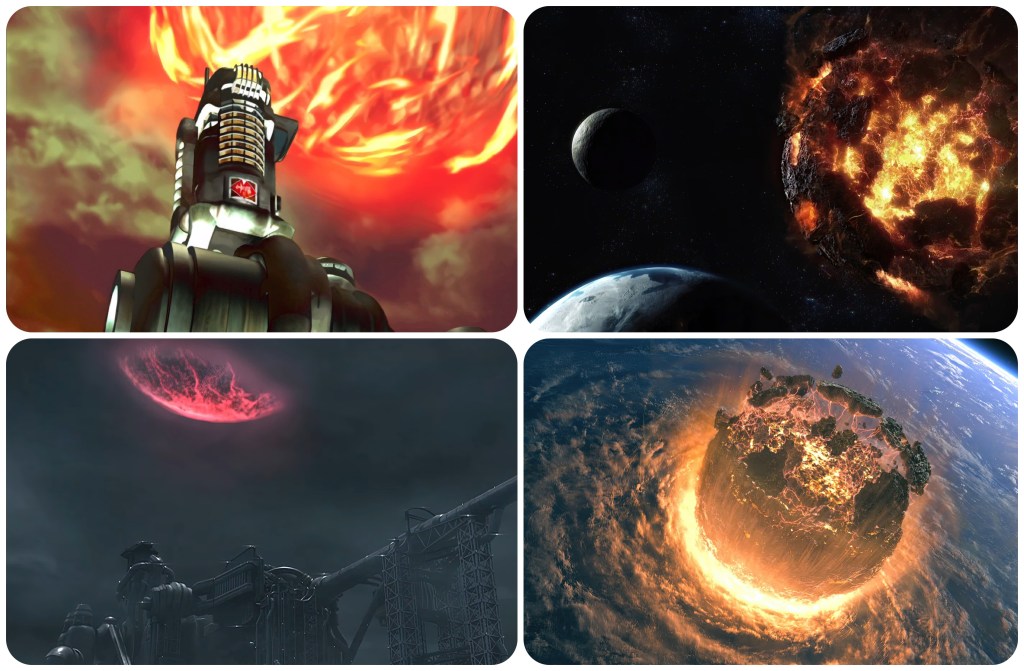
Some potential counter to this I have considered is that with the White Materia, there’s a whole plot thread about how it has to start glowing green in order to signify the activation of Holy. Bugenhagen and Cloud focus on that detail of it still shining even while plummeting into the depths as indication that it was working.
- Bugenhagen: “Get the White Materia. This will bond the Planet to humans. Then speak to the planet. If our wish reaches the planet, the White Materia will begin to glow a pale green.”
- Bugenhagen: “Ho Ho Hooo!! It’s pale green!!”
- Cloud: “..Aerith has already prayed for Holy.”
- Cloud: “Holy is there. Holy is shining…Aerith’s prayer is shining!”
So perhaps the Sacred Materia are unique in that they need to remain active for the entire duration of their spell, and the Cetra therefore interrupted or reversed the Gi’s deliverence when they took the Black Materia. Yet even if the Black Materia had to continuously be active, continuously be shining, in order to gravitationally pull Meteor into the planet, then that would mean that the spell had completed if it was responsible for pulling Jenova’s meteor into the atmosphere. The Cetra could not have deactivated or reversed Meteor by claiming the Black Materia from the Gi, since Jenova’s meteorite did impact the planet. Were Jenova’s meteor that which they were calling, then the Gi have succeeded. So that interpretation would affect nothing either. In order to justify the Black Materia having been used once before, then you have to say that the Gi somehow used it cast a lesser spell that only attracted a (comparatively) smaller meteorite, and that they were still somehow charging it with their magic and hatred in preparation for the true Meteor even after the Cetra had sealed it away in another plane of reality. I suppose there’s some small wiggle room where you could imagine that the Meteor spell pulled Jenova close to Gaia, the Cetra obtained the Black Materia and deactivated it, but then Jenova used her own magic to send the meteor down into the planet and finish the job. Again though, in that case the Gi’s wish would be considered fulfilled because Meteor made impact. So thematically or narratively, I can’t subscribe to that idea of a lesser Black Materia spell. Meteor is the destroyer of worlds, the ultimate destructive magic. The Cetra say so blatantly. Even the ultimate white magic Holy could not stop it, in fact we see at the end of FFVII that Holy sped up Meteor’s rotation and accidentally made its destructive capacity stronger. Nearly the entire Lifestream itself had to rise up to the surface in order to catch Meteor before it could hit. Jenova’s meteorite did make impact though, so if that was the Black Materia having been used in the past then it would have accomplished its goal of ending the world.
For the Gi using the Black Materia in the past to make sense, they require access to a much weaker Meteor spell that just so happened to catch a nearby rock with Jenova’s genetic matter on it, instead of Sephiroth’s full-scale spell that casts a magical gravity net over a small planetoid. This is one of the few ways that could support the stance that the Gi had called Jenova to Gaia through Meteor. But that’s a big assumption, which I don’t believe is supported. You see, Gi Nattak tells of the Black Materia that:
- Gi Nattak: “From the planet, we claimed the greatest of materia – a most sacred treasure – and imbued it with our desire for freedom. After an eternity…the materia began to stir. And thus did we rejoice, knowing that salvation was within our grasp. We rejoiced, so convinced were we that our prayers for release had not been in vain. Yet the loathsome Cetra trespassed upon our lands and stole the treasure that would grant us deliverance. Therefore, we ask that you retrieve it – the black materia, key to our oblivion.”
- The Cetra: “The Gi, who with bitter prayer forged the black materia. So foul was the orb’s magic that we knew at once it must be hidden, that none might ever wield its terrible power.”
The Black Materia is formed from the centuries, millennia, eons of the Gi Spectres focusing their deathwish into an especially sacred Materia that they looted from the Cetra. Eventually, after what is described as an eternity, the Materia became viable. So it’s not like the Black Materia could even be used to cast a weaker Meteor. From the time at which it’s completed by the Gi, sealed away in the Temple of the Ancients, retrieved by Cait Sith and then pulled out of its pocket dimension by Sephiroth, the Black Materia should be at full magical charge and likely does not accrue any more of the Gi’s negative energy, since it was removed from their reach by hiding it in another dimension. The potency that Sephiroth uses it at is the potency that the Gi would have used it at – the destroyer of worlds. Meteor is all or nothing, and the Cetra intervened before it could be fired off. I get that the imagery is there – the Gi hate the Cetra and seemingly worship Jenova in their ceremonies, they birth the Black Materia that pulls Meteor into the planet and had done so before Jenova’s meteor eradicated the Ancients – I see it too, but the Cetra yet claim that the ultimate black magic had not been cast, and the Weapons had not been drawn. Unfortunately, I just don’t believe that there’s any room for this interpretation when both relevant parties are stating the Black Materia was stolen before use. A lot of plot points or imagery would be far easier to resolve if we could just say that the Gi summoned Jenova’s meteorite, but in order to do that you have to straight up defy the dialogue, history and how we’ve known the Sacred Materia to function.
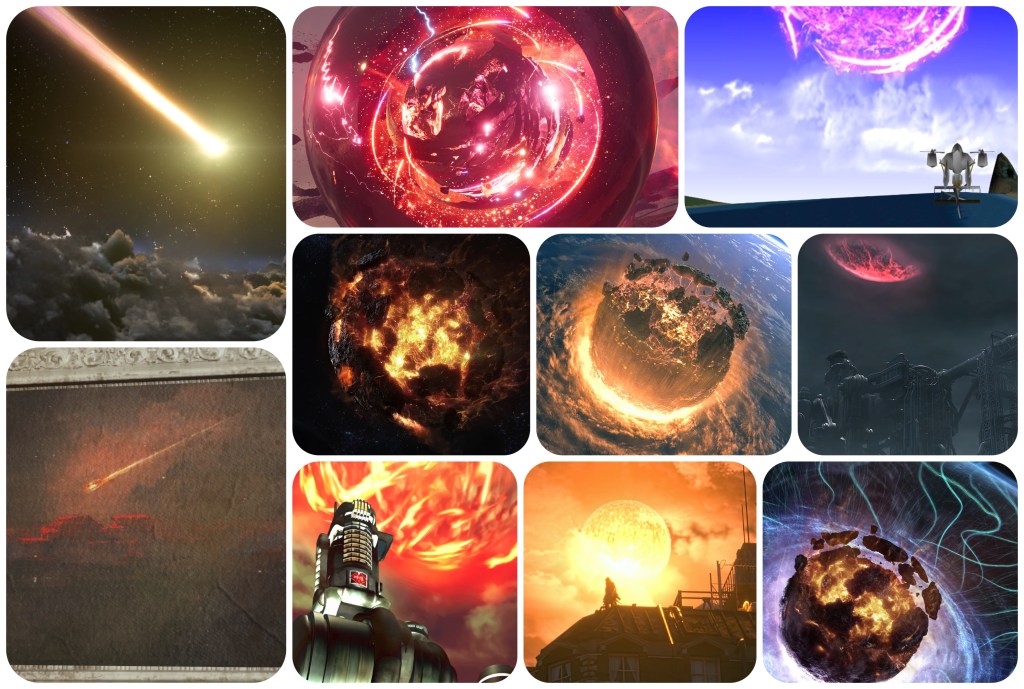
Since it probably needs to be clarified, the Comet materia could not achieve this either. Comet and Cometeor are totally mundane spells that generate large rocks or boulders maybe ten metres above the caster. In the original game that’s just a standard magic materia, in the Remake series it’s one of the many products of Chadley’s research. Cloud’s Meteorain Limit Break is similarly limited. Neither of these would have the Gi Tribe out there wrangling a massive celestial body. Also…they’re not the Black Materia, so they’re not relevant to the discussion.

Let’s talk about the Hall of Murals next. Previously I had said that arranging the murals together as four parts of one story makes a lot of sense. The Temple of the Ancients – that whole superstructure with its many dimensional layers – primarily exists as a sealing mechanism for the Black Materia, so the very inclusion of Jenova’s tale should therefore be part of it. From an insular perspective this does make sense. Viewing them from within the Temple of the Ancients without any regard for the wider world history, you might see this as one single story that supports the Gi having called down Jenova’s meteor. When you just chuck them into a collage it looks good, it flows well, I like it.

But you are arranging them to make them fit that progression. When the party are heading toward the Black Materia’s chamber, we encounter the murals in the order of humanity, the goddess, Jenova, the Gi forming the Black Materia, and then the Meteor mural. No matter how you slice it, that’s out of sequence.
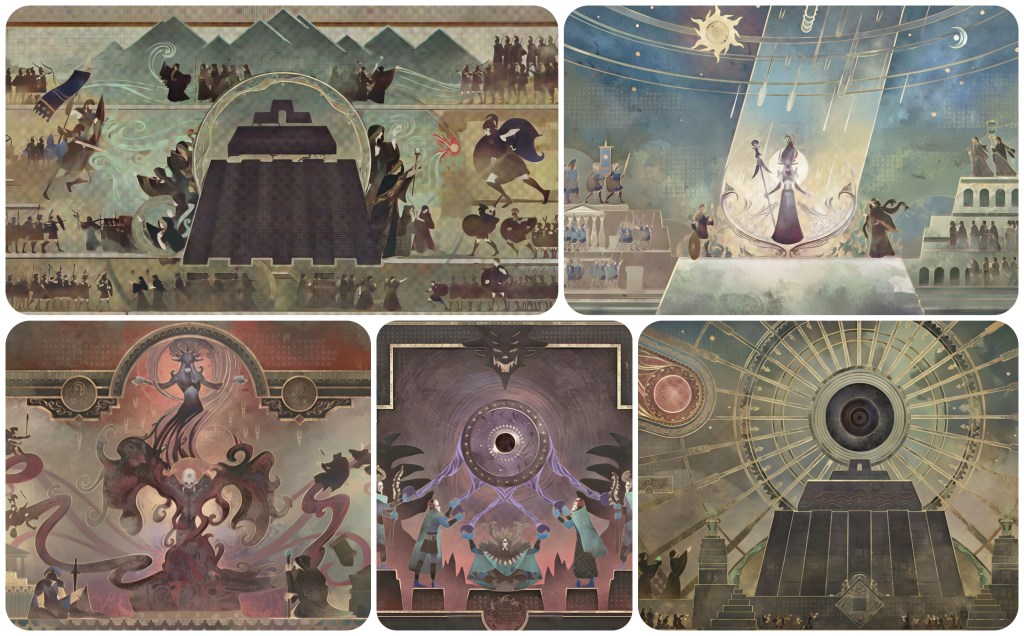
The war with mankind is the final chapter in Cetran history, so perhaps it’s reversed and the paintings actually begin at the innermost part. But that makes its ordering even more confusing. So in my opinion there are a few narrative issues with treating them as one storyline. The Hall of Murals does incorporate a retelling of Jenova’s war against the Cetra, but it also tells the story of how the humans had driven the Cetra to near-extinction – an event which takes place after Jenova had been sealed by Shiva and the people of Knowlespole. The murals, I would thus say, are likely to be separate conflicts. Not a single Gi is glimpsed in the Jenova paintings. They’re just saying like man look at all this stuff we had to deal with – please do not take the planet-smashing orb. There are no Gi tribesmen present in the Meteor mural either, and it depicts meteor being summoned to the Temple of the Ancients itself, rather than to one of the Cetran cities. So I’d sooner think that this mural is just a warning of what would happen if the Black Materia was used, not a historical record like the other murals are. The Temple of the Ancients may originally have been built as some dimensional puzzle to keep the Black Materia away from the enemy, but they have evidently repurposed it to double as a home for their souls, and a museum to display the scars of their history. See, while the Hall of Murals does dictate that Jenova may have motivated the humans to hunt the Cetra to extinction, this is a broad generalisation of their collapse. Jenova’s meteor didn’t instantly wipe them out, nor did the humans. The Cetra’s dominion over the planet was broken, but some small pockets of people did survive for a while yet. Ever Crisis shows us a group who had still existed in Wutai as recently as 500 years before FFVII. Therefore, some surviving remnant of the Cetra must have returned to the Northwood temple and added new murals about the war with the humans. And if they’d added that, then we can reasonably argue that they inserted the new history of Jenova’s attack as well. Perhaps all the murals were drawn well after the fact, and the reason that the Cetra painted Meteor with a tail is because the legitimate spell had never been seen before. That’s one thing which I think raises issues when trying to use the murals to link Jenova, Meteor and the Gi; They fundamentally cannot have all been painted at the same time that the temple was constructed to seal the Black Materia’s keystone, and so are just as likely to be separate chapters of Cetran history told through long-removed artistic interpretation.
Therefore, I’d say the more likely scenario is that Jenova hit Gaia by chance, or by her own discretion. Due to the purple colouration which we can glimpse at the end of the tail it’s possible that she was exerting her magic over the meteorite, or that she had morphed herself into a meteor similar to Lavos. I don’t really know enough about the properties of high-speed fire to tell whether that colour shift would be a totally natural and expected light phenomenon or whether it’s indicative of big-scary-psychic-alien-demon-magic. But nothing of its behaviour or appearance aligns with the Black Materia’s Meteor spell. We’re directly shown Jenova’s original meteorite during the Stewards of the Planet VR simulation, which at this stage I’m just choosing to believe is a legitimate representation on account of how Jenova and Sephiroth were inside that datastream hacking the simulation to show Cloud a catastrophic vision of the future. Jenova’s an alien, she can psychically interface with advanced technology I guess. We see the meteorite which signalled the end of the Cetra’s times. That rock which carried Jenova to the surface just appears to be a totally normal meteorite. It seems much smaller in size than Meteor, appears to enter at an angle due to the effect of the planet rotating and has a fire trail from the high speed with which it’s entering the atmosphere. Meteorites come in fast and carry a lot of potential energy, so the explosion from impacting the surface always creates a much larger crater than you’d expect. Google is telling me that it’s commonly at least 20x the size of the actual rock. While we don’t have any legitimate size reference as to how large that meteorite is, my gut instinct is that the visual does seem consistent with the size of the North Crater. At the very least, you can imagine it being so, which is absolutely not the case for the Meteor spell. Jenova’s meteorite is shown working like a normal meteorite.
The ultimate black magic Meteor, however, is not actually a meteor. Astronomically speaking, that’s a dwarf planet.
- Aerith (FFVII Ever Crisis): “The ultimate destructive magic, Meteor. It finds small drifting planets out beyond the sky. And then guides them to come crashing down. This planet might get wiped out entirely.”
- Final Fantasy VII Ultimania Omega (page 214): “Black magic Meteor. This is the ultimate destructive magic, summoning stars floating in space and bringing them down to earth.”
- Maiden Who Travels the Planet: “The Ultimate Destructive Black Magic Meteor was on the move. The devil’s hammer that would descend from the distant heavens to smash the Planet was summoned.”
The Final Fantasy VII Ultimania Omega describes as a spell that summons “hoshi” from space. This can translate to either “star” or “planet”, but the Final Fantasy series commonly uses it to refer to the latter, and this is especially true of VII. Many NPCs refer to it along the line of “a big red planet in the sky”.
- Sector 5 NPC (FFVII): “The planet’s getting closer. You can hear it rumbling. We don’t do something about it and pretty soon it’ll be…ker-blam!”
- Wutai NPC (FFVII): “Life is like the dew on the leaves of the trees. Whether that planet falls or not is no more than a fleeting glimmer.”
- Wutai NPC (FFVII): “No, Gramps! That’s a big red planet in the sky! Everyone’s scared of it!!”
- Wutai NPC (FFVII): “When that big star bashes into us, both Wutai and Da-chao are going to be dust! Can’t we do something?”
- Wutai NPC (FFVII): “Help me. Help me. Help me…I hope the planet doesn’t fall anywhere around here.”
- Wutai NPC (FFVII): “Have you ever heard the story of the scales of the Water God? They’re not just regular scales. They have special hidden powers. And are impervious to the strongest flames. But of course I don’t think they’d stand up to the fire that huge eerie-lookin’ planet’s gonna make when it crashes into us.”
Despite its name, “Meteor” is a gravity spell which pulls in a dwarf planet. That’s why blasting it with the Shinra No. 26 rocket doesn’t manage to decrease its mass at all, the planet and all its debris are being held inside of a magically-charged gravity field. Despite the similarity in appearance, Meteor is in a totally different family of magic to Sephiroth’s conceptual spells Divine Proclamation and Supernova. Side note: those two might actually be the same spell at different intensities, since the animation and camera angles of Remake’s Divine Proclamation is legitimately identical to World of Final Fantasy’s Supernova. The Supernova family of magic is a subspace manifestation that works kind of like a Summon, while this is a real celestial body being pulled into the planet. Meteor approaches at a lumbering pace, and doesn’t curve along the planet’s rotational field, instead cutting vertically down onto Midgar with no visible fire trail.
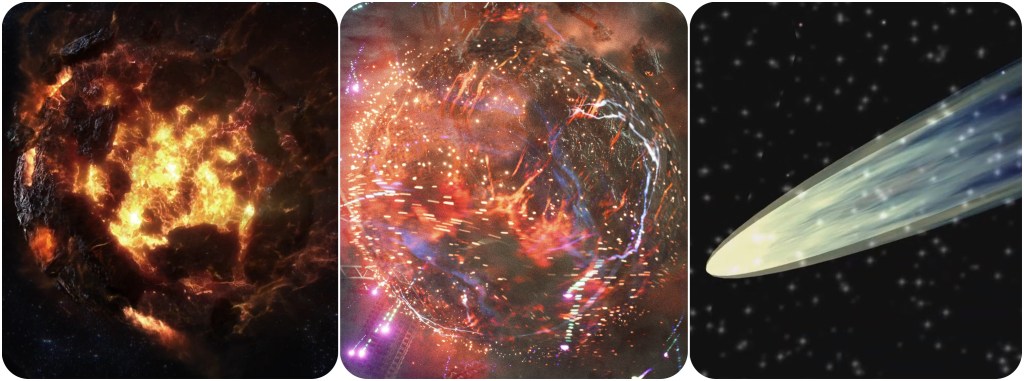
The cool thing about the Compilation of Final Fantasy VII is that we have a large timeline with actual years and dates attached to a lot of things. While we don’t know the exact day on which Sephiroth uses the Black Materia, we do know that the raid on Mako Reactor 5 happens on December 10th 2007. Mixing together FFVII and Remake depictions, I can remember canonical nighttimes following at Wall Market, the Shinra building, Kalm, Under Junon, the Shinra-8, the first Gold Saucer visit, Gongaga, the second Gold Saucer visit, Cloud falls into slumber after the Temple of the Ancients though it’s not clarified if any days have passed, and I think the party take a night to rest in the City of the Ancients after losing Aerith. Based on its general trends I assume part 3 will have the party spend a night at Icicle Inn, then traverse the Great Glacier and North Crater all in one day. Therefore, we could put Sephiroth receiving the Black Materia and casting Meteor at somewhere around December 21st. Tifa falls into a coma for a week, then when she wakes up around the 28th Meteor is looming in the sky. We do have information confirming that it finally impacts the planet on January 21st 2008. My date is a rough approximation, but that would put it around one month for the Meteor spell to complete, or three weeks to travel from close orbit to the surface. Meteor is not fast.
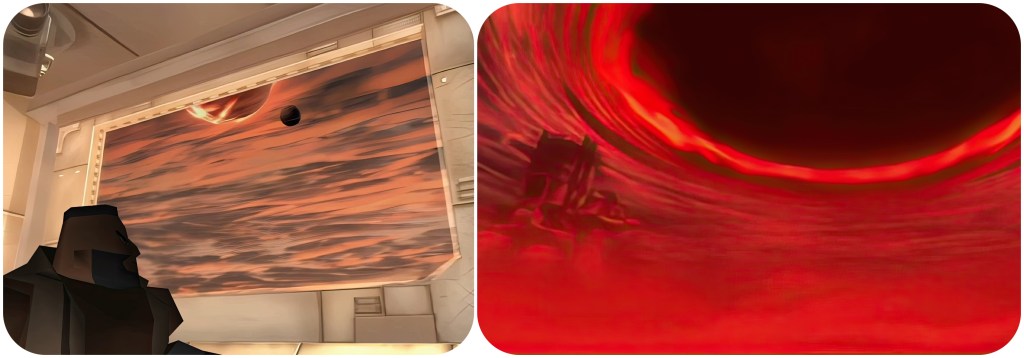
In addition, by comparing the size of the Turks’ helicopter in the opening of Advent Children against how it scales to Midgar, the black magic Meteor can be discerned to be at least as large as the entire circumference of the North Crater, if not much, much larger. FFVII’s Midgar is roughly the same width as the North Crater on the overworld, maybe a little larger, whereas in the film the crater is visibly far smaller than the city. I see someone online having mathed their way to the claim that Midgar should be roughly 100km from one end to the other. FFVII’s final cutscene shows us that Meteor absolutely dwarfs Midgar. It is enormous.

Thanks to that painting found in Bugenhagen’s observatory, we can even directly contrast what a meteorite over Cosmo Canyon looks like in comparison to the Black Materia’s Meteor. This to me is further indication that Jenova’s meteor was not the same thing as the Meteor spell.
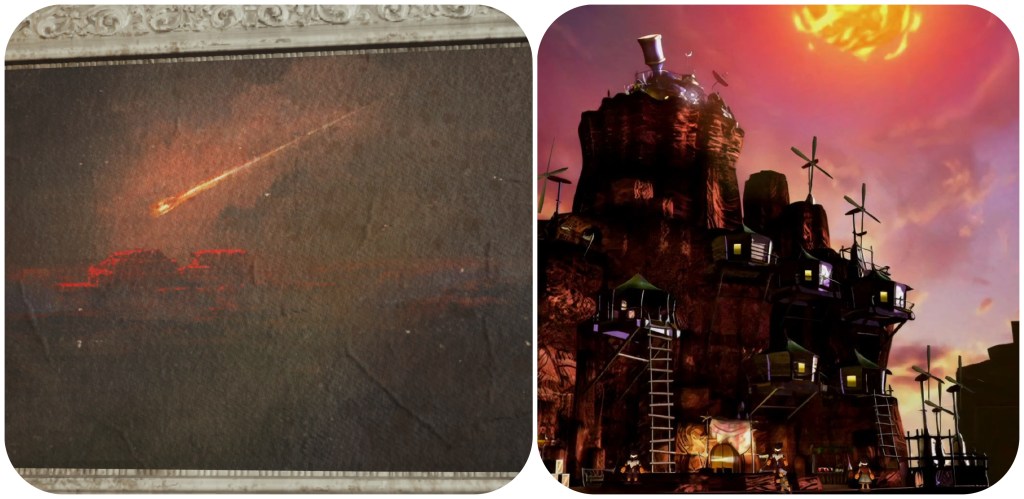
It’s also worth noting that in the original game, which the Remake trilogy is still more or less adhering to, it was Sephiroth that wanted the Black Materia, not Jenova. This clarification comes from the Final Fantasy VII Ultimania Omega. First, some quotes that establish Sephiroth’s will as being distinct from Jenova’s, and confirming that he is the one actually holding the balance of power.
- Final Fantasy VII Ultimania Omega (page 213): “Despite boasting legendary strength, he lived as an ordinary human up until learning the secret behind his birth five years ago. At that point, he began to walk a different path from humans. He didn’t fall under Jenova’s sway but rather seized control and assumed command over her actions. This development gives us a sense of the extraordinary strength the lifeform known as Sephiroth possesses.”
- Final Fantasy VII Ultimania Omega (page 211): “Reunion is the ability of Jenova, but the orders she gives to the Sephiroth Copies are given with Sephiroth as their master.”
- Final Fantasy VII Ultimania Omega (page 55): “Sephiroth’s will began to control not only his brother-like copies, but also his mother Jenova.”
While its specific events are not wholly canon, The Maiden Who Travels the Planet was also written with this implication in mind. Here are three separate bits of dialogue indicating that Sephiroth had overtaken Jenova’s will, or framing his own ambitions as distinct from hers.
- The Maiden Who Travels the Planet: “The pale black and silver white man, who was once a hero, had taken over the will of the ‘disaster that fell from the skies’, Jenova, and was in a state of madness.”
- Hojo (The Maiden Who Travels the Planet): “My son – Jenova’s ruler is calling. He’s asking for more life energy. Hahaha, I shall offer myself. Then he will become one with me, the one who he hated the most and looked down upon. This will be our reunion.”
- The Maiden Who Travels the Planet: “Sinking into the Planet’s scar and absorbing the Mako energy, the original Sephiroth was revived with his wounds fully healed. In the battle that unfolded afterwards, the will he inherited from Jenova, his own ambitions and the strong thoughts he had inside him granted him formidable power, but the humans still managed to crush him in the end.”
The above quotes all reveal that Sephiroth is the one controlling Jenova. She had been scheming to take hold of him for decades, but in that decisive moment Sephiroth’s fury overwhelms her psychic control. The following quote specifies that Jenova’s only goal was to head north for the Reunion, it was Sephiroth who had sent her on the detour down to the Ancient Temple in the southern reaches of the world.
- Final Fantasy VII Ultimania Omega (page 55): “Jenova (in the form of Sephiroth) was supposed to have crossed Mount Nibel and headed north, but it headed south toward the Temple of the Ancients. It first followed the Reunion instincts and headed north toward the final destination, but along the way received an order from the main body to bring back the Black Materia.”
It’s my opinion that FFVII Rebirth agrees with this information as well, since Sephiroth’s focus very clearly shifts once he learns about the Black Materia from Gi Nattak. There are minor differences since the Ancient Temple is now in Northwood instead of the southern islands, so Jenova is no longer going on that worldwide detour, but you can still see that the Black Materia inspires a huge change in his actions. Until that point Sephiroth is just kinda passively watching events unfold and parasocially harassing Cloud, but once he learns of the Black Materia Sephiroth suddenly becomes very direct, taking a more aggressive and active stance as he commands Cloud and the Black Robes to retrieve it. Constantly flashing in, saying “Cloud, bring me the Black Materia.” He is desperate for it. Which to me suggests that the knowledge he obtained from the Lifestream and Jenova contained no mention of Meteor or the Gi Tribe’s Black Materia.
When Sephiroth does finally use the Black Materia in FFVII, the Weapons are mobilised. The planet’s threat response is immediate and immense. Yet Professor Gast’s recorded interview with Ifalna tells us that the Weapons had never been unleashed before this point.
- Ifalna: “Yes, Professor. The one the Professor mistook for a Cetra…was named Jenova. That is the ‘crisis from the sky’. The Planet knew it had to destroy the ‘crisis from the sky’…You see, as long as Jenova exists, the Planet will never be able to fully heal itself.”
- Gast: “Back then, Weapon was a weapon the Planet produced of it’s own will?”
- Ifalna: “Yes, but…There is no record of Weapon ever being used. A small number of the surviving Cetra defeated Jenova, and confined it. The Planet produced Weapon…But it was no longer necessary to use it.”
The first known awakenings of Weapon all happen during 2007, when the actions of Fuhito and Sephiroth cause an unprecedented amount of peril to the planet. The Jade Weapon had been summoned during the early months in order to combat the ultimate summon Zirconiade before it could burn the world. Minerva, who can be theorised to exist somewhere between Summon and Weapon, is the next to be called out in response to Genesis. Two smaller, unnamed Weapons are sent swimming through the Lifestream to try and thwart Sephiroth while he’s absorbing the Whispers. Then toward the end of the year Sephiroth succesfully casts Meteor, which finally triggers all the major remaining Weapons to awaken at once. Jenova and Meteor made the planet develop these kaiju to run through the land like white blood cells purging a sickness, but the presence of the Black Materia alone was not enough. Ergo, the Gi Tribe never activated the Black Materia’s spell. The planet would have intervened.
Reasons such as these may support the stance that the Gi cannot have used Meteor in the past.
What is the case in favour of the Gi having summoned Jenova’s meteor?
Once again, with the presented information I think it’s hard to definitively reveal whether the Gi had any hand in calling down Jenova’s meteor. There are very valid cases to both agree and disagree with that statement. Whether we support or deny this claim hinges on how we choose to interpret the Cetra’s story of the Black Materia, since they leave some level of ambiguity in both the english and japanese wording as to whether the Black Materia had ever been used before.
- The Cetra (English ver.): “So foul was the orb’s magic that we knew at once it must be hidden, that none might ever wield its terrible power.”
- The Cetra (Japanese ver.): “kono magamagashī materia o kōsei no yashin kara kakushi tsudzukenakereba naranai”
- The Cetra (literal translation): “This sinister Materia must remain hidden from the ambitions of future generations.”
The english localisation says it was hidden so that “none might ever wield its terrible power”. It does not say “ever wield its terrible power again“, leaving room to read into this and interpret the Cetra as saying that the materia had not been used, it must never be used because its foul magic will call the destroyer of worlds (which they do then define as Meteor, not any alien invader). The original japanese version of that line though just specifies that the materia must be hidden from future generations. They’re fundamentally saying the same thing, but it’s a little harder to read any connotation of the past or present in that sentence. In that case, perhaps the original intention was to get people questioning if the Gi had used Meteor. So let’s say that the Gi did once use the Black Materia to cast Meteor. In that case, all four major murals in the Temple of the Ancients are actually sequences of the one event. You would order them as the Gi forging the Black Materia, calling Meteor upon the Ancients, Jenova lands from the meteor looking like a goddess, then reverts to a beast to attack the people.
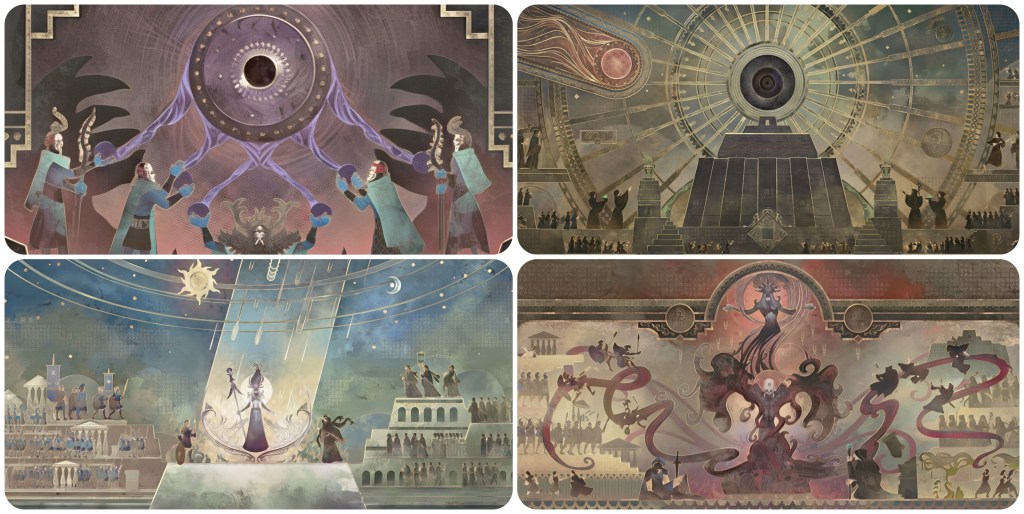
This is good because it…just kinda works. The Temple of the Ancients exists as a cage exclusively created for the Black Materia, or at least this was the case in the original FFVII, so why would the murals even reference Jenova if not to implicate her as being part of this. Since Jenova is in the images, the meteor represented should probably be hers. It looks to be the same as the one we see in the Stewards of the Planet sequence, with the tail and everything. The place it’s shown approaching is possibly therefore the same seen in the presentation, in which case you would have two sources depicting Jenova’s meteor and one of them illustrates it being pulled toward the Black Materia.
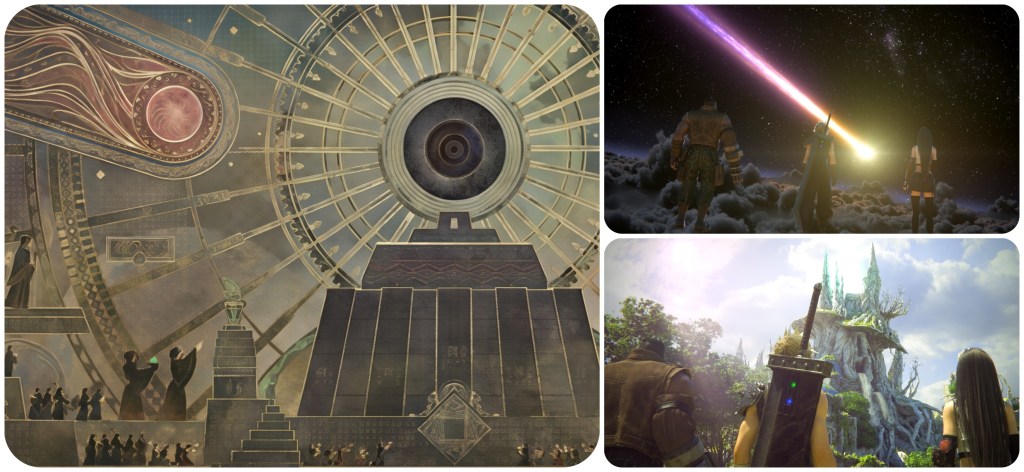
That storyline is simple to understand and makes sense with all the Jenova imagery in the Gi’s village. I’ve been convinced that the Gi Tribe encountered Jenova on their planet Terra, so when it came time to wish death upon Gaia perhaps they did set the scourge upon this world through the Black Materia. In this way, we can label that six-eyed beast idol as Jenova and address why one of Jenova’s earliest incarnations, the Shadowblood Queen, is charged with Terra’s signature red Lifestream that also runs through the Black Materia. You would no longer have to look for alternative, convoluted explanations regarding the Jenova-like effigies or masks in the Village of the Gi, they would simply be a symbol of worship because the tribe were already familiar with Jenova as an eldritch deity before Gaia. The Weapons were not triggered by the Black Materia’s first use because the planet only created them after Jenova landed. The “star that threatened all” from the reveal trailer is Gi Nattak discussing Meteor after all. Bam, bam, bam – it’s just that easy.
In my earlier argument I suggested that the lack of a tail on Meteor invalidates it as having been the same one which brought Jenova. Every depiction we’ve seen of Meteor thus far has been incredibly slow on approach, and floats into the planet without any fire trail. However, there is in fact a single depiction which illustrates it as such. Sephiroth’s Divine Proclamation attack in FFVII Remake does have flame following it as it speeds into the battleground.
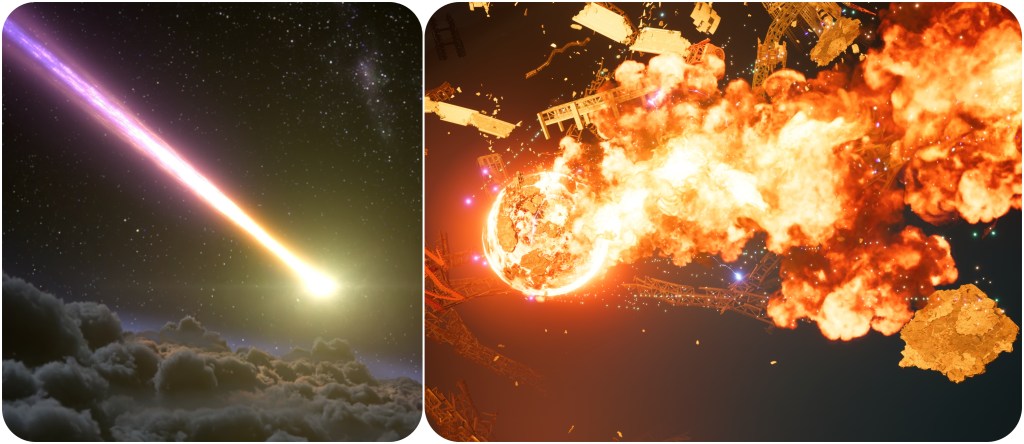
This isn’t exactly Meteor per se. As in, it’s not the Black Materia’s spell. Well, it is, but not the direct storyline usage. Rather it’s Sephiroth using the Whispers to summon a spectre of Meteor from another realm. It looms in the sky until Sephiroth finishes his countdown, upon which he activates magic that causes it to rapidly speed up and crash. Divine Proclamation does use the actual Meteor model with the broken bits and everything, but the circumstances of its summoning make it a slightly different phenomenon. Meteor isn’t actually a summon, it’s a magic spell that catches a dwarf planet. Whereas Divine Proclamation is a summon of sorts. It’s also much, much smaller than the true Meteor from the endgame as well. So there is some room to say that maybe the abrupt shift in speed which causes the trail isn’t from Meteor itself, but from Sephiroth using his time manipulation to forcibly send it to the ground. It hangs almost totally still in the sky, suddenly fast-forwards, then slows to a crawl again after impacting the party. But at the very least there is now some manner of imagery where Meteor has a tail, similar to the Stewards of the Planet and Temple of the Ancients depictions.
Additionally, I mentioned that in my opinion it’s a bit too convenient to think that the Gi Tribe would somehow only summon a smaller meteor instead of the world-ending dwarf planet that Sephiroth pulls. But episode one of The First SOLDIER might have actually given information which could justify that disparity. Rhadore’s main island is littered with low quality fragments of natural Materia, which Matt tells Glenn not to bother with since it’s impossible to extract magic from them. Sephiroth, however, has no issue picking up these shards and using them to cast powerful elemental spells. So if we extend that to Final Fantasy VII Rebirth, we could create a scenario where Sephiroth’s immense magic power and affinity with Materia simply permits him to catch a celestial body several orders of magnitude larger than the Gi Tribe. In fact you know what lads, I kinda just forgot that the original FFVII almost implies something along these lines anyway, when Cloud points out that Sephiroth was using the healing energy gathered in the North Crater to supercharge Meteor. While this doesn’t confirm the earlier meteorite was deliberately induced by magic or materia, it does draw some kind of plot comparison between Jenova’s arrival and Sephiroth’s usage of the Black Materia. Cloud specifically says “next time the wound won’t be so small”, and the FFVII Remake project might have extrapolated that into a storyline where the previous time was also related to the Black Materia with less of a magical battery behind it.
- Cloud: “An old crater. Something fell out of the sky and crashed down here, leaving a scar on the planet. Sephiroth took that energy and is trying to use Meteor. Next time the wound won’t be so small.”
The Gi’s usage of the Black Materia would still be especially damning though, since even at their level it’s kind of equivalent to a magical nuke. Mako is a metaphorical fusion of fossil fuels and nuclear energy, and the Cetra neutralising the Black Materia is effectively nuclear disarmament, so that parallel may be in line.
I do think you kind of have to bend some things to maintain the claim that the Gi Tribe used the Black Materia in the past, but the imagery line absolutely is satisfying. We all want it to be true.
Which of these verdicts surrounding Jenova’s meteorite & the Black Materia will the discussion be proceeding with?
While I think both have cases for and against, I will still be concluding that the Gi Tribe never got a chance to use the Black Materia to cast Meteor. There does seem to be some nuance to the history of Jenova and the Gi Tribe, however both the Cetra and the Gi seem adamant that the Black Materia was stolen before it could summon the ‘destroyer of worlds’, Meteor. If Meteor had been cast, then I really do feel it would have finished its job.
However, my next suggestion is that…perhaps this does not matter all that much to the overall sequence of events, since I do believe that Jenova existed on Terra before the Gi were evacuated by the Omega Weapon. Enemy Intel puts a particular spotlight upon Gi Nattak’s unique red miasma, which is likely to be the Lifestream of planet Terra. We also see Jenova with red particles quite a number of times, probably because she had consumed their Lifestream and had a long history with the Terran people. And most importantly the Black Materia design is now filled to the brim with swirling red energy. In that case, I think that Jenova must have just managed to detect the Gi’s energy signature within the Black Materia and shot herself that way. Maybe she sensed them, maybe they communicated with her through prayer, but either way I think it has to have been through the Black Materia as a conduit, but not through the ultimate destructive magic Meteor.
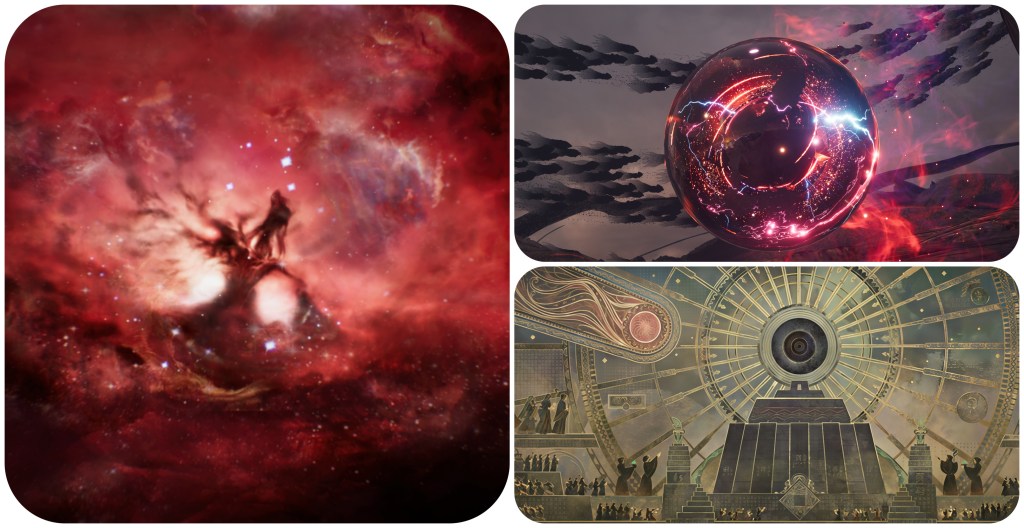
That’s as far as I can concede. Even as my direction or conclusions have dramatically rerouted, I still cannot agree that the Gi Tribe managed to successfully cast Meteor, because in that case it would have already destroyed the world millennia ago. Jenova’s meteorite did impact the planet and wound it to where it couldn’t properly heal, but it certainly didn’t end life like the real Meteor would have.
Why do Bugenhagen and Gi Nattak disagree on the Temple being a place of worship?
- Bugenhagen: “A ‘temple’, you say? If you mean a place where they worshipped gods, none exist. The Cetra never engaged in such practices. Maybe it was referred to as such by someone ignorant of their culture. If instead it is a site of importance to the Cetra that you seek, texts do speak of one─and of the pains taken to conceal it.”
- Gi Nattak: “The Gi cannot rest until our sacred treasure has been restored to us. Moreover, in redressing the crime of her ancestors, the Cetra may help us to let go our ancient grudge. It is said the orb lies within a place of Cetra worship.“
Bugenhagen is adamant that the Cetra did not have any religious practices that might constitute worship, which is at odds with Gi Nattak’s claim. There are a few ways in which to proceed from this, since the only explanation is that someone here is either ignorant or lying. While I don’t give this idea any real credence, I did mention some slim possibility where, based on their hallucinatory nature and yet unexplained Jenova imagery, the Gi might be read as just a large-scale delusion instead of a genuine group of people. If we went from this angle, then we could suggest that Gi Nattak was actually Jenova lying about the temple in order to lead the party to it. But that doesn’t hold up, because there’s enough supporting history across the canyon and temple to prove the Gi’s existence. So one of the two is speaking out of ignorance, and I think it’s pretty likely the elderly man whose entire plot arc is about his scholarly hubris, as opposed to Gi Nattak who has first-hand knowledge of the Cetra’s lost history. Yeah, Bugenhagen’s probably just confidently wrong. Professor Gast is known to have frequented the vale, and considering he was also able to convince himself of this assumption that Jenova was a Cetra, these two may have simply been sharing incorrect conclusions with each other.
Did Jenova destroy Terra?
After much deliberation, I think she has to have had a hand in its death. I’m not sure that she, like, went all Day of Lavos cosmic demon and straight blew it up or anything, because it has to have been subtle enough that the Gi would still revere her image in their land under Cosmo Canyon. And I’m not sure that she’s anywhere near powerful enough to do a Day of Jenova in the first place. As far as planet-busters go she’s more of a King Ghidorah than a Frieza, you know? It takes time. She’s not raining hellfire to obliterate civilisation in mere seconds like Lavos would.
I do however think it suits to believe that Jenova infiltrated their society as both a humanoid ruler and a beast god, was never really exposed, and ultimately drained their Lifestream to the point that the environment collapsed. I have flip-flopped on this verdict a number of times, but the immutable truth is that there’s something haunting the Gi and it does match to a face seen on Angeal’s Jenova-fuelled transformation. The Hall of Murals, the Gi idol, Gi Nattak’s mask, and the crotchguard of one of the effigies all display this beast-like face. It’s gotta be Jenova, right? Varghidpolis samples grown in Shinra R&D labs have six slit eyes, and they seem to be a preferred way for Jenova to spread her mutations.
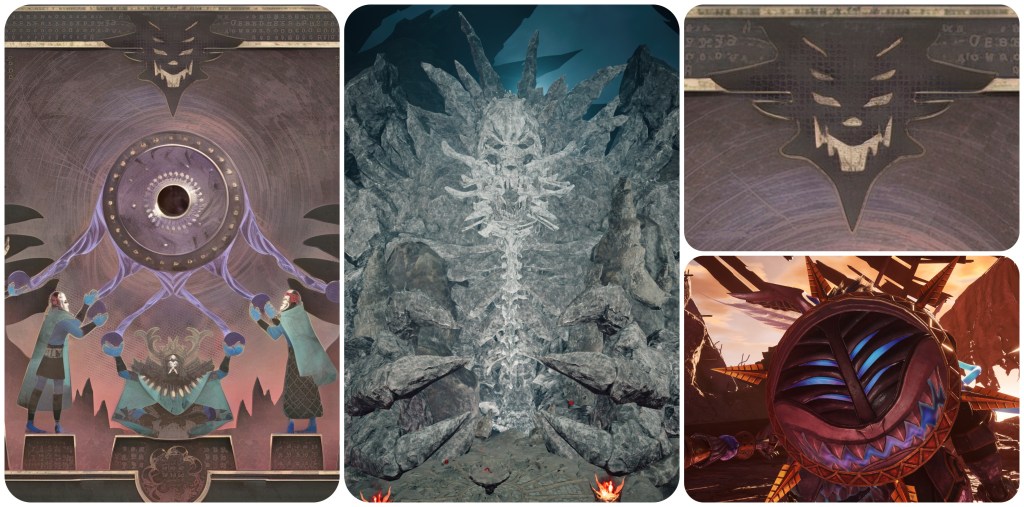
Importantly, there are also effigies of Gi tribesmen with clear Jenova mutations. This is another immutable truth to the situation. Gi Nattak does state that some of his people survived the chaos of the world’s end, but we know that this has to have been an eternity ago, millennia before Jenova entered Gaia’s picture. When we meet them, they’re spirits. However, can Jenova’s DNA mutate ghosts…? I wouldn’t think so. Remake Jenova does have an eldritch, spiritual, interdimensional element to her powers, but to say that her genetic material could mutate ghosts is a rather big stretch. I mean…I guess our swords can touch them so maybe they’re physical…but they’re spectres – they’re called Gi Spectres! They manifest out of pyreflies and float and teleport and stuff, surely that means something to em. Feels like a copout to say that our ability to battle them explains the lore of Jenova infecting their spiritual tissue. But…what if we just pretend that it isn’t a copout? They are basically FFX’s Unsent, who do make similar references to an “endless dream”. The Unsent are spirit beings with physical bodies. Everyone in the fandom talks about how overpowered that actually is for Auron, while Yuffie makes a similar remark about the undying Gi Tribe. Maybe a tongue-in-cheek reference there. Then if I revive that whole Gaia-Spira discussion about Jenova, Sin and Yunalesca possibly all being the same entity, well, Sin can mutate the Unsent. Perhaps Jenova therefore can mutate the spectral.
But that’s hard to substantiate and needlessly convoluted. Which is why hypothetically, the Gi would have had to be alive when this mutation happened. But it’s difficult to think that it could have happened while they were on Gaia because of how ancient they are. Gi Nattak does allege that a small amount of his tribesmen survived their planet being subsumed and carved out a new home here, but the timing of this should be long before Jenova arrived. He describes the Black Materia as taking “an eternity” to awaken, but we know that Jenova was running rampant for less than fifteen hundred years. Still an unimaginably large period of time, but certainly not “an eternity” and barely worth mentioning in the long, long plight of the Gi Tribe. The meteor landed 2000 years before FFVII, then 500 years before the game Swordsmith Masamune, a Wutaian Cetra, returns to the Igara Forbidden Zone knowing nothing of its cosmic demon. Just barely a legend that a battle against beasts had probably taken place in this land, though it’s the stuff of folklore by now. A staggering amount of generations perhaps, but certainly not “an eternity”. Jenova cannot have been involved during the Black Materia’s formation on Gaia, so that six-eyed face and the mutated effigies would present a problem.
To make the mutation happen on Gaia, we can either assume that the Gi are ageless, that their lifespan naturally stretches many millennia, or that they had descendants whose physical bodies were still alive while forming the Black Materia; Then Jenova offered them mutagenic enhancements, they marched against the Cetra and all died in battle. Both of those are pretty easily invalidated, but I’ll still work through them. First off, the notion that the Gi may have had successive generations of children with living bodies for Jenova to infect can’t actually work on Gaia, because we know that in FFVII’s setting the cycle of old and unborn souls exists within the Lifestream, and theirs has been lost forever. So the only remaining idea for mutation on Gaia would have to be that the Gi are just unimaginably long-lived (even without Jenova’s immortality), since this doesn’t demand a link to their Lifestream. In fact there are two ageless creatures in FFVII Rebirth who coincidentally both make use of red particles, and have features reminiscent of the Gi Tribe. The Jabberwock’s Enemy Intel highlights its rock-like skin, similar to the Rebirth Material Ultimania drawing attention to the rocky texture of Gi Nattak’s skin. It’s said to slumber at the bottom of the canyon, which is where the Village of the Gi is also known to be located. As for how the Adamantoise resembles Gi imagery, it’s to do with the horns, but I can’t fully reveal why yet. But my thinking might be that the Jabberwock was a Terran lifeform which survived the interstellar journey, whereas the Adamantoise is a Gaian creature that got mutated at a later date.
- Jabberwock: “A legendary dragon that sleeps at the bottom of the canyon. It is an unaging creature that has lived for eons-much like the minerals its bodily composition resembles.”
- Moss-Grown Adamantoise: “Large herbivorous creatures with life spans so long they are said to have coexisted with the Cetra.”
However, I simply struggle to believe this idea of the Gi being ageless. It’s not impossible that the survivors lived long enough for their physical bodies to meet Jenova, but it is messy. And it’s also totally unnecessary. Maybe they live a long time and originally shared a planet with the eternal Jabberwock, but that’s ultimately just a different discussion now, because there is some fairly definitive evidence the Gi were already mutated when they landed on Gaia. The element in question here are the mutated effigies. Were they like that beforehand, or were they changed by Jenova’s arrival on Gaia? While the effigies on their own are a little tough to place since they’re only tying back to the enigmatic Gi Tribe, they do actually have an accompanying set of statues. The four idols which seal the gate to the Gi’s cavern are based on the four mutated elders found within the Village of the Gi. The mural of the Cetra pushing the Gi underground, as well as the Cetran architecture in the cavern, indicates that this sealing system was likely also constructed by the Cetra. That tells us the Gi must have already been mutated like this when they landed millennia before Jenova. Meaning that Jenova must have descended upon Terra.

Suggesting that Jenova occupied and slowly destroyed Terra addresses most of the otherwise unexplained and most central imagery. Whereas suggesting that she didn’t would leave me questioning, well, how were they infected then? You’ve gotta make them physically immortal to enact that, and I find that such a big stretch. The designs of the sealing statues invalidate that idea, since they prove that the Gi were exhibiting Jenova mutations before she arrived on Gaia. It has to have happened on Terra. Thumbs up. Nice. Moving on.
Was planet Terra destroyed by a meteor?
You could suggest that a meteorite ended the world, but not in the same way that FFVII’s Meteor spell or Chrono Trigger’s Day of Lavos would directly and violently tear the planet apart. Terra’s Lifestream declined across millions and millions of years.
Since I don’t believe it was the Meteor spell that forced Jenova to Gaia, this might then indicate that riding on or transforming into a meteor is Jenova’s natural way of moving throughout the universe. So Jenova perhaps landed on Terra as a sentient meteorite like Lavos, then spent eons manipulating society from the shadows without the people especially realising or rebelling against her true, invasive identity. That’s 100% imagination right now though. In fact, I am also coming to imagine that this is what she’d done on Gaia too, landed as a kind of Lavos-like living meteorite. Because I do somewhat unironically believe that Jenova is a regrowth from Lavos. But even without going that far, the mere parallel of the ‘planet-eating meteor’ idea can serve to define the Lavos-like intent with which her meteorite was flung at Gaia. It’s her natural behaviour. Much earlier in the script I suggested that First SOLDIER’s Alissa may have revealed there was no distinct humanoid body on Jenova’s meteorite, and I’ve mused on the purple fire trail perhaps being a sign of her magic; That is how I would come to the conclusion of Jenova morphing into a kind of living meteor for interstellar travel, which is probably just part of her life cycle.
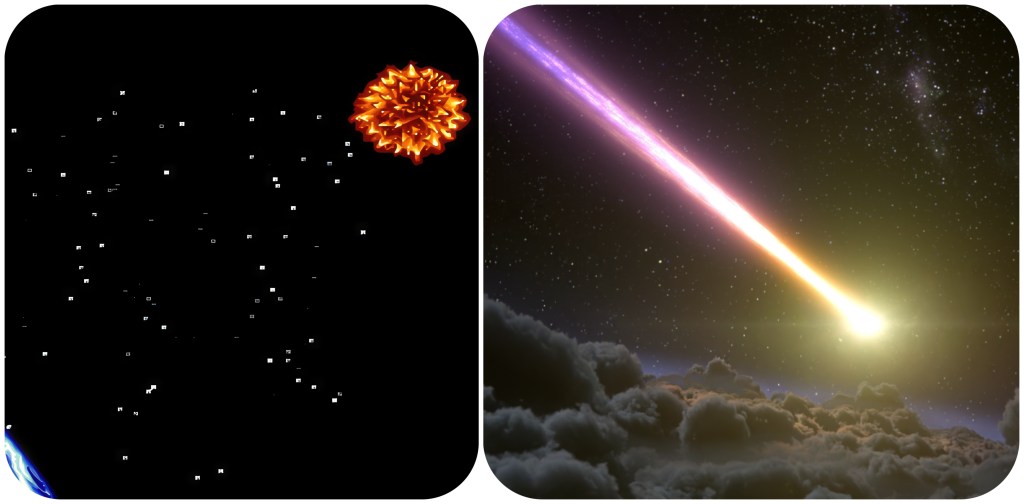
Could I clarify the timeline of contact between Jenova and the Gi Tribe?
The core of my argument rests in a few key findings: The Gi arrived to Gaia thousands of years before Jenova did. They were likely brought here by the Omega Weapon. The Gi Village has evidence of Jenova’s mutagen. The Gi did not cast Meteor. Yet Jenova has red spirit energy. In trying to figure out a cohesive pathway through all these points, my preferred timeline comes to look something like this:
- Jenova arrives to planet Terra and is actually welcomed by its satanic, warlike people.
- She positions herself as both a humanoid ruler and a bestial god, distributing “blessings” to the tribe’s elders in the form of bodily mutations.
- Unbeknownst to the Gi Tribe, Jenova is slowly consuming their Lifestream across many eons.
- Planet Terra wanes, eventually becoming incapable of sustaining life. This leads to the awakening of the Omega Weapon.
- Perhaps at this point the Gi Tribe finally realised Jenova’s true destructive nature and subdued her, or perhaps she was simply too weak to parasitize such a Weapon.
- The Omega Weapon ingests what little Lifestream remained, including the souls of the Gi Tribe and Jabberwock captured within. It evacuates into space, while Jenova is left behind on the rocky husk of the planet.
- By some manner of non-Jenova-related accident, their Omega crashes on Gaia. However since this planet is occupied and very healthy under the stewardship of the Cetra, Terra’s weak Lifestream that spilled out of the Omega Weapon is absorbed by Gaia, leaving the Gi spirits as outsiders who could never disappear.
- The Cetra try to communicate with them at first, but then perceive these foreign entities as a virus in the Lifestream and so push them into a cavern below Cosmo Canyon.
- Desiring revenge on the Cetra and their planet, the Gi spirits manage to steal a sacred materia. They focus their hatred and their own Animus energy signature into it. After an eternity, the Black Materia finally becomes viable.
- Sensing its foul magic, the Cetra march upon the Village of the Gi and lay claim to it. Such an affront to the planet cannot be permitted to exist. They seal a dummy keystone away in the Temple of the Ancients, itself under several layers of reality-bending traps, while locking the true Black Materia in an interdimensional cage
- Either because it had sensed the Gi’s life energy within the Black Materia, because they had sent their prayers to the psychic alien Jenova, because it was seeking a Reunion with its cells in the Gi Tribe, or by random chance, Jenova begins to head to Gaia. The shapeshifter attaches itself to some rocky remnant of Terra’s decayed mantle, then shoots itself all the way over to Gaia where it impacts the North Crater.
- This shapeshifting, body-snatching creature changes into the form of the Cetra and infiltrates their society, beginning to spread its hivemind through a virus comprised of its own mutagenic DNA. Eventually the ancient people realise the deceiver among them. The Shadowblood Queen, the Blighted Spirit, the demon of Knowlespole – many battles are fought against Jenova’s copies in many places.
- The war against this alien cancer begins to wind down. In the south, the Shadowblood Queen is put to death by the arcane powers of the Emerald Witch. In the west, the Blighted Spirit is burned away by Gakuren’s powerful fire spell. In the north, Jenova’s main body is finally subdued by the Cetra, then locked away in a tomb of rock and ice by Shiva for good measure. By this point however very few Cetra are left alive. Jenova’s final acts of deception had inspired the human population to begin hunting down the Cetra, so a small community goes into hiding in order to preserve their bloodline.
- 1500 years after impact, the southern peninsula of Wutai had long been a forbidden area due to the terrible scars from Da Chao’s battle against the Blighted Spirit. However, a small group of people decide to return anyway, seeking to reestablish a township in the area. While gathering blacksmithing materials, Swordsmith Masamune stumbles upon something. Odd biological remains which compel him to forge them into his sword, most likely. Or perhaps some shard of space metal. While Jenova’s body had long been imprisoned in the Northern Crater, this allows her spirit to emanate out of the sword and drive the people of the town insane. Swordsmith Masamune becomes seduced by his blade. So too do the villagers begin to covet it, killing each other in order to claim ownership of it. Eventually Masamune massacres them all and burns the village to the ground, with imagery very evocative of Sephiroth in Nibelheim. The immortal swordsmith then seals the blade away in a temple, awaiting the day that the one worthy to wield it may appear.
- 500 more years pass. Through the sacrifice of noble watcher Seto, the spirits of the Gi are sealed back in the cavern below Cosmo Canyon. Ifalna, the last pure-blooded Cetra passes away, leaving her only daughter Aerith alone in the world. Shinra excavates Jenova and quickly grow far too ambitious. An offspring is engineered through experimentation with the lifeform’s extracted DNA. Sephiroth retrieves the Masamune, and before long the battle for the Black Materia begins anew.
- In the deepest caverns beneath Cosmo Canyon, Cloud and Aerith make contact with Gi Nattak, who begs them to retrieve the Black Materia.
- Sephiroth overpowers Jenova’s will, commandeering the Reunion for his own purposes. He steers Jenova and the Clones to his own location at the Northern Crater, then assimilates them in order to fuel his own body’s regeneration. Sephiroth does not want to let Jenova kill the planet, he wishes to protect the world in his own corrupt, insane way. Eventually the man is resurrected in full, ready to face Cloud and his party for dominion of the planet.
- Against all odds, however, Sephiroth is defeated. His body is once more incinerated by the Lifestream, but he wants desperately to protect the boundaries of his mind. So he tosses all the memories of his human life and emotions into the stream as it rushes against Meteor. Everything except the preservation of self is deemed unnecessary and erased. They’re consumed by the flow and lost forever. Sephiroth’s spirit becomes an empty shell, at long last ready to be subsumed by Jenova. She gains total control over his actions and desires. He no longer cares to protect the planet, but seeks to abide his mother’s will by asphyxiating Gaia and piloting its wreckage into space where they can find their next world to prey upon. While the body may be strong however, Jenova’s force of will was never a match for Sephiroth’s, and so Cloud casts them down once more.
Something like that would be my final sequence of events with respects to Jenova and the Gi. While I had originally been a proponent to the opposite, I now believe that we can trust the first reaction we all had upon seeing Gi Nattak to say that there is some history of contact between Jenova and his tribe. For some odd reason the two most immediate imagery links of Gi Nattak’s colour scheme and Meteor do not actually pan out, but the mutated effigies, the tusked skull masks and the special red Lifestream can be used to reveal a framework that supports it.
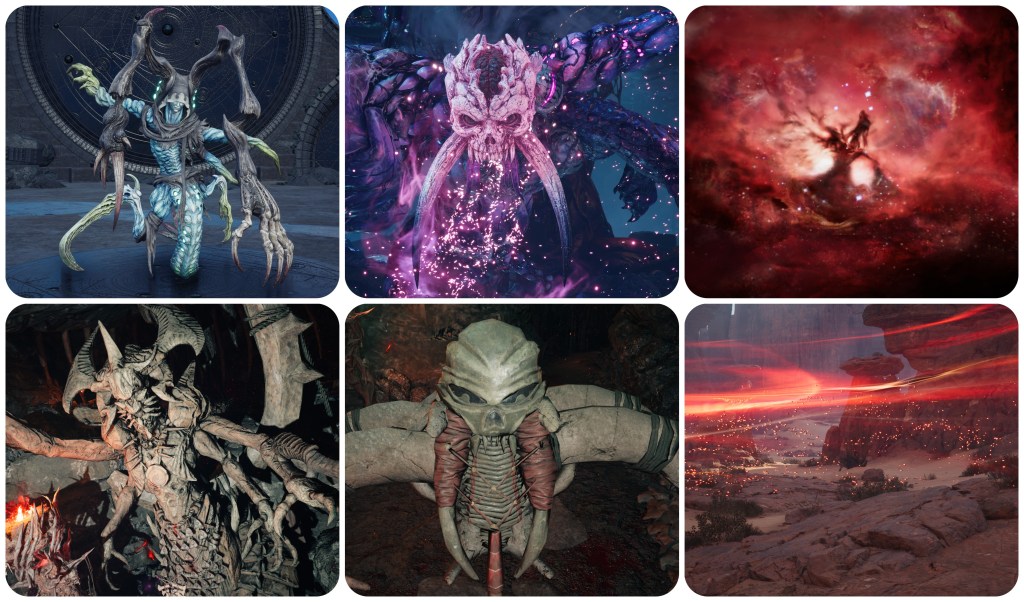
Have we seen red spirit energy anywhere other than Jenova and the Gi Tribe?
Buckle up, because we have. There are lesser examples such as the Temple of the Ancients or Hecteyes, which can be tied to the Gi with some work, and some others that just don’t really conform such as the Berserk buff states of Abzu, Skeeskee, Levrikon and such. Perhaps their particles comprise some unspoken distinction between spirit energy and elemental magic. But I will not retract the claim that red Lifestream is linked to the Gi, just look at how particular they with it in the Gi quests. You get an actual red lifestream, deep red miasma, and the Gi’s red spirit particles which infect groups of Skeeskee and Desert Sahagin, causing those Gaian lifeforms to fade away into red spirit orbs instead of their usual green.
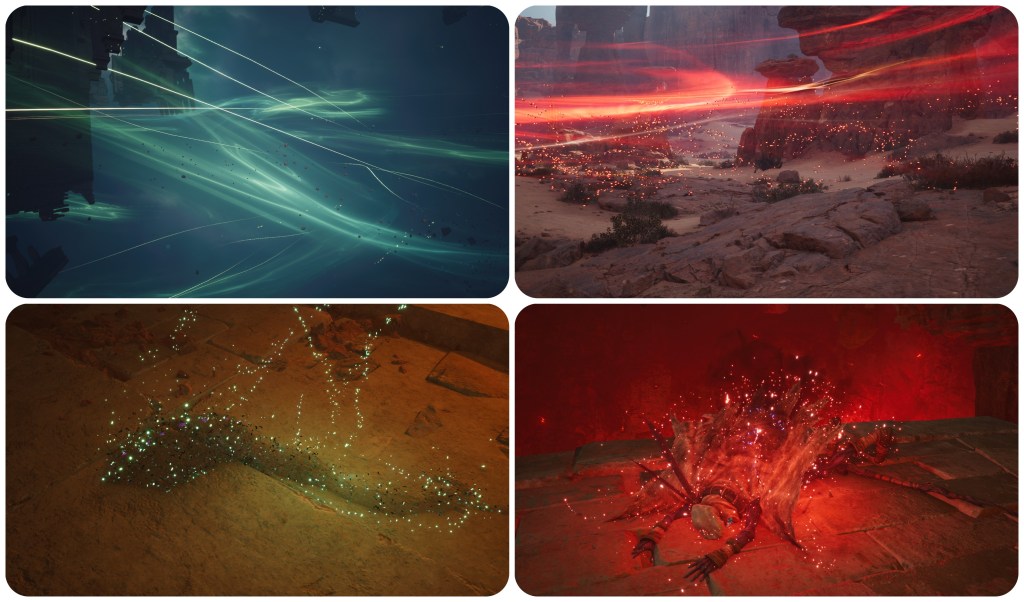
However, there’s something much more important than any of those. I’ve been kinda skirting around it in order to keep it reserved for this final chapter of the discussion. The first major depiction of an entity with red or purple particles in the Compilation of Final Fantasy VII was not Jenova. In fact the first FFVII game appearance of even that skull with tusks that’s so important to establishing a relationship between Jenova, the Gi and the Cetra, was not Jenova.
Here’s the thing. I pointed out how the Jenova woman had been changed in Rebirth to where she does not actually match to Gi Nattak. Granted my discussions on the matter have kinda progressed to where that became irrelevant, but whatever, she was redesigned. The Jenova monster has been quite heavily revised too. Jenova’s original model in FFVII had its face looking more like the malformed dog from The Thing, and its whole face would become recoloured with each successive appearance. It wasn’t this distinct human-like skull with tusks that runs so deeply throughout Cetran and Gi culture. Of Jenova’s faces seen in the FFVII Remake series thus far, Jenova Lifeclinger is actually the closest because of how it foregoes the bone tusks for drooping tentacles instead.
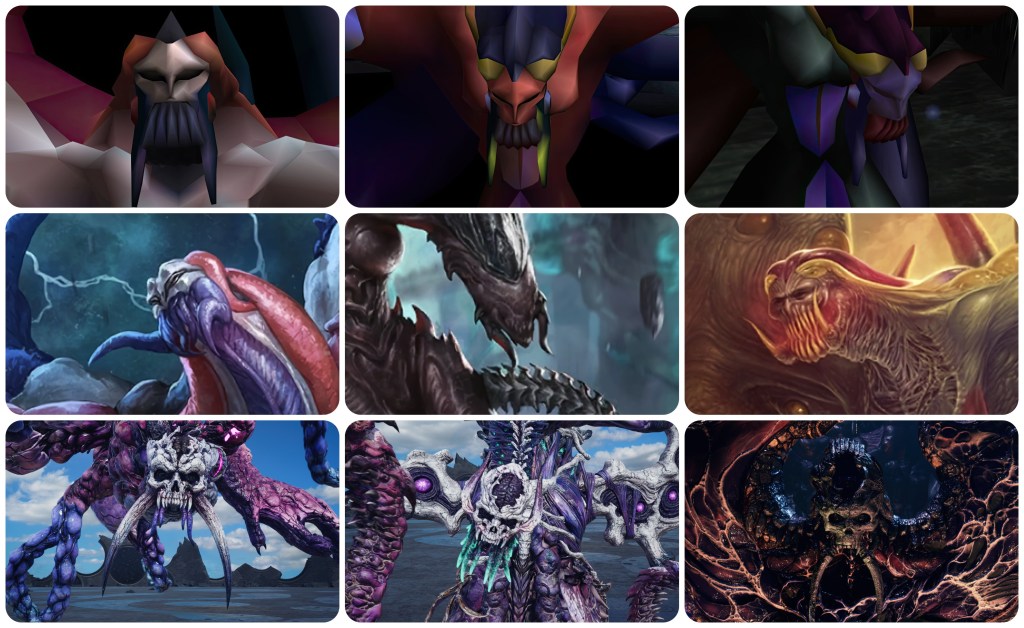
Neither the 1997 models nor any of the Mobius Final Fantasy cards have her face looking as such, and new prequel content in The First SOLDIER reveals The Blighted Spirit, a past manifestation of Jenova that had a more alien skull instead. Jenova SYNTHESIS, which is the most complete form of Jenova seen in FFVII, returns to a distinctly alien skull as well.
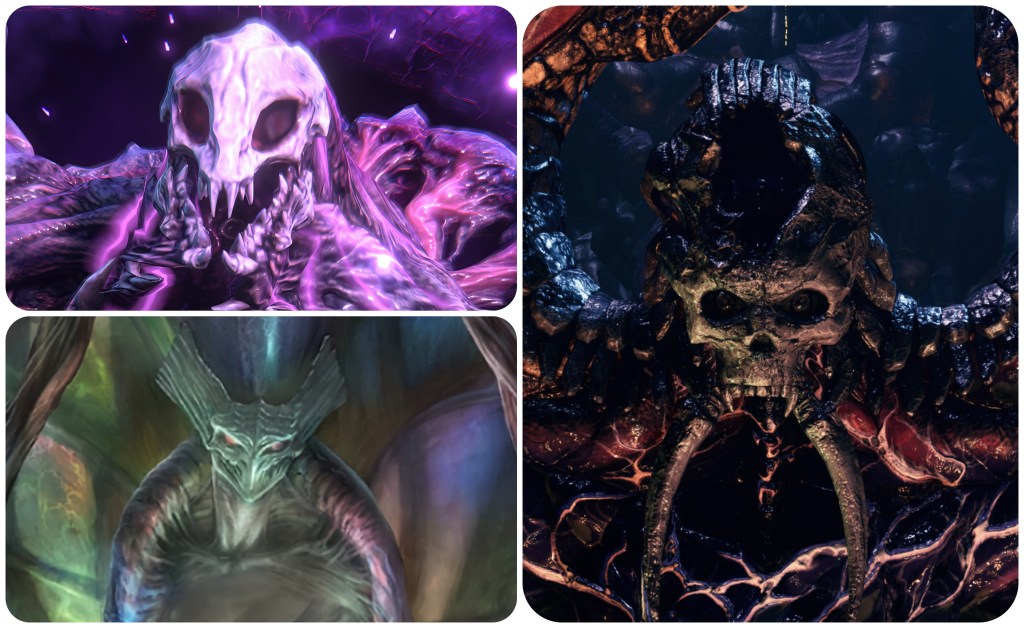
That primate skull is therefore a new feature they drew onto Jenova in order to make some kind of additional implication about her nature, or to position her better within Remake’s new lore and history. So what is it? Have we seen this skull anywhere in the original Final Fantasy VII, perhaps? That’s the question that must be asked, and I do have an answer. Not just the Joker’s skull face or Level 5 Death which I mentioned a while back, but something far more significant. As it goes I was looking through my footage to get a screengrab of something else and just so happened to flick onto it by complete accident. A particular move used by a particular Protomateria-imbued party member called the Satan Slam. Vincent, in his Chaos transformation, uses an attack with a skull that again very clearly matches to the Cetra’s statues, the Gi’s ceremonial masks and Jenova’s face. Broadly speaking this symbol of a skull with tusks is actually just the image of death in Final Fantasy VII, but that’s precisely why it’s got me thinking about its assocation with Chaos. Now that I see it before me again, I recall that I did have this epiphany about the Satan Slam some years ago, but that information didn’t stick it seems. In my defense I am lazy and so have usually always stuck with Cloud, Barret and Tifa; For this FFVII footage I specifically went out of my way to use characters that I wouldn’t ordinarily. That tusked skull is the thread tying this whole discussion together, which I have been trying so hard to definitively identify. Jenova has it – oh but she’s a shapeshifter and we have seen two potential earlier depictions with a totally different skull. The Cetra have statues of it, so it might be something from their folklore. The Gi have masks of the skull too, but then where did they see it? From where does this image originate? Who inspired who? If there is one depiction of this symbol that should exceed all the kerfuffle, it is Chaos. While the Cetra may have influenced the Gi who influenced Jenova, or the Gi may have influenced Jenova who influenced the Cetra, Chaos should be above all that cultural back and forth. A Weapon born to the planet who heralds the end of days. Devil to the Cetra, saviour to the Gi.

Not that this makes the discussion any simpler from here on out though. In fact this sets off a whole new chain of puzzles about who inspired who.
Section 3: Chaos and Calamity
Were the Gi Tribe actually worshipping Chaos all this time instead?
That is what this whole section of the blog post previously used to say. In fact the little guitar section at 3:11 in the Gi-centric track Purest of Materia even gives me similar vibes to the intro of Vincent’s theme The Nightmare Begins. But as I’ve continued working on it I’ve changed those claims. The Gi worshipping Chaos is possible, but much clumsier to justify. That sequence of events would demand that the Gi Tribe did not know Jenova prior to arriving on Gaia; Jenova lands on the planet, battles against the Cetra and eventually makes it to the Village of the Gi to link up with this other group that also cursed the Cetra. While there she noticed their skull masks and took one of their appearances in order to make the Gi think that she was their god manifest. The issue with this though is that there are undeniably Jenova-mutated effigies in the village. If Jenova and the Gi did not have a history on Terra, then this would mean that many of the Gi lived for millennia on Gaia and their physical bodies survived up until the point where Jenova could mutate them. Which is just too awkward for me to get behind. Physical immortality feels a touch too far to me, especially when we know that even if they were that long-lived, the Cetra probably slaughtered them all well before Jenova ever arrived. It definitely is a possibility, but I’d say that tying the Gi Tribe’s history to Jenova supports so many more answers and imagery lines than Chaos would.
Isn’t the Satan Slam just Jenova BIRTH’s face?
They’re similar, but not identical. Jenova BIRTH doesn’t have fangs, it has tentacles drooping out of its mouth.

Is Chaos the “destroyer of worlds” that the Cetra warned the Black Materia would summon?
- The Cetra: “The black materia shall summon the destroyer of worlds. The meteor shall fall, sundering the skies and shattering the earth. All life shall perish…”
The “destroyer of worlds” which the Cetra speak of is not Chaos, but Meteor itself. We know this because the Meteor scene in Remake is accompanied by a track titled The Great Destroyer. Plain and simple.
However, to make it not plain and simple, the Cetra are the ones using this “destroyer of worlds” phrase, right? Well their legends are also the basis for the LOVELESS poem. And how does that go, again?
- LOVELESS (prologue): “When the war of the beasts brings about the world’s end, the goddess descends from the sky. Wings of light and dark spread afar, she guides us to bliss, her gift everlasting.”
The “war of the beasts” causes the end of the world. One of Chaos’ lesser forms is named the Galian Beast, and throughout Dirge of Cerberus scientists repeatedly refer to Chaos or Omega as a “beast”. Perhaps that terminology was assigned deliberately then, and in this way we may consider that the “destroyer of worlds” is implicitly alluding to Chaos and Omega who will be called after Meteor cracks the planet’s mantle.
- Shalua: “I carried you back here from Edge after you collapsed during your fight with Deepground. It seems like the beast inside you went a little wild back there. This happen often?”
- Rosso: “So, you cannot control the beast without this.”
- Reeve: “However, Deepground is attempting to awaken the beast (Omega) early. Thus the kidnappings.”
- Azul: “It looks like you were more a beast than I. Very well. I’ll see you again, Vincent…in hell!”
- Hojo: “You know, when I first read it, I thought that woman’s thesis was utter nonsense. I couldn’t believe some fabled beast from legend past had anything to do with your survival.”
Are Jenova and Chaos related, or do they have any clear overlap?
This is a really, really odd one. I don’t know them to be related species. Well, I don’t know much about Jenova to begin with. That’s kind of the point. After all these years with FFVII, Jenova is still largely this unknowable cosmic horror. From where and why did it come? What does it want? Is it even actually sapient or just an autonomous hivemind? We can only make educated guesses. The only sort of direct explanation we have actually comes from Mobius Final Fantasy, where the four Jenova transformations are described as such:
- Jenova BIRTH: “An abhorrent fiend fallen from some distant star”.
- Jenova LIFE: “An abominable life-form fallen from a remote planet.”
- Jenova DEATH: “An extraterrestrial fiend that feeds on death.”
- Jenova SYNTHESIS: “A malformed beast hailing from distant stars.”
Jenova is an extraterrestrial life from a remote star system. She is an alien lifeform. Something organic that evolved on a distant planet. Filmic horror is very important to FFVII’s villains. Sephiroth’s presentation is said to take cues from Jaws, while Jenova’s inspiration from Invasion of the Body Snatchers, and most importantly John Carpenter’s The Thing, runs deep. A grotesque, gory alien shapeshifter is encountered at the snowy pole. It sows discord in the community through all manner of imposter, and its ultimate goal is determined to be harvesting their DNA to expand its own hivemind before seeding its spawn back out into the stars.
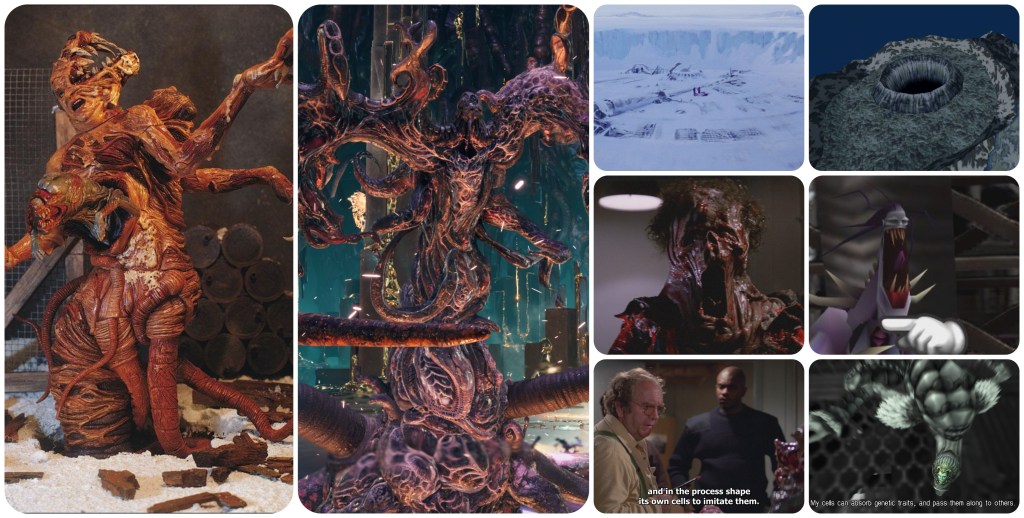
You want to know why Sephiroth in FFVII, Kadaj in The Kids Are Alright and Swordsmith Masamune in The First SOLDIER all burn down a village? It’s a reference to the way that The Thing ends.
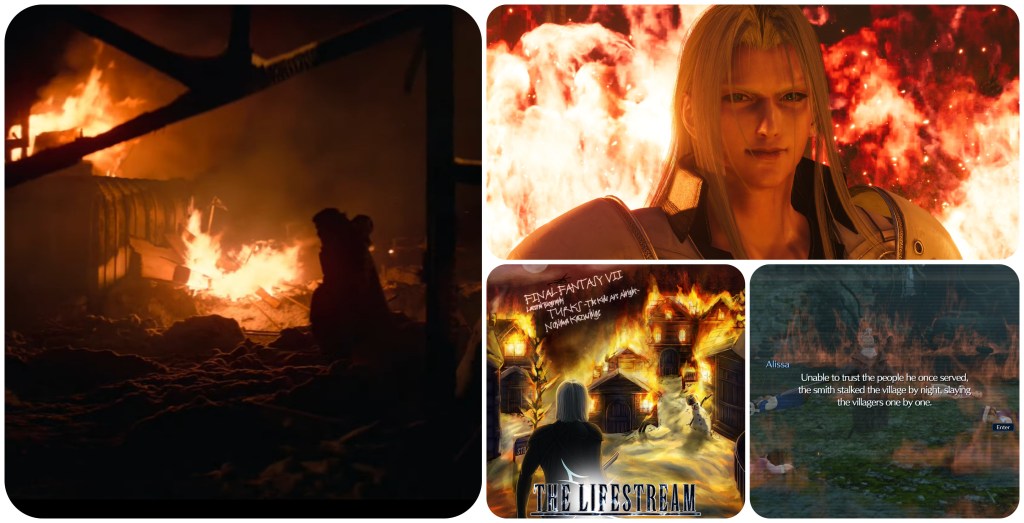
When you talk space horror, 1979’s Xenomorph is obviously going to be an inspiration as well. While the biggest Xenomorph in FFVII is clearly the unrelated Demon Wall, Jenova has a podlike head in some forms, and acidic blood that rains from her disgusting, fleshy nest. Its primate skull and grotesque skin make Remake’s Jenova look a lot like the hybrid from Alien Resurrection as well. You don’t know where the Xenomorph truly came from or how vast its history is, just that it was picked up like a contagion on a remote rock. Some are seduced by its limitless evolutionary potential and perfected form, some seek to domesticate or militarize it, others worship the creature, but a great many see it as embodying fear and the violation of bodily autonomy. Jenova has that kind of vibe – a living body horror from deep space unknown.
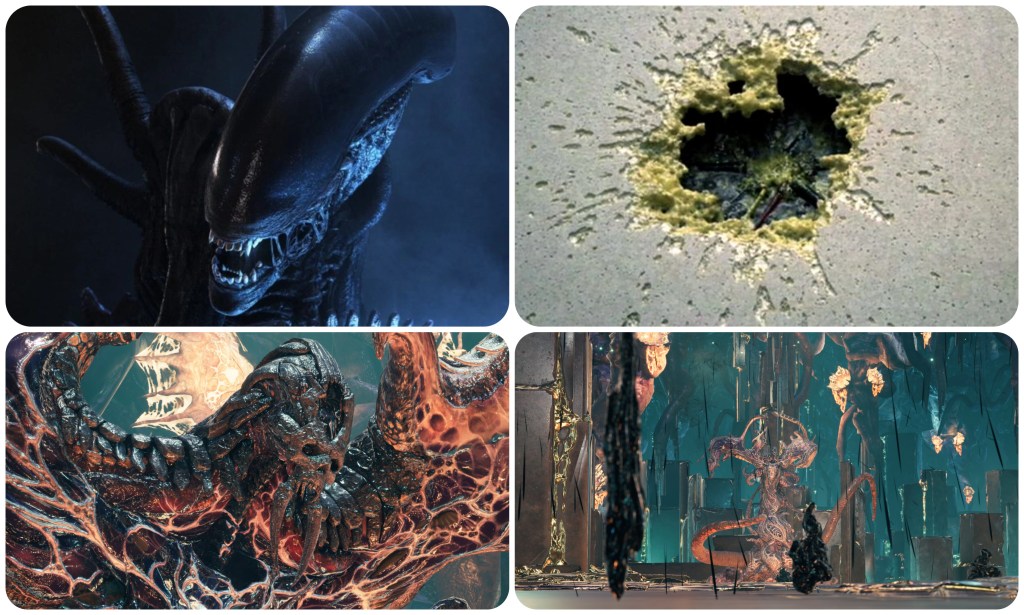
Chaos though, is a Weapon. Or at least it seems to be, since it’s a pawn the planet creates in service to the Omega Weapon. It’s a manifestation of the Lifestream equal part magical and physical, but not something I would readily term an independent “lifeform”. With that said however, there are undeniably similar patterns in the design of Chaos and Jenova, and they are abundant. I feel like the imagery is yelling at me that yes Jenova, the Gi and Chaos are interconnected, because certain recurring design elements and Enemy Intel lore snippets are actually lining up in the way that I want them to. So let’s talk about some of them:
What are some of the overlaps in aesthetic or function between Jenova and Chaos?
During their previous depiction in the Compilation of Final Fantasy VII, Vincent’s Chaos transformation had grey skin as well as lines that ran from the mouth up the cheek, leading its face to resemble that of the Jenova Doll. Though I specify the previous depictions because Rebirth has actually removed those lines from the Jenova Doll, perhaps to make it more closely resemble Deus from Xenogears. With that said, keep in mind that Rebirth also changed Jenova’s blue skin to grey and I’ve kinda deduced that to be a way of obfuscating her link with the Gi Tribe, so the decision to erase the Chaos-like facial lines may have been a similar act of design secrecy.
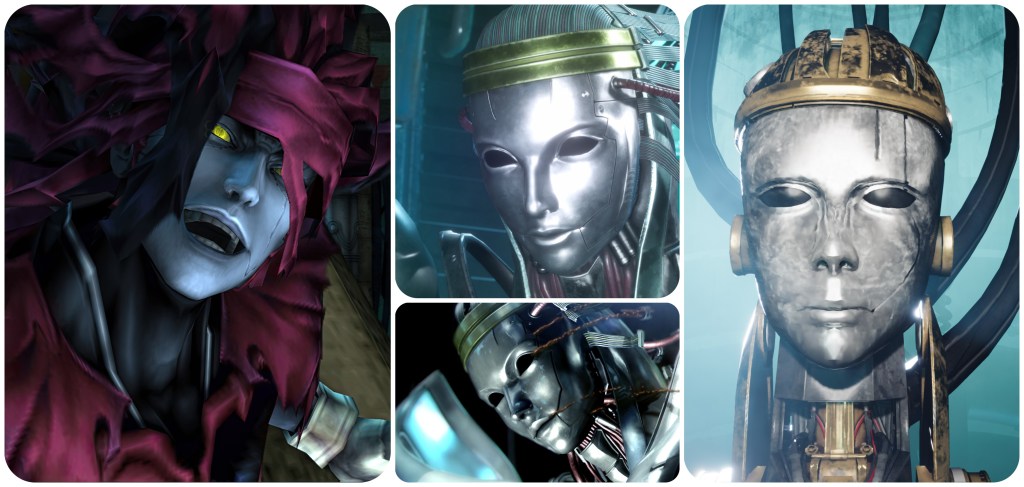
Chaos is not only one of the rare two-winged supernatural entities like Jenova seen in FFVII, but has six segments on its wings like the Jenova Doll.
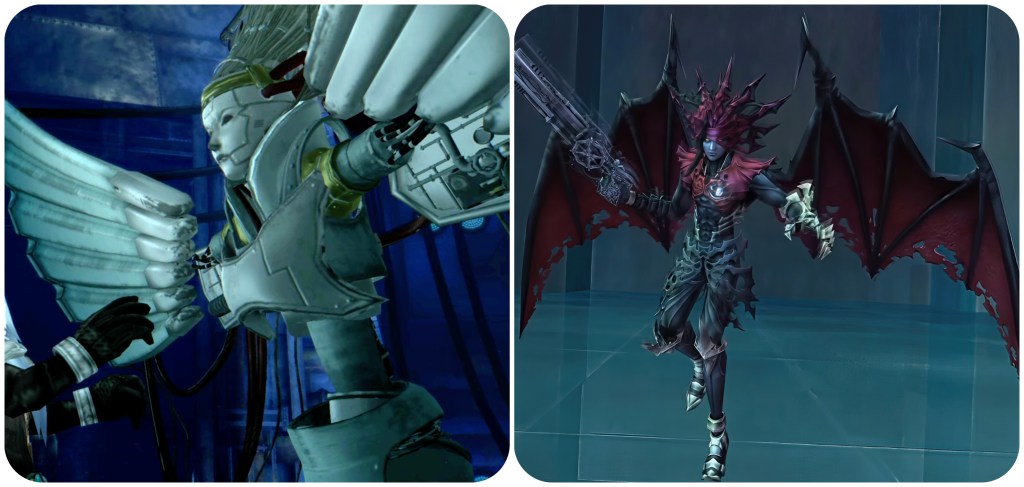
Two out of the four Galian Beast designs we’ve seen have silver hair, akin to those who have either been degraded by or fused with Jenova cells.
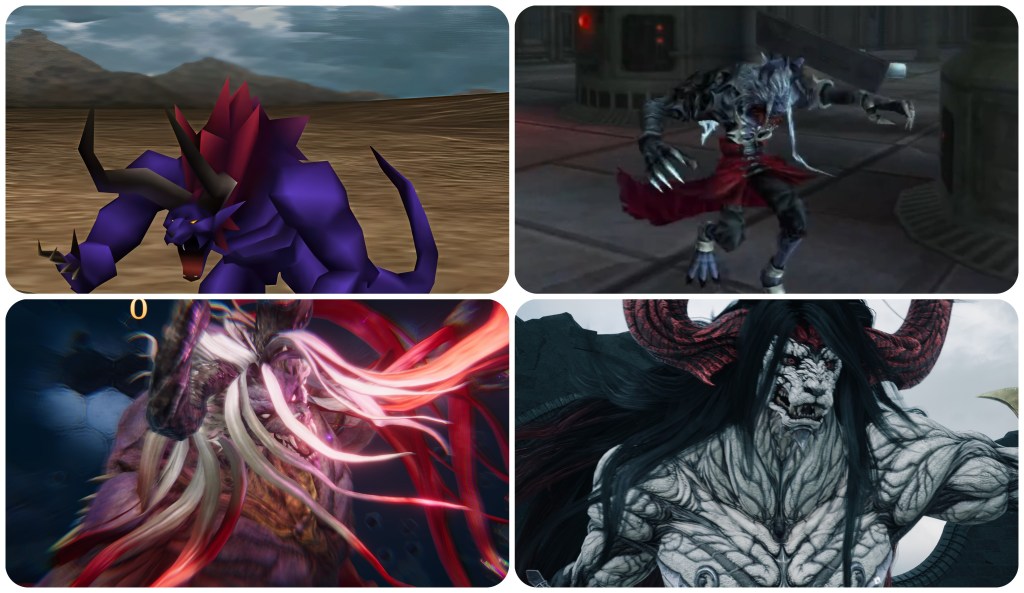
Vincent, the main host of Chaos, has these eyes which look a burning sun. Back in Dirge of Cerberus however, his eyes were simply red while in base form. As Chaos, his pupils shifted between circular or sharp depending on whether he or the entity were currently holding control.

Nero, who also carries some lesser part of Chaos due to experiments with the Stagnant Lifestream, permanently displays the same slit eyes as Sephiroth, coming in pink instead. Nero was injected with Stagnant Lifestream while in the womb, so in that sense he’s kind of the Chaos equivalent to Sephiroth. Whereas Vincent might be more like Genesis? He had a foreign gene mapped onto his own fully formed DNA, and at least aesthetically the Protomateria is similar to the Goddess Materia. Vincent is embedded with the Protomateria to keep Chaos under control, while Genesis absorbs the Goddess Materia to purge the degradation from his Jenova cells. For what it’s worth, I don’t know if it was ever specified who lead the Stagnant Lifestream human experimentation projects. We know that Hojo witnessed Lucrecia implanting the Chaos Gene into Vincent, and that he eventually conducts some experiments involving Weiss, but not if his broader R&D bio-engineering had expanded to include any further experimentation with the Chaos factor.
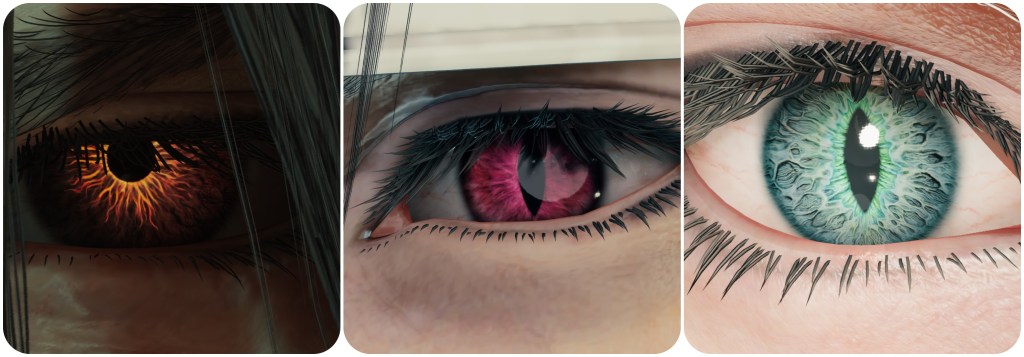
Nero and Azul previously had orange eyes in Dirge of Cerberus, and Nero’s would only turn pink when he fully unleashed his powers of darkness. Remake has now treated pink as his base eye colour though, perhaps to make the mental connection between Chaos and the Gi easier? While they shouldn’t share any genetic matter, it was a conscious stylistic decision to redesign both Gi Nattak and Nero’s eyes this colour. Could be an implication there.
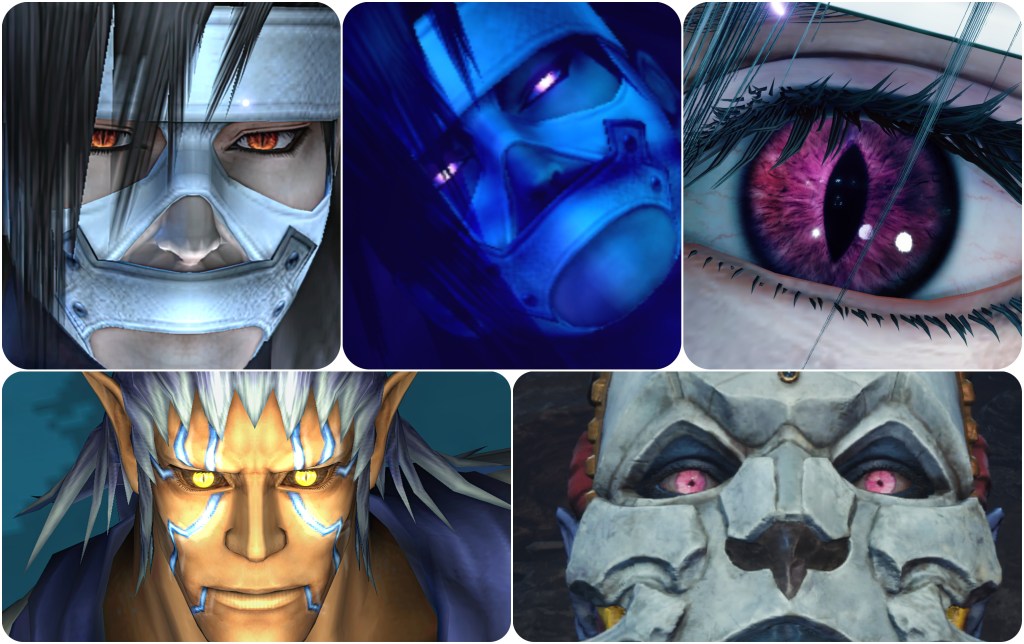
To make matters confusing, Sephiroth’s slit eyes are not seen on any actual Jenova form thus far. Jenova Emergent’s body has a row of cross-shaped eyes, that’s the closest we’ve got. The monster’s main face always has this disturbingly human looking gaze, and so far every one of its other eye growths has had a new design each time.
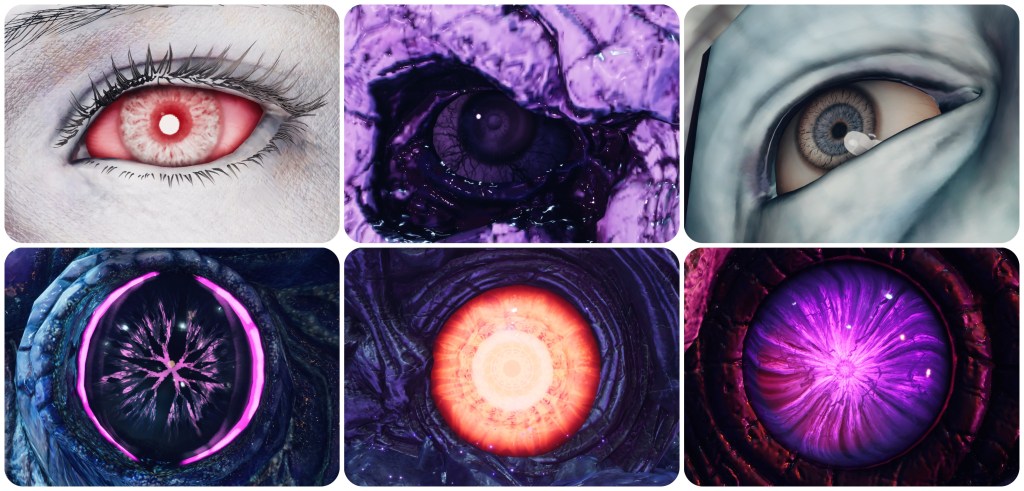
Specimen H0512-OPT, which serve as remote eyes for the skull-faced Specimen H0512, do have the slit eyes. However these are more of Hojo’s lab experiments, not something independently spawned by the main Jenova body.
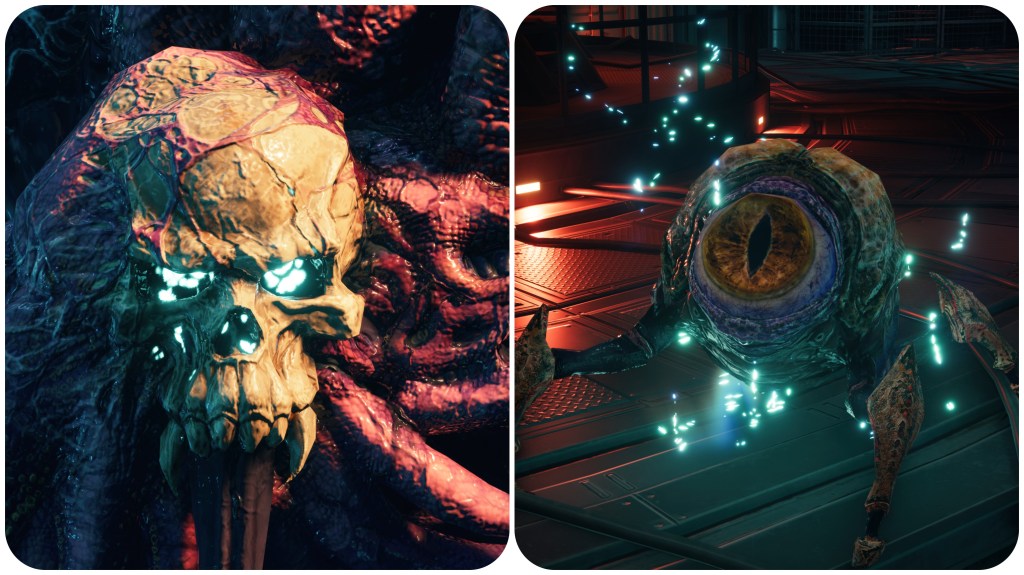
Predominantly, the slit eyes are only expressed in himself, the Remnants of Sephiroth, and those deeply under his control like Cloud and the kids during Advent Children.
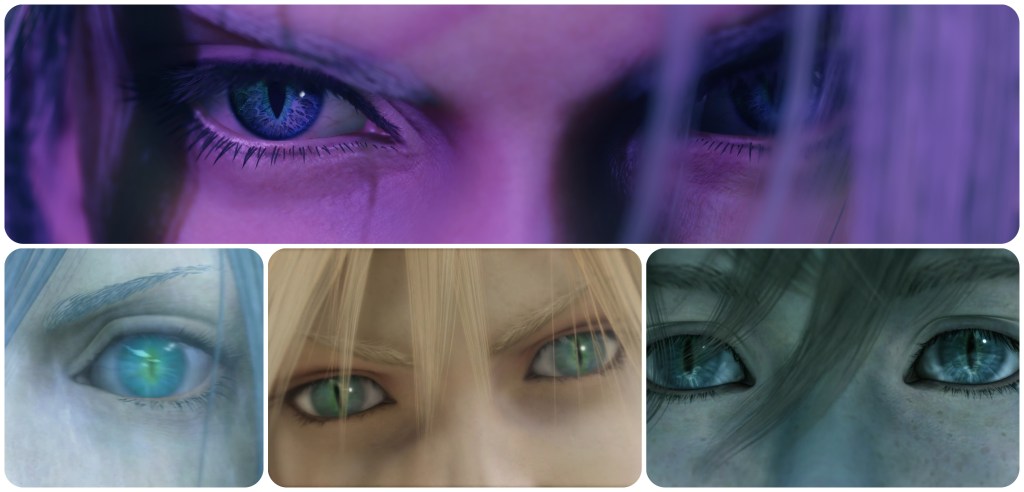
The Final Fantasy VII Remake series has yet to show people under Sephiroth’s control displaying these sharp eyes, even when he literally possesses Cloud. However, I assume that this is currently done to hide their connection and so has a pretty good chance to appear at the North Crater when he delivers the Black Materia to Sephiroth’s true body. My reason for thinking this way is that Remake had represented Cloud’s Jenova episodes through the use of a blue filter and static overlay, whereas Rebirth returned to the rapid flashing of blue cells that was seen in Advent Children.
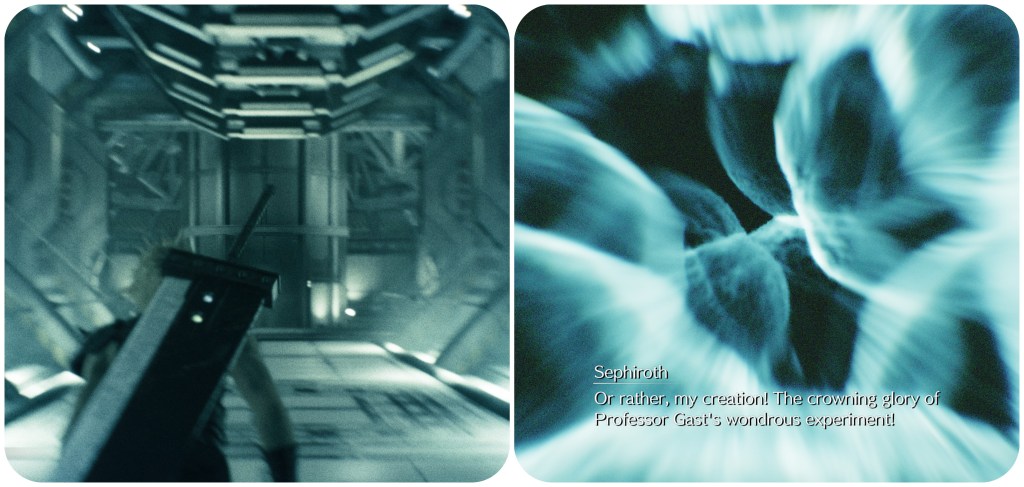
Lucrecia claims that “the Jenova inside me wouldn’t let me die”, and the Cetra similarly imply that Jenova could not be killed, only put to slumber. Cloud mutters that he’s started to suspect the same of Sephiroth. Well, the Chaos inside Vincent makes him immortal too.
- Lucrecia (FFVII): “I wanted to disappear. I couldn’t be with anyone. I wanted to die. But the Jenova inside me wouldn’t let me die.”
- Gi Nattak: “Those not born of the lifestream can never join its flow. One cannot ‘return’ to that from which one did not arise.”
- The Cetra (Rebirth): “For the planet did we lay down our lives in battle, and in death returned to her embrace. Yet our adversary did not. Could not. Thus did it fall into a deep slumber.”
- Cloud (Rebirth): “I dunno if you can kill him. And even if you could…I think he’d stick with you. Somehow.”
- Vincent (On the Way to a Smile: Episode Nanaki): “Nope. Not me. I don’t age, and I don’t die. It’s…a mixed blessing.”
With Remake context, and the particular way that Jenova is described as unable to return to the planet’s embrace, this immortality likely stems from the fact that Jenova is affecting their spirit energy to where the planet no longer accepts them as her own. Jenova, the Gi and Lucrecia are all Unsent, which were unable to dissolve into the Anima Lifestream. That seems to be the interaction here. Chaos’ red Animus energy that grants Vincent immortality may link back to Jenova.
Likewise, FFVII Rebirth depicts Vincent having the ability to levitate when he softly slows his landing on the coffin, similar to Sephiroth’s levitation and feather-falling seen throughout the Compilation. Nero also possesses a similar ability to fly despite his mechanical wings not being functional, similar to how Sephiroth, Genesis or Angeal will often psychically fly without actually flapping their wing.
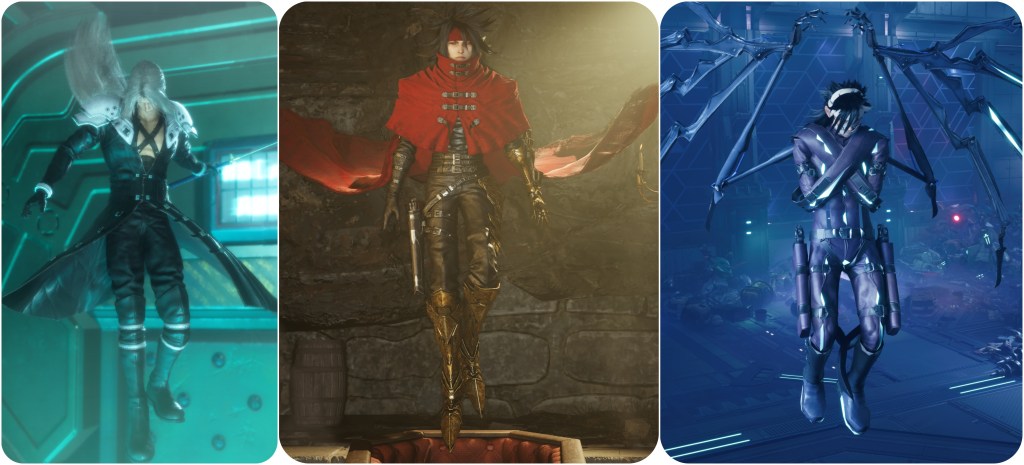
As Vincent’s rage boils over, the doors to the supply closet slam shut, lights flicker and loose objects are tossed about the room. Through this horror scene, Vincent is perhaps exerting psychic pressure over the environment. Jenova also has immense psychic powers, with which Sephiroth could even toss skyscrapers at the party.
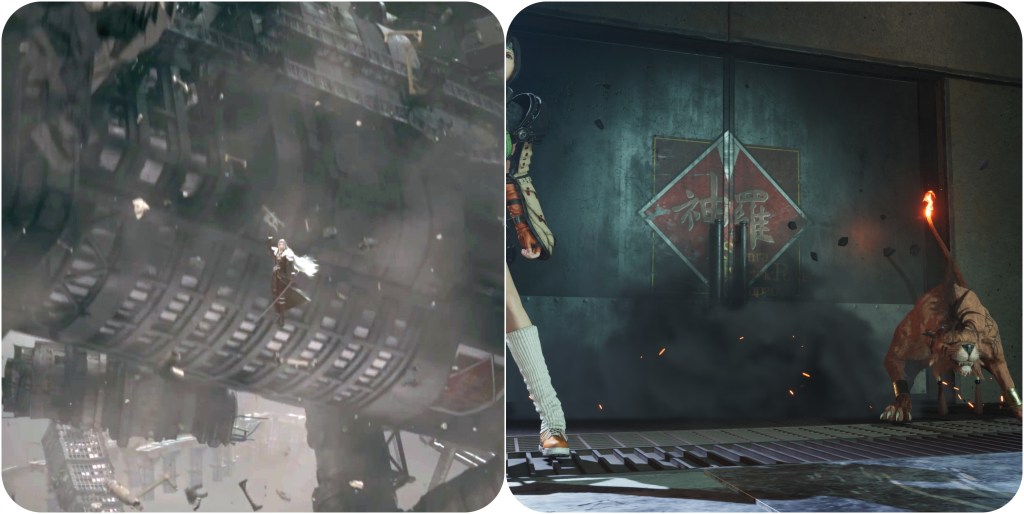
The “Diabolic” line of Jenova R&D experiments are shown with a solid hair structure, similar to Chaos Vincent. The Variant creature also has horns, which traces back to the Galian Beast in many instances.
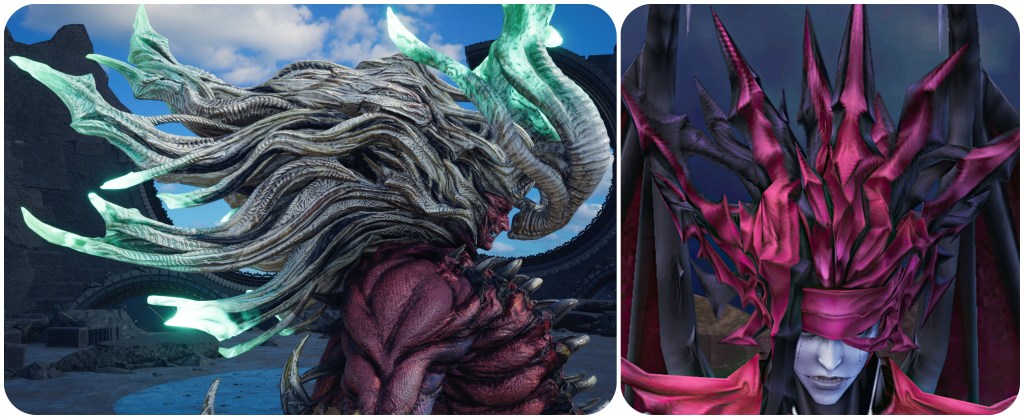
Furthermore Jenova and some of her servants have now been seen emitting red spirit energy or red haze, which before Rebirth had most strongly been associated with Chaos. We also see the Igaran and Type-G Jenova mutations developing bat wings that resemble Chaos, instead of the usual angel wings.
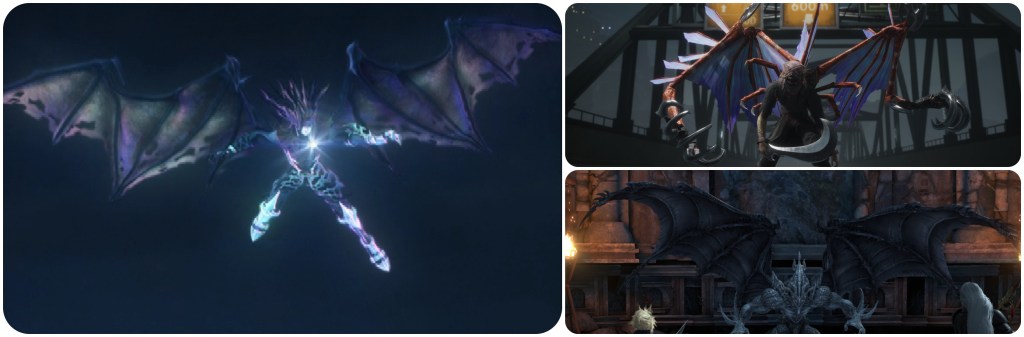
I will say that one thing I’m not wholly sure how to reconcile yet is that the Remake saga has placed a greater focus on Jenova as an illusionist. She uses her purple haze to induce hallucinations that warp spacetime. I’m not quite sure what this means for the lore or the mechanics, since if Jenova were just some kind of living illusion then it kinda voids the distinction between those who have been experimented on with Jenova’s mutagenic cells and those who haven’t, since Jenova can just do whatever she wants. And, yeah, I guess I am a little resistant to the idea because it almost seems to imply that all her shapeshifting is based on illusion rather than genuinely altering her own genetic makeup, which negatively impacts her connection with The Thing and Lavos a little. In this section of the discussion though, that may arguably strengthen her connection to Chaos. Dirge of Cerberus presents Vincent transforming into Galian Beast and Chaos through a purple orb that generates over his body, which may be the same phenomena.
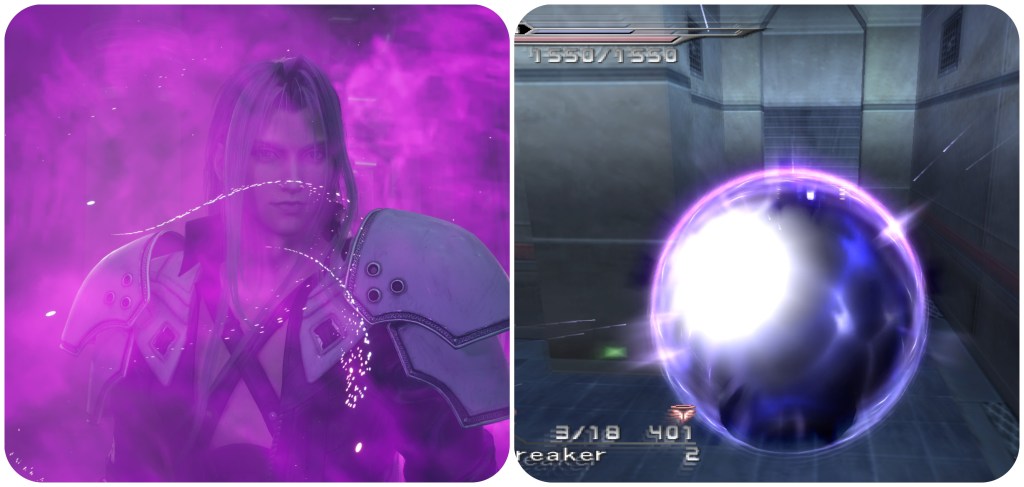
Sift through Vincent’s mad scrawlings across the walls of the Nibel Manor’s basement, and you can find a copy of some advanced mathematical equation which also accounts for Jenova. This graffiti was all done by Vincent in his stupor, so this must be connected to his Chaos factor in some way. The equations also mention Loz and Yazoo, which arguably may invalidate their use as any serious lore link, but consider this: On the Way to a Smile and The Kids Are Alright both introduce this idea that the Remnants of Sephiroth are three totally unrelated spirits which he had taken over in order to send them to the surface, since Sephiroth didn’t have enough of his memories left to recreate his own body. The Remnants do not originate as some three-way split of Sephiroth’s spirit, they were assimilated after their own deaths. We don’t know who these spirits were though. Kyrie thinks that she recognizes Kadaj at first because of his striking orange hair, but it turns out that those were just memories that Kadaj had hacked into her mind through Jenova’s power. So it’s just as likely that Kadaj, Loz and Yazoo are names that Sephiroth or Jenova imparted to these spirits upon their rebirth, not the names that those people originally had. In which case, maybe FFVII Rebirth is subtly implying that “Kadaj, Loz and Yazoo” might be some name that the Jenova Project team applied to various strands of Jenova’s genetic factor, or something along those lines.
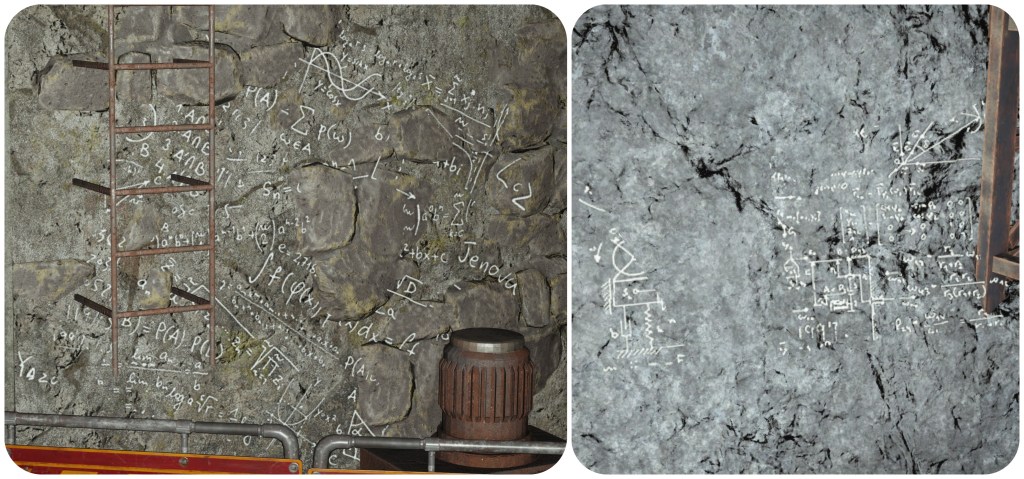
Hojo in Dirge of Cerberus comments that it was his experimentation on Vincent’s body which made him strong enough to withstand being infused with Chaos, and that seeing Vincent successfully merging with Chaos is what inspired Hojo to inject Jenova cells into himself in preparation for parasitizing the Omega Weapon. It’s never explicitly clarified whether Vincent’s alterations involved Jenova cells or not, but the context might be implying they may have.
- Hojo: “I couldn’t believe some fabled beast from legend past had anything to do with your survival. However, three years ago when you transformed into Chaos right before my eyes, I must say I was shocked. And so I began thinking. If Chaos exists, then so too must Omega. And if you could become one, then maybe I could become the other to traverse the cosmos in a blaze of glory! But there was a problem. Only a strong shell could hold back Omega’s might. And it could not be just anyone. You see boy, the reason you were able to play such a perfect host for Chaos was because my experiments had endowed you with a nearly indestructible body. Thanks to me, you are standing here today. Now, where was I? I attempted to perfect my body for Omega by injecting myself with Jenova’s cells. However, that didn’t go as I had planned. I failed to consider the fact that the cells might try to take over my mind and eat away at my soul.”
The Nero section in the Trial of Yuffie has a motif that to me sounds like an adaptation of Those Chosen By the Planet. There could be any number of reasons for this. Perhaps to indicate how the trials are inadvertently building towards Sephiroth’s own goals, perhaps to hint at how the Cetra are using reality-altering illusions similar to Jenova and Sephiroth, or maybe we could even stretch it to where this motif being involved implicates some connection between Nero’s Chaos and Sephiroth’s Jenova.
The main obstacle to any comparison here, I would say, is that we don’t know what Chaos would look like on its own. We’ve only seen the fusion that resulted when Hojo used the Stagnant Lifestream to inject the Chaos Gene into Vincent and turn him into a pseudo-Weapon. That still very clearly looks like Vincent though. The independent Chaos Weapon has yet to show its face. At the very least though – Satan Slam – that face which Chaos summons is the devil in Final Fantasy VII. Vincent’s hold further solidifies this through the multitude references to “pandemonium”, which in FFII is the castle from which Satan ruled over Hell. So either Jenova took its face from Chaos, or Chaos took its face from Jenova.
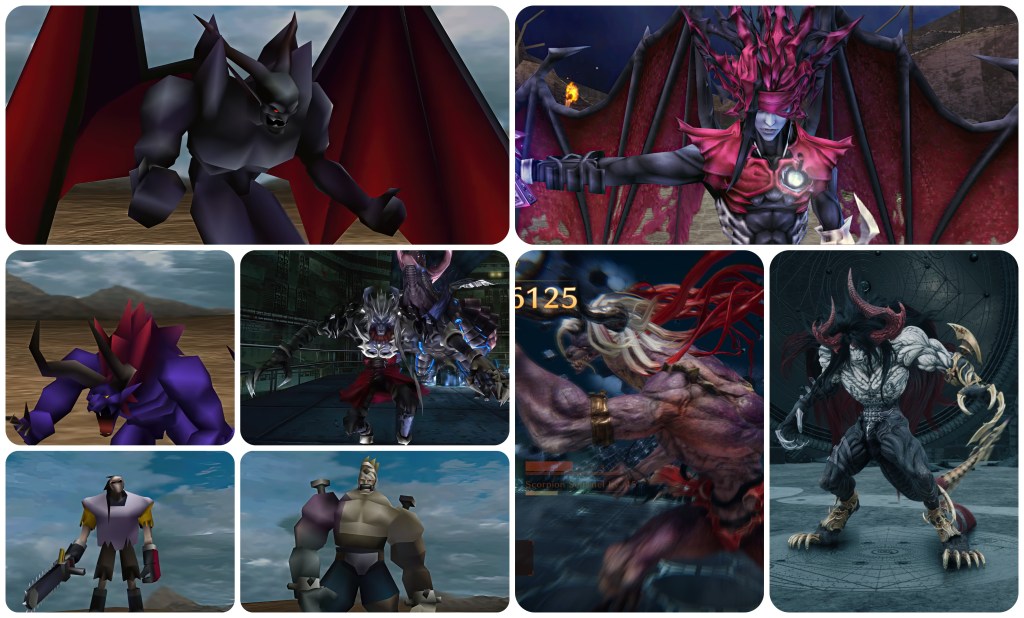
With that said, the very existence of a “Chaos Gene” is significant in itself, given all the tests Hojo had run with Jenova’s gene expression.
- Shalua: “Chaos? Your body harbors the Chaos gene?”
All products of these experiments wage a similar tug-of-war with their entity for control over their mind and body. I mentioned a while back that The First SOLDIER Episode 2 really emphasized the effect which one’s mental health has on how much influence Jenova can exert. Despite being almost as deeply embedded with Jenova cells as Sephiroth is, Angeal is able to resist her manipulations by remembering the heroic values his parents had instilled in him. Sephiroth, however, is much more vulnerable, with few friends to ground him. Jenova preys upon Sephiroth specifically at his most unstable moments, first appearing to him with Lucrecia’s face, then swooping in at the precise moment his heart is broken at Mt Nibel. Likewise, Chaos is constantly vying for control of Vincent’s mind. He manages to stay sane due to the Protomateria in his body which regulates Chaos’ spirit energy, but when Rosso steals it he begins falling further and further into the demon’s mental grip.
- Angeal: “I know for sure now. That you’re not my mother. I don’t know what happened in my mum’s past, but I do know the lessons she learned from those hard times and passed down to me. Be true to your own sense of justice. Don’t let your surroundings dictate your actions.”
- Sephiroth: “Here I am, your son. Mother, together we will reclaim our world. And I know exactly how we can do that. The promised land…Mother, they have come again. The ones who robbed you of the planet. Your planet. But there’s no need to be sad, Mother. Because I’m here for you, now and forever.”
- Shelke: “Vincent. You cannot defeat this enemy by simply trying to overpower him. Take control. Don’t let Chaos rule you. You must rule Chaos.”
Dirge of Cerberus and the FFVII Remake games have both visually represented Chaos and Jenova’s control in the same way, seen through the character’s eyes from a first-person perspective under a thick static overlay.

Now that I think about it, Chaos is a shapeshifter too huh. Hmmm…in that case:
Is Jenova the Chaos Weapon from Planet Gi?
Chaos, Omega and Jenova have all been referred to as “beasts”. Together with everything, I see the signs pointing that direction. But I don’t believe that she can be a Weapon, because Jenova is a sapient, independent lifeform. She’s known to be a deceiver who schemes her way into a position of power with the intent of propagating her own hivemind throughout space. Chaos though is a kind of being generated natively by the planet for apoptosis. It’s a shapeshifter, a destroyer of worlds, but a ruler it is not.
As discussed prior, Jenova arrived to Gaia millennia after the Gi did. If she was their Chaos Weapon and she was the one who dropped the guillotine on that planet’s people, then Jenova would have likely been reabsorbed by their Omega Weapon and arrived to Gaia at the same time. Yet this isn’t the case. There definitely are some hard to ignore overlaps in their aesthetic though. Chaos is a shapeshifter, it does have dimensional and psychic powers, Jenova’s spawn do develop similar bat wings, one of its hosts does have the same sharp eyes as Sephiroth and the other is granted a similar immortality that Jenova has been known to bring. However Chaos’ shapeshifting is never shown to function quite like Jenova’s, only transforming Vincent into various humanoid horror film monsters, never into anything distinctly alien or stealing anyone else’s face.
Is Jenova the Omega Weapon from planet Terra?
It does stick out to me that Jenova Lifeclinger seems to have a Magnus Materia in its chest, similar to the main Weapons. When that core gets crushed, a bunch of green Lifestream that Jenova had swallowed spills out to heal the party. The Omega Weapon ingests Lifestream before setting out into space. And remember when I said that Terra’s Omega Weapon probably should have had red wings? Jenova Lifeclinger’s got magenta wings. That’s sort of close. The massive heart that the Mt Nibel woman is growing out of may be indication that once upon a time Jenova’s body was actually much, much larger than we have ever seen her.
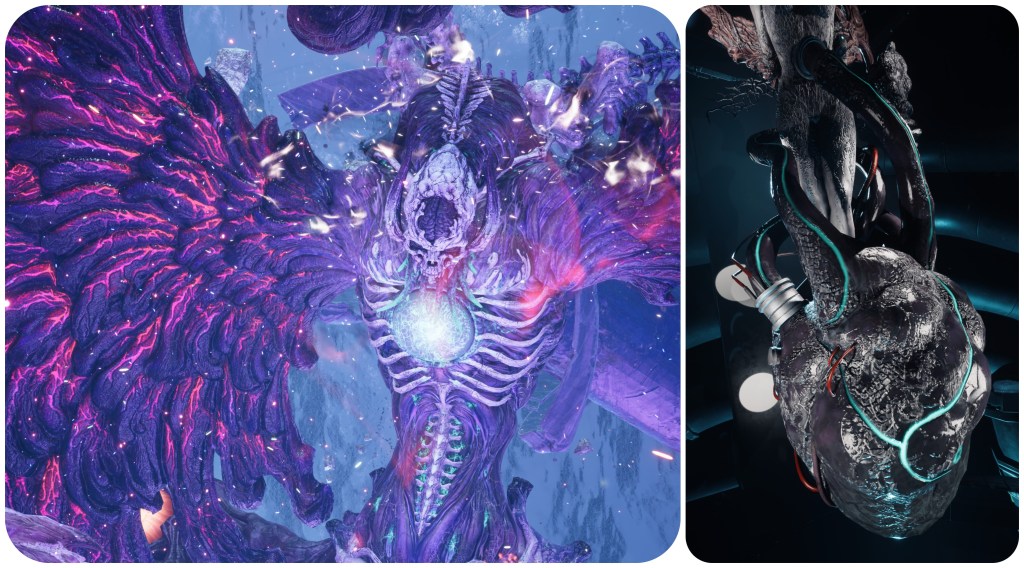
However those aside, the idea makes no sense. Like I said in the previous question, Jenova is also known to exist as an intelligent, humanoid shapeshifter. She’s certainly no Omega Weapon, you couldn’t even theorise about her as a counterpart Alpha Weapon or something. She’s too conscious for that. Her behaviour and nature do not match. Based on these ideas, if we had to put a clear definition in place for Jenova then I might say that she’s an ancient parasite which has evolved to imitate Chaos in order to prey upon Omega Weapons. Not sure that holds up thematically or narratively though…or if I even like it.
In any case, I would say that Jenova is not a Weapon from the Gi’s homeworld. But…Chaos and Jenova, what if my cause and effect are reversed? There is a theory I’ve heard before and quickly dismissed without much thought, but I’m starting to see it as the answer to all my problems. Well, a lot of them anyway. And that is to ask – did Terra have a Chaos? Is Chaos actually a natural phenomenon? In a second I’ll talk about what can be done for us when we say that it isn’t.
Chaos is said to be born from the blackened Stagnant Lifestream. Is this the same as Geostigma’s Negative Lifestream?
While the ingame information presented in Dirge of Cerberus seems to position them as two distinct Lifestream distortions that just so happened to manifest similar discolourations as a result of different underlying principles, I am going to make a large assumption here and explore what happens if we decide that they are in fact the same thing. Remember near the start where I said that naming the Gi’s planet “Terra” would be of central importance in realising my conclusion? Now is that moment. To shift trajectory one last time. Let us read from the stone tablets that Grimoire Valentine discovered.
- Omega Report 1 (Dirge of Cerberus): “Soul wrought of terra corrupt. Quelling impurity, purging the stream to beckon forth an ultimate fate. Behold mighty Chaos, Omega’s squire to the lofty heavens.”
Soul wrought of terra corrupt. Within the original Compilation lore, this was just understood to be saying that Chaos is the soul created from corruption within the earth. The Cetra’s negativity built up over generations and was stored in the Crystal Cave in case the planet ever needed a Weapon to purge all life. This is an assumption of an assumption here, but with the new story elements added to the Gi Tribe, and the new skull and spirit energy elements tied to Jenova, I am going to toy with the idea that “terra corrupt” has been recontextualised to where it’s now secretly pointing at Planet Gi, which I believe should have been named Terra.
The assumption I’m making, and it is a rather extreme one, is that Chaos does not exist. Or at least that it isn’t what we’ve been told it is. With the new imagery that has been revealed through Jenova and the Gi Tribe in Rebirth, I believe we can support a claim that Chaos is fabrication. That it is the Jenova-infected energy of the Terran Gi Tribe stagnating within the Lifestream, just like Geostigma. Something I’ve been holding back screenshots of until this very moment is that there are some scarce pockets of green energy that can be found within the Cavern of the Gi. Perhaps a minor amount of their spirit residue therefore did manage to get taken in by the Lifestream somehow, then as Gaia gradually filtered the Gi’s Animus element out, this pooled into one location in the Crystal Cave. And this is the Stagnant Lifestream which becomes Chaos. In fact Lucrecia’s thesis did describe Chaos as a “xenoform”, though it’s unclear whether she truly meant to dub it an extaterrestrial or if she was simply referring to some non-human lifeform.
- Shalua: “Crescent. Shinra class A scientist specializing in biotechnology. In her research thesis, ‘The Planet’s Pulse, she refers to Chaos as one of the sentient xenoforms residing among us.”
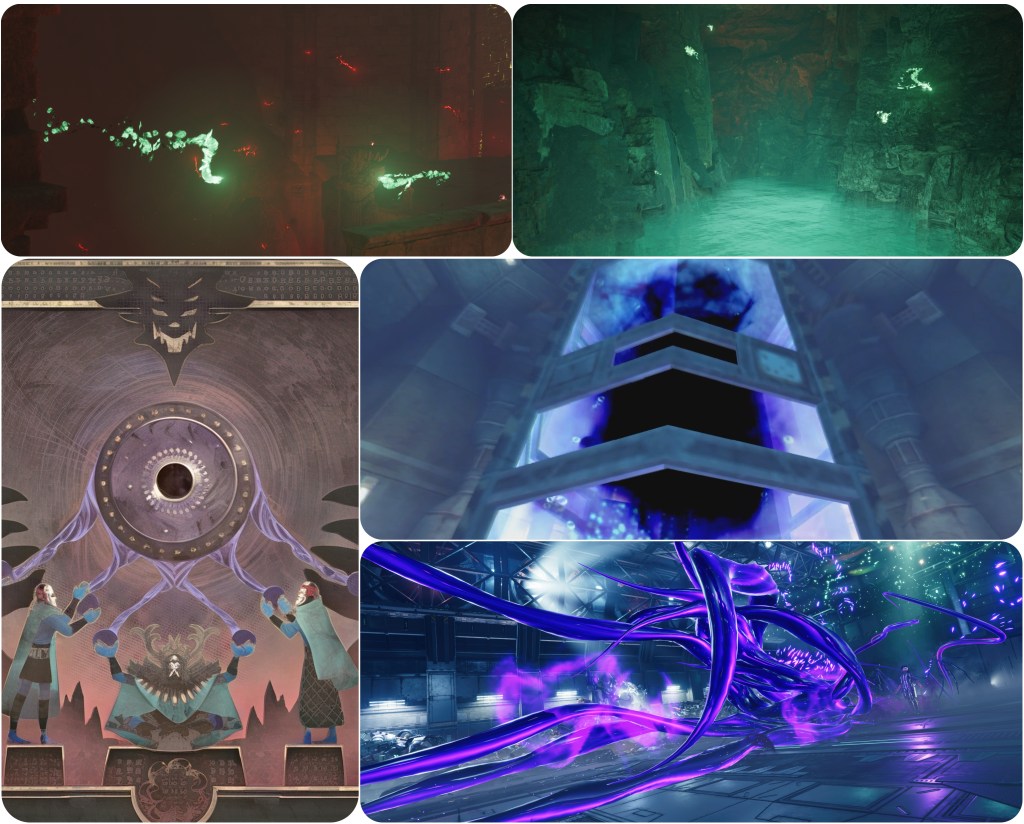
Have any Jenova-related lifeforms evolved to resemble Chaos?
Yessiree, and one of them is actually quite significant. However for my first example, I’d point out that Jenova itself has been steadily developing horns across the three forms seen so far in Remake, while its spirit particles and haze have become increasingly coloured red as the trilogy goes on.
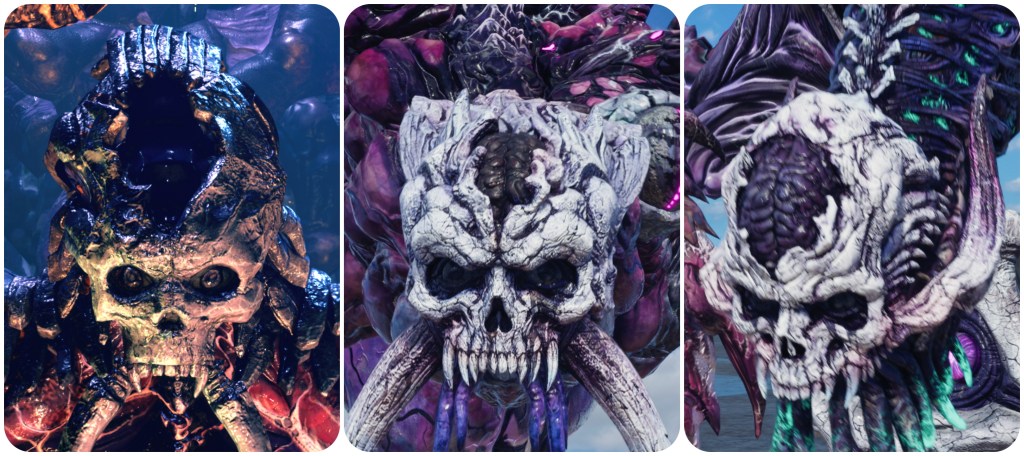
All four of the mutated Gi tribesmen have some manner of horn, and their mutation must stem from Jenova due to the clear visual overlap it has with the Necrotic Entity.
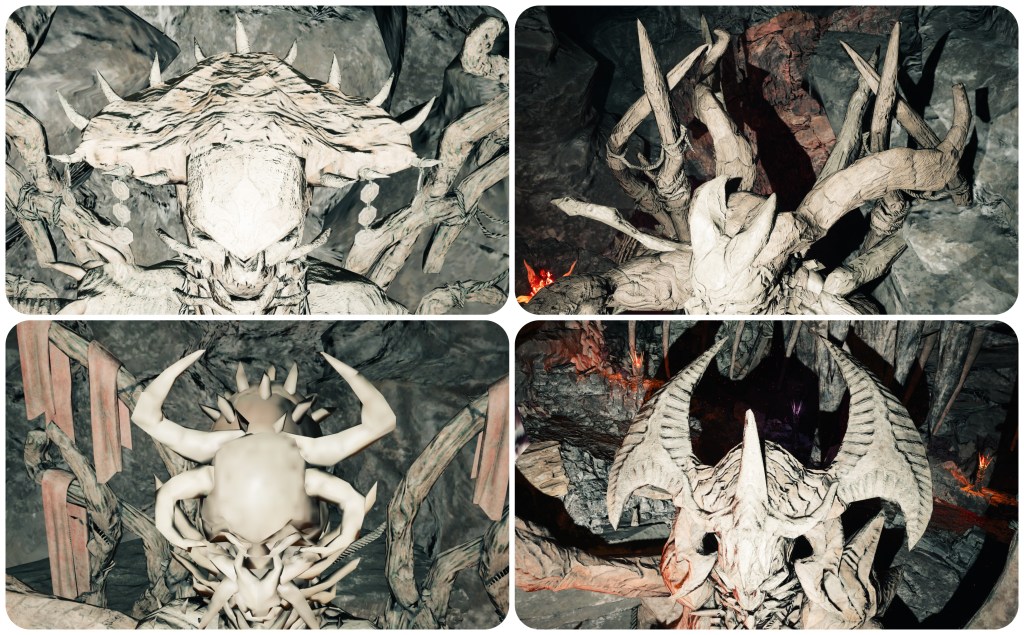
The texture of the largest effigy’s horns and the shape of his spikes resemble features from the Galian Beast.
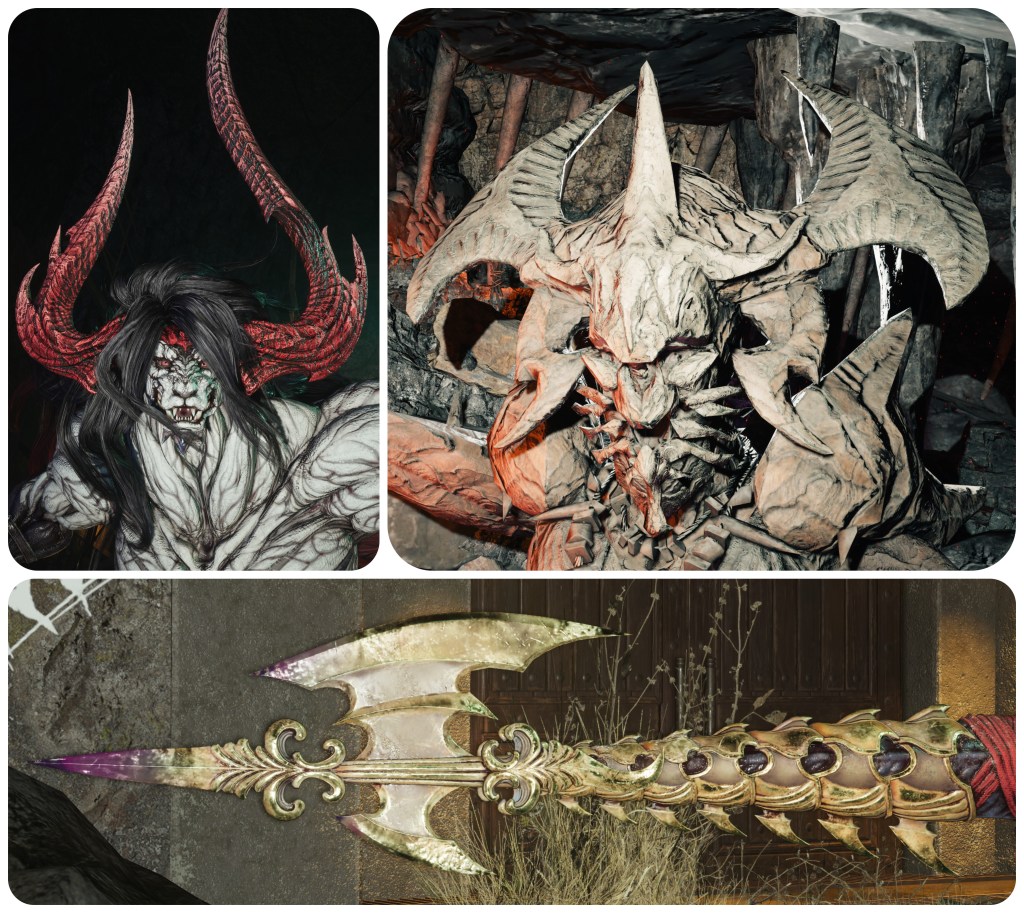
Another of the effigies has horns that are near-identical to that which Chaos had in his original Final Fantasy VII appearance. It’s possible that this might be considered Chaos’ true design, whereas Vincent is a human hybrid.
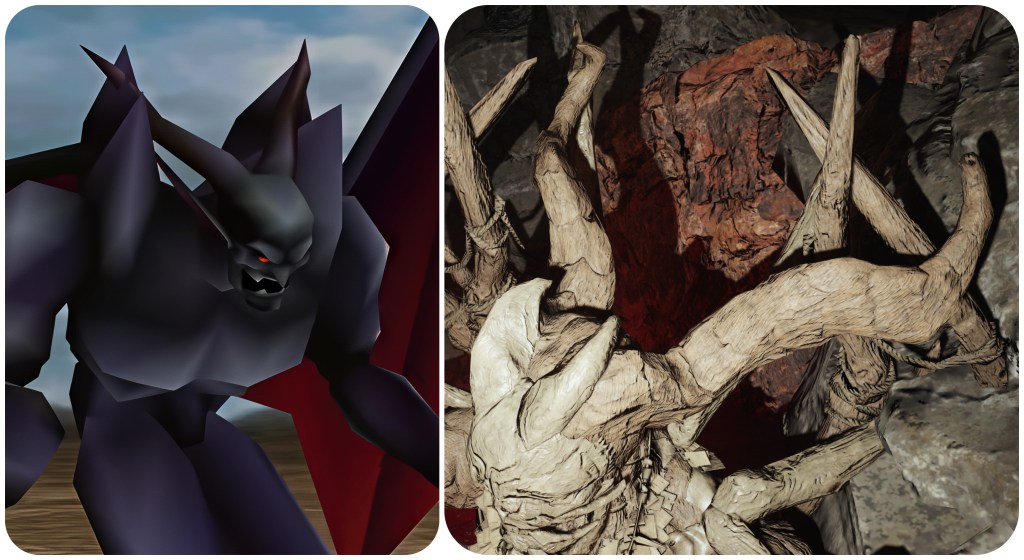
Gi Nattak in both forms, the Jokers and Vincent’s Galian Beast all wear clawed half-gloves that are similar in appearance. The latter two are even made from the same golden metal.
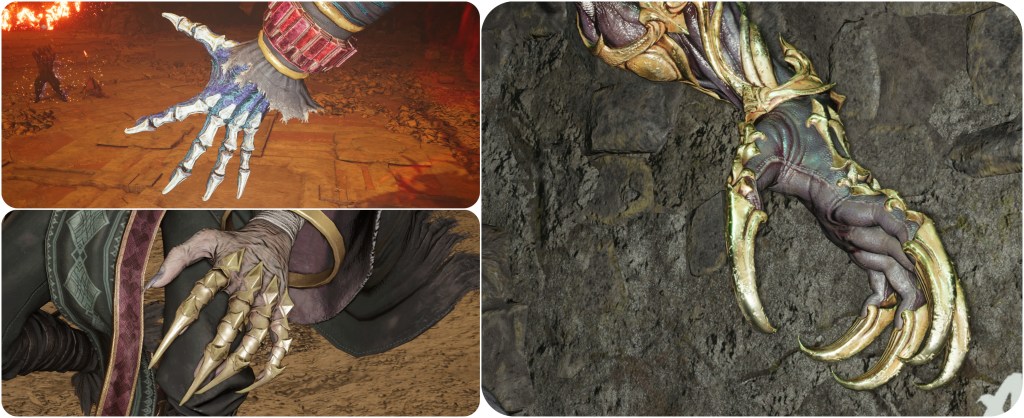
The second-tier Genesis Copies have an ornament on the tip of their wings which heavily resembles the tail of Rebirth’s Galian Beast.
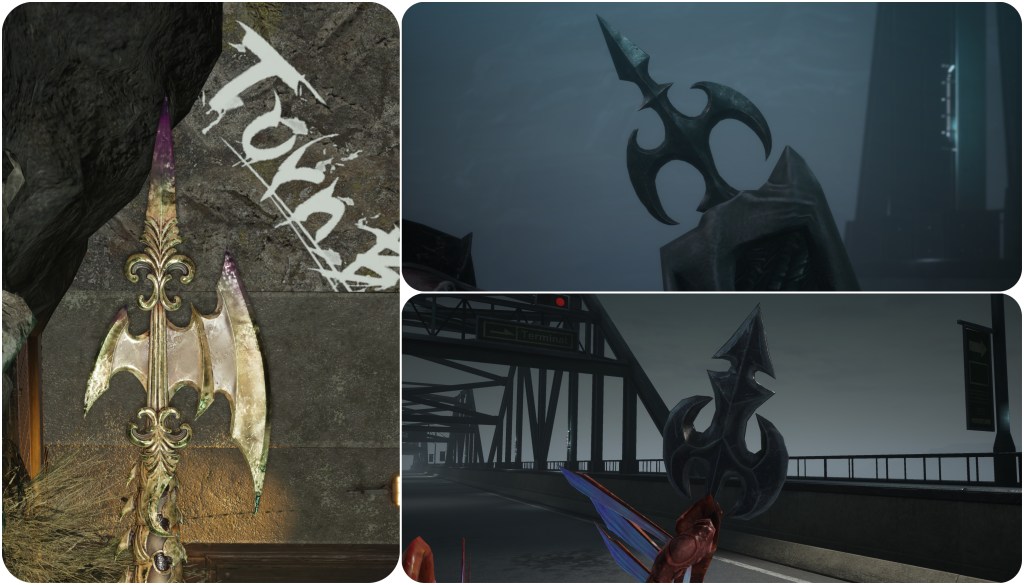
After ingesting S cells from Zack’s hair, a Genesis Copy is shown becoming enflamed within a dark Lifestream, similar to the napalm-like stickiness of the Stagnant Lifestream and Animus.
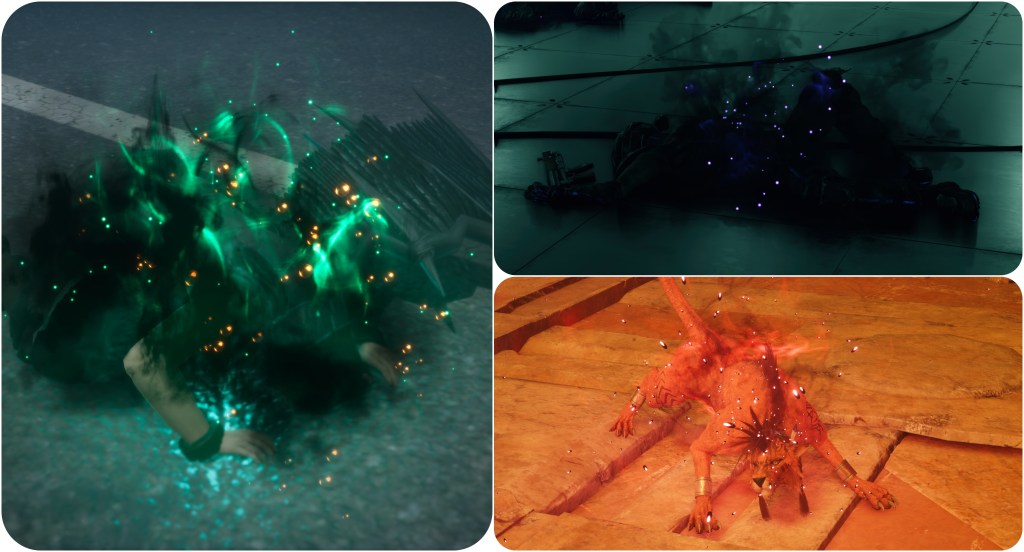
It then explodes, bursting out with red particles and an inverted Lifestream. The effect in the original Crisis Core resembled Chaos more than Geostigma due to its transparency and outer glow, though the Reunion version trends closer to the latter. Both are accompanied by a bright red light as that mutant evolves into his next stage. Genesis himself refers to S cells as “a modified version of Jenova’s power”. This is 23 years after Vincent was implanted with the Chaos factor, so perhaps by this point Hojo had studied Chaos and figured out how it evolved from Jenova.
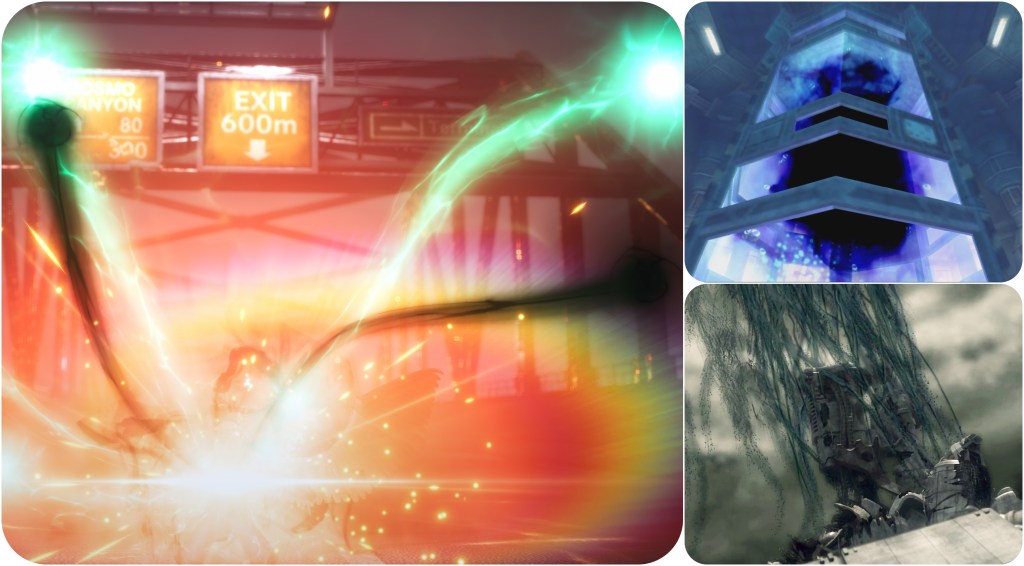
- Genesis: “You were a test subject in Hojo’s new experiment. A modified version of Jenova’s power runs through you.”
Ingesting this modified Jenova gene is what triggers the Genesis Copies to begin veering from humans with angel wings into skull creatures with bat-wings and beyond. The G Eliminator who first undergoes this transformation has two wings with clawed hands at the end, resembling Nero.

The late-stage Genesis Copies such as the G Devastator and G Deleter look rather vampiric, and have begun to develop red horns similar to Rebirth’s Galian Beast. There is also another strand along the G Guardian and G Enforcer mutants who have black horns instead.
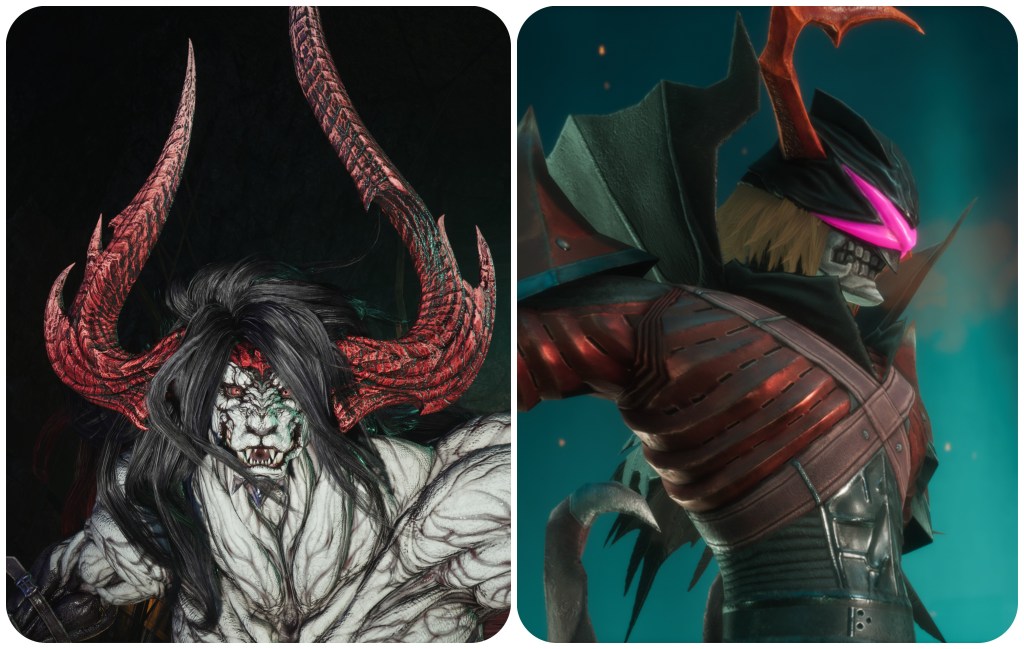
The Makonoids are immature versions of the Diabolic Creation, which both have a solid hairpiece similar to Chaos. The Diabolic Variant, which is red and has horns, is described as a further mutation. Additionally, it uses a move called Enshadow which spreads a dark haze throughout the area and begins draining HP, which is identical to the final phase from Nero’s Intermission boss fight. Perhaps these traits could be implying that Chaos is a variant form of the Jenova gene.
- Diabolic Creation: “A man-made monstrosity created by Shinra’s Research and Development Division, it has since been disposed of for its cannibalistic nature and disobedience.”
- Diabolic Variant: “A man-made monstrosity created by Shinra’s R&D Division. It has since been disposed of for its disobedient and cannibalistic nature, but some specimens escaped the research facility and have undergone a unique evolution in the wild.”

There are instances of supposedly Gaian creatures with horns that heavily resemble the Galian Beast, perhaps tracing back to the Shadowblood Queen whose blood was a “wicked ichor” that allegedly birthed all the fiends of the world. The Kelzmelzer and Behemoth families come to mind, the former even having distinct red eyes. There are also some of Hojo’s Jenova-grown R&D monsters like the Hell Rider and Cavestalker who have red horns growing in. The Cavestalker itself seems to be a further mutated version of the Zenene, so these red horns must be the responsibility of either Jenova or Chaos.
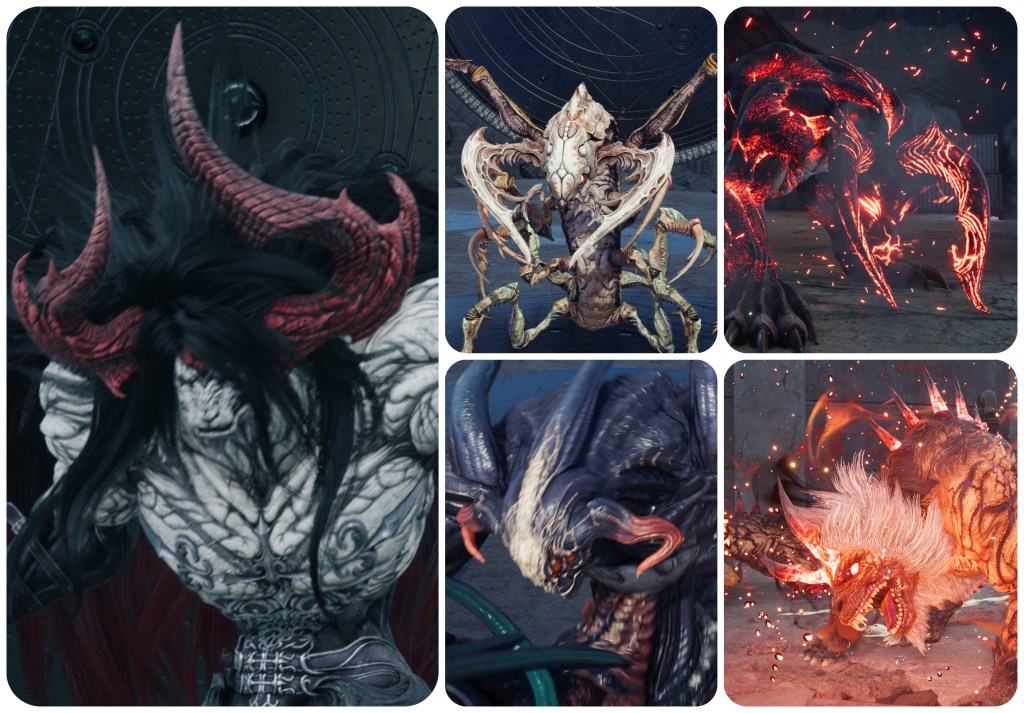
Jenova’s pollution seeping out of the Mt Nibel Reactor causes the region to suddently spawn some new, mutated fiends. One of which is the Twin Brain, that possesses both the same internal bioelectricity as Jenova and horns in line with the Galian Beast.
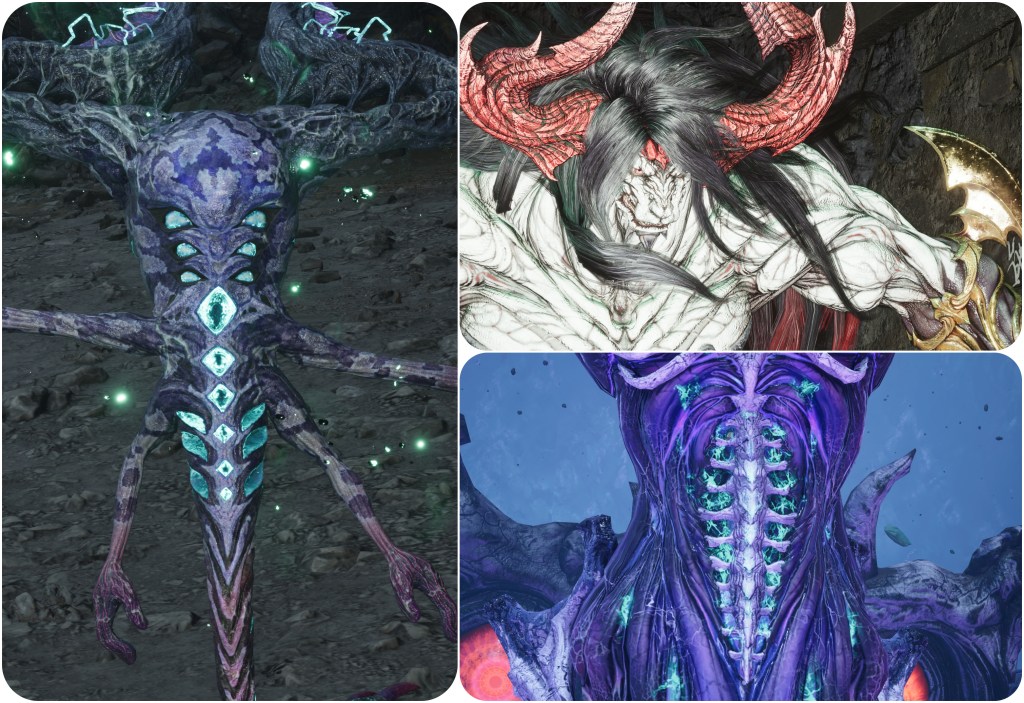
But there’s one monster that especially springs to mind where you can most easily see the mutagenic forces of Jenova, Gi and Chaos all in play at once. The Enemy Intel for the Panthera Protector decribes it as once suffering from a “strange illness” that the Cetra cured for it.
- Panthera Protector (Enemy Intel): “Half-man, half-beast creatures that live in the Temple of the Ancients. Saved by the Cetra while suffering a strange illness, they now guard the Temple in order to repay their benefactor.”
Notably, the Cetra saving it from this ‘illness’ is what inspired the Panthera Protectors to take up residence as a security force in the Temple of the Ancients. The temple was built sometime during the conflict with the Gi, to contain the Black Materia. If we overlap those events, it’s possible that the Panthera Protector may have even contracted its ‘illness’ from the Jenova pathogen present introduced by the foreign Gi Tribe, and that may be what caused it to mutate into a chimera, growing these Galian Beast-like horns which tip purple at the end similar to the Galian Beast’s tail, sharp teeth and tusks that match to Gi designs, four arms, and a feathered halo at its back similar to the Jenova mural, Safer Sephiroth and several of the Gi effigies.
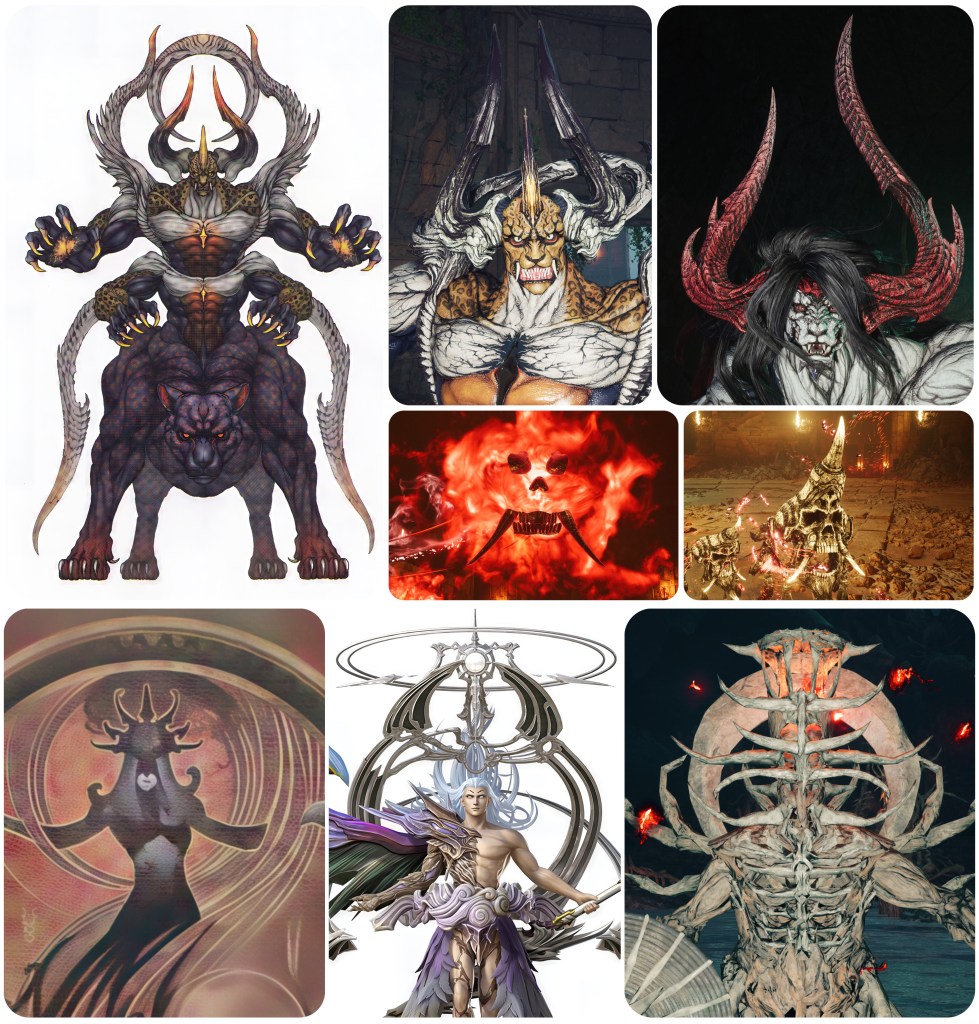
Panthera Protector’s concept art has a crystal in its chest that appears to be the same as the one on Gi Nattak’s mask, though this didn’t make it into the final ingame model.
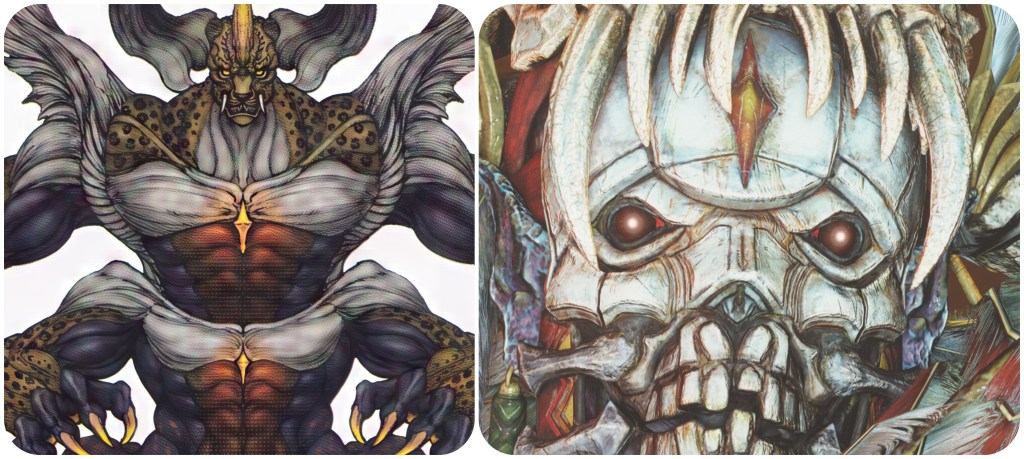
The original version of this enemy, called the Doorbull, was not nearly as mutated. It ony had one torso, two arms, no central horn, none of the Safer Sephiroth-styled adornment on its back. And so gentlemen I feel like this…is it. That the Panthera Protector, its mutations and its illness, is the key to the history of contact between Jenova and the Gi.
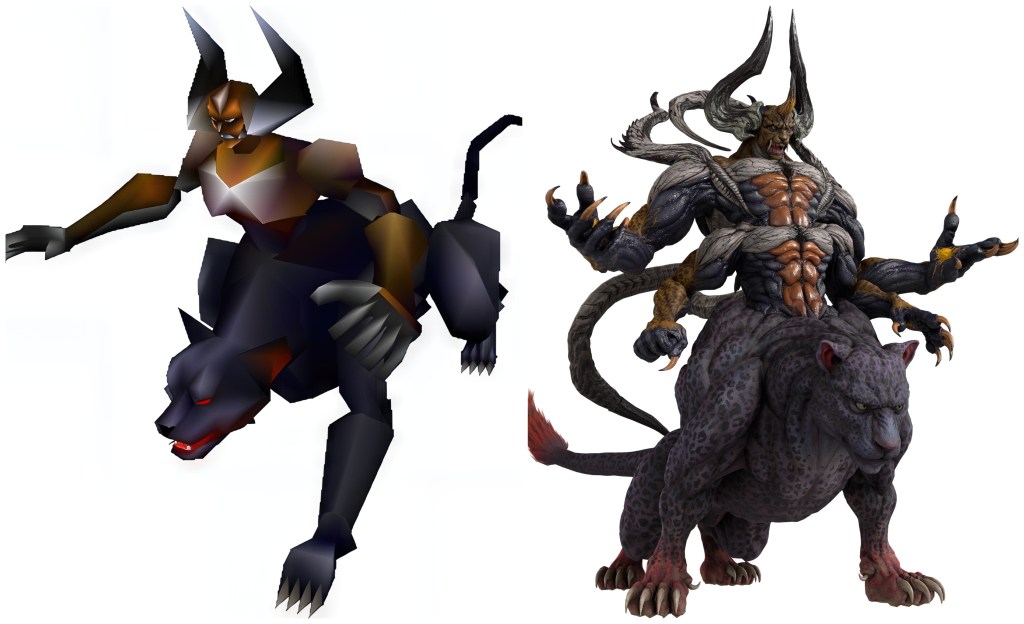
Even if we say that these fiends took up residence in the temple after the fact, that changes little in the reading. Because their mutations still undeniably resemble the Gi, yet FFVII speaking of a “strange illness” is surely meant to invoke Jenova’s so-called virus. The wording though gives the impression that the Cetra did not know this disease to stem from Jenova yet. Heck, maybe this small amount of Jenova infusion into the Chaos-like lifeforms and Gi Tribe are what called Jenova to this planet in the first place as part of her Reunion. The Panthera Protector’s outward fangs and central horn make it a dead ringer for the skull from Gi Nattak’s Soul Flame spectres and Doom spell. Together with the other things I just mentioned, this may serve well to galvanize a link between the Gi, Jenova and Chaos through parts of all three imagery sets manifesting in this one enemy and its mysterious ‘illness’.
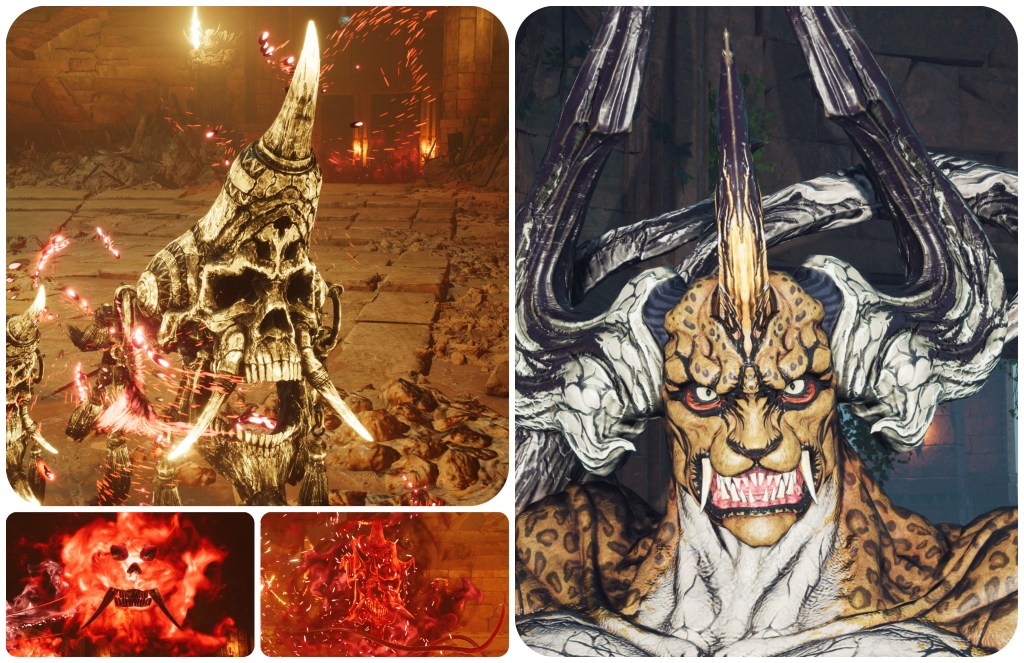
It’s also one of the few (alleged) Jenova-cell hybrids to express the same slit eyes as Sephiroth. Granted in this case the feline eyes may be because it’s quite literally a cat, but still worth drawing attention to given how rare they actually have turned out to be.

The visual effect of the Type-0 Behemoth and Cavestalkers, two of Hojo’s R&D monsters, is identical to the Irasceros when possessed by the Gi Spectres. Red particles flying all around, and a red glow that emanates out of the horns and spreads throughout the body. The Panthera Protector and Moss-Grown Adamantoise from the Temple of the Ancients also do something similar when powered up.
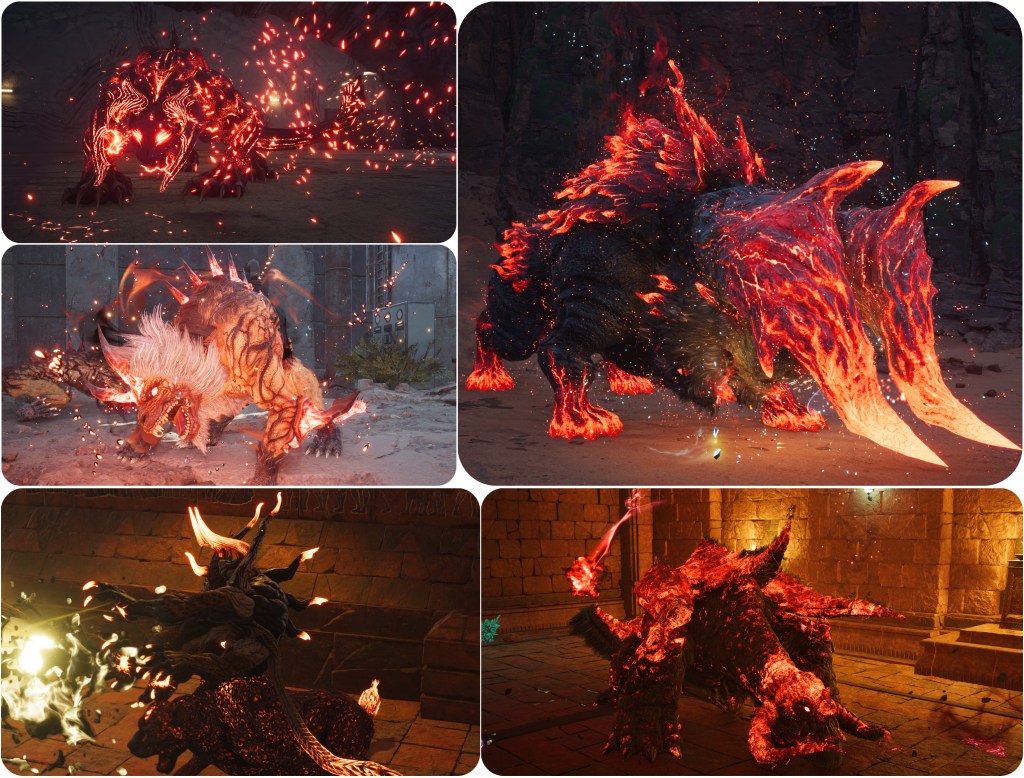
The Gi Tribe’s Animus, Chaos’ Stagnant Lifestream and the Negative Lifestream from S cell infusion are all shown capable of attaching themselves to enemies, burning them kind of like napalm.
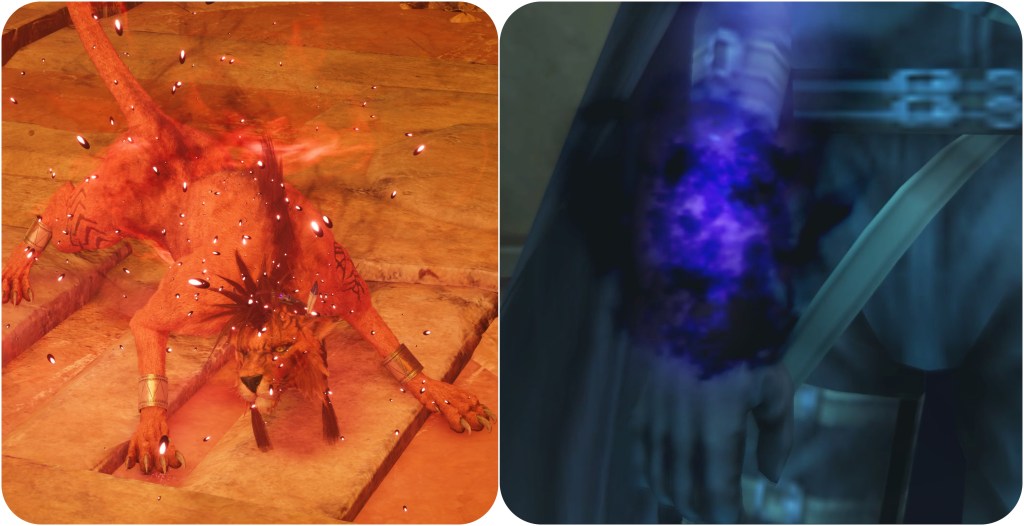
Cosmo Canyon’s Jabberwock is described as an ageless creature that’s survived for eons. Its skin is rocky like Gi Nattak, and the Gorgon Shield buff is achieved by empowering itself with red particles. The area we battle it in also has some cave drawings similar to that outside the Cave of the Gi. This may be suggesting that it became immortal after contact with the Gi’s Jenova cells.
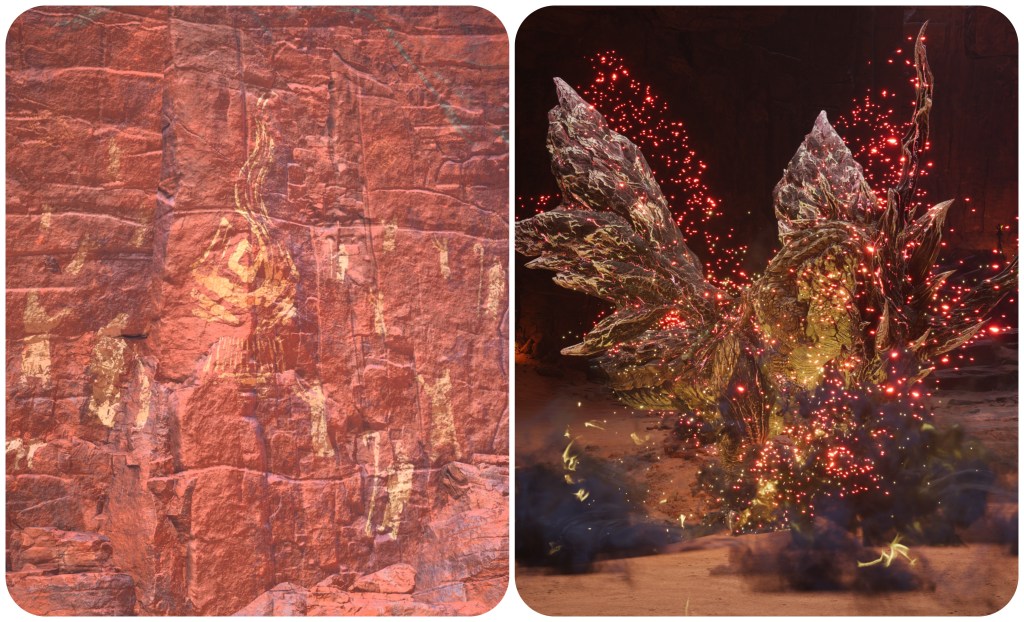
If Jenova and Chaos are related what does this achieve?
That, I think, would solve…everything, actually. The one lingering inhibition I had in using the red miasma to link Jenova and the Gi Tribe was Chaos. How could the red miasma be Terra’s connective tissue when the Chaos created on Gaia is also red? Saying that Chaos is actually a devil born out of the Stagnant Lifestream that formed through Jenova Cells originating from the Gi Tribe enables you to preserve the notion that red Lifestream is specifically Terran in nature. The game frames it as being a significant detail, so I want to treat it as such.
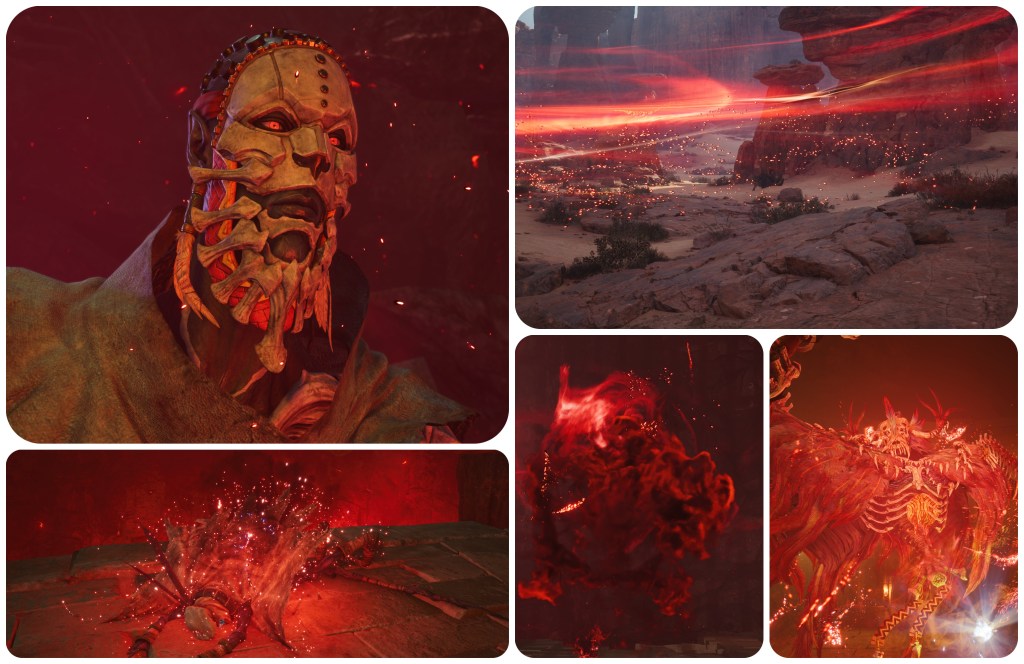
While there are some implications in there that I think damage the cosmic elements of the setting quite a bit (namely that treating Jenova as some genuine “source of everything” like Aerith said makes the universe feel smaller), defining Chaos as the greatest of Jenova’s spawn – possibly even more so than Sephiroth – lets you finally set history straight. A pretty perfect pathway reveals itself.
By the time of Crisis Core, Hojo has already figured out that Jenova was not actually an Ancient. Perhaps he knew the whole time and simply bit his tongue to let Gast self-destruct. Sephiroth’s birth is 1982 at the latest, while Vincent receives Chaos during 1984. Somewhere around that time Hojo witnesses Vincent transform, which inspires his ultimate goal of awakening Chaos and the Omega Weapon to leave the planet. Since Remake is Compilation-compliant, Hojo spends the entire span of FFVII looking right through Jenova and actually seeing Chaos. The Weiss battle in Remake Intergrade’s VR arena proves that Hojo has already begun working toward this by the early days of FFVII. Maybe Hojo had somehow figured out that Chaos was a spawn of Jenova, and so placed the Jenova Doll at the Mako Reactor in tribute to Chaos.
What prevents this from being the case?
One, that I’m making a huge assumption about Dirge of Cerberus’ Chaos Weapon storyline being retconned by a part of the Remake trilogy that does not exist yet, which depends on a scenario where Dirge’s ingame teams of scientists simply got things wrong. Two, the Negative Lifestream seems like it might be a very dark green rather than jet black, with a feathery or sandy texture, while Stagnant Lifestream is a cloudy black plasma with purple hints.
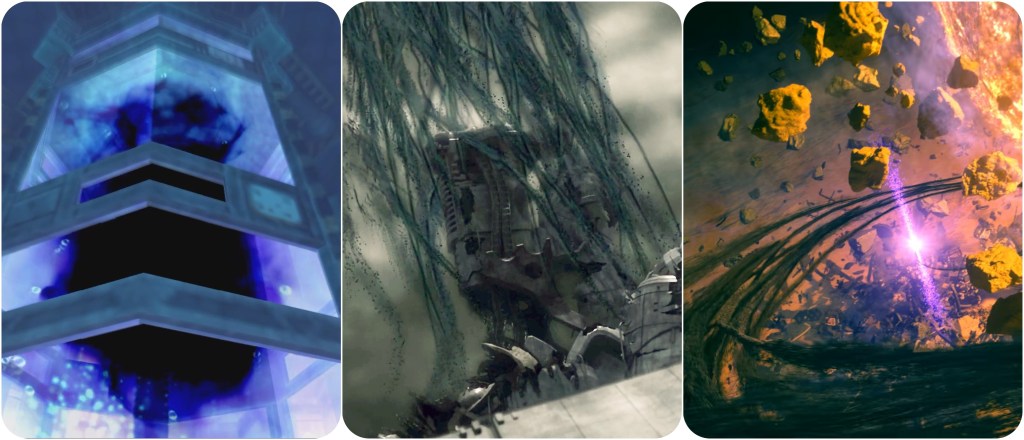
Three, that Rebirth specifically went out of its way to remove the lines that the Jenova Doll once shared with Dirge of Cerberus’ Chaos. Though in some twist of fate Jenova’s new grey skin matches to Chaos and makes up for it. Four, we have yet to see Chaos’ design or shapeshifting as represented by the Remake series. I’m sure they’ll abide by the Dirge of Cerberus design since it’s so good, but every design for the Galian Beast we’ve seen has been distinctly different from all the others, so who knows how that might extend to Chaos. Five, Chaos literally just returns to the planet at the end of Dirge of Cerberus so it has to be some manner of native Weapon after all.
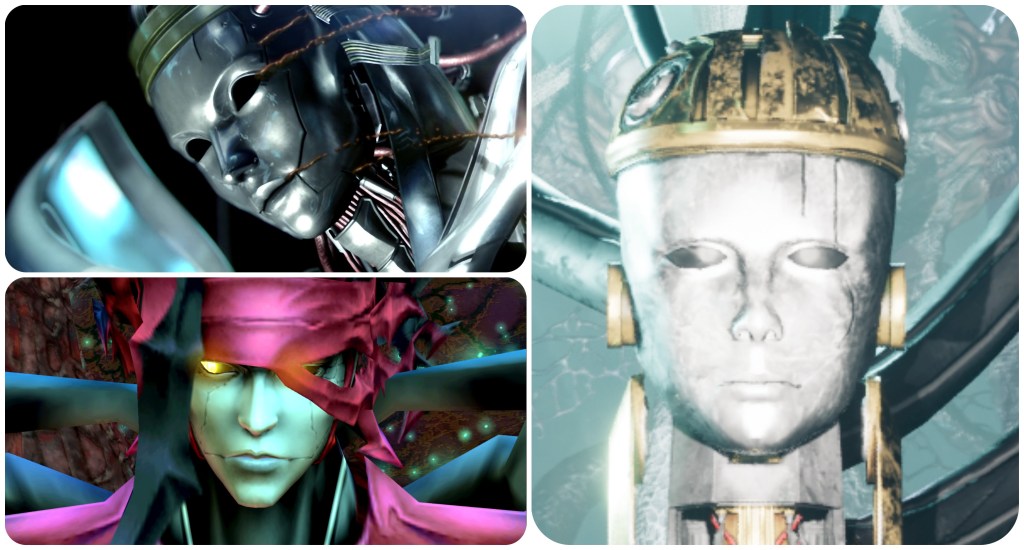
And yet the more I linger on this, the more I feel that this is the key to unlocking that last section of answers. It’s not too tough to invalidate because I certainly am reaching, but I like what imagery it implicates and what design connections it can be used to enact.
Do I really think that Chaos is nothing more than a Jenova-derivative fabrication?
I think that this is an idea I’ve seen projected into the public sphere even before the Remake series, and that it can actually be substantiated by arranging the imagery of FFVII Rebirth in the right way. You probably just crack that theory in two by remembering that Chaos does return to the planet at the end of DoC so it should be a genuine, natural Weapon after all. But the imagery absolutely is there. Chaos presents like a naturalised Jenova. Through the unaddressed green pyreflies within the Gi’s lake of blood, maybe this is a case where the planet has finally managed to subsume some small part of Jenova’s genetic material and spirit. Gaia did subsume Terra’s Lifestream after all, even though their materials are not immediately compatible. Just as the Gi finally managed to inject their Animus into a Materia crystallised out of Gaia’s Lifestream after an eternity of trying, with enough time perhaps the planet would at least gain the capacity to burn Animus as fuel.
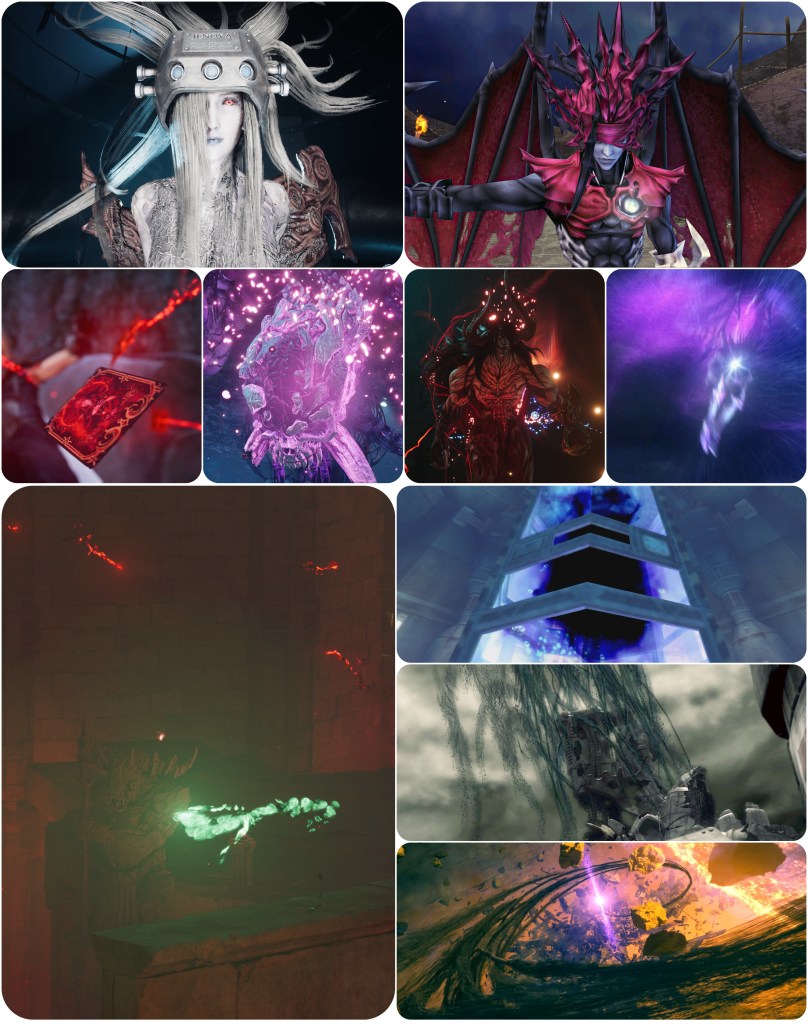
Either that, or the Cetra conducted their own experiments to convert the foreign Jenova DNA into a native Weapon known as Chaos. The three guardians of Rebirth’s Hall of Murals can all be traced back to Jenova, which might indicate as such.
- Panthera Protector (Enemy Intel): “Half-man, half-beast creatures that live in the Temple of the Ancients. Saved by the Cetra while suffering a strange illness, they now guard the Temple in order to repay their benefactor.”
- Floating Death (Enemy Intel): “Aerial creatures that dwell in the Temple of the Ancients. They forged a pact with the Cetra whereby they agreed to serve as staunch defenders of the Temple in exchange for arcane enhancements to their abilities”
- Moss-Grown Adamantoise (Enemy Intel): “Large herbivorous creatures with life spans so long they are said to have coexisted with the Cetra. Though docile in nature, they do not take kindly to any who would disturb the peace of the temple.”
The Panthera Protector, as described prior, manifests traits of Jenova, Gi and Chaos all in one. The Moss-Grown Adamantoise also has Galian Beast-like horns, and attacks with red spirit energy. Whereas the Floating Death uses purple Void attacks (Jenova’s calling card), and has a technique named “Evil Incarnate”, which might be an allusion to the final boss theme of Dragon Quest IV “Incarnation of Evil” since Psaro & Estark are known to be a model for Sephiroth & Jenova. I don’t think it’s a mere coincidence that Rebirth chose to group these three specific enemies together like this, since through them you can prepare a framework to link Jenova and Chaos.

Chrono Trigger’s Lavos, Xenogears’ Animus and Anima, Dragon Quest IV’s Incarnation of Evil, huh. I do love me my intertextual discourse. Homage, references, analogues, and some things that might secretly be in the same canon. The only one explicitly stated to be linked though is Final Fantasy X, and this may in fact be the last piece needed for connecting Jenova and Chaos. Just like it’s no accident that the Temple of the Ancients has those three particular Jenova-stricken enemies together, it might be deliberate that Gi Nattak and the temple both call back to FFX at the exact moment necessary. One of the more major mysteris I still had lingering is that the Temple of the Ancients does have red Lifestream present at certain fountains, yet I believe that this colour should be locked to Terra. Earlier, however, I did remark that the Gi Tribe functionally are Unsent. Which is why it might be significant that Aerith tries to soothe the red energy in the Labyrinth of the Lifestream by genuinely performing a Sending dance. It doesn’t work out due to her lack of skill, be that is seemingly the methodology imparted to her by the spirits of the Cetra. So I think that might be the key.
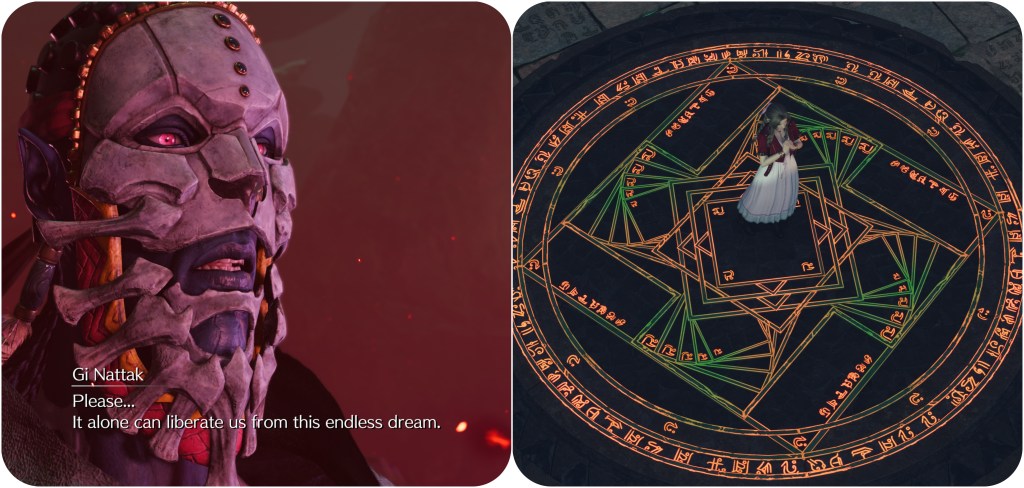
What is a Sending in the first place? It’s a ceremony for guiding lost souls.
- Lulu (Final Fantasy X): “The dead need guidance. Filled with grief over their own death, they refuse to face their fate. They yearn to live on, and resent those still alive. You see, they envy the living. And in time, that envy turns to anger, even hate. Should these souls remain in Spira, they become fiends that prey on the living. Sad, isn’t it? The sending takes them to the Farplane, where they may rest in peace”
When rage, hatred or anything else prevents the dead from finding their way to the Farplane on their own, a Sending is used to move them there. Recall how I pointed out the presence of a scant few green Gi pyreflies in the Lake of Blood. The Gi are the Unsent, then we also have Aerith converting red to green through a Sending. I did notice that the 4th-dimensional tesseract thing in the Hall of Serenity has a green soul orb in it that resembles Gi Nattak’s Animus sphere more than it does Joker’s extracted Anima. Interacting with this is what then activates the red spirit particles that lead the party into the hallucinatory trials. That might be one visible instance of a converted Gi soul being utilised by the Cetra to access Jenova-like illusion powers.
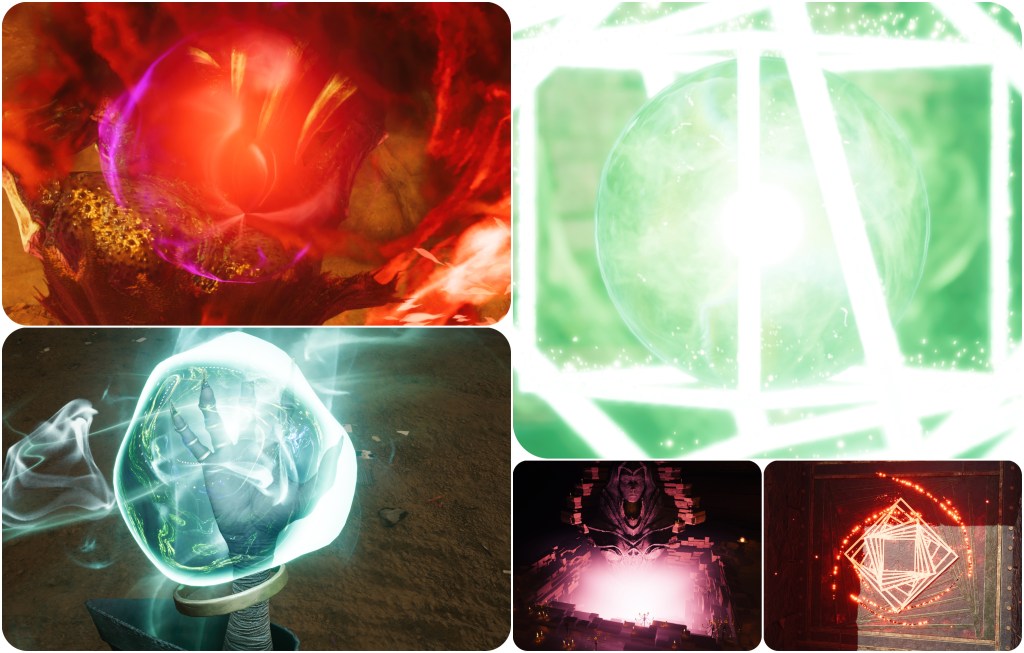
So the evolution from Jenova to Chaos might go something like this.
- After Jenova destroys their planet, the fleeing Gi Tribe crash-land on Gaia. Some survive, most perish. Their bodies are incinerated, but their spirit forms remain as Unsent.
- Surviving Gi warriors invade the Temple of the Ancients to steal the Black Materia. During this, some small amount of Jenova’s genetic mutagen seeps into the temple, infecting the Panthera Protector, Adamantoise and birthing the Hecteyes. When the Cetra kill the Gi, their red Animus energy lingers in the Temple since it isn’t soluble within Gaia’s Anima Lifestream.
- Red energy was impeding the Lifestream’s spiritual function, leading the Cetra to create altars to commune with the Gi. They perform Sendings to transmute the Gi’s soul energy into a form that the Lifestream might accept. This technique must have first been tested at the Lake of Blood and the Cosmo Canyon altars, before the larger-scale operation was moved to the temple.
- After being converted to green, some souls of the Gi are able to immerse themselves into the Lifestream. However, the planet does realise the deception and rejects the Gi after all. It expunges their Animus, collating it in a stagnant fountain in a hidden grotto.
- This Gaian Lifestream, tainted with the essence of Gi and Jenova, is eventually discovered by Grimoire Valentine. Before long there are experiments to infuse it into Vincent and the Tsviets, giving rise to the Jenova-derivative entity known as Chaos.
Chaos is kind of Gaia’s version of Jenova. I’m liking this idea a lot. I acknowledge that it is a pretty radical claim, but I’ve talked myself to a point where the opposite no longer works. There is just too much overlap in how these entities function.
If we were to restore back the original, main implication in the pre-Terra Compilation canon where Chaos is a consciousness born out of the Cetra’s stagnating Lifestream, and therefore a lifeform native to Gaia which is genuinely meant to be symbiotic with the Omega Weapon, the new interpretation would be that Jenova landed with this alien skull we’ve seen on the Blighted Spirit (Ever Crisis). She infiltrated Cetran culture and saw their legends of this tusked demon, located the Village of the Gi and saw them worshipping the same symbol, then took her current face from that. To empower the Gi as they marched against the Cetra, having also given them her terrible mutagenic enhancements, and to strike fear into the Cetra who had seen their folklore made flesh.
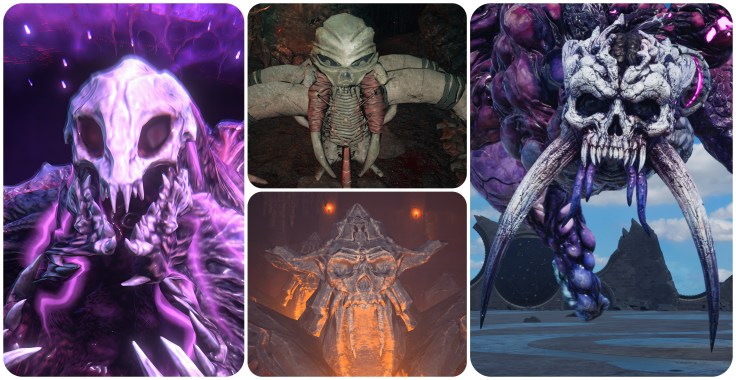
What was that demon? Chaos. From the places where we’ve seen this skull, if it isn’t Jenova, then Chaos Vincent’s Satan Slam should be the most valid origin point for the imagery. The Gi weren’t worshipping Jenova, they were worshipping the avatar of Gaia’s death – the executioner Weapon, Chaos.
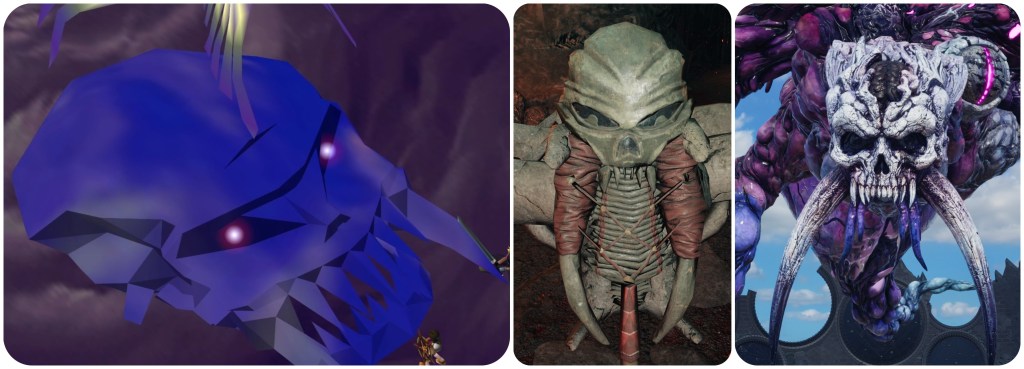
However, this seems convoluted to me because the mutations on the effigies demand that the Gi were mutated by Gaia while still on their own world. Jenova landed here an unimaginably long time after the Gi did, there’s now way that they lived that long for their physical bodies to even coincide with Jenova in the first place. If Jenova’s got this tusked skull, and the Gi village features both mutated effigies and ceremonial masks in its image, then that must mean Jenova (or at least one incarnation of it) must have looked like that on planet Terra as well. Surely the Gi Tribe are worshipping Jenova, and the skull is therefore evidence of some bond with Chaos.
The other big difference is that if Chaos and Jenova are not connected in any way, it would mean that red spirit energy is no longer unique to Terra. Instead, red Lifestream would just be understood as signifying death or a soul that’s been rejected by the Lifestream. The Gi are red because they’re dead. The Shadowblood Queen is red because she’s dead and has bathed in the death of her people. Chaos is red because it’s an avatar of planetary death.
Like, instead of going with my preferred assignment of:
- Green = Gaia
- Red = Terra
- Purple = Void
- Gold = Holy
- Black = Tainted
- Iridescent = Spira
- Blue = Chrono Earth
We would have to simplify it to where the colours are just temporary stress responses within the planetary consciousness, or indicative of any subject’s current spiritual status. In that case, Terra would have natively had a green Lifestream as well and only turned red when the Gi became trapped within eternity.
- Green = Life / Peace
- Red = Death / Hatred
- Purple = Space / Evil
- Gold = Time / Righteousness
That line of thinking. It’s workable, probably even more so if I’m being totally honest. Stagnant Lifestream was said to be a result of negative emotions causing people’s spirit energy to flow improperly, and the dried up Lifesprings in Cosmo Canyon are described as “frightened”, once again placing importance upon the Lifestream as one larger consciousness. Likewise, Sephiroth at the City of the Ancients hints that he’s preying upon the emotions contained within the Lifestreams of each subworld, and this particular line really feels like it might be Jenova speaking through.
- Gi Spectres: “Steeped in our one desire…Purest of materia no more…With pain and spite made black.”
- From Whence Life Flows: “The fallow lifespring flickers with a dim light, as if frightened.”
- Sephiroth: “The reunion – when worlds merge…when spite and sorrow are harvested to feed the planet!”
- Sephiroth: “A confluence of worlds…and emotions. Loss, chief among them. It engulfs fleeting moments of joy, transforming them into rage, sadness, hatred. Never have I felt them so keenly.”
- On the Way to a Smile: Lifestream (White): “She discovered there were many more spirits than before who resisted merging into the Lifestream’s eternal flow […] Whenever such souls entered the Lifestream, she tried to relieve them of their anger. She contrived to free those memmories so they could move on and melt into the stream.”
- On the Way to a Smile: Lifestream (Black): “He saw something in the new spirits joining the Lifefstream – the shadowy places of the heart seemed to define them […] Perhaps he would be able to do something amusing with it. Like, for instance, turn the entire Lifestream black.”
But that’s a bit boring in comparison. Maybe it’s easier to justify, but you don’t get to make any exciting claims about entities or cultures being related and detective your way into a satisfactory sequence of events, since it just pulls the Lifestream back into being the big mood ring that circles the planet. Which is fine, but I quite like what tying Jenova and Chaos together does for my theorycrafting options.
What do I believe is Jenova’s true form or origin point?
While expecting an ancient shapeshifter like Jenova to have a genuine, central “true form” is likely misguided, there are some recurring physical traits in Jenova’s mutations which may hint toward something along those lines. At the very least, she does have patterns.
First and foremost, Jenova is female. She presents herself as some abominable cosmic mother. The three known instances we have of a humanoid Jenova from the Hall of Murals, the Shadowblood Queen and the Mt Nibel tank are all women. Furthermore in the original Final Fantasy VII both of the Jenova monster designs have breasts. The only time we’ve seen a Jenova not explicitly presenting as female in this regard is Emergent. She might still have a chest, but the lumpy, mutilated texture of this particular form’s skin makes it impossible to tell.

Another trait with just as much significance is her wings. Though their style varies greatly, Jenova genes consistently cause subjects to develop wings. A hologram of Cetran Jenova in the Hall of Murals has two presumably white angel wings. Sephiroth and Genesis have black angel wings, Angeal has white. All three of the Jenova Projectsare different in wing structure. Krelian, who is Sephiroth’s equivalent character in Xenogears, also has two glowing angel wings.

Angeal’s copies and transformations retain his white wing colour. Genesis’ transformation displays his black wing as well, but his copies begin to display bat-like wings as they grow ever feral.
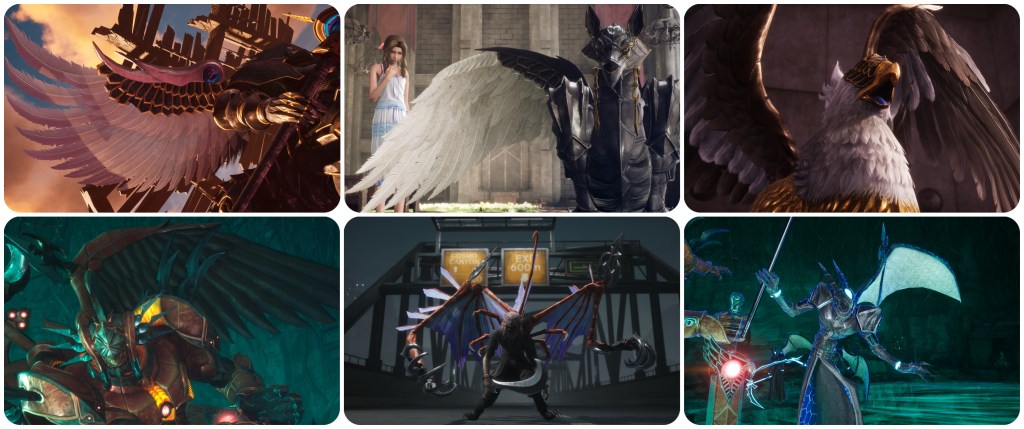
Sephiroth Reborn has wings growing from his arms and hair. Safer Sephiroth has six white angel wings, marred by one grotesque black wing, which itself resembles that seen on Revenant Mother Alissa.

Jenova Dreamweaver and Emergent have these fleshy, handlike protrusions that may appear as vestigial wings, and Jenova Lifeclinger sprouts two proper wings with which she can fly through the Ancient Capital. The woman we find at Mt Nibel has two grotesque, incomplete wings on her back. Some R&D monsters infused with Jenova genes begin growing wings as well, such as Yin & Yang.
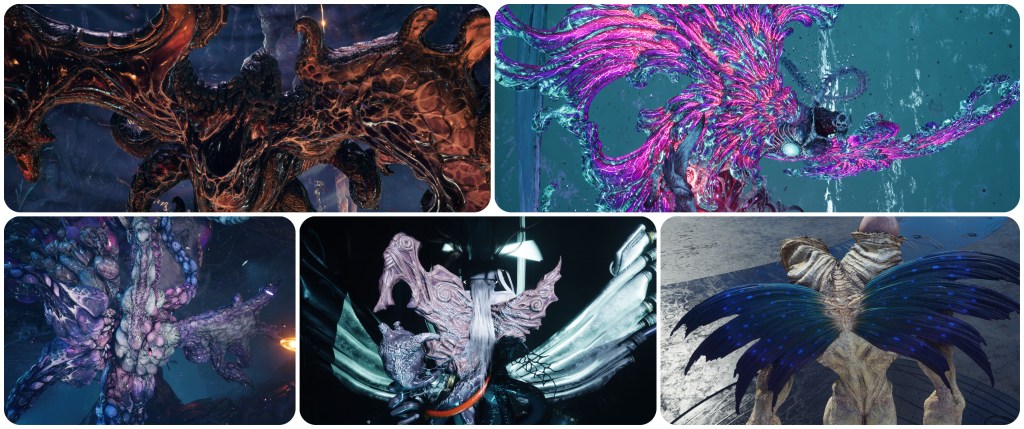
I’ve also given my own theories about the Jenova Doll possibly signposting connection with Chaos earlier.
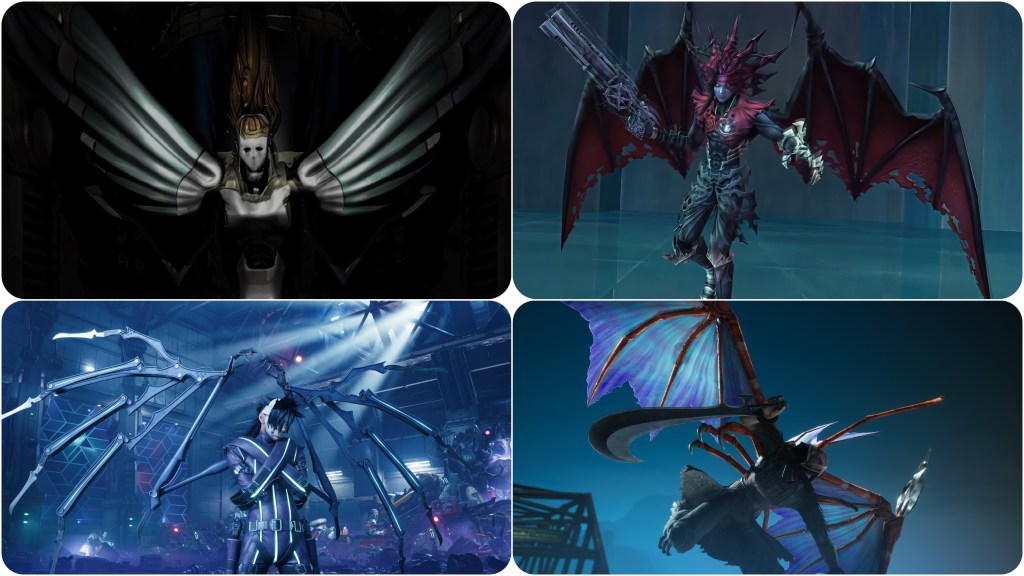
That signature skull gets passed down to other creatures experimented on with her genetic matter. Specimen H0512 has the skull exposed below its goopy face, Specimen H1024 seems to have the skull with proper skin on top of it. As suggested in my prior theory, this may have also influenced the creation of Chaos.

For what it’s worth however, the mouths on Jenova Emergent and Jenova Lifeclinger almost give the impression of some other monster merely wearing that human skull like a mask at the very front of its giant head. Lifeclinger’s long mouth running down its neck honestly gives me a similar vibe to The Imprisoned from The Legend of Zelda: Skyward Sword.
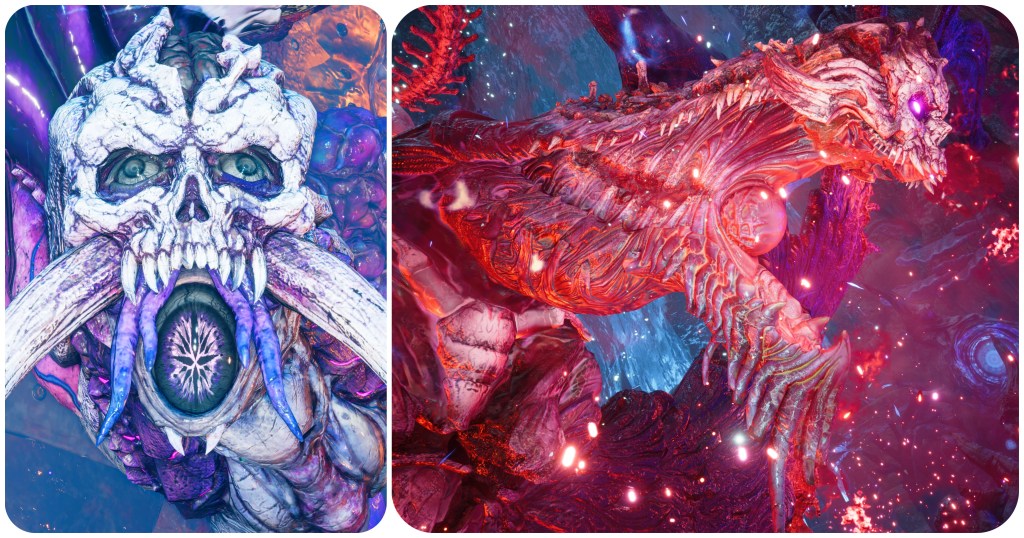
Numerous Jenova mutations are seen with thin, segmented, insectoid legs protruding from random points on their body, such as the Necrotic Entities or Gi effigies. Many also have serpentine lower halves alongside this.
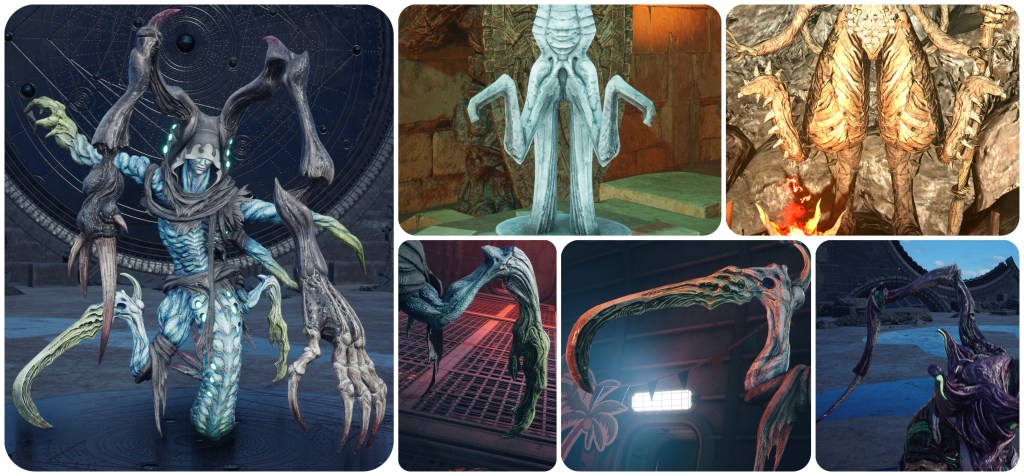
1997’s Jenova, Rebirth’s Soul Flames, Gi effigies, Cetran effigies, and the Panthera Protector which was likely infected by some small culture of Jenova’s virus that the Gi carried to Gaia, all have a large horn in the middle of their head. Notably, the Remake Jenova bosses all lack this as they currently have a large crack in their skull where that horn should be. Only time will tell if it grows in as Jenova steadily regains her strength.
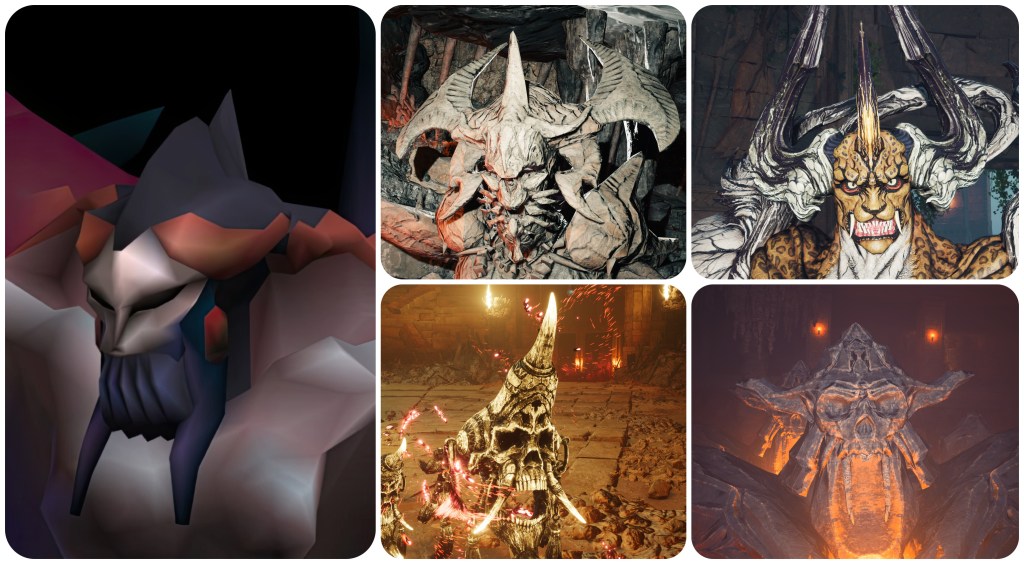
Jenova itself has sprouted numerous of these veiny humanoid arms and hands with sharp nails.

The Shadowblood Queen and Revenant Mother are both depicted with hair or flesh that covers the eyes like a veil.
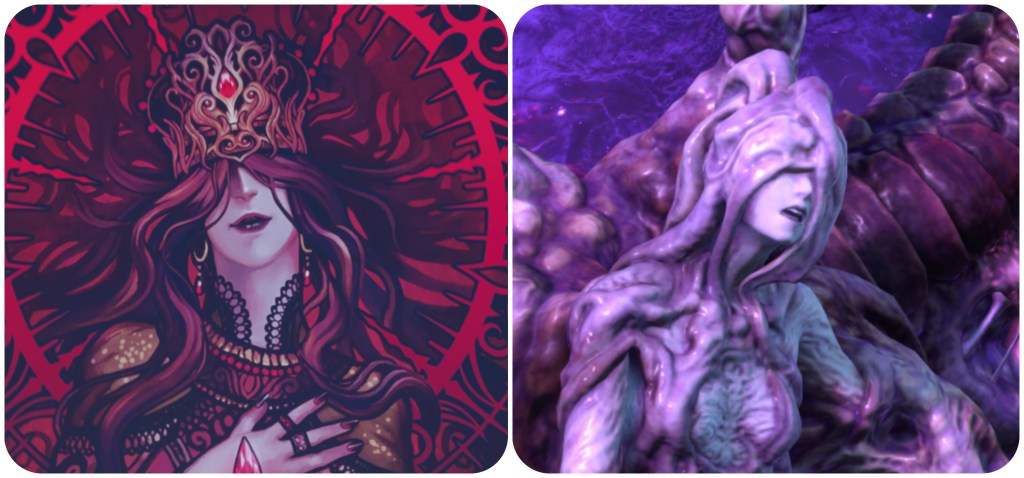
The Blighted Spirit has a distinctive mouth that runs down its chest. This trait, and overall body shape, resurfaces in some Jenova experiments such as the Diabolic Creation and Diabolic Variant. Historically, I have suggested that the Blighted Spirit’s alien skull may indicate it to be among the earliest, and therefore most natural, forms that Jenova has taken.
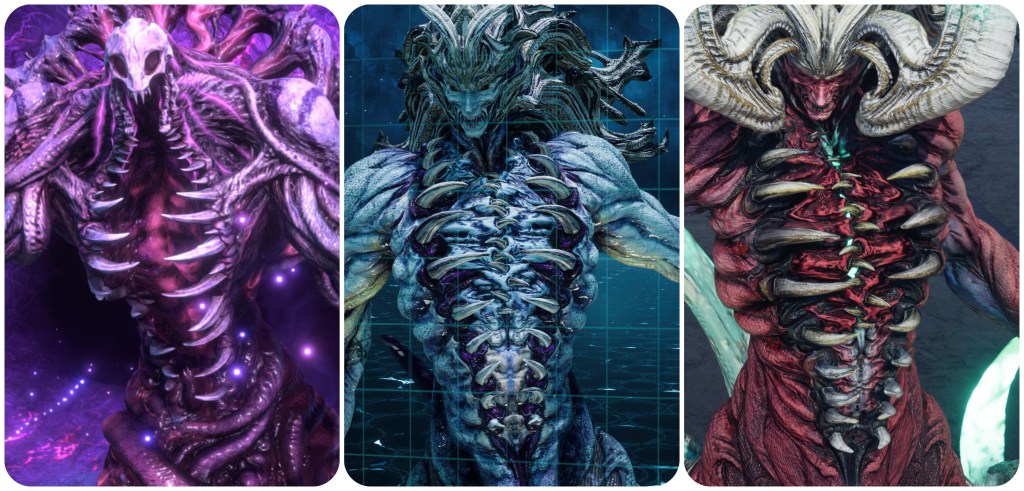
Beyond this though, the fact of the matter is that we just don’t know anything about Jenova. We don’t know what The Thing’s native species was, we don’t know what Lavos’ native species was, we’ll likely never know what Jenova’s native species was either. She’s a cosmic scourge that defies comprehension, the very notion of of a native form betrays her concept. As mentioned earlier, I think there’s reason to believe that what the meteorite brought to Gaia was not a bespoke body, but just cancerous alien cells which began propagating into one and then infecting others for its hivemind. Therefore, even Jenova SYNTHESIS cannot be considered her true form (despite the battle theme being named “Jenova Complete”) because Remake/Rebirth now show us that the Lifestream is somehow able to affect its own spacetime and fate on a localised, per-planet basis, rather than as an all-encompassing building block of the universe. 1997’s FFVII did already show us a discrete night sky with its own moon existing inside of the planet’s core, but that idea has been taken so much further now. Even the altar located just below the City of the Ancients seems to hold its own sky. The Temple of the Ancients hides yet another subdimension. The Edge of Creation, Path of Sephirot or alternate worlds are all dreams existing within Gaia’s own Lifestream.
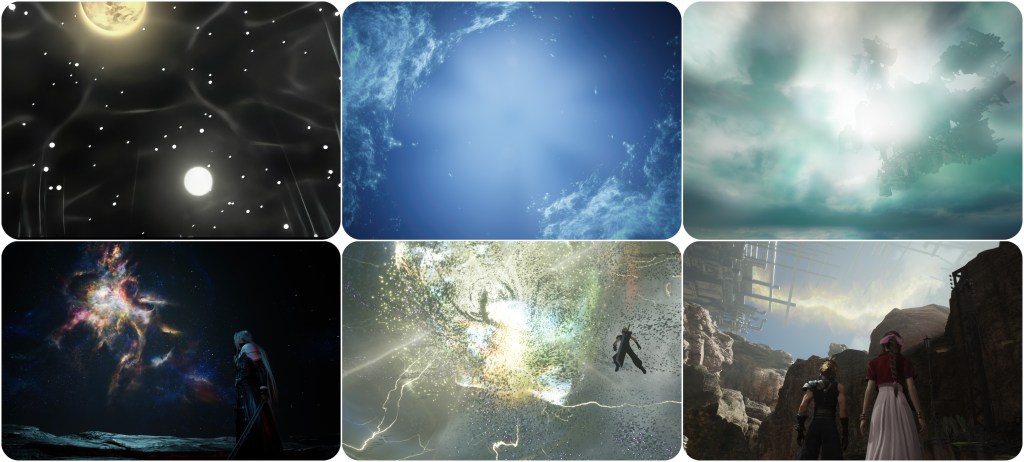
Sephiroth wants to absorb a massive amount of spiritual energy from Gaia and become God to rule over Gaia‘s cycle of souls. So Jenova SYNTHESIS is likely operating the same way. That is the most complete form of Jenova as created through Gaia’s Lifestream, history and environment. The Jenova idol we see in the Village of the Gi looks totally different to any other incarnation. What Jenova itself really, truly is or where specifically it came from, we’ll likely never know. Assuming that it can be taken as canon or still accurate information, the only hint we have to go off is the Jenova LIFE card in Mobius Final Fantasy stating that Jenova is “an abominable life-form fallen from a remote planet.” So she at the very least should be a genuine alien lifeform from a corporeal planet, not some conceptual cosmic cancer that manifested from the ether. Anything more than that though is perhaps unknowable by design, and it should remain so.
Now, it is possible that the Edge of Creation may have hinted to the opposite by having Sephiroth gaze to the ends of the universe and hypothetically observe Jenova being born out of space dust, but I would sooner think that this scene is metaphorical due to his one wing also being represented as a galaxy. Jenova evolved on some harsh planet in the far reaches of space. Beyond that, we’ve got nothing.
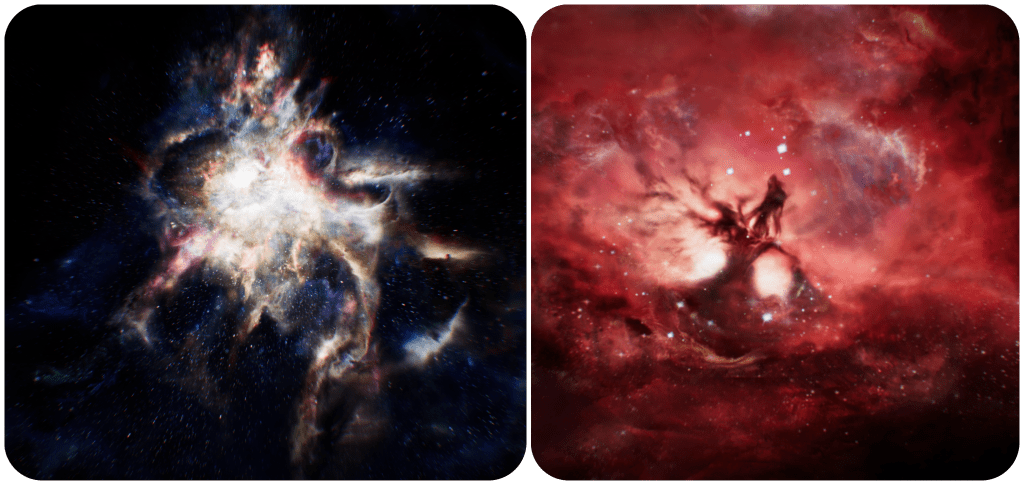
My fun answer to question of the invader’s identity is that Jenova is a fragment of Lavos. It doesn’t take much to fold Chrono Trigger into the mix, as it’s the stylistic basis on which Final Fantasy VII was built. Lavos is just Jenova on a much larger scale. A DNA harvesting ancient alien which manipulates the governments and revolutionaries of the world throughout 65 million years of history across multiple timelines, steering evolution for its own purposes. Like Jenova, Lavos is an alien with psychic abilities which it uses to influence people’s spirits. Its genetic material is also highly mutagenic. Schala is infected by its DNA in order to assimilate her as the Dream Devourer and Time Devourer, and there are other mutants in Chrono Trigger possibly tracing back to Lavos’ mutagenic touch.
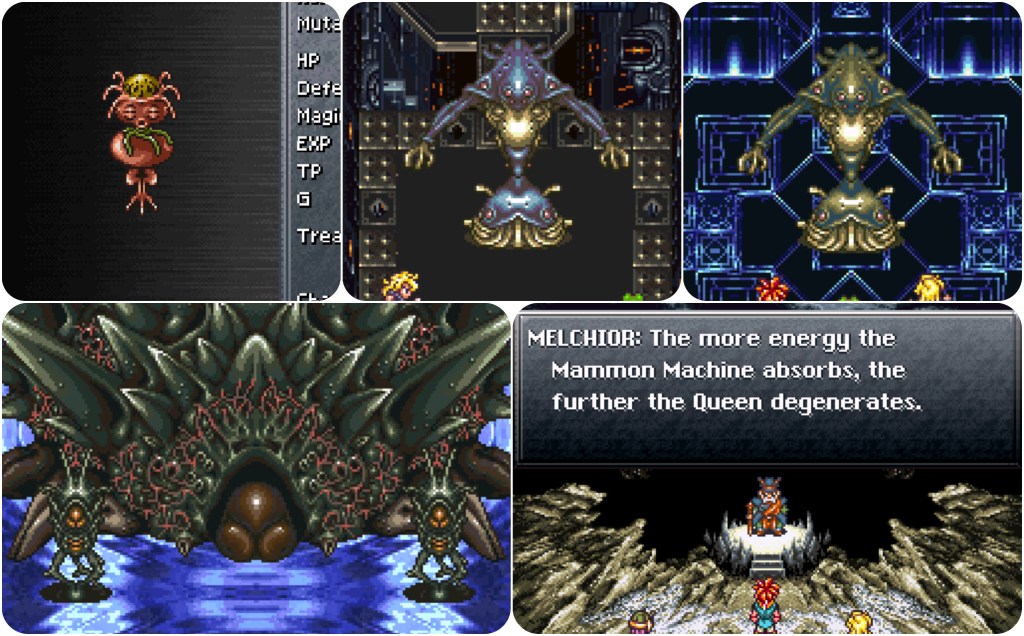
Both entities are immortal, with the kingdom of Zeal wanting to harness Lavos’ power to gain eternal life themselves, reminiscent of how Jenova’s mutation had inadvertently made Lucrecia ageless.
- Queen Zeal (Chrono Trigger): “Don’t stop Schala! We’re almost there…Immortality will be ours! Zeal will have the glory it deserves!”
The root concept for the Lifestream is found here in Chrono Trigger as well. In order to combat the world parasite, the party locate these circular gates through which they travel back and forward in time. Sephiroth in Rebirth has also shown off similar looking entry points into alternate world lines. Robo muses that the gates must be the gift of some god, since the 400 years he spent tending to a forest has convinced him of higher purpose. While never clarified ingame, the most likely candidate would be that The Entity is the consciousness of the planet itself, and this is confirmed in outside interviews. In which case, The Entity can just be described as that planet’s Lifestream, similar to Spira’s Farplane. The FFVII Remake series makes the two even more alike, as the Lifestream is now depicted as having greater influence over spacetime, and internal spaces with gates to access the various timelines.
Not only does Chrono Trigger have a Lifestream, but its humans have “spiritual energy”, equivalent to the spirit energy of FFVII. Lavos and Jenova are both spiritual parasites.
- Robo (Chrono Trigger): “Unbelievable energy! As if the sum total of all the human spiritual power that has ever existed were somehow being amplified…”
- Bugenhagen (Final Fantasy VII): “Lifestream…In other words, a path of energy of the souls roaming the Planet. ‘Spirit Energy’ is a word that you should never forget. A new life…children are blessed with Spirit energy and are brought into the world. Then, the time comes when they die and once again return to the Planet… Of course there are exceptions, but this is the way of the world.”
- Melchior (Chrono Trigger): “The more energy the Mammon Machine absorbs, the further the Queen degenerates. Her spirit has been stolen by the infamous immortal, Lavos.”
So again, if not Lucrecia, Minerva, Shiva or Yunalesca, maybe the lady in the tank is Jenova defaulting to the form of Schala since she’d bonded so deeply with the progenitor Lavos. It’d be totally impossible to identify through Akira Toriyama’s art style, but it’s another fun option nevertheless. At the very least though, I think it’s actually not that nonsensical to imagine a world where Lavos splintered off into Sin and Jenova.
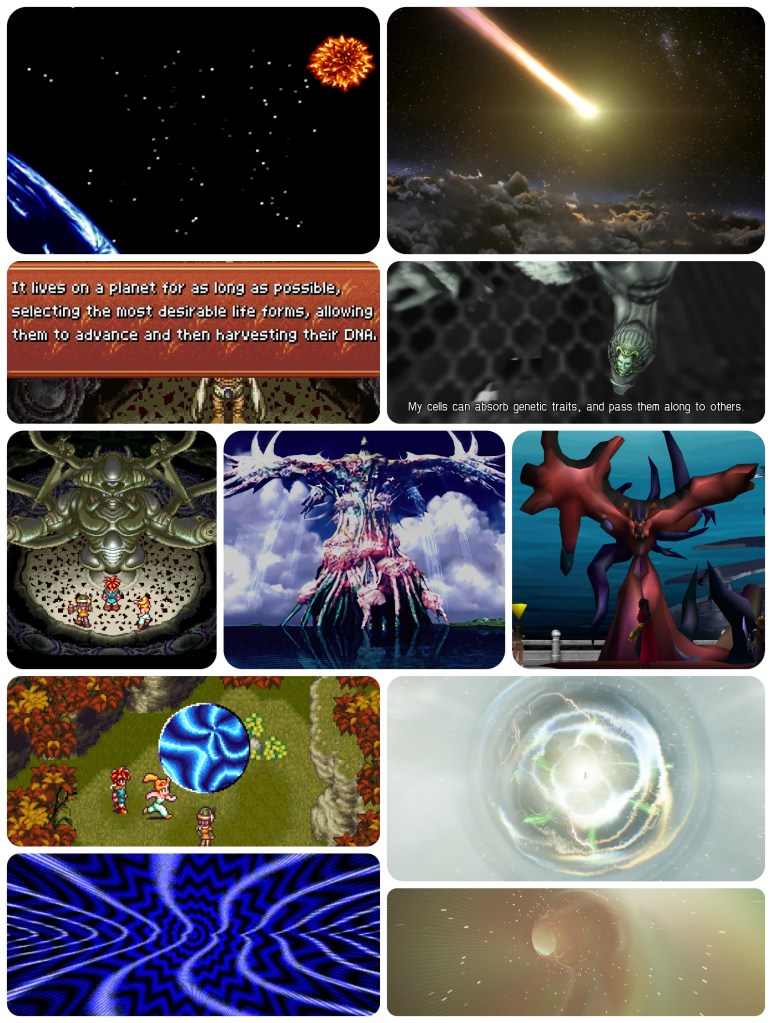
Granted from what I remember Lavos isn’t itself shown to have shapeshifter abilities, or at least not of the imposter kind, but it does have several vastly different transformations that we see it adopting. A humanoid, a tree-like form and a round form. All of which Jenova also has. I even happened to find that Jenova Emergent has an eye in its mouth with little mandibles on bottom, which kind of gives me Lavos Spawn vibes. Lavos itself is hiding what appears to be an eye within the mouth of its shell form. Considering the human eyes on her skull never move, this frame almost looks like the real Jenova is some Lavos-like alien simply wearing a skull as part of its disguise.

By absorbing the DNA and spiritual power of lifeforms, Lavos is able to imitate their powers. Throughout the FVII Remake series, Jenova is also seen using moves that resemble other enemies. She strikes with an energy imitation of the Masamune, unleashes red and blue flames that heavily resemble Gi Nattak, and is able to pass her own Void techniques such as teleportation and psychokinesis onto any other beings who have received her cells.
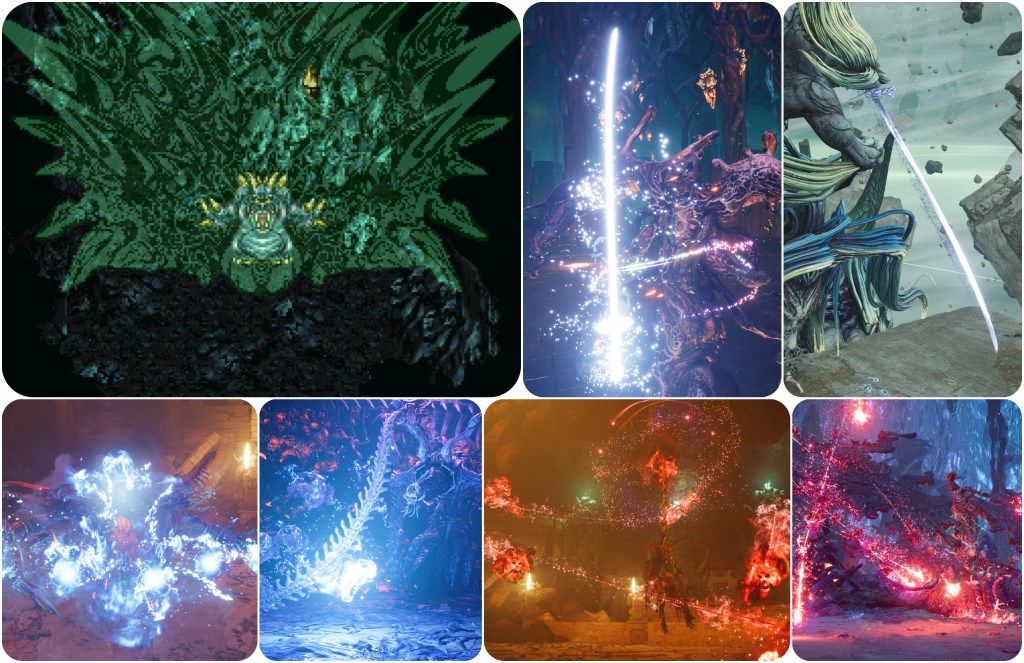
Gi Nattak, who should be connected to Jenova and whose boss design is loosely similar to Jenova Lifeclinger, has an unexplained red core attached to his body. This one doesn’t appear to be a Magnus Materia like Lifeclinger of the Weapons however, it’s an unknown material with strange markings and dangly bits. To me, the appearance of this orb could bring to mind the Frozen Flame, a fragment of Lavos’ shell that inspires the events of Chrono Cross. It’s even got an indent that looks like the beady little eye.
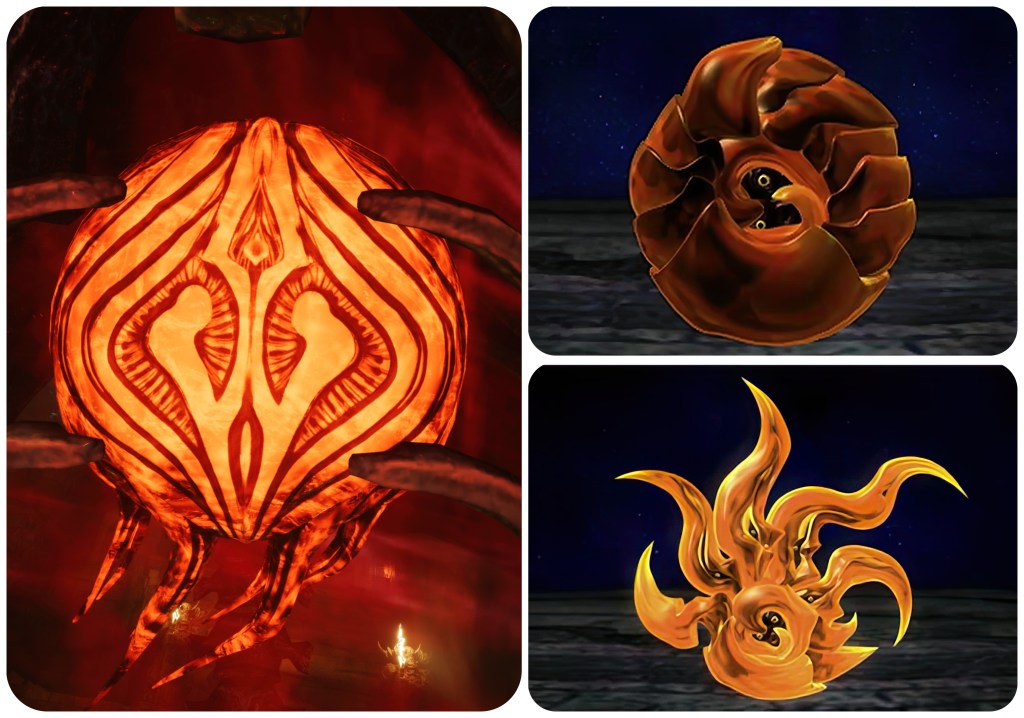
Interpreting it as a face with one cyclops eye up top, it does also loosely resemble the two inner forms of Lavos.

Jenova Lifeclinger herself has some kind of a core in her mouth. When you take the camera into her head the black half makes it look super in line with the Lavos Core, but that part of it is impossible to glimpse with the regular camera and so is likely just something they didn’t bother to texture or model. Lifeclinger’s concept art shows it extending all the way down its opened neck-mouth instead, this feature just didn’t make it into the game since Jenova only opens her mouth for like two seconds under specific conditions in one phase and you can barely see it anyway.
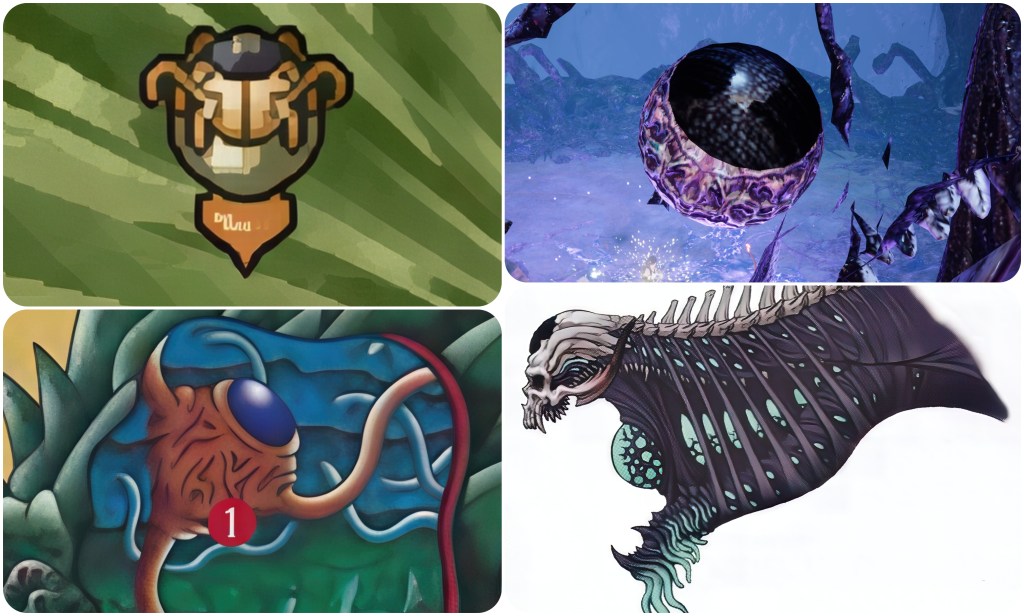
With how little we know about either entity, I honestly think that there’s nothing stopping this suggestion. Chrono Trigger basically has a Lifestream and it has a planetary parasite. In this big, wide universe, that’s enough to go on. Jenova’s true form or her native origin story is unknowable with the current information. Final Fantasy VII is written with the intent of hiding Jenova’s true nature. For that reason, I think there’s nothing wrong with just sticking to your favourite headcanon. Which for me is Lavos from Chrono Trigger. My maybe 70% genuine answer is that I reckon because of the immense overlap in imagery, motivation and abilities, and just the way in which these games were all kind of made in response to each other, in my own headcanon world Jenova is probably a fragmented growth from Chrono Trigger’s Lavos. I’d suggest FFX’s Sin is also a product of the same original creature who infects Yu Yevon and Yunalesca to become its avatar, and then another Lavos fragment elsewhere in that same universe was captured, researched and used to create the self-evolving, interplanetary bio-weapon Deus in Xenogears. Perhaps Yunalesca and the woman in the tank are both secretly Schala.
I just like to see Chrono, the Compilation of Final Fantasy VII and the Xeno series talking to each other through references and imagery considering how deeply tied they all are. This is something I’ve rambled about so much, and that’s why at least on a theorycrafting level I like the idea of connecting them all through their conspiratorial alien gods. Xenogears is probably the hardest to make work since the existence of the Perfect Works lore bible means we do know a lot more specific information regarding where Deus came from and how it works than Lavos, Jenova or Sin. It’s a manmade interplanetary bioweapon system. But I’m content to say that, well, maybe that research began when they discovered a fragment of Lavos somewhere out in the universe like the Frozen Flame. Or maybe Lavos itself is an errant intergalactic bioweapon like Deus, which is why when the Kingdom of Zeal’s researchers are trying to harness Lavos’ energy they inevitably create control systems like the Black Omen and Mammon Machine that are analogous to the Eldridge and Zohar. We know that Deus is biomechanical because it’s an artificial lifeform in a symbiotic existence with the Zohar engine and Kadomony supercomputer. Lavos becomes increasingly biomechanical as you cut through its layers too, with the core resembling an astronaut accompanied by two drones. And while they’re probably just magic blasts, Jenova Lifeclinger does kinda look like it’s shooting out spaceship laser beams. They have an aiming light and even a machine-gun mode. Lifeform-Hojo N’s model is rudimentary due to not appearing in Remake yet, but his design does give me Lavos vibes in its colour scheme and dome head too.
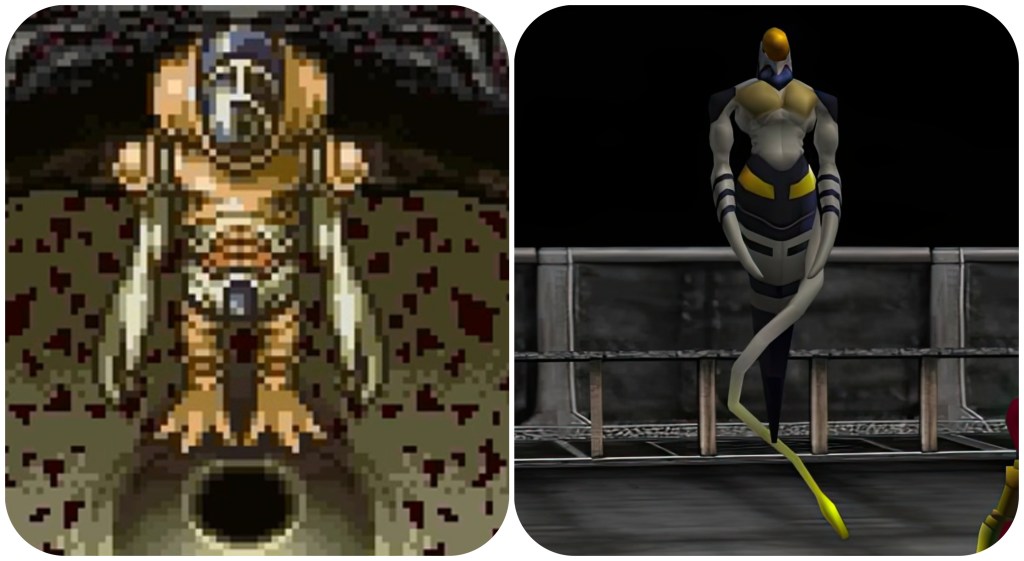
Conceptually I would think Chrono Trigger and its iconography to be the origin of all the other offshoots though, and the ending of Xenogears demands it being put at the end point of any given timeline. So Lavos, then the Time Devourer, then Jenova, then Deus.
People don’t take well to the idea of even FFX being connected to FFVII, let alone Chrono Trigger or Xenogears. This, I know. But I think people get too heated over the idea because they just don’t seem to realise that…it doesn’t matter. Connecting FFX to FFVII might explain or address one or two niche Lifestream mechanics and an equally minimal amount of background imagery. Nobody’s saying you need to play one to understand the other, or that they share any important continuous plot at all. It’s just a little bit of extra fluff context that further situates the way their worlds work. There’s no significant story connection between them, so neither game is especially bothered by that link, but it’s just loosely, broadly canon that yeah someone from Shinra (X-2)’s lineage established the Shinra Company, and that yeah Pyreflies are Lifestream ether. It’s not that big of a deal…Rather the intertextual connection that will make me enemies is when I say that I’m, uh, somewhat serious in considering that the new universe Lightning creates at the end of XIII-3 could be the one containing Spira, Terra and Gaia, since it shows something that’s pretty undeniably the Lifestream spreading throughout the cosmos, the way they redesigned Sephiroth’s god form in Dissidia NT heavily resembles Bhunivelze, and there are unexplained god-machines like the Omega Weapon’s internal control interface that we could easily dub Fal’Cie. But that’s a discussion for another day, I am finally done here.

I’ve strayed pretty far from Cosmo Canyon at this point, basically just stitching together several other small blog posts I had drafted or published. In any case, this has been fun. I love free-camera tools and how they allow us to really pour over environmental details or abstract symbolics with a much keener eye. When I first managed to set up the freecam mod in the Xenoblade trilogy I lost countless hours inside of it. I’m sure I’ve probably spent a whole playthrough’s worth of time in Xenoblade 2 just snooping around in freecam for optimal discussion screenshots. A full playthrough of that, mind you, being between 60 and 80 hours. The fact that FFVII Rebirth’s PC port is compatible with the amazing Unreal Engine 4 Unlocker right out the gate was such a blessing for it. I’ve had so much fun taking the camera around to focus on things the game doesn’t particularly want me to. In conjunction with that, I think that my freecam experience permitting me to put together a piece such as this helps to visualise one key part of why I love the FFVII Remake games so much – the expanded lore implications found in every conversation throughout every location. If a game lets me make collages about it, that’s a sign of quality. When I made that Pneuma video it was my first exposure to freecam. That script was a little different than usual because it focused less on interpretation and more on using this mod to provide clear screenshots of details which where obfuscated during cutscenes, then further substantiating my suggestions with artbook scans. It was so much fun. Freecam has totally rewired how I approach my screenshot selection in discourse, stepping back into these worlds as a more active participant in the gamespace to sneak up close and engage in something along the lines of digital news photography. Being able to do this kind of fun activity in the world of Final Fantasy VII is unreal. I’ve never played Pokemon Snap or anything similar, but these days I kinda get the appeal of that concept. Photo mode really is a whole other side to a video game experience which allows you to engage with it in a totally different way. To be able to have these investigations into the imagery and history of the Final Fantasy VII setting at a level in league to the Xeno games is phenomenal, and so perfectly catered to me as an FFVII fan. I’m putting some things together in my mind, completely at a loss with others, writing one blog then leaving it as a draft to write another instead because I’ve remembered one line of dialogue or stumbled upon a couple of screenshots illustrating a point to the opposite, and I am loving it. The history of Jenova, Chaos and calamity that we can find hidden away in a village below Cosmo Canyon may not be all that integral to the plot, or to the trajectory of FFVII Remake moving forward, I’m not trying to like – epic part 3 FFVII Remake theory does the Gis is aliens and Black Materia revealed!?? – that’s not me and that’s not the Gi. But the things which you can piece together about the past, and how this may implicate the present, is so fascinating to uncover. While I may have just spent the last several hours talking in circles as I go through my messy lines of thinking, I do feel like I have a clearer understanding of FFVII’s world now, and it’s place in a potentially larger universe.
 skapbadoa
Leave a comment