Final Fantasy VII’s villain Sephiroth is a character with a long historical cause and effect. He himself is the next step from Chrono Trigger’s Magus, and he has tons of really significant derivative characters like Krelian, Seymour, Caius, Xemnas, Jin, Malos or Z. The root character concept that would eventually become Sephiroth, however, predominantly traces back to Psaro the Manslayer from Dragon Quest IV. Contrary to what people might tell you, Sephiroth is not a visual ripoff of Psaro, as the latter was only redesigned to be Sephiroth-derivative in the 2001 remake of his game. The original sprite was a man with spiky, purple hair and an orange sash draped over his torso, not the black caped hero with his long, silver hair that’s become so iconic to us. However the reason that Psaro’s design eventually became matched to Sephiroth’s was with respect to the overlap they share in story, setting and symbolism. That component is the one worth discussing.
Dragon Quest IV: Chapters of the Chosen was first released to Nintendo of Japan’s Famicom game system in February 1990, then localised for the American Nintendo Entertainment System as Dragon Warrior IV in 1992. This was the era of game localisation where the western teams just really did not seem to care about consistency with the source material, which is why you got all the weird translation decisions like renaming Rock Man to Mega Man, Princess Peach to Princess Toadstool, the jovial Doctor Eggman was turned into the dead-eyed Doctor Robotnik, Final Fantasy IV, V and VI became Final Fantasy I, II and III. As such, Psaro the Manslayer was dubbed Necrosaro. Because Psaro was just too silly and not evil enough for the hardcore Nintendo gamers of 1992, I suppose. This character eventually got his due respect however, when elements of his presentation and storyline were adapted into what would become Final Fantasy’s most renowned villain yet, 1997’s disturbed hero, Sephiroth.
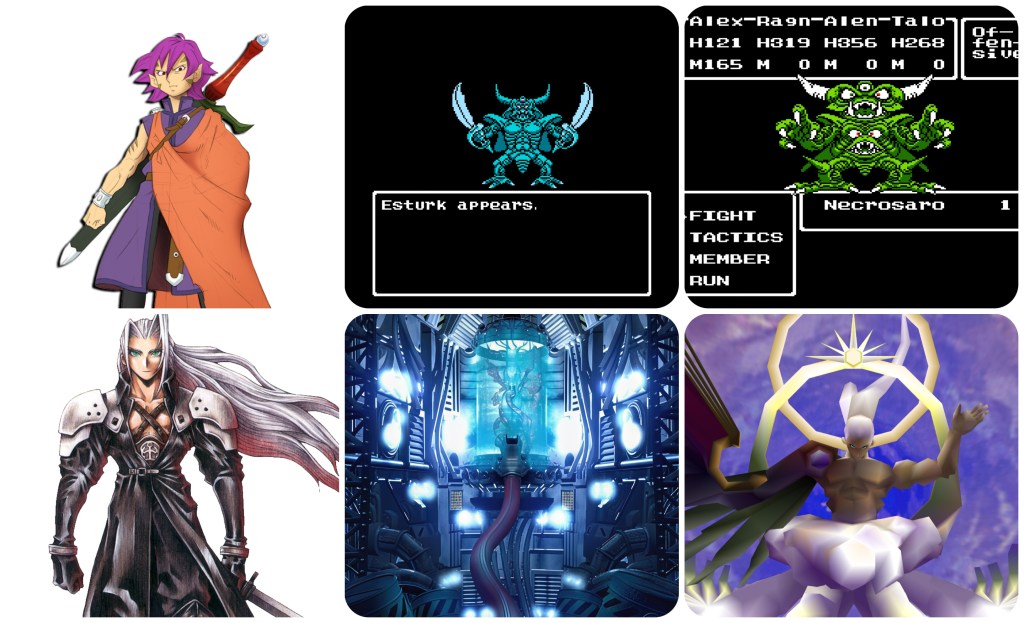
There are lightly analogous plot elements and imagery found in the dynamic of Psaro & Estark as compared to Sephiroth & Jenova. Psaro is the “master of monsterkind”, Sephiroth is the one “chosen to rule this planet”. Psaro spends the game searching for the blue demon lord Estark, hoping to combine with him and gain enough power to eradicate humanity, creating a world where monsterkind can thrive. Sephiroth was instinctually called to the blue alien Jenova, assimilating with her cells and seeking to dethrone humanity as the planet’s dominant species. Sephiroth is a fallen hero, and Psaro has skills from the Hero class when he becomes a playable party member in the postgame of the DS port. Both ultimately sacrifice their memories and cease their current form to evolve into a grotesque god. Sephiroth, however, is a much more prestigous character with a greater force of will. So while Psaro does fully fuse with and have his persona consumed by Estark, Sephiroth steals the balance of power back from Jenova. The final boss of Dragon Quest IV is the Evil One Estark, who mutates into an increasingly demonic form as the battle goes on. Sephiroth too is reborn into a gigantic, monstrous body at first, but after that is able to refine his transformation into his idealised divine self.

However the main point of comparison between Dragon Quest IV and Final Fantasy VII is the methodology of Psaro’s introduction. He has the same horror, so the way they build Psaro up in the background can be seen as paving the way for Sephiroth’s eventual advent. For majority of the game Psaro the Manslayer is just a name you hear in passing. Monsters praise him as their revolutionary lord, the Tsar prophesies the calamity he’ll bring, and the colosseum receptionist warns Alena’s group to stay out of the manslayer’s way lest they suffer his severe violence. Although once they finally make it to the last round Psaro is a no show, because Dragon Quest IV won’t give him to you that easily. FFVII takes a similar approach. You hear a lot of gossip about this legendary hero from a few years back. Then the party ends up following his path of destruction through Shinra Tower and the Swamplands, while still having no sight of the man himself. You have to get quite a number of hours into the game before Sephiroth finally appears on the cargo ship. Cloud is the first person in the game to mention Sephiroth, trying to impress Tifa in a flashback by telling her that he wants to be a legendary hero just like that man. President Shinra adds further credence to this, musing that Sephiroth may have been too brilliant to truly contain. The two characters are spoken of with reverence, creating a sense of mystique and awe around them long before they ever appear onscreen. Additionally, Alena returning home at the end of her chapter only to find the castle eerily silent is a similar story beat to Cloud’s party following the trail of blood in Shinra tower. The group’s journey is suddently interrupted by this quiet horror scene. And perhaps most striking is when the hero’s village is set ablaze like Nibelheim. Sephiroth’s theme Those Chosen By the Planet has strings that sound notably like the Jaws music, which is very likely a deliberate choice in the composition as FFVII’s director Yoshinori Kitase has stated that Jaws was one primary influence on their decision to hide Sephiroth so much, and composer Nobuo Uematsu has mentioned citing the theme from Psycho for similarly scary strings in One-Winged Angel. Psaro’s final boss theme Incarnation of Evil (Symphonic Suite version) is a very classically sounding horror piece which actually has the Jaws motif too.

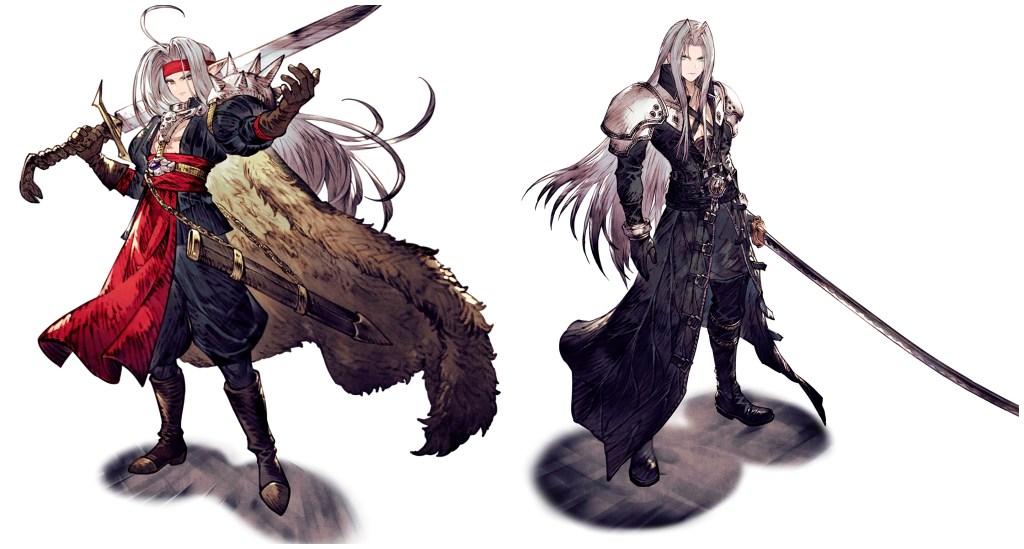
That’s basically the crux of why people compare Sephiroth to Psaro. In a discussion of homage and lineage, Psaro is both Sephiroth’s father and son. It’s this circular design loop. So many key elements of Sephiroth’s presentation were adapted from the manslayer. However, it is equally important to know that Psaro did not originally resemble Sephiroth. He was only redesigned that way after the fact, in acknowledgement of how he fundamentally is Dragon Quest‘s Sephiroth. Psaro eventually got to be a guest character in War of the Visions: Final Fantasy Brave Exvius, and that we now have these two high quality drawings of Psaro and Sephiroth in the same art style is so cool. Psaro is so cool. But he’s cool, and not much else. He is very lacking in narrative content unfortunately, and this is the point where I think that Sephiroth snuffs out all criticism from the people who like to cry ripoff instead of homage. As mentioned just prior, Psaro’s modern character design is based on Sephiroth, not the other way around, and while Sephiroth does adhere to much of Psaro’s overall story framework, he has so much more going for him. I have written so much about Sephiroth’s character and circumstances guys, you’ve got no idea. Psaro would probably struggle to fill more than two paragraphs of plot recap. I’ve pointed out a handful of scenes where Dragon Quest IV presents Psaro similarly to FFVII’s Sephiroth, and that’s…kinda just his entire screentime right there. The only major moment I think I left out was his banquet of monsters, where he gives a short speech and then teleports away. Dragon Quest Monsters III: The Dark Prince was a bit of a disappointment in this regard, as I’d really hoped this would be the hard-hitting tragedy prequel to put Psaro into a much-deserved spotlight. Shows how unfamiliar I am with Dragon Quest, right? But I guess that was never going to happen with the strange, unholy fusion of non-canon mainline prequel and spinoff monster-collector that Dark Prince for some reason was. Psaro genuinely only has like five scenes in DQIV, two of which are flashbacks, and it’s kinda memed on how in one of them he just walks up to Rose and says “I have something to tell you, I’ve decided to destroy all of mankind” with no great degree of elaboration, unlike Sephiroth whose motivation and dialogue requires unpacking at significant length based on a large multi-game presence and cross-franchise references.
 skapbadoa
Leave a comment