
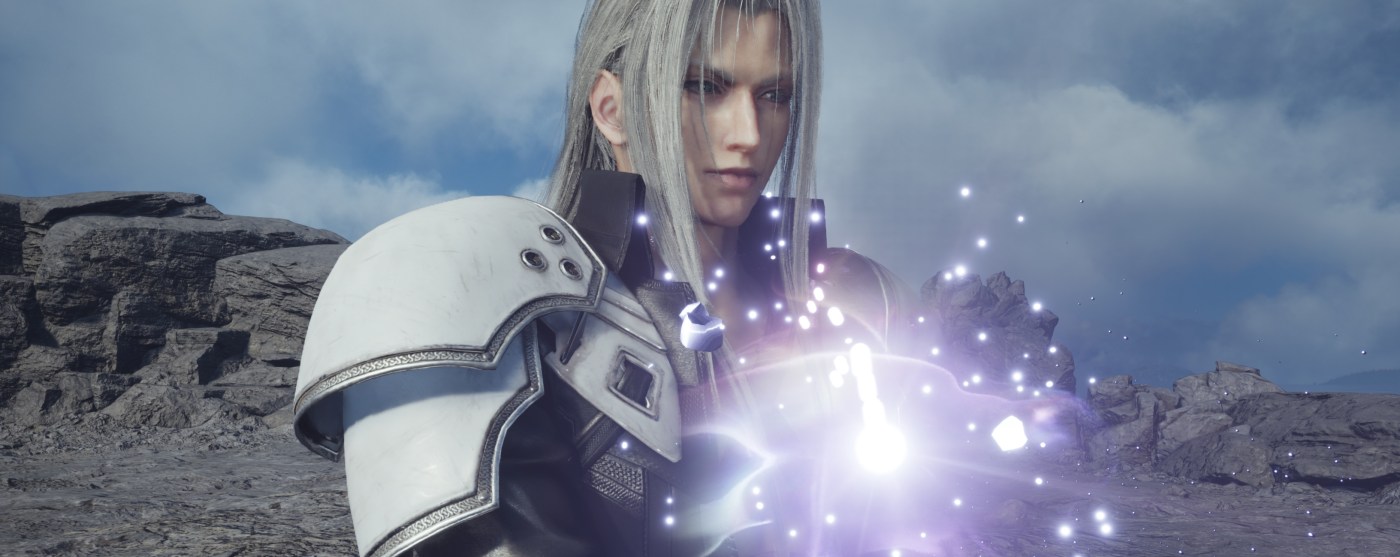
I do not believe that the Final Fantasy VII Remake saga is a sequel to the original Compilation. Do the characters have prophetic knowledge of events to come? Sure seemed that way. Might it be a Garland-esque time loop? It very well could, and that’s what I’m here to play around with today. But do I believe that this is a sequel happening after the original Compilation timeline concluded with Dirge of Cerberus? No, I think that’s self-defeating, turning it into the Compilation of Final Fantasy VII…and then the exact same Compilation just with FFVII subbed out for Remake. The prequel games Before Crisis and Crisis Core are both still very much canon – their events extensively referenced and cameoed in Rebirth, and around Advent Children’s 2023 theatrical rerelease the directors have plainly stated that it is still the piece which will come after the Remake trilogy. In my opinion Remake does likely overwrite FFVII within the Compilation storyline, but certainly not as a sequel enacted through time travel. Square Enix have presented a version of FFVII that stylistically adheres to the exaggerations of the Compilation so that the original can return to being standalone. Restored to its state of reverence, free from all that heavily controversial extended content. There are lore mechanics in place which could allow Sephiroth to physically travel back in time, but if so then even still I think this is just a new storyline introduced into FFVII’s spot. I know it sounds like a nitpick to necessitate that if Sephiroth did travel back in time or link his memories to an earlier incarnation then it must happen within the original timeline rather than as a sequential secondary timeline, but I do feel that distinction important because it has massive connotations and ramifications in the matter of character.
Earlier in the year I published a video discussing more deeply why I don’t myself agree with reading the FFVII Remake saga to be some time-manipulation sequel particularly because I take issue with the characterisation of Sephiroth which would be needed for that claim to function. I understand that some of the mannerisms Sephiroth had in Advent Children have manifested in Remake’s performance, but the motivation is not the same at all. His portrayal does match up to AC in a lot of ways, the same way in which it matches up to Kingdom Hearts and Crisis Core and Dissidia. That is to say, it’s just Sephiroth. The same as he’s always been in like every game other than the stiffly-translated 1997 release. Everyone’s always saying oh Sephiroth is acting the same way from the film and he fixates more on Cloud than he did in the original and the Ultimania says there are multiple Sephiroths running around and he knows the future and therefore he’s clearly-totally-irreconcilably different, but I dunno man as someone who’s replayed the Compilation multiple times, it’s just Sephiroth. That’s just how he is. He’s a broken man with a saviour complex, his personality insane and unstable as a result of enduring simultaneous mental attack from an eldritch monster and a planetary consciousness for six years straight. Final Fantasy VII is a cosmic horror story, and Sephiroth has heard the call of Cthulhu. I know it sounds rude and gatekeepy, but truth be told I can’t help but feel that a lot of the people who perpetuated this idea just probably hadn’t played FFVII in over 20 years when they picked up Remake, and had never even heard of On the Way to a Smile, therefore being mislead by the imagery of the final battle. This whole suggestion hinges on Sephiroth and people saying he’s written differently, but for me looking at that all-important Sephiroth I just…he’s not. He really isn’t. I believe Sephiroth’s characterisation in Remake is wholly in accordance with the fragmented state of his mind revealed to us during the original Final Fantasy VII and Crisis Core: the contradiction between Jenova’s cosmic evils and his own deeply heroic nature driving him insane, so leading him to try saving the world through a twisted divine love. By becoming god to rule over all souls he’ll situate himself as the foremost existence and therefore make it so that nobody can deny his existence ever again, and governing the cycle of rebirth will supposedly let him protect humanity from suffering once again. Sephiroth, up until those very last moments in On the Way to a Smile, tries to hold onto his identity as a hero in whatever way he can. It’s violent and wrong because his virtues have been totally ruined in the two-pronged assault of Jenova and the Lifestream both eating away at his psyche, but Sephiroth in FFVII and in Remake is nonetheless acting out of some love for mankind.
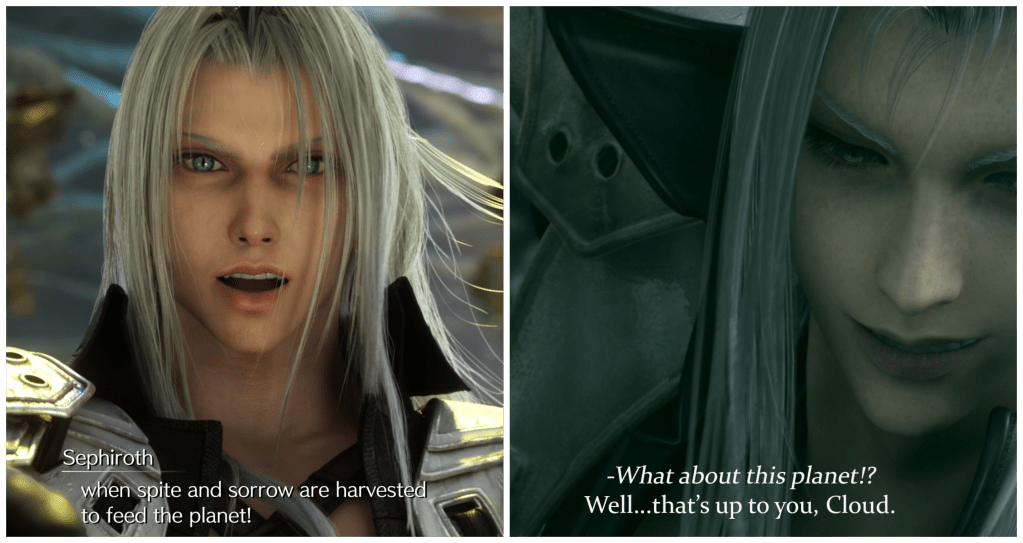
That’s where the contradiction and confusion comes from, Sephiroth is equal parts love and hate. Cloud recognises that he is legitimately wanting to save the planet, which therefore makes him incompatible with the evil ‘One-Winged Nightmare’ of Advent Children. By that point the Lifestream has totally stolen all of his human history and emotions, Sephiroth has only chosen to hold onto his anger and hatred as the basis for his reincarnated soul. After his death in the final battle of FFVII, Sephiroth disperses into the stream and loses so much of his memory to the extent that the primary reason he can’t manifest back into the living world is because he no longer remembers his own form. The Remnants were therefore created for the purpose of using their Jenova powers to read into Cloud’s mind, so that Sephiroth could extract information with which to rediscover himself. Sephiroth’s resurrection there is formed solely out of Cloud’s perspective on him as a villain. Unlike his usual appearances there’s no illusions, no manipulation or lengthy schemes, this time Sephiroth purely states ‘I’m going to kill you, kill this planet and head out into space to kill other planets if they don’t worship me as the new Jenova’, immediately trying to eliminate Cloud with a fury never before seen. Hence I personally do not buy the sequel theory. Certain characters have seemingly peered forward into the future, but if you ask me they have not sent their body or mind back into the past. Aerith knows her own prophecy and responsibilities because the lingering spirits of the Cetra have whispered it to her. Sephiroth is aware of how events will proceed since he’s immersed himself in the Lifestream, soaked in knowledge both ancient and after, then breached into the nexus of creation where he can watch worlds unfolding through a dimensional window. Forward, not back. While that difference may seem negligible in a discussion about time loops, I feel it of utmost functional importance. If that Sephiroth came back to this point in time, he would not be acting out the saviour complex he has in Remake. He’d simply just murder the party in disc one then beeline straight to Jenova.
Next because the game has only had additions sat on top of the original narrative, filling existing gaps or adding extra Compilation-compliant context with no genuine divergences or indications of it irreperably shifting course, so it still fundamentally has just been an expanded, modernised remake of Final Fantasy VII occupying its expected spot in the storyline, proceeding down the expected path. My other major hesitation has been that no force in the Compilation of Final Fantasy VII has displayed anywhere near the degree of power needed to manipulate an entire universe. I’ve tried attributing that to Minerva, I’ve tried attributing it to Chaos or the Omega Weapon, but the glove doesn’t fit. And my final complaint is plainly just because I think the idea is a little stupid and pollutes the integrity of these games as our long-awaited FFVII remakes. I’m not a hater, I do love these games just as much as the original – potentially even more than the original by this point because of how my gameplay, story and soundtrack preferences have aged – but for them to be sequels instead of remakes is something that, yeah, I’d be a little disappointed at that outcome and its implications for the FFVII brand. Like I’m sure I’d get over it because guys I am so in love with the world of FFVII, but I’d be wishing to the opposite.
But that’s neither here nor there, because FFVII Remake and Rebirth, with what they’ve given us so far, have not convinced me to support any of the bold claims the playerbase has been so readily swearing by, and I for the most part do not agree with such dramatic leap in the power scale either. I’m not backtracking that stance or those characterisation claims here, I just thought it might be good to also host some small discussion for the other side as well. Because you are lookin at a man who just played Final Fantasy V. Which I really should have done years and years ago, but I think I’ve probably always left III, IV and V unplayed because I wanted that safety cushion to say that there are still Final Fantasy games I haven’t played. There’s a couple major spinoffs I still need to get to and I’ve no interest in the MMOs, but to think that I’m predominantly kind of…done now is a complicated feeling. My JRPG backlog is a million miles long and there are other franchises I greatly adore as well, but Final Fantasy has always been my king. Regardless, continuing on to the latter half of the Final Fantasy Pixel Remaster series has given me some appreciation for this time-travelling Sephiroth idea, particularly due to FFV. With that now in mind, I can see how one’s response to the sequel theory really just hinges on how you choose to view Final Fantasy VII Remake, owing to FFVII having become its own multi-work subseries semiotically distinct within the main Final Fantasy franchise. The original game is obviously in stylistic sequence to Final Fantasy VI and VIII, but I feel like there’s not as much continuous connective tissue in its aesthetic as there is from Final Fantasy I to II to III and so forth, or from XII to XIII to XV and XVI. With the individual games your attention is always on the franchise legacy. The way we discuss them, review them or how media outlets report on them is as the “newest Final Fantasy entry”. Yet, any new FFVII spinoff is instead treated as “the newest entry in the Compilation of Final Fantasy VII” or “the FFVII Remake series”. That mental separation is key. Almost all my discussions relating FFVII to another game are about Xenogears, Xenoblade or Chrono Trigger, or for film I compare it to The Thing and maybe Escape From New York or Metropolis. FFVII is very different among its peers because of how large a media space it occupies. When you play Final Fantasy II, you’re evaluating how its production has evolved from Final Fantasy I. Wandering through Final Fantasy XV, I’m constantly thinking that yeah I can see how these landscapes and architecture are the next step after Lightning Returns, as well as how they served as a basis for XVI. But when you play Remake, Crisis Core, Dirge of Cerberus or read any of the accompanying books, you’re inevitably weighing them against the other parts of their own larger FFVII narrative. So it’s not uncommon or incorrect to approach it as its own project. If you view these time-loop claims through the lens of Final Fantasy VII as something of an independent series, then I would say they come up distasteful, and this I think is a major component of what’s always soured me on the idea. We’ve had Final Fantasy VII for decades, we know how Final Fantasy VII works and it ain’t like that. Sure it’s done some questionable things in Crisis Core, yes I have on more than one occasion insulted Deepground as Kingdom Hearts rejects, it did get randomly and repeatedly linked to Final Fantasy X in its distant past, and yet the story has still never totally jumped the shark at the scale which a time loop would demand. FFVII with its CRTs and cars and fossil fuels and guns and private militaries is one of the most realistic Final Fantasy settings, alongside VIII and XV. There are monsters, supersoldiers and aliens, but by and large it’s a world of fairly normal people living fairly normal lives.
However if we instead choose to view this theory not as a product of the isolated FFVII subseries, but in the broader context of it being another Final Fantasy game, or a Square Enix game, then there are things which stick out to me in potential support of this ‘sequel’ idea after playing FFV.
To address the obvious option first, if FFVII Remake must be placed in a loop following the Compilation, then I don’t really think it’s as simple as Sephiroth using the dimensional nexus to enter back into an earlier point of the timeline. For starters it’s as yet ambiguous if these should be considered timelines or world lines. I would lean more toward the latter, nebulous though the distinction may be, because Sephiroth says “that which lies ahead does not yet exist”, indicating that he isn’t actually seeing the full scope of the timeline laid out before him from a 4-dimensional perspective. There must be rules to where and how he can intrude. And more significant I would say is that all the other worlds we’ve seen are clearly, obviously and dramatically different from Final Fantasy VII. They also may or may not be some manifestation of the afterlife, since Zack and Biggs note the specific dying moment in which they were pulled into the dimension by a blast of light. Treating them as world lines, with what we’ve seen I think it unlikely that Sephiroth could cross into the nexus at the end of Advent Children and then locate another identical world to enter for Remake. The plotline seen in Final Fantasy VII and Remake is the main one from which Sephiroth originates. And again, I think Advent Children’s Sephiroth is a very different personality to Remake’s; In my opinion all this kerfuffle around fate and the edge of creation are just extra detail which will help make Sephiroth’s transformation into a god at the end of part 3 more believable, where it had previously been kind of a random twist in the original.
Rather I think the more likely method by which FFVII Remake could believably initiate time travel would actually be what I originally entertained back in the year of its release; one of my first little FFVII Remake ideas, an un-narrated slideshow likening Remake’s final battle to a Dissidia stage, because I had noticed that the boss retains that moveset. If we were wanting to position FFVII Remake as a loop or a sequel, that, in my opinion, is actually the correct line of thinking. Dissidia – specifically the Void from which it takes form. The Final Fantasy franchise, in case you didn’t know, is a multiverse. Any time that crossovers happen, such as Kefka and Exdeath in Final Fantasy XIV or Gilgamesh wandering wherever he pleases, these are effected through a known interdimensional space. This was first introduced to the series in 1990’s Final Fantasy III where the warriors chase the Cloud of Darkness into a world beyond normal reality, but is most strongly codified into canon a couple years later in Final Fantasy V when main villain Exdeath breaks into the Interdimensional Rift, better known as the Void. This is the space between their realities. Nearly all Final Fantasy numbers occupy their own universe within a larger multiverse, the only exception is that Final Fantasy X is located within FFVII’s universe in a faraway galaxy a long, long time ago. I do also have some mostly non-serious theories about the ending of Lightning Returns creating the FFVII universe based on key repeating imagery of the Lifestream, warrior goddess and Bhunivelze, but that’s for another time.
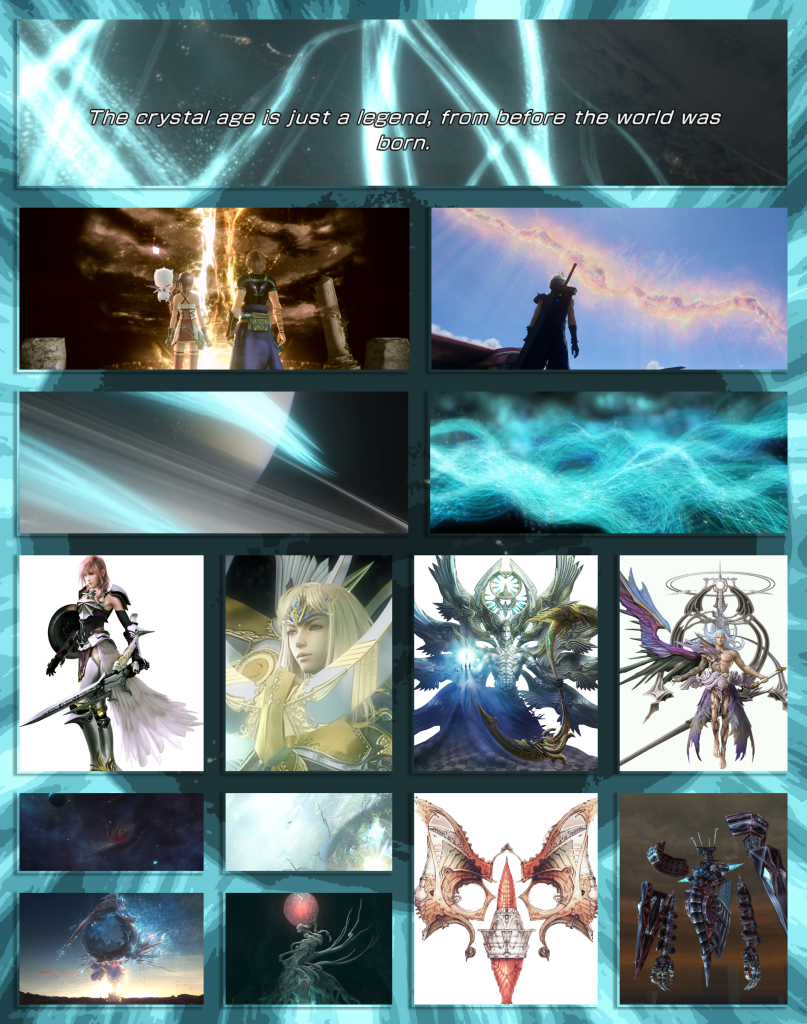
Predominantly speaking the games occupy neighbouring universes. When the Lufenians from Stranger of Paradise make contact with the realms of other games for each level, they’re simply referred to as World 2, World 3, World 4 and so forth to indicate which game they come from. I played a ton of Dissidia Duodecim on PSP, so before Remake I was already aware that the Void exists as the backstage of the Final Fantasy multiverse because it’s the justification for all crossover games, and that it’s been part of the series lore for a long time.
What I didn’t remember until I was reading the Final Fantasy wiki a couple days ago however, is that apparently Dissidia’s version of events reveal that the method by which Garland travelled back in time to become Chaos was by traversing the Void. That’s why his portal looks the same as Exdeath’s, they’re retconned to be the same force. The Void provided a pathway for him to go back 2000 years. So then it’s just like yeah, okay, sure…Sephiroth just did that too then. The end. Discussion over. You can just say he did the same thing as Garland and it works itself out that easily.
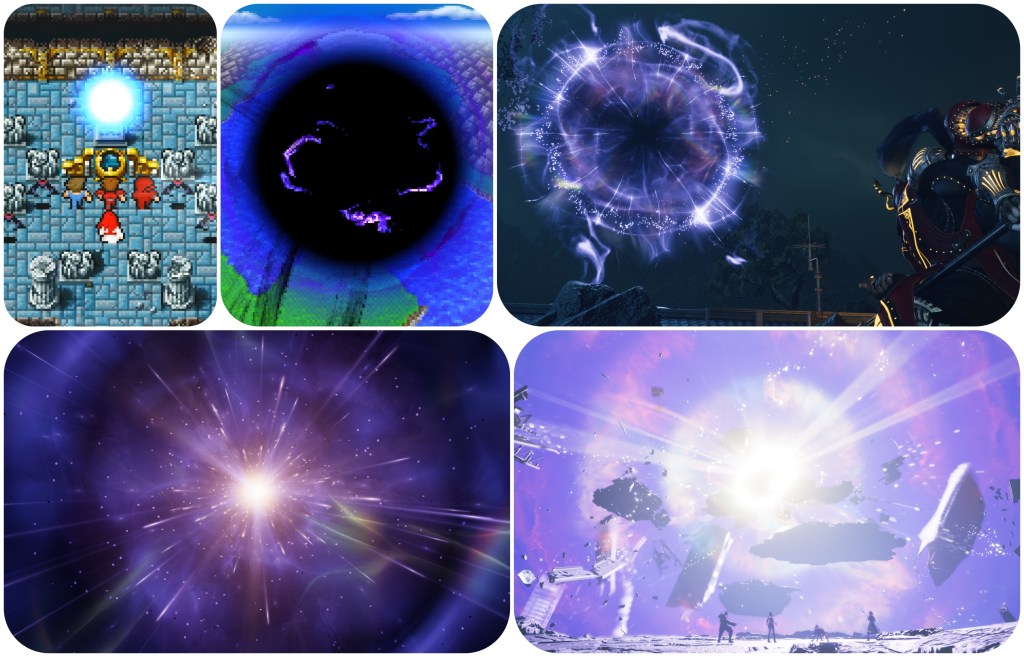
Literally one of my first reflections after playing FFVII Remake was to point out how much its finale reminded me of Dissidia’s subspace, ergo the Void, ergo the exact power which Garland used to time-travel. In the original game, FFVII’s finale was just a mental arena located in the heart of the planet, but in Remake it seems more like a physical location beyond normal spacetime, referred to by Sephiroth as the “edge of creation” and accessed by getting sucked into a circular blast just like FFV. That is all very Void-coded if you want it to be. Furthermore, this isn’t some entirely new setting element inserted for Remake. We already knew that the Interdimensional Rift exists within FFVII since Cloud had previously stumbled into it and ended up all the way over in Final Fantasy Tactics, and Rebirth only reinforces this with the Edge of Creation imagery and presence of Gilgamesh. He and his island are initially noted by Chadley to be located in a different realm, only later are they summoned onto Gaia by Sephiroth, after having instructed his servants to retrieve the Void-imbued Genji Armour. The effect used when Cloud gets transported to Gilgamesh Island is the same that was seen when Sephiroth pulls Cloud into the Edge of Creation, and in Gilgamesh’s case this has to be the Interdimensional Rift because that’s his whole thing. He crosses the Rift and uses the power of Void to enter into other Final Fantasy worlds. Therefore helping to solidify the idea that Sephiroth is accessing the Void. Though not specifically recognising him from Dissidia or anything, Sephiroth still revealed a preeminent understanding of what the Interdimensional Rift is when he calls Gilgamesh a “wayward soul”, handing him off to the party because he acknowledged the threat a Void-wanderer represented.
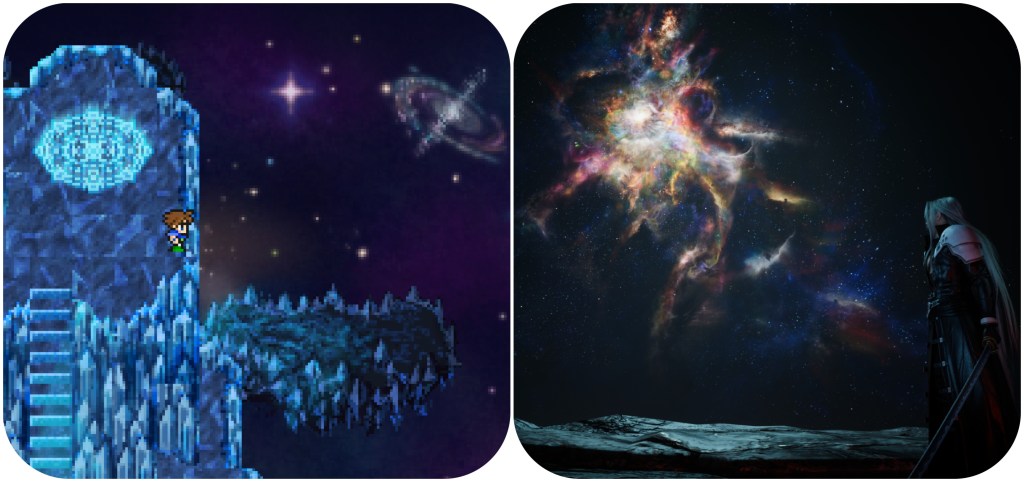
With that said, a strong counterpoint to this theory which immediately springs to mind is that the dimensional nexus seen in Rebirth, which sort of seems like a kind of Void, is definitively a conceptual plane which exists within Gaia’s Lifestream. Sephiroth names it as “the true nature of reality”, the nexus from where we see that “the planet encompasses a multitude of worlds.” That location is internal to FFVII’s own setting. So from a logical standpoint it could, perhaps should, be inferred that the Edge of Creation is also still internal to the planet just as it was in the original Final Fantasy VII. And even before that, would Square Enix permit Sephiroth to join those most elite ranks of Chaos, Cloud of Darkness, Exdeath, Bhunivelze, Ultima or Zeromus as one of the few Final Fantasy villains to successfully breach into the multiversal Void? In terms of legacy he definitely deserves it, but I’ve always seen one of the appeals of FFVII as being that it’s actually relatively low in Final Fantasy’s power rankings. I feel like power-wise many of those gods should be a clear cut above even Safer Sephiroth, and there are other antagonists such as Ultimecia who I’d think should have had an easier time accessing the Interdimensional Rift than Sephiroth. And would Square Enix actually let a mainline plot directly interact with the Void ever again considering it’s usually just a tool for crossovers, especially a remake with this many eyes on it? Dunno, I lean more toward no. Sure Stranger of Paradise wasn’t that long ago, but that wasn’t meant to be mainline. Wandering the Rift has been Gilgamesh’s exclusive gimmick all this time, I don’t really buy Sephiroth intruding upon that.
But hey, I’m just brainstorming here, I’ve said so many times that I just can’t get on board with the time travel claims. It’s just that, while it’s still very unclear and ambiguous, I do think that there is at least room and justification for it now. When you factor in Final Fantasy V and the wider franchise lore, some of these more abstract mechanics introduced into the storyline can start to fall in place. The concept of the planet housing numerous world lines is so strange when you try and rationalise it against the comparatively grounded storylines of the prior Final Fantasy VII games, however that idea is totally okay when you’re reviewing it purely as a Final Fantasy. Multiple dimensions overlapping or being cleft in twain was the core of Final Fantasy V’s conflict, which established the Interdimensional Rift multiverse that paved way for crossovers such as Final Fantasy Tactics, Dissidia, World of Final Fantasy and Stranger of Paradise, then this story concept was readapted for Chrono Cross, and if you know of Tetsuya Takahashi’s Xenogears woes then you can also easily draw a line from FFV to Chrono Cross to the divided universes of Xenoblade. The galactic space in Remake looks essentially identical to that of Final Fantasy V’s last dungeon, the white space from Rebirth looks a lot like the domain of the goddess Cosmos in Dissidia, and the golden tear in the sky of World B certainly seems to be the same kind of time-rift phenomena observed in Final Fantasy XIII-2 as well. In any case, I just felt like putting together this little post to make my collages and talk through how if it were the case, I could see the method in which they would do so and it’s actually not hard to justify or explain at all. It feels unfitting for Final Fantasy VII, but right at home when you seat it together with the rest of Final Fantasy. I feel like that’s an element I haven’t necessarily paid proper appreciation to. Masamune having a whole backstory in Ever Crisis is unnecessary within the scope of Final Fantasy VII, but not at all unexpected when you link it back to Chrono Trigger and Chrono Cross. That sort of thing. Mentally connecting FFVII back to Square Enix’s common concept space at large. Because if we’re looking for it and choosing to accept it as the case, then the Void can be readily located in the imagery and mechanics of Final Fantasy VII Remake. After all these years of debate and deep theorising it’s, uh, shockingly not complicated at all and we all just need to collectively agree to go play Final Fantasy V because it’s a great game that’s very important to a lot of other great games.
 skapbadoa
Leave a comment