
Firstly, before literally any other justifications, because the directors and producers have blatantly said that the Final Fantasy VII Remake saga is still leading into Advent Children.
- “We’re not drastically changing the story and making it into something completely different than the original. Even though it’s a remake, please assume the story of FFVII will continue as FFVII always has.” – Final Fantasy VII Remake Ultimania (2021)
- “While the pair are tight-lipped on what story changes to expect from Rebirth – and the currently untitled third entry – Nomura reveals that Advent Children fans will be well catered for: “If you play right through to the end, it will link up [to Advent Children] so you don’t need to worry about that,” he says with a knowing smile.” – ‘We remade it from a fan’s perspective’: the creators of Final Fantasy VII Rebirth (2023)
- “We are finally going to link up with Advent Children, that is going to be part of canon,” said Kitase. “The overall storyline, the developments, will not go wildly out in a way that will not add up to Advent Children in the end. I don’t think anyone wanted that, that’s not what we’re looking to create here.” – Final Fantasy 7 remake trilogy will link with Advent Children, confirms producer (2023)
- “Another thing is that in terms of the story Advent Children itself depicts the world after the original FFVII, but the remake project essentially also follows the major elements of the story of the original FFVII so timeline wise, Advent Children‘s story should be positioned as one just beyond the story within the remake project.” – Final Fantasy VII Rebirth Advent Children Pre Movie Exclusive Interview (2024)
These next two quotes I found on reddit, but have not yet managed to locate the source interview for. They clearly align to the sentiment repeated above though.
- “However there will be no point if the story were to change completely different. The challenge we have been working on is even if we are to introduce a new mystery into the game, how do we make it so it does not deviate much from the original game.” – Nomura (interview)
- “As with Final Fantasy VII Remake, we have been careful to maintain the storyline from the original game, while at the same time adding extra story content to flesh it out as a remake.” – Hamaguchi (interview)
They’ve reiterated again and again that, minor differences aside, Final Fantasy VII Remake is in fact a remake. Lots of people hyperfixate on phrases like “link up” or “essentially also follows”, but keep in mind that these men do not give their interviews natively in english. There’s some translation awkwardness, but they’re otherwise very direct that Final Fantasy VII Remake happens in place of Final Fantasy VII and leads into Advent Children as it’s supposed to, and nobody would be weirdly hanging on these phrases had the Rebuild of Final Fantasy VII theory not been propagated so hard.
With that said, the key points I want to raise through this post are that Sephiroth creating his own future is already a point in the 1997 original, the Whispers have had literally zero effect on Final Fantasy VII‘s original trajectory thus far, and Remake Sephiroth is actually nothing like Advent Children‘s depiction of the character. The two are incompatible because he’s just a wholly different thing by that point. There’s a reason why the film has different lyrics to all the main versions of his music: the human hero has a unique choir in The First SOLDIER and so too does the AC incarnation, but that central chapter of his madness detailed through Crisis Core, Remake, Rebirth and FFVII all follow the same songbook. The two lyrical outliers are positioned at the two extremes of his mind.
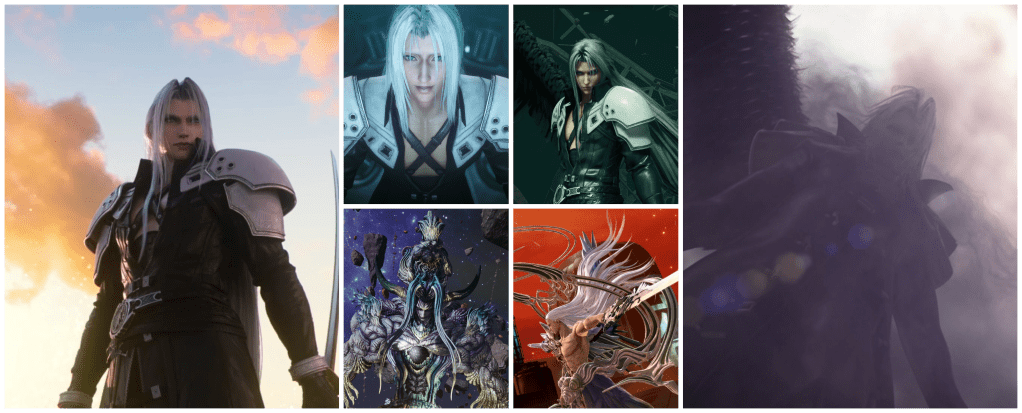
Sephiroth in FFVII and in Remake is the ‘one-winged angel’ with a fragmented mind that he’s trying to unify within the boundless divine; He’s a deeply traumatized man trying to still his panic by reaching out to Cloud, Jenova and then God. What we see in the film is the ‘one-winged nightmare’ with no humanity left at all, because the prequel book explains that before death Sephiroth had let the Lifestream reabsorb all his memories and emotions, tossing out things he no longer deemed necessary so that he could dedicate greater effort toward retaining his sense of hatred for Cloud and the planet. Sephiroth in Advent Children is an autonomous mass of hate and nothing more, any nuance or turmoil he may have previously had is thrown away. Remake‘s characters emphasize that Sephiroth is going to these extremes because, in his own crazy way, he’s trying to save the planet from something. It’s twisted, but there is a love underpinning his actions because his mind still considers himself a saviour in some part, perhaps wanting to become the ‘hero of the dawn, healer of worlds’ foretold in LOVELESS, and seeming somewhat gentle when he tells Aerith that she’ll be reunited with Zack soon. But in Advent Children he holds zero concern for its safety and even uses this as a point with which to taunt Cloud, which Case of Lifestream offers supporting information to contextualise this as a result of his erased memories. So the Remake instance of the character cannot possibly be placed afterwards, because that part of the man’s heart has already returned to the planet and been permanently lost.

Those are my conclusions that I really want to just get out quick, and you can stay if you now want to hear me elaborate.
I recall that magical month when I first played Final Fantasy VII Remake. It’s everything I wanted it to be and more. When I was probably three quarters of the way through, a passion in my heart boiled over and I did decide to post a comment somewhere gushing about much I admired the decision to style its character interactions and combat choreography in a way that better connects to the Compilation of Final Fantasy VII. As you may expect, I was then immediately responded to by someone telling me that I was wrong, stupid and then spoiled that Remake‘s finale actually does the exact opposite by rejecting the smelly Compilation content. Stemming from this, the dominant theory in its review space became one about AC Sephiroth going back in time so that he can relive the original events and better influence them in his favor. And not once have I liked this theory. This is something I’ve given my stance on time and again, buried hours into either of my relevant reviews on Final Fantasy VII and its remakes, but you are lookin at a man who just got laid off. So, like, what else am I supposed to do except talk about Final Fantasy VII Sephiroth, huh. Please indulge me as I just quickly, cleanly lay out why I do not and have never subscribed to the idea that the Sephiroth seen in Final Fantasy VII Remake or Rebirth is the same character from Advent Children somehow instigating a time loop and returning to the beginning in order to rewrite his own story.
The three main points I would contend with being the Whispers, the future knowledge and the different nuances of the character in his later stages.
Like even with just that brief summary, I find myself wanting to raise issue with it on multiple levels already. Firstly because thus far all we’ve seen are expansions and additions to the story. It otherwise is proceeding completely according to expectation with no significant or irreconcilable rewrites. Yes events have been shuffled around, yes they’ve added a bunch of extra setup as a way of granting more screentime to the hugely popular Zack and Sephiroth, but for all the arbiters of fate or multitude worlds floating about, the core storyline is still the same characters going to the same places for the same reasons and doing the same things in the same way, and I’m not convinced part three will be any different. Aerith feeling an unseen force pulling her to the City of the Ancients, and wanting herself to be the one who stops Sephiroth, was already in the original. Sephiroth recognising her as the main obstacle in his plan was already in the original. No, a new section where Cloud heads up to the plate with Jessie does not mean that the timeline has permanently changed. Despite how much Aerith and Nanaki revere them, the Whispers haven’t actually done anything yet. At this stage they’re just a surface-level allegory from the directors about how long we’ve been waiting to see its world again, acknowledging the concerns and expectations that inevitably build up after so many years of people wishing for it. Final Fantasy VII proceeds according to plan, and the Whispers are us the fans occasionally forcing our way in and saying “okay but what about Zack and Sephiroth”. Metaphorical, metaphysical fanfiction. There’s still one more game for me to be proven wrong, but so far all the Whispers have accomplished is to ruin the imagery of a bunch of important scenes. The only time they’re relevant is during their own sections, they otherwise haven’t shaped the progression of the story at all. Frankly, next time I replay it I think I’ll install the mod that makes them invisible. Likewise, Zack going through his own timeline shenanigans has no immediate bearing on Final Fantasy VII’s overall destination, it just provides an excuse for him to appear because this character is now so much more beloved than he was in the 1997 original. I truly believe that whole part of the story is just a means of getting Zack on screen. Rebirth even adds an option to disable these sections entirely on New Game+. Sephiroth’s extra-dimensional space has no immediate bearing on its trajectory either, my guess is that this probably is just creating a more substantial footing for Safer Sephiroth’s heavenly boss arena. Bizarro Sephiroth appearing early doesn’t automatically validate that Sephiroth is ‘playing with the narrative’, this to me just seems like the creators shuffling some things around in a way that affords each game in the trilogy a good Sephiroth fight to close out on. Dividing his ascension between separate battles fundamentally changes nothing in the plot, lore or setting. Oh, Cloud is talking to Aerith which must mean his perception is stuck in another plane and this will have massive plot ramifications that create a new world and bring her back to life? Well, no. Not really. We already know that Cloud sometimes catches sight of her spirit in FFVII and Advent Children. Again, I think this is probably just an expansion of imagery from the original, not anything that will inspire a genuine divergence, it’s likely that Cloud sees her here, doesn’t fully internalise her passing, and once he does realise it in the next game will be when he returns to the church and spots her like in FFVII disc 3. That’s my line of thinking on those matters, almost all of the ‘changing fate’ stuff has been window dressing, so this alleged future Sephiroth must be doing a pretty poor job of rewriting the story.

The 2015 reveal trailer is set to Beyond the Wasteland from AC‘s soundtrack, but I would explain this away as it just being a fitting piece for the trailer’s mysterious tone and because only a select few would have immediately recognised it as FFVII music, allowing the trailer’s cliffhanger to really hit. Arranging The Promised Land – Cycle of Souls for the aftermath of Sephiroth’s first appearance does not confirm a temporal link to the sequel film, it’s just them padding the soundtrack with Compilation leitmotifs that were otherwise too good to waste. Just like Rude’s battle theme which is also adapted from the film. Borrowing a couple music pieces from Advent Children or referencing a pose from its marketing does not automatically subject Sephiroth to an ingame time loop. These remakes are being made long after the Compilation of Final Fantasy VII, so it’s not at all unexpected for them to stylistically conform to FFVII‘s new aesthetic in certain aspects, to integrate iconography that became important to FFVII‘s brand or to make nods to the other entries. It’s not only Advent Children though, the remakes interact with Before Crisis, Crisis Core and Dirge of Cerberus to just as heavy a degree. Traces of Tifa has Barret mention Elfe when he first asks to join AVALANCHE, and in Rebirth he discusses the insurgents at the Corel Reactor as per its new depiction in Before Crisis. The bombing of Kalm that Broden recalls is similarly a history first established there. The other member of Nanaki’s race spotted in a painting is named Deneh, and she too was introduced in BC. Tifa’s cat also gets her debut in that game, and again Traces of Tifa has her specifically recount the time she and Fluffy got lost in the mountains with the playable Turk from it. Zack being given a larger spotlight is a product of Crisis Core‘s popularity, and they recreate his iconic last stand a number of times throughout the two current remakes. They pull Under the Apple Tree for the new Gongaga BGM, and even have Cissnei appear. Degradation, S cells, G cells – they’re all here and very important to the setting. DEEPGROUND from Dirge of Cerberus have been worked into the world already, Vincent’s coffin is decorated with the Cerberus symbol and the way it presents him harbouring Chaos aligns to the lore from DoC. The whole extended universe is represented in equal part. This is why I have repeatedly referred to it as a “unified Final Fantasy VII‘.
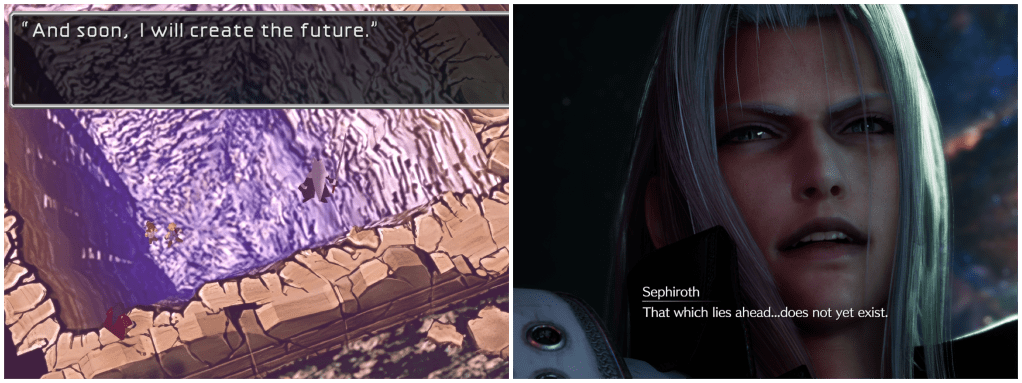
Secondly, I take issue because a lot of this claim on Advent Children‘s Sephiroth enacting a time loop or traversing back to the past hinges on the fact that Sephiroth does seemingly possess future knowledge which he wants to apply in his plans, and the majority audience therefore believing it must be sign of the story heading in a new direction…despite the fact that this plot beat actually finds its roots in the original and everyone simply forgot. This exchange happens after Sephiroth obtains the Black Materia at the Temple of the Ancients.
- Sephiroth: “I became a traveller of the Lifestream and gained the knowledge and wisdom of the Ancients. I also gained the knowledge and wisdom of those after the extinction of the Ancients. And soon, I will create the future.”
- Aerith: “I won’t let you do it! The future is not only yours!”
While I don’t think that was meant to be a literal remark on timeline alteration, the idea has been there for as long as FFVII has been around. The Jenova cells inside of Lucrecia also enabled her to see visions of Sephiroth’s future in Dirge of Cerberus. Considering every other part of Remake‘s plot is also just a massively-expanded version of the original script, to me it feels as though the writing team has simply taken this exchange, the scene where Sephiroth and Aerith both manifest into Cloud’s dream in the forest and the scene where Aerith heals the Geostigma in AC, and hugely extrapolated on that dynamic to paint them as symbolically opposing forces in Remake. One of the thematic goals stated in an interview was that they really wanted to emphasize the opposing forces of Holy and Meteor, which is enacted through the renewed enmity of Aerith and Sephiroth. Following this, those two do come into Remake‘s story with sage-like knowledge of future events, which creates thematic justification for why Kadaj, Loz and Yazoo themselves are explicitly stated as being channelled into the trio of Whispers in its final battle, or also why it borrows footage from Advent Children when the larger one’s energy makes contact with them. However importantly, the scene of Aerith’s death in that battle is a new cut, which throws the significance of the other shots into question and, in my opinion, compromises that scene’s use as evidence of Remake irreparably diverging from the known sequels.

The only parts they pull out of the film are from the opening section where it’s just recapping FFVII events, not any of Advent Children‘s own plotline. Because that one scene is different, it makes me interpret their usage of FFAC footage as a cost-saving measure and a fun reference for the fans. If they exclusively wanted us to receive it as them sending a message about the Compilation, then they’d have used the film’s animation of Aerith at the altar instead. Ultimately neither of those elements, nor any of the prior, are convincing to me in the claim that AC‘s Sephiroth time-travelled to the start of FFVII, because these elements are largely confined to their own chapters and the base storyline is otherwise the same as it’s ever been.
But that’s not even what I actually wanted to talk about (I lied when I said this would be cleanly laid out), because rather than getting worked up over lore mechanics that we probably won’t fully understand even by the credits roll in the third game, what I do feel confident in saying is that it’s just observably not the same person. I’m not suggesting that there are multiple Sephiroths running around, in fact that’s a part of the dominant theory that I want to dispute. It is still the same core consciousness in FFVII, Remake and Advent Children, but the thoughts and feelings that defined him have disappeared, and that’s why I believe Remake cannot be a timey-wimey sequel to Advent Children. Specifically what I take issue with in all of this is that central idea of it being a Rebuild of Evangelion style sequel instigated through some unspecified world loop. Indeed Remake Sephiroth has searched the Lifestream and found some knowledge of how the future will progress, this much was true even in FFVII, but he himself is not the same continuous character instance crossing over from Advent Children as an alternate future. Because by the time of said film, Sephiroth, for all intents and purposes no longer exists. The man is a shadow of his former self, missing most his memories and deprived of every emotion other than hatred. He’s a fundamentally changed existence to that of Final Fantasy VII or Final Fantasy VII Remake.
“When the Lifestream erupted from the earth, he let the planet have all those memories that no longer held any meaning. Memories of his boyhood, of his few-and-far-between friends, of battles he fought before knowing his true self, of his life in those bygone days – he let them join the rushing torrent and dash themselves against Meteor.”
On the Way to a Smile Final Fantasy VII (2009) | Case of Lifestream: Black
Sephiroth in the Remake saga aligns to his Advent Children depiction only in the sense that this is the modern version of the character, written, acted and represented in a way that aligns to where his performance is currently understood. His homoerotic mannerisms, his mad ramblings and heightened fixation on Cloud – this is just how Sephiroth acts whenever they use him nowadays because it’s where the character’s image and personality have developed to across the Compilation of Final Fantasy VII, Kingdom Hearts, Dissidia Final Fantasy, Opera Omnia, Mobius Final Fantasy and the like. For this reason I still truly believe that Final Fantasy VII Remake and Rebirth are just imaginings of what Final Fantasy VII would look like if it stylistically agreed with the Compilation, since the 1997 original is so at odds with all its sequels, and that by the end we’ll basically be able to replace FFVII with FFVII Remake in the Compilation play order to finally sever its connections to the controversial expanded universe. So I can understand where people see AC’s Sephiroth within the character acting, insofar as this is just the modern Sephiroth and a lot of his quirks therefore appear.
But I really feel that this suggestion collapses when we start talking to the actual character himself. The writing, the motivations, the ambitions. Because that’s just not the same Sephiroth as the film. The character we see in the remake is fragmented, caught in a spiritual tug of war. His mind is held in the north crater, being pulled between alien instincts and remnant human tragedy, while also trying to fend off the Lifestream as it absorbs his memories. He speaks of secretive knowledge and tries to convince everyone he alone knows the truth, but Sephiroth is a madman desperately clawing at anything that might restore him. One part of Sephiroth’s mind is fighting to reclaim his title as hero, another is directly opposed to that sentiment and instead wishes to restore Jenova to her full eldritch power so they can subjugate the planet, and a yet equal part is so ashamed of it all that he’s trying to disappear into an eternal prison. The hero of man in a state of madness, believing he sees some ultimate truth hidden within his violent delusions. Sephiroth in Final Fantasy VII, and in Remake, is just as broken as Cloud is. Yet since nobody is willing to save him, Sephiroth’s lunacy culminates in a belief that he can only protect himself by becoming the highest existence above all others. Betrayal, rage and sorrow extinguished within divine love. This is the man that Sephiroth was during the original Final Fantasy VII, and so is the expected characterisation for him during this period of his storyline. True enough, Sephiroth in Remake and Rebirth has acted wholly in accordance with this sentiment. The One-Winged Angel lashing out because his understanding of himself and his place in the world was shattered when stumbling upon the demon in Nibelheim’s mountains, forever muddying his capacity to properly understand the boundaries of love, self and hatred.

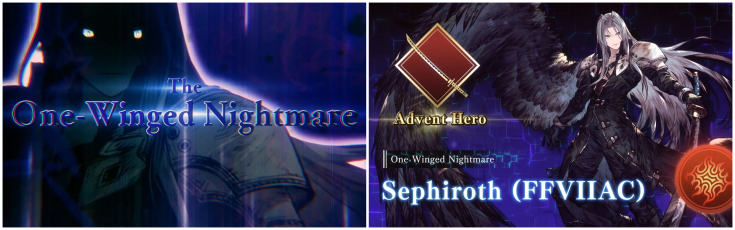
Advent Children’s Sephiroth though, does not have any of that inner conflict or tragic nuance left. Due to the mental assault that his soul is suffering in the background of Final Fantasy VII, the longer the story goes on the less of the original man is left. And by the time the game ends, he can barely be considered human anymore. In fact, this stage has been christened the One-Winged Nightmare in its War of the Visions release.
Sephiroth’s role within Advent Children itself is short-lived and mostly consists of combat, so to find insight into his psyche we instead refer to its accompanying anthology book On the Way to a Smile; A collection of short stories that reveal how these people all bridged the two year gap from the game to the film. Case of Lifestream: Black introduces Sephiroth into the post-Meteorfall time period by first explaining that when the Lifestream rushes against Meteor his own memories also get swept up in that flow. Though he perhaps could have resisted a bit more, Sephiroth willingly lets them go. Memories of his childhood or his few loved ones, the last pieces of humanity he held are discarded. He still manages to hold onto his ego/will after Cloud strikes him down, but the specifics of his personality or his connection to humanity are gone forever. Who he was, how he looked, what he wanted – Sephiroth’s spirit no longer remembers. From within the stream his spirit gazes out and finds that the only strong indicator of himself left in the world is the hatred that still burns within Cloud, creating the Remnants to make contact with him and so use that emotion as the core of his resurrected existence. AC Sephiroth’s only foundation is hatred, the human tragedy or corrupted love for the world which defined his life are entirely wiped away. The single feeling Sephiroth has left to understand himself with by this point is a hatred for the world around him. There are no longer any delusions about Jenova being a Cetra, he fully acknowledges his mother to be a planetary scourge and still longs to support her wishes.
“He tried to send his spirit above to walk the surface, but nothing came of it. The planet had consumed the memories of his own form, leaving him with no image on which to anchor his consciousness.”
On the Way to a Smile Final Fantasy VII (2009) | Case of Lifestream: Black
During the the events of FFVII Sephiroth had repeatedly tried to establish a connection with Cloud and Jenova, because there’s some grand design to his deceptions, some goal he wants to achieve alongside them. He deliberately overlooks several opportunities to kill the party because they’re all necessary for his endgame. He could just carve up Midgar after the party have left, or send one of his cultists to grab the Black Materia. But that’s never been the point of Sephiroth. He’s trying to prove something to the world & himself through his actions, which often involves using Cloud’s response as his own moral compass. What that thing is fluctuates along the storyline because Sephiroth constantly contradicts himself due to insanity and mental instability. First he’s the hero of man and takes immense pride in that position, then is denigrated as the monster of Mt Nibel, in search of a way to reject this he deludes himself into believing that he and his mother are the heir to the Cetra, and then at the end we can discern that he actually moves on from Jenova and just uses it as a tool in his own deification. Nevertheless the method is just as important as the end goal. In the film though, Sephiroth immediately goes for the throat. There’s no panic, there’s no insanity, there’s no twisted heroism or murky, distorted sense of love underpinning his actions, Sephiroth just wants to torment Cloud for a brief moment before fully embracing his alien instincts and disappearing into the cosmos. The Lifestream stole all recollection of his days as a hero or his life before Jenova, and he willingly threw away the memory of his few friends like Genesis, Angeal or Glenn. Advent Children‘s villain has wholly given up on humanity and has no care left for the planet. Whereas in Rebirth, Cloud describes Sephiroth as having an earnest desire to save the world from some impending cataclysm, even if his methodologies are violent and insane, and the madman himself later reiterates this, which is an impossible thought for his mind after Meteorfall.
They don’t act the same, their goals don’t align and On the Way to a Smile gives a solid reason to believe that they shouldn’t be the same. Therefore, I just truly do not believe that the two characters could possibly be considered the same exact instance. Remake‘s Sephiroth, though coming with the flamboyance of all his other modernised depictions, is still fundamentally that same tormented mind that can be seen buried even in the text of the 1997 original, unlike the character’s final appearance in the film where his ego has at last become complete again by ruthlessly severing all of his lingering attachments to the world of man. An angel and a nightmare.
 skapbadoa