This post is to serve as a set with the other uploaded today containing revisions to how my Monado Trinity positioned Kadomony and the Trinity Processor – mainly fixing how I initially tied Ontos to Persona, when it should have been the fullerene quantum computer. They were written and almost entirely edited as a single script with two sections, but for topic reasons I decided it would be best to split them into simultaneous uploads. With that out of the way, I’ll now be looking to locate the Aegis in the Sword of the End.
My relevant claim during the Monado Trinity video was:
“Technically the Sword of the End and Sword of Origin have a more clear parallel to Shulk’s Monado than the Tertiary Sword did. The ring opening on the guard is entirely unobstructed, Noah has kanji symbols on his Arts palette and understanding its link to Aionios and Origin reveals that its powers are implemented by hacking physical parameters to alter the passage of fate. It’s a dimension-ripper. However even with all that, the fact that it doesn’t have Ontos, Logos or Pneuma backing it leaves it completely unrelated to the Conduit Experiment and it therefore cannot be classified as a Monado.”
For the time, I think that was a fair reading. Other than a green glow in his blade when Noah was maybe using Foresight and a general feeling that Malos likely would have wanted to protect Consul N in the same way he did for Amalthus and Jin, nothing in base XC3 indicates the presence of the Trinity Processor, Aegis, Monado or Conduit at all.
- Nia tells the Sword of the End to be “a byproduct of resonance between the Kevesi queen’s heart and Origin” and further remarks that “Z commands the world’s very fabric. And yet, you too can break Z’s fetters, as you’ve shown, smashing through the rules he established. With your Ouroboros powers, and the Sword of the End both.”
- Melia muses that “Present lives and future ones. Moebius aside, the wills of countless people persist inside of Origin. The Sword of the End you carry, and Ouroboros, they take their shape from these thoughts.”
- Z describes its power as “that which denies fate and makes its essence mercurial.”
The first two statements together said to me that the Sword of the End was not a Monado at all, but rather it was a metaphysical phenomena that Origin manifested by interacting with Melia’s memories of the Monado. The reason it looks like a Monado is because its design therefore was inspired by Shulk’s. And because it was such a powerful artifact created by Origin, it therefore had the ability to exert administrative rights over its functioning. Since Origin was overseeing the spacetime distortion of Aionios, this basically grants its user access to godlike power. The thing about Xenoblade 3’s setting is that because the characters are once again drawn into a spatial microcosm with finite ether resources and a god-machine managing everything, it inadvertently comes to resemble that of Xenoblade 1. Hence, the Sword of the End accesses Origin to hack physical space in effectively the same way that the Monado accessed Ontos and the Conduit to hack physical space. So as its story drew to a close, this is the conclusion I was left with. That it was a divine sword specifically constructed to control the unique reality circumstances of the Aionios ether microcosm.
That was a perfectly fine reading to be left with. It made sense enough to me. That is, right up until the February 2023 Nintendo Direct, where the wave 4 DLC trailer throws Alvis onscreen frame one and suddenly the Monado is thrust back into discussion. With the revelations from Future Redeemed’s dialogue, as well as extra tidbits in the Aionios Moments artbook, we’re now able to adequately locate all three Trinity Processor cores hidden in the setting and understand what their relation is to the three Weapons of the End.
The Sword of the End, fundamentally, is still not a Monado. To be classed as such it would need to belong to one of the Aegis and/or have an ether link to the Conduit in place. The only such sword with either of these traits to be found within Aionios is, as expected, the Monado held by Alvis, A and Alpha. The one that’s legitimately, blatantly, obviously, non-disputably a Monado with no extra justification needed. My estimate of the progression goes something like this. First, understanding that Ontos is the supercomputer chip operating the whole core system of Origin. As discussed in my earlier section revising the Kadomony structure, Ontos is equivalent to its fullerene computer element and should therefore have the capacity to make logic-based decisions on its own. When the group drafted their plan to have Origin survive the universal impact and then restore everyone to the new world, this seemed like it wouldn’t be an issue. The directive given to Ontos was concise and clear. However when Moebius unexpectedly arise as an embodiment of mankind’s collective fear, and their endless world leads to the birth of a whole new faction of people in the City, Ontos is not equipped with the processing faculties to properly evaluate what this means for its program. Ordinarily this is where the emotion-based Logos and Pneuma would have stepped in to provide their opinions, but since they aren’t present in Aionios (I’ll clarify this later), Ontos instead elected to reference the methodology it had used during the most comparable situation in the past – this being Zanza in the Xenoblade 1 subspace. So Alvis spread his four glowing wings and unleashed the Monado’s wrath upon the world, subjugating them as he prepared for the incoming dimensional shift and rebirth. This is why Alpha’s wings and halo, usage of the Monado I and his boss theme are so similar to that of XC1’s final battle – lore-wise he literally is copying Zanza.
However when Ontos’ previous admin Shulk comes to combat him, this is enough to wake the persona of Alvis from Xenoblade 1. As per my previous framework Shulk had spent most of the game using Zanza’s Monado, which was a substitute for Logos, and Rex is deeply linked to Pneuma. Therefore A manages to split herself out of the main body using those two as her balancing elements. Alvis is cleft in twain, with A and Alpha each retaining two of the four wings and a lesser incarnation of that Monado. Within the first Xenoblade, I assigned Meyneth’s Monado as Pneuma, Zanza’s Monado as Logos and the True Monado as Ontos. It therefore tracks that despite both A and Alpha’s swords resembling the Logos-derivative red Monado I, A retains that bright blue coating from the third sword & her Monado Buster is a silver stream of energy which matches its stream of ether seen in XC1’s finale. Whereas Alpha’s imitation of Zanza is reflected in the purple coloration of his ether attacks.

As I understand it, the Sword of the End predates A’s arrival, so she seems to have based her Monado’s shape on them. Except that where the others are basically just the outer shell of a Monado with the soul of an Aegis imbued as a power source, Ontos is still active and physically present in Aionios, so hers is the genuine artifact. Despite Alvis having instructed the Conduit to vanish from the universe in compliance with Shulk’s wish for “a world without gods”, the fact that Ontos is the central component of Origin and that time has been slowed to an extent which the future movements of the ether can be predicted allow A to manifest powers of Monado and Vision similar to what was displayed in the world of the Bionis.
So that’s Ontos accounted for. The next most obvious step is going to be looking at where we find Pneuma in Aionios, considering it’s pretty hard to miss the big emerald Aegis core that pops out from under Matthew’s Fists of the End and bathes the whole area in a green glow. However, if we watch the scene more closely, we notice that it seems to be a projection, rather than the actual core. The object is translucent, and its shape fades in rather than being physically hidden under the sheath layer. This is because Pneuma and Logos are not present in Aionios. Not in a genuine, physical capacity, because if they were then Ontos would obviously have never run haywire and then Xenoblade 3 never happens in the first place. And no, Glimmer’s core doesn’t count. Though she inherited the aesthetic qualities of Pneuma’s shape, colour and internal halo, the authorisations elude her to the degree that neither Rex or A ever even bring it up. The genuine trinity cores are absent. Logos completely shattered at the end of XC2, and I see no satisfying way that Pneuma could have ended up in that battle or retained its high level of power, considering the Architect explicitly says they’ll stop being demigods once the Conduit vanishes. Rather it’s that the Fists of the End and the two Swords are made from Origin Metal. Literally, fragments of metal or circuitry broken off of Origin’s physical database, which can thus access its servers to copy the memory data of certain individuals. Like a weaponised holy hard drive.
“Next there’s the Origin Metal that Matthew has, the Fist of the End. What’s in it is Pneuma, which means both Pyra and Mythra. Please recognise that the will of two people resides within. Noah ended up with Lucky Seven. This isn’t mentioned in the game, but it’s Fiora. […] Their rank is the same as Alvis and the rest of the Trinity Processor. And this is also true for Melia, Nia, and Fiora, who possessed Meyneth’s Monado.”
Tetsuya Takahashi, Aionios Moments
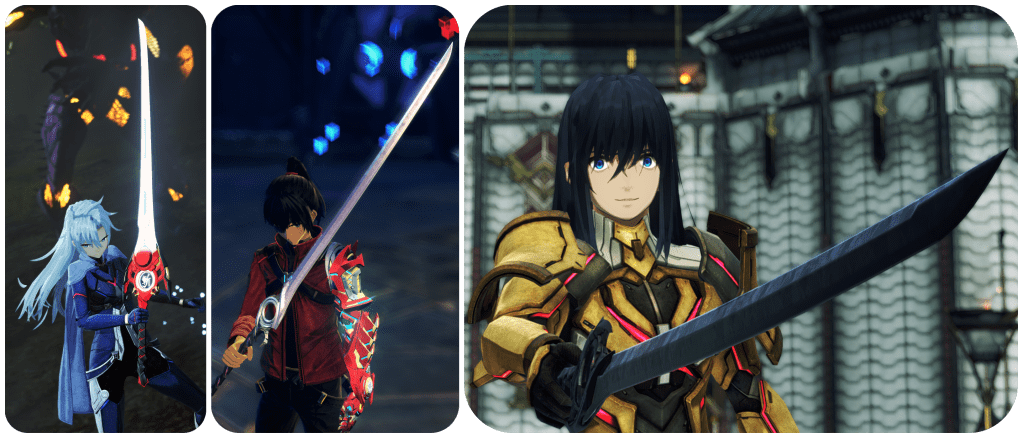
But importantly, none of those are the actual cores. The Origin Metal recorded Pyra, Mythra, Fiora and Malos, not Pneuma and Logos. Additionally, through 4-dimensional imaging or whatever, it seems to have recorded them at the peak of their power. Since Origin is the machine maintaining Aionios, Melia somehow figures out that this metal can be used to channel the power of the embedded person. So when she and her team of nopon engineers fashion the Origin Metal containing Pyra and Mythra’s data into a pair of gauntlets, for example, it enables Matthew to recreate their power within Aionios. When they use the piece that recorded Malos to create a black Monado-like sword, it gives N access to his Monado Speed, Monado Shield and ether manipulation. Origin is said to have recorded the data of people past, present and future in its storage, so it also managed to image Fiora from the point where she was imbued with Meyneth’s Monado, which I previously classified to be a substitute of Pneuma. That piece of metal is used as the basis for the white Sword of the End. When Noah channels her for the Dimension Ripper vortex or enhanced Tachyon Wave blade beams they give off a reddish ether.
However, quite literally on the other hand, the Aionios Moments artbook again suggests some further secrets, as the page detailing Noah’s Veiled Sword mentions that there’s a ring of Origin Metal present in the actual Blade, which we can easily pinpoint as being introduced at the time in which Riku altered it to fit over Lucky Seven. It further explains that this ring is what somehow allows the red Veiled Sword to rearrange into a gauntlet, with the idea given being that the sword’s powers grant ultimate offense and the armour’s powers grant ultimate defense. Now, whether that ring is just a locking mechanism which was always meant to be part of Lucky Seven’s structure, or if it’s a piece Riku recovered from the Fists of the End – who’s to say. The translation doesn’t say. I’ve always found the suggestion that Matthew’s gauntlets must be the same thing as Noah’s to be a pretty forced reading, considering the red part of the Fists of the End is a regular Blade and it’s actually the grey weapon hidden underneath that’s made of Origin Metal. This is true of N’s Sword of the End as well. Not every piece of Origin Metal has a soul in it, it just contains that potential. Origin Metal is inherently above and external to the flow of Aionios, but the only ones with admin rights so to speak are those adjacent to the Trinity Processor. The three Weapons of the End and A’s Monado, as well as Shulk and Rex’s weapons since Takahashi states them to be Avatars equivalent to A. The Veiled Sword itself can’t overwrite Z’s administrative power to destroy Flame Clocks, that’s exclusive to Lucky Seven. Nor does any further divinity get added to it when the Nopon Engineers enhance it with even more Origin Metal, just a general boost to its attack power.
The only actual consistency between those in question is that they’re red gloves with some kind of Trinity Processor motif on them which, okay, fair enough, but that’s seriously where the similarities end. Matthew’s is only just a few bits of Blade attached on top of his silver Origin Metal weapon, which just bugger off elsewhere when he unseals the underlying fists. Whereas Noah’s is the whole Veiled Sword forming into armour after unsealing the underlying sword, using the Blade’s golden parts as the trunk. Matthew has two short gloves with open fingers, Noah has the larger enclosed gauntlet from a suit of armour. One’s a red fist when it’s inactive, one’s a red fist after being activated. The functions don’t match, the shape doesn’t match at all, and the blue ether on Noah’s is totally different from the gold and green of Matthew’s. While Noah’s is honestly closer to how Pneuma’s turquoise ether looked in Xenoblade 2’s art style, it doesn’t conform to how Xenoblade 3 represents it in the Fists of the End or Firelight Swords. From a design perspective the lines just aren’t connecting for me, because it means you have an Origin Metal weapon with a red Blade layered over it as a sheath, then you discard that first red Blade and turn the first Origin Metal weapon into a red Blade as a sheath for a second Origin Metal weapon. I don’t think Noah has Pyra and Mythra in his Veiled Sword because that doesn’t fit with my understanding of the setting or lore, and if that were the case then Takahashi had ample opportunity to mention it in this interview section I keep referring back to. But he doesn’t. So I’m just mentioning it for consideration because I know a lot of other people in the mainstream discourse are fond of the idea. Me personally, I would have sooner suggested that Nia inherited Pyra and Mythra’s metal after Matthew’s passing as an explanation for her Anima Sword. The party from Future Redeemed are the first group to successfully manifest into Ouroboros, so that particular Origin Metal glove would he been irreplaceable to Nia’s research.
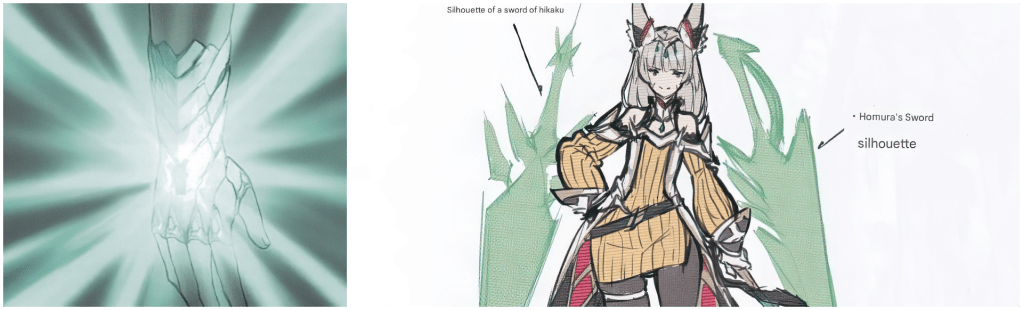
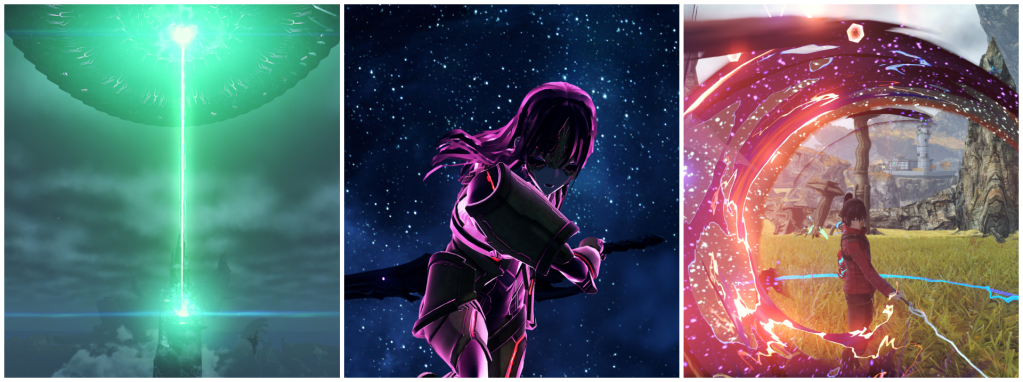
Either way, regardless of whether it’s Fiora coded as Meyneth coded as Pneuma, or just that genuine essence of Pyra and Mythra in his glove, this Pneuma-aligned weapon enables Noah to use defensive abilities like a barrier to withstand a Ferronis Beam, he can use it to dispel Moebius’ mind control, and when he activates something reminiscent of Foresight to predict Mio’s movements there’s a green glow present in his sword that’s never seen again afterward.
Admittedly ether colour is a bit of an unreliable indicator in Xenoblade 3, but I think we just have to apply common sense and feel out where it represents the Aegis and where it doesn’t. The green healing magic that characters use is obviously just a common visual tell for HP restoration, whereas the green that emerges from Matthew’s glove or that wafts off of an Ouroboros giant’s body has specific reason to be linked to Pneuma energy, since that was the basis of Nia’s research. N’s Veiled Sword having purple flames in the flashbacks should be a decision done to draw comparison to Malos’ Monado, but the fact that Moebius have purple ether shouldn’t be associated with Logos. While there is a case for consideration because Z isn’t purely evil, he’s the embodiment of mankind’s collective fear. The heroes know what’s going on and have the strength to weather it, but the general populace have only been told “our universe will collide with another and kill us all, but trust that we will manage to resurrect you in a new world afterward”. Who could possibly be alright after that? In that sense you could definitely say that these are exactly the kinds of people Logos was designed to provide emotional support to, and I will say that Ouroboros do embody Pneuma’s principle of “the path of the righteous shines ever brighter until the full light of morning” and Logos’ principle of “hatred stirs up conflict but love covers all wrongs” would see it standing by Moebius’ side hoping to heal them, just the same as their champions in the prior two games. But unless using Ontos as the core processor has inadvertently led Origin/Aionios to dole out ether colouration with the function of a moral barometer, then I don’t see any reason for them to have a legitimate connection to Logos or Malos. Z should be equivalent to a pseudo-Ontos more than anything, since he’s described a “partial administrator”, and we can determine that he uses Moebius X and Moebius Y as his substitutes for Pneuma and Logos in the same way as Alvis-Zanza-Meyneth or A-Shulk-Rex.
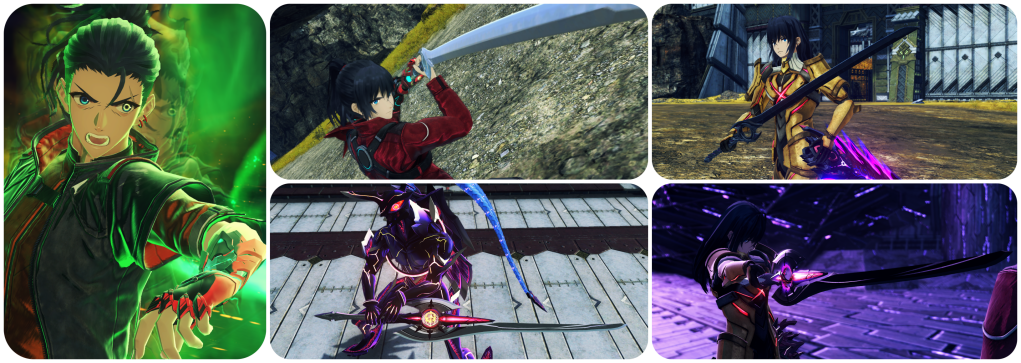
Lastly, as revealed earlier, the soul of Malos is contained within the Origin Metal from Consul N’s black Sword of the End. “Hatred stirs up conflict, but love covers all wrongs” is the Bible verse that informs the Logos processor, which is why Malos mourns so deeply for Amalthus and Jin. Hence a lot of people speculated that N was associated with Logos when base XC3 released due to the fact that Noah’s sword had purple energy across his reincarnations even before joining Moebius. Future Redeemed further hints toward it using a contrasting shot that lingers on Matthew’s Pneuma-imbued Fists of the End and then N’s sword. But the actual confirmation is only given at the last possible moment, when Tetsuya Takahashi and the team are discussing it during the artbook’s interview section:
“The Sword of the End that N holds is Logos. Well, it’s Malos, but after he’s died. Or rather, disappeared. As for why Malos is here, I’m sorry but I can’t answer that yet. However what N has is Malos himself.”
Tetsuya Takahashi, Aionios Moments
I’m not quite sure why the need for secrecy is about considering the Origin Metal weapons for Pyra, Mythra and Meyneth still displaying divine-level power should already be enough to tell that Origin has taken snapshots of characters even during their past states, but I assume we’ll get more on him during either Xenoblade X Definitive or Xenoblade 4, since regardless of the way he ended up in the sword, his essence being recorded by Origin means he should be restored to the new world alongside everyone else.
For some reason there’s still a lot of confusion as to how N has a Sword of the End or why there are two of them, but this seems straightforward to me. Kevesi queen Melia and Agnian queen Nia are fighting a war against Moebius. In search of a trump card, Nia focuses on creating an interlink energy similar to how Drivers and Blades empowered each other. Melia instead looks to develop divine weaponry akin to the Monado. Once she discovers that Origin Metal can be used to achieve this, the natural candidates are obviously going to be those who held the power of the Trinity Processor – Pyra, Mythra, Malos and Fiora fused with Meyneth (Shulk and Rex were unavailable due to being summoned as Avatars). Melia crafted three weapons, I think it’s just that simple. One ends up with Matthew, one is given to the original Noah, and the last goes to the protagonist version of Noah. The Aionios Moments interview equates possessing a Sword of the End to having admin rights over Origin, so within the database it was likely coded onto Noah’s file and therefore repeatedly makes its way to him across every reincarnation, up until he eventually becomes Consul N. Therefore the purple flames on his sword aren’t from Moebius since the sword had them even while he was human, but an emanation of Malos’ ether leaking out through the gaps in the Veiled Sword’s sheath. While it is the colourless metal weapon underneath that actually contains the data, we see all three of their veils glowing with the colour of Logos or Pneuma at some point. Eventually though, N betrays the city and their side loses access to his divine sword, which swings the war in Moebius’ favour. However when Riku finds that another version of Noah has somehow reappeared in the Flame Clock system, he determines thatshould be the one to hold the final Origin Metal weapon, nicknamed Lucky Seven. Eventually the two Noahs merge together into a single being, and our protagonist unites Malos (Logos) and Meyneth (Pneuma) within his sword, enabling him to step into Ontos’ domain at the heart of Origin and give his command to restore time to its original speed. With that, all three End weapons which Melia created are accounted for, and their respective links to the Monado Trinity detailed through Origin manifesting the memory of their powers.

Also, fun little side note that I couldn’t find the right place to slot in earlier. The Ouroboros interlink is Nia replicating the ether bond between Driver and Blade, and the Sword of the End is Melia replicating the reality-bending divine sword Monado through the use of Origin Metal. So when Noah runs his Ouroboros energy through the blade, the larger shape it transforms into it takes on is basically all three games merged into a single point. The highest achievement thus far of the post-experiments peoples. An Origin-powered, Monado-adjacent divine sword with an Ouroboros core inside of its circular guard. It would have been cool if that was more significant in the plot or cutscenes, but nonetheless it definitely makes me like the sword more.
So…that’s that. I dunno, just ramblings on Xenoblade stuff. The Sword of the End, ultimately, is still not a Monado in my books. But with a renewed description of how the Trinity Processor is analogous to Kadomony and the remaining information revealed by Future Redeemed, I feel we’re now able to look at the mysteries of Aionos and its divine sword to better locate the three all-important Aegis within its confines, and appreciate how the lore of Xenoblade 1 and 2 connects to create the world of 3.
 skapbadoa
Leave a comment