Channel update: I’m alive hey thanks. Life update: Final Fantasy VII Rebirth. In conclusion, I believe that I have made my case. It’s stream of consciousness review time, because I noted down a bunch of thoughts or reactions while playing and, well, now I’m endeavoring to compile them into something vaguely coherent. A very, very spoiler unsafe review, to reflect on where these remakes currently land from perspective of a lifelong FFVII fanboy.
How magical it is to be seeing Final Fantasy VII in full swing. It was around the point of recruiting Yuffie that I finally got that comfy feeling of seeing the party together again in earnest. The way her green tank top and short hair complement the colour schemes of everyone else honestly has a big effect of making it all seem real. To see Cloud Strife walking around with Tifa, Barret and Aerith in such detail! And Nanaki, and Yuffie, Vincent and Cid. Or heading into the Gold Saucer with the cozy vibe of everyone being friends who would spend real recreational time together. The girls & Nanaki head into the park, creating space for Cloud and Barret to be grumpy men bonding over their distaste for all the gold and glitter. This is the level of cast interaction I’ve been waiting for. Barret looking out for the younger Cloud, sassing Cait Sith for his Shinra connections. Aerith and Tifa talking about boys. Vincent and Cid being lads and dads. Or Yuffie constantly hugging onto Cloud, Aerith or Nanaki, and generally bringing so much energy to the scenes. And of course I have to mention: [insert Tifa montage]. 10. Gentlemen. Traces of Two Pasts, On the Way to a Smile: Case of Tifa, Advent Children. That was cathartic.
She hesitated, then blurted out, “Promise you’ll come and save me.” For a brief moment, time stood still on the water tower. She hadn’t come intending to say something like that. It just popped into mind. But once the promise was sealed, it seemed to her a thing of singular importance. She’d discovered that Cloud – the quiet neighbor who had always seemed as unreachable as the stars – was just a normal boy. She’d come to understand that she did like him. And it was that special kind of “like” – the one that ties up your heart, making you yearn to be with that person for the rest of your days.
Traces of Tifa
Finally unleashing Elena was great as well, I became such a fan of her after reading the Turks book. Or for an even earlier reference, rushing into the Ancient Temple may look above their paygrade, but then I remember that whole ordeal where they put an end to Zirconiade and the Jade Weapon. The Turks have strong enough personalities that whenever they show up it briefly turns the dialogue and fight choreography into something reminiscent of Advent Children. Can’t wait for the PC release so we can mod out the HUD and record them without the battle menu. This really is the best cast. I’ve waited so long to get Tifa, Aerith and Yuffie just hanging out, and everyone doting on Nanaki. It does the heart good to hear them casually calling him by his true name, considering in the original game you have to set their names at debut so it can’t be changed. Beyond the party, it’s just generally nice to put so many faces to names, like Marlene’s mother Eleanor, Barret’s wife Myrna, Ester, Chocobo Billy and so forth. Zack’s parents are his spitting image. And, speaking of which, I did notice a marked improvement to the facial animation in this game. I wish they did something with the idle poses though. Every character awkwardly standing in a neutral pose is something I was hoping they would recognise as needing improvement. They didn’t make any attempt to fix the lighting issues on the ingame faces either unfortunately. Though obviously the big point of the visuals is in getting to see more locations remade with a modern level of skill, since Disc 1 comprises the largest chunk of Final Fantasy VII. Stepping out and seeing the scale of the grasslands is a pretty accurate recreation of the feeling when you originally leave Midgar and realise there’s a whole world out there. It’s almost a bit dizzying. It outclasses the return visits to these areas in Crisis Core or Dirge of Cerberus. Even if Kalm was technically larger in Dirge, Rebirth’s rendition of the town has a more interesting layout. Similarly, while Crisis Core let us explore multiple levels of Junon, the inner mall area from Rebirth is a much more organic way of adding complexity to the simple town layout. Or the Midgar wastelands and Corel. While I’d hate to visit such a barren place in real life, I’ve been seeing these rocky environments in Advent Children and Crisis Core for so much of my life that it’s amazing to get in control of Cloud and explore them.
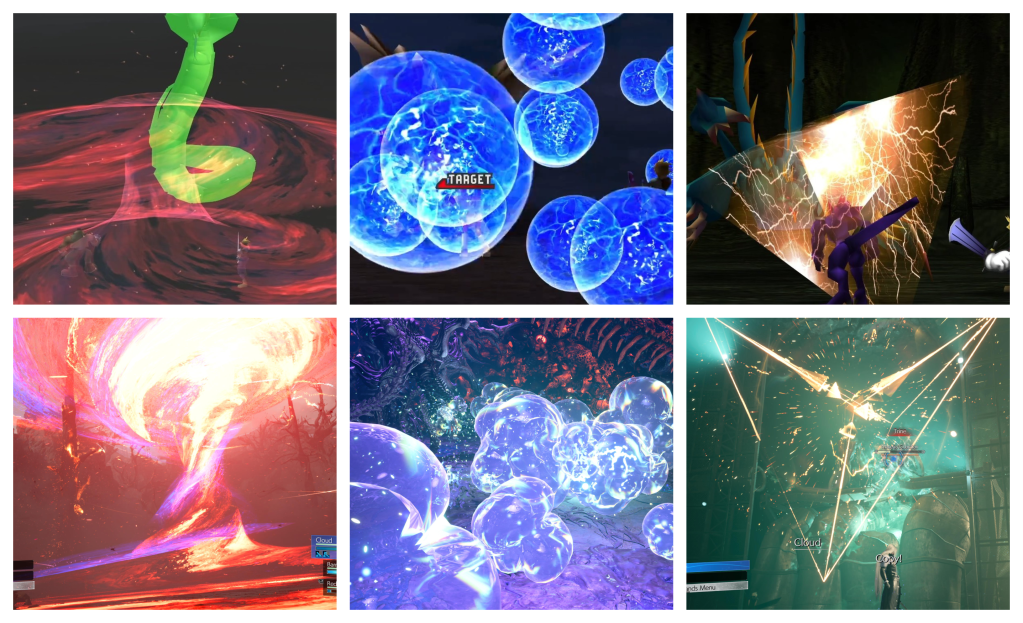
Combat in the game was fantastic. Cloud’s air combos are super sick since FFVII combat has always been aerial in the Compilation. The returning characters have some refinements which will make it hard to ever return to Remake. Such as Aerith’s previous heavy attack now being a charge of her basic attack, letting her add a more interesting warp ability, Cloud’s ranged blade beams or Tifa being given an alternate powerup to pick dependent on whether she wants physical or magic damage. While the new characters Nanaki and Cait Sith feel totally unique from the rest. I played as Caith Sith. Voluntarily. Even if only for a little bit, there were times where I said “you know what, Cait Sith’s RNG mechanics are interesting.” That is a victory on part of Rebirth, because otherwise speaking I think I’ve always done my best to keep him out of play. Not out of disrespect, Cait’s relationship to the group becomes super wholesome in the later works, but because his combat is ordinarily just too weird compared to the straightforward action you get from Cloud. I would have loved to have Cid and Vincent too, but I understand that they’ve gotta save something for the next game and am glad that they were still relevant in the story despite not being playable. You’ve gotta give them a pass on that anyway since they went the extra mile to give Sephiroth a moveset for the single chapter he’s available, and do the same for Zack despite only getting two fights. Remake was one of the smartest action RPG systems I’ve encountered, and Rebirth’s battle system is better. Combo attacks add more variety, perfect guarding increases complexity, and the synergy strikes introduce a mini-goal to keep track of in each encounter as you build meter. The last phase of Jenova Lifeclinger where Cloud leaps down, then the side panel just displays everyone joined the party to carve their rage and sorrow upon her putrid flesh is low-key a very badass moment. I didn’t think anything of it the time, but replaying sections to grab footage that part gave me chills actually. Such a sick way of using its game mechanics for an extended purpose. Even from the demo, my immediate impression was already that it would be a BotW/TotK situation in the sense of unlocking a lot of combat/exploration/loadout freedom in the formula and going “the one before was a tech demo, now here’s the real game.” In Final Fantasy VII Rebirth, you can swim…What purpose it serves I dunno, but it’s nice anyway. That’s the vibe. Having party formations quickly accessible means that it’s easy and fluent to make use of every party member instead of sticking to one trio the entire time, fixing one complaint I had of the original where using anyone other than Cloud, Barret and Tifa is a hassle. Being able to rotate teams without Cloud keeps combat fresh, since older Final Fantasy titles would usually lock the protagonist in play. The sidelined party members still battling from the perimeter is a very nice decision too, since it means everyone can feel relevant. Given how it worked in the previous game I didn’t really expect anything else, but I do feel slightly ripped off that the Enemy Skill materia didn’t let us steal Beta, Aqualung or Trine. However White Wind, now known as Soothing Breeze, is even more useful than its original version, even though that one is already integral to FFVII. Catch the very end of the battle with Soothing Breeze and it continues running out of combat, essentially giving a free Cura-All. Sonic Boom was way too good to be given as early as it was, and I got a ton of mileage from the Plasma Discharge skill as well. It’s nice to see that many things actually had their utility enhanced in the new balancing instead of scaled back.
Looking at the overworld gameplay next, I love the larger fields + wider camera perspective to accommodate. The closer an overworld gets to resembling the Xenoblade experience the more I’ll like it. Though admittedly at first glance the world wasn’t quite as large as I’d hoped, since the next stop is almost always in direct view. Stepping out of Kalm into the grasslands, you can already see the swamp. Junon is just around the corner from the Mythril Mines. You can see Mt Corel and the Gold Saucer from a bit past Costa Del Sol. Nibelheim is just past Cosmo Canyon, and when you reach it the mountain with the reactor is in view. It’s a bit jarring when Cait Sith tells us to keep an eye out for a jungle when the Gongaga region is already visible, or the Ancient Temple flashes back to something supposedly a few hours ago despite being about 10 minutes earlier in gameplay. The buggy is neat, I’m glad it’s in the game, but if you’re taking the story path it serves its role by taking you like two minutes down the road before ditching it. On the other hand I had zero faith they would let us freely control the Tiny Bronco through the ocean, so even though there were few reasons to do so I give them props for it. There’s some trickery going on which threw me for a loop when first attempting to guess at the scale of the game, since as far as I can tell the field map does not actually conform to the world map. I don’t think the scale or direction line up if you go to the northern edge and look over to Midgar, which was my first point of confusion. Something about it is off. Kalm is just the tiniest section on the world map, where you can barely make out the features it has in the region overview. Because of this, initially I was thinking, okay, if this aligns to the original FFVII then this game is humongous and I’ve got a long walk south and around ahead of me to reach the swamp. In reality though it turns out that everything is crunched more closely together, which is where my confusion came from. If you’re expecting the original’s overworld layout and try to reconcile that with the contradictions which already exist between Rebirth’s two maps, then it appears certain features such as the grasslands are duplicated, the road to Midgar is misplaced and the mine just doesn’t geographically make sense in how it stretches to Junon.
Yet at the same time…I left Cosmo Canyon at around 53 hours into the game. That’s huge. In the original you’d probably reach it around the 10 hours mark, and that’s with Midgar. From there, it still took me about 30 more hours to finish. It was so hard to resist rushing the storyline, but I wanted to explore everything. Thankfully the quests and cutscenes do eventually take you just about every single thing which looks interesting as you traverse the regions. Nearly any time there’s a door you want to go through, it will eventually be opened for something. World quests admittedly were fairly repetitive tasks and therefore could be argued as filler content, but I was too drawn into the magic of getting to see the land turned into real, believable locations to care. And it was all worth it in the end, since the Protorelic questline eventually leads into what I might consider the coolest Gilgamesh in the franchise. The intro where he haikus his way into the signature “morphing time” was a total mic drop, and the steampunk take on his armour is a feast for the eyes. The battle is fun, Gilgamesh is always fun. I enjoy the chaos of him being a buffoon…but also an incredibly fearsome warrior. Excalipoor in this game truly embodies Gilgamesh in a way I’d never have even dreamed up. The first time it hit I couldn’t even process what just happened. On the corner of the screen it literally looked like MissingNo had for some reason popped up over Tifa. The numbers all layer up like a glitch block, where despite all hitting for meagre damage the sheer amount of them totally shreds your health. It’s a stroke of genius really. That’s so creative and so perfect for Gilgamesh.
Alexander’s here too and that’s worth some points on its own. The boy showing up tends to become an indicator of quality for an FF entry in its own right.
There is a lot to digest with the world intel and crafting, and they really went all in on the minigames. Which I’m not complaining about, that shows they respect the essence of 1997’s FFVII, but I can see where others might get exhausted. Sometimes you’re awakening towers like Breath of the Wild, sometimes you’re repairing rest stops like Tears of the Kingdom, the dolphin in Under Junon now has a whole Wave Racer course, Barret has an arcade shooter segment because why not, the Gold Saucer will have you playing clones of Punch Out or Star Fox, and the Chocobo racing has been expanded to feature a huge amount of racetracks and music. Collecting quick resources everywhere and having an instantly accessible steed feel very reminiscent of Metal Gear Solid V. I kept thinking about the part in Brentalfloss’ Final Fantasy VII With Lyrics where he just starts going insane yelling about all the minigames. That’s more fitting now than ever. Is that not sign enough for how phenomenal a remake this is? With the larger fields, the terrain jumping, the unrestricted materia (could have multiple Magnify/All, where Remake limited you to a single one) and the silly minigames, this one situates itself better as a remake of Final Fantasy VII than the previous game in my opinion. Not that Remake failed at it in any capacity, if anything its more limited scope makes it serve fantastically as an adaptation of FFVII’s initial illusion that Midgar will be the whole game, but my eyes can perceive Rebirth as a facelift of 1997’s videogame a lot easier.
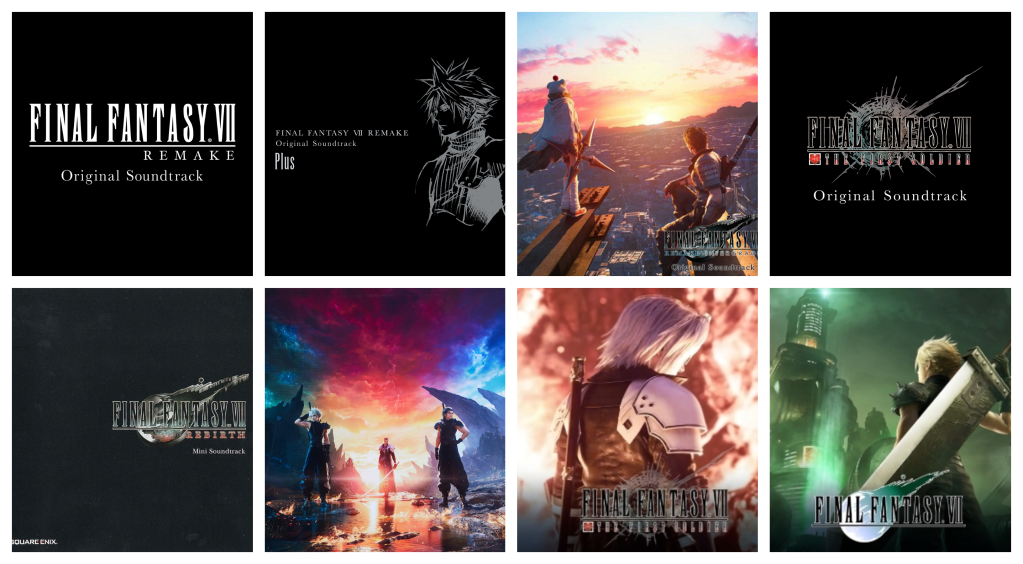
And the music! It’s gonna take so long to get the whole thing waiting for at least another soundtrack, soundtrack plus and then someone to upload all the unreleased variations which inevitably slip through the cracks, but there are so many sick tracks. It’s hard to pick a favourite. The most striking was probably one of Those Chosen By the Planet’s horror arrangements in the Nibelheim flashback. Or Gus’s Theme for how catchy it is. Big fan of the Materia Guardian battle as well. One of the sickest things about the VII:R project being so over the top is that like every boss theme becomes a 3-4 phase symphonic rampage. Phase 1 is the same Let the Battles Begin we already had in Remake, but once it begins mixing in those triumphant/heroic sections of Those Chosen By the Planet in phase 2 (1:50) it gets so awesome. Obviously we’ve had The World’s Enemy since Crisis Core and recently young Sephiroth’s theme in Ever Crisis, but still, I’ve been interested in the prospect of pre-fall Sephiroth music for so long and it didn’t disappoint. But the music decision that impressed me the most was taking the Weapon Assault theme and reconfiguring it to be a unique military march for the Junon capital. Though the choral rendition of Rufus’ Welcoming Ceremony which happens on the other side of the city was also quite legendary. The soundtrack isn’t out yet so I can’t check, but I believe I heard every region focusing on a different section of the Main Theme, which I thought was another very smart musical decision. It helps to keep things fresh in the different fields and draws attention to how the main theme’s emotional ebb-and-flow, the way it rises, falls, swells and then eases out in a mood caught between melancholy and optimism, mirrors that of FFVII’s storyline itself. I also have to gush because one of the few things I was set on really wanting to hear was a more heavenly rendition of One-Winged Angel to balance the scary version from Remake, and it did in fact appear to accompany the Bizarro Sephiroth battle. Which, by the way, I actually really like the decision to include here in part 2. This way each game can have a different form to fight. The verdict is still out on whether that makes up for no Birth of a God, but man the OST cannot release soon enough.
My call for the final rendition in part 3’s Safer Sephiroth battle: I reckon that it will be something in the area of a thirteen phase symphonic or operatic suite. Becoming the crowning jewel of FFVII Remake’s signature long, multi-phase battles. My reasoning begins from the context that One-Winged Angel is known to be directly inspired by a lot of other songs. Such as Jimi Hendrix’s Purple Haze (for extra clarity, weigh it against the Earthbound Papa’s performance of OWA) and the main string motif from Alfred Hitchcock’s Psycho, as revealed by Uematsu himself. Estuans Interius Ira Vehamenti and Veni Veni Venias are operatic movements in the Carmina Burana cantata. The main influence I want to pick out here is Stravinsky’s Rite of Spring concert. The Rite of Spring is a huge inspiration on popular composers such as John Williams’ work on Jaws and Star Wars. I remember the first time I played the Nibelheim Incident movement from the Final Symphony Concert at a squad night, my brother instantly said it sounded like Star Wars, and then as I listened through with that perspective I agreed quite heavily. Hence it’s also an integral inspiration for One-Winged Angel. Many of the sections sound reminiscent, but especially the appropriately named “Glorification of the Chosen One“, which is bang-on for Sephiroth’s opening drums. Whether coincidence or not, much of Sephiroth’s storyline even matches the titles in the Rite. “Ritual of Abduction” for when he was stolen from Lucrecia, “Mystic Circles of the Young Girls” for his desire to murder Aerith before her magic activates, “Glorification of the Chosen One” as he ascends to the divine and “Evocation of the Ancestors” as he seeks to redeem the mother he mistakenly believes to be an Ancient. So I dream that in the finale they’ll lean into it and give us the full-scale Sephiroth concert we deserve. Rebirth is pretty much there already with its 7 phase suite and total runtime of about 35 minutes based on the uploads I’m presently seeing around, so I can only see the Seraph battle going further with an increased amount of distinct phases to hit that Rite of Spring quota.
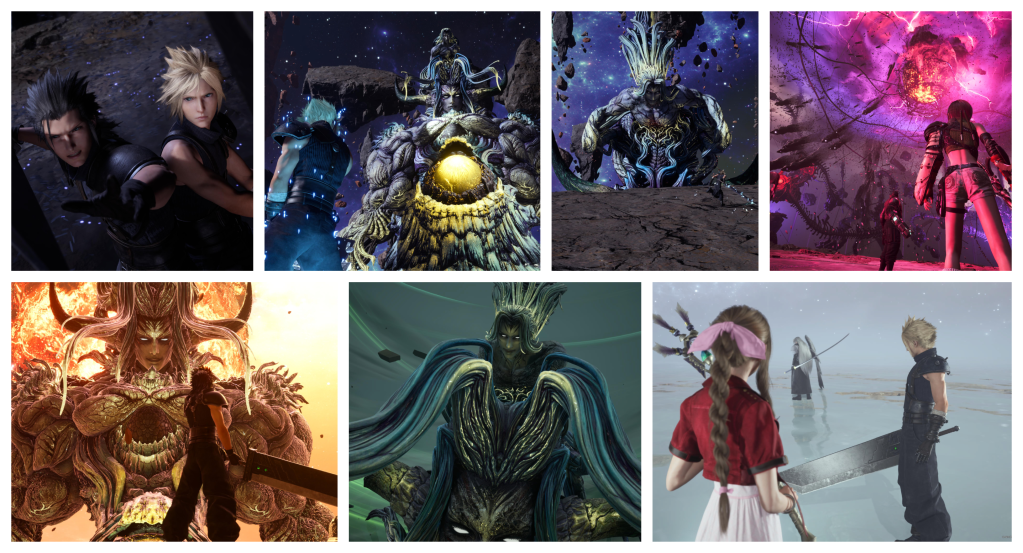
The form’s presence does ham up the City of the Ancient and I mourn that we didn’t get the opportunity to properly explore it since that was close to my number one thing I was waiting for in the remakes, but at least we got a new rendition of Listen to the Cries of the Planet and The Promised Land. The game’s ballad No Promises to Keep was a real surprise as well! Remake is already a very exaggerated saga and Aerith randomly singing on stage tests the limit of how much I can accept, but it does feel in line with Julia writing Eyes on Me in Final Fantasy VIII, or Garnet singing Memories of Life for Zidane in FFIX. In some sense, these cheesy love songs are the heart of Final Fantasy. It’s been ages since we got a love song like this from the series and, as strange as the whole situation may be, I kind of like that they committed to it. Feels like they’re respecting the place VII has in series history. Final Fantasy VII propelled Square into a new dimension of gaming back in 1997. Rebirth is meant to do something similar. Square Enix are known for their graphics and their music – so here they give their A game on both.
Uematsu’s original melodies are legendary and need no further introduction, but I also love how it takes literally one second of song to identify Hamauzu’s work in the Sephiroth battles. Final Fantasy hogs all the best composers, I swear man. Last year had all the makings of an unprecedentedly fierce contest in the OST category. Under any other circumstances I would have loved to give it to Atelier Ryza 3 because Ryza instrumentation is always super high quality. This entry has the spectacle of Atelier attempting their very own One-Winged Angel clone in The Place to Come Back to Someday and Epoche closes out as the trilogy’s snazziest final boss theme. I think about this short trumpet bit a lot. Tears of the Kingdom also makes a great case with more of BotW’s signature ambient/moody pieces and grand battle tracks, occasionally injected with interesting corruptions to reflect the story focus on rampant ancient technlogies. Xenoblade also reaches for the trophy by being similarly high quality in production, with the benefit of having more cinematic range than Atelier (or most other non-FF JRPGs really) & holy moly Joanne Hogg is back for an emotional franchise-ending song. I was shocked when the base game of Xenoblade 3 didn’t end with some reprised version of Small Two of Pieces, but it turns out I was just too quick on that call. Instantly becomes the top vocal theme in the series. I have a history with One Last You but dangit man Joanne Hogg is just too powerful. Those are just the RPG picks, not even bringing in bangers like Gravity Circuit, Ghostrunner 2 or Mario Wonder. But unfortunately for all of them and their own incredible musical triumphs, Final Fantasy XVI also released, and you just don’t win against FF in their bigger-scale symphonies. Even if Ascension were the only track in the score it likely still would have made a solid case for taking home the gold. And yet I am calling Rebirth their A game. Its upcoming soundtrack release reportedly numbers around 400 songs. Added onto the 360 or so when Remake Intergrade, Intermission and their unreleased bgm variations are collated, and we’re genuinely on course to fly past 1000 new FFVII-related tracks by the time the curtains are finally called on this project in 2028 or so. Downright ludicrous amounts of music on display here. Ten years ago the standard sat around 4-6 hours for a big budget JRPG. I used to make a consistent effort of getting into bed early for a meditative few hours sinking into the emotional journey of Fate/Extra CCC’s music as it sinks further and further into despair, for them to just barely snatch back hope at the end, or the natural beauties perfectly envisioned through Hitoshi Sakimoto’s orchestras in Final Fantasy XII. And to be fair 5ish hour soundtracks haven’t really disappeared, ie Atelier Ryza, Shin Megami Tensei V, Star Ocean 6, CrossCode, Harvestella, Blue Reflection and Second Light, etcetera. But nowadays as the production values in cinematic games just get higher and higher, the upper limit has ballooned to where it’s shockingly common to see them settling around 7-9 hours, such as Final Fantasy XV and XVI, Xenoblade 3, Sea of Stars, Octopath Traveller II, Kingdom Hearts III, Fire Emblem Three Houses, Tales of Arise and more. However showing up just about everything ever that isn’t a long-running live service game, Final Fantasy VII Remake and its expansion together, covering one third of the total project, are 17 and a half hours of music, not even including the additional 2 hours from the jukebox songs because I chucked em under a different album and rarely remember they exist. Seventeen. The 3 and a half hour Intermission soundtrack is legitimately the same length as its actual gameplay, if not just a touch longer. FFVII Remake does have something of a cheat advantage since it’s mostly just mixing and matching Uematsu’s original motifs into various emotions and instrumentations, with a comparatively minimal amount of truly new melodies, but still. 17 hours and only a third of the way there. This is not a trilogy at this point, getting through all three soundtracks will essentially just be a complete fourth game in the series itself.
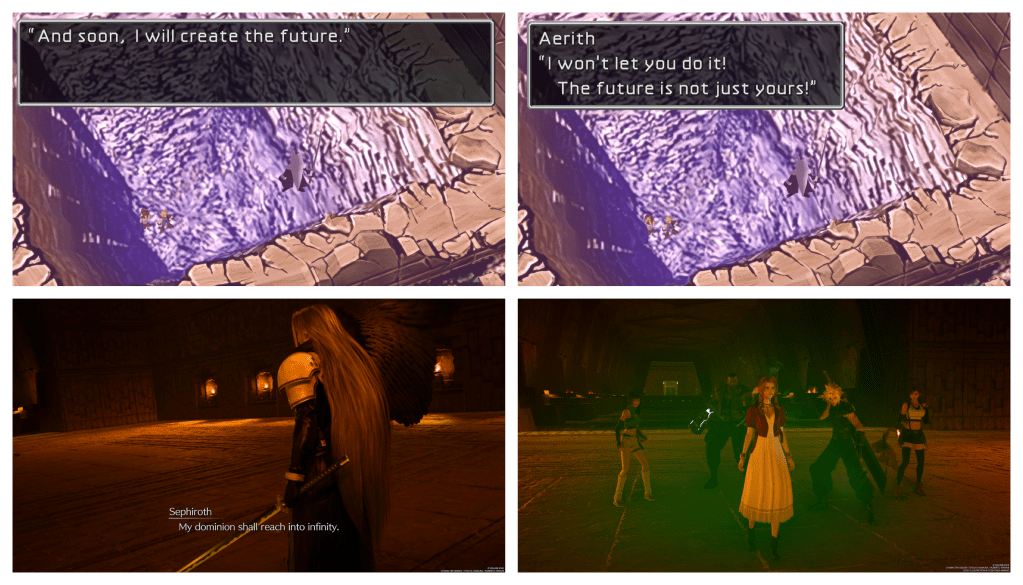
But as a reviewer, the main parts I find myself interested in talking about are those pertinent to the story and the setting. What has it done and what does it mean? On the whole, it’s just Remake’s second part, right? The same design philosophy is in effect: taking everything which comprised the original concept and maxing out the scale. Particularly focusing on narrative expansion to fill gaps in the original world and interlock events more tightly. It backs up Remake’s decision of introducing Sephiroth much earlier than he should have been by giving more persistence to him and the black-robed cultists. There is a track on the FFVII score titled Chasing the Black-Caped Man, but it isn’t until Rebirth where the visuals properly reveal us as chasing the black caped men across the continents. In the original they’re just occasionally spotted around some towns. Similarly, Sephiroth possessing Cloud during the new section in Gongaga reveals to us early that this is even capable, giving precedent for when he eventually tries to forfeit the Black Materia to the enemy. Seeing him take up the stance was jaw-dropping. This plotline eventually develops toward a sick shot of Cloud standing in flames, paralleling Sephiroth’s iconic scene during the incident. Vincent’s history as a Turk brings benefit to the story since he can use that experience to chase the Turks’ radio signals. Another big change is working Yuffie into Under Junon and how her event line unfolds from there. Crisis Core and Remake have made the Wutai War into a much bigger point of context for the setting, so Yuffie’s motivations are provided proper definition. It’s not just any materia she’s after, but specifically the Magnus Materia which Shinra are attempting to synthesize. The cores in a Weapon which were originally just references to Evangelion are turned into Magnus Materia as well, and the race to be the first to claim these materia establishes urgency and political enmity between Yuffie and Rufus. A strong link is made between all these events. Introducing Cid early was another pleasant surprise. Not huge on his redesign though. Cid is the only member in the cast who doesn’t really align to his previous designs. Why is he handsome? I get what they’re doing making him an ‘all-american astronaut hero’ type, and it likely will further the impact of his abuse on Shera by first making him seem like a standup guy, but it’s so weird not seeing him as an alcoholic greasemonkey goblin man. Recognizing the daughter of Ifalna is a bit unnecessary too, not everything has to be that connected. Next, having Tifa fall into the Lifestream and witness all that metaphysical memory phenomena will ease us into accepting that such a thing can happen when we get to Mideel in the next game. And even the Whispers, despite ruining the shot composition and thematic integrity of any scene they touch (like, they’re just always there annoyingly in the background; any time there is an important moment or cool-looking scene it comes with the caveat that you just have to try and zone out the Whispers), are utilized to make Sephiroth’s turn to the divine not feel so out of left field. It’s by taking the reins of fate and peering into multiple realities that he seeks to claim a higher, perfected existence. The alternate dimension is merely a larger version of the conceptual space Aerith speaks to Cloud from before leaving the party, which is where I figured it would slot in. This and the higher dimension are likely how they will make sense of Seraph Sephiroth’s heavenly arena in the finale as well. Everything this does is in expansion of Final Fantasy VII’s original storyline.
Since release I have dug my heels in and said that all Remake has done is draw itself out into some big, long, messy arc which will ultimately hit all the same points and terminate in the same place. The story all actually went just about how I expected it to. Figured it would start with Zack gameplay. It did. I always enjoy seeing the juxtaposition between Cloud and Zack, since the latter has real First Class strength. Mans just straight up throws a street lamp at a helicopter. Love it. Figured the Unknown Journey was purely a marketing vehicle to give Zack more spotlight since, like Sephiroth, he’s too popular to be kept as secretive as he used to be. It was. Bonus points because I anticipated it more or less following the framework from Maiden Who Travels the Planet where he and Aerith help fight Sephiroth from the other side of the Lifestream, and that’s more or less how it unfolded once adjusted for Rebirth’s reality mechanics. Somewhere in there was a proper recreation of Advent Children’s shot of Meteor, furthering my claim that Remake’s Whisper battle only pulled those shots straight out the film as a reference and cost-saving measure. One or two decisions I didn’t jive with because they invalidate some niche interactions from the side story books – particularly the Turks escorting Tseng out of the temple, which ruins a sweet emotional moment from The Kids Are Alright where Elena runs up to hug him and then sasses Reno and Rude for being too embarrassed to do the same. Copping out on Dyne’s suicide was weak since that’s one of the hardest-hitting moments in FFVII, and having the Whispers pull up the Buster Sword during Aerith’s prayer instead of a deluded Cloud attempting to slash her himself is also a cowardly change. It’s hauntingly beautiful in the original how Aerith’s theme plays uninterrupted throughout the boss fight, so the decision to only keep that in the first phase of the Jenova Lifeclinger battle, as much as I do love FFVII Remake’s multi-phase boss battles and music, ruins the emotional hit. At the same time though, it is palpable how full of anger and sorrow each member of the party is as they tear into Jenova, and that hits very hard in a different sort of way.
In general Aerith’s death was pretty mishandled. If you were to somehow play the original without being spoiled on its plot twists, Sephiroth taking her life is a shocking moment that hurts because of how swift it is. One moment Aerith is with us ready to use her ultimate materia, the next her body hits the floor. In the remakes however they foreshadow it in a very non-subtle manner during the first game, have Marlene directly mention that Sephiroth is after her life, establish that this is a branching point for realities where Aerith likely survived in another timeline to ease the pain, have her stick around as an apparition for the lengthy final boss rush and then give her ghost an emotional parting in the epilogue, all done before finally instructing the player to process her departure. The big thing Sephiroth said was “seven seconds til the end”, because it takes about seven seconds for him to fall down and impale Aerith. But in Remake that whole sequence from approaching the altar through to the closing cutscene took me about three hours because *clears throat* Octaslash Prime. So, y’know, instead of seven seconds and it’s too late, it was more like 11,000 seconds before we’re even directed to grieve. But we’ve already seen Remake falter in this regard with just about everyone in Sector 7 seemingly escaping the plate drop. I suppose that’s fair enough since it’s not like Aerith would have left all those people to die when she runs off to grab Marlene in the original, and it has been illustrated multiple times that Cloud sometimes spots her ghost. But spotlighting those things this much dulls the edge on the moments which are meant to cut. Final Fantasy VII is a devastating game and the remakes fumble during many of the defining turns.
But I get it. They have to go above and beyond with every little thing. I recognise and respect that as a deliberate stylistic decision. Remake has been nothing if not extravagant. Look at the Don Corneo rap battle which not only comes out of nowhere but is annoyingly good, or Love Live Gold Saucer Project for crying out loud. For good and bad, Remake goes the distance.

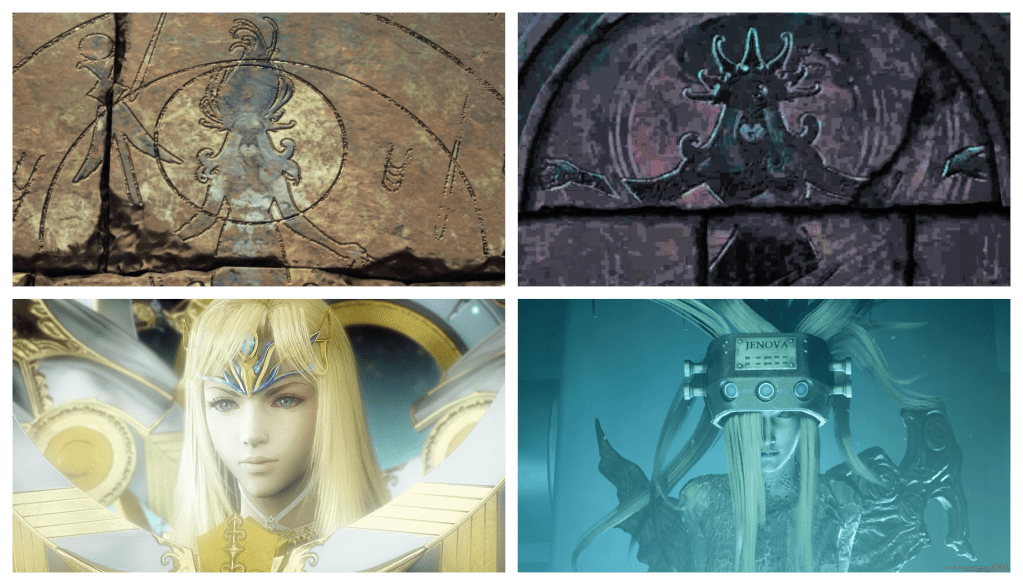
On the whole most of the alterations were positive, and they really throw in some bones for the deep lore fans (me). That is to say, if you don’t know Before Crisis, haven’t read Maiden Who Travels the Planet and Traces of Two Pasts, played Final Fantasy X and Xenogears or watched John Carpenter’s The Thing, then Rebirth is laughing at you in the details. Yes FFVII Rebirth, I am the one person who recognises Deneh in that background painting, I remember the attack on Kalm that Broden alludes to and understand that Barret claiming Shinra crafted a cover story when the Corel reactor exploded is actually a complex situation to unravel. That’s the kind of energy which is found everywhere you look. This is made by people who adore Final Fantasy VII and, like I originally suggested years back, establishes that the Remake saga exists to unify the extended lore into a version of the Jenova War that can stylistically coexist with the Compilation. There’s a constant stream of references to the expanded universe. Whether cheeky nods like Cait Sith’s fortune imploring Cloud to protect what he ‘cherishes most’, Sephiroth mimicking a pose from Advent Children’s promotional imagery when casting the Whisper Whirlwind attack, or more substantial additions like stumbling upon Cissnei in Gongaga. Zack’s parents told her to move in, nice to see she actually did manage to get away from the Turks. Ticking off one out of the four or so characters who I have been wanting incorporated. Elfe was mentioned during Tifa’s section in Traces of Two Pasts, so being lenient I’ll mark her as spoken for as well. Though this may make me enemies, that now leaves Genesis and Shelke as the two I really want to encounter in some capacity during the time the remakes have left. All the way through Rebirth I was keeping an ear out for anything at all in LOVELESS or the Cetra religion pointing to the existence of Minerva as well. The first vague nod was Aerith being surprised to learn that her people did not historically worship a deity. Other than that, it was only one mural of a golden warrior goddess in the Ancient Temple which seemed to be representing her. Interestingly, the opposite wall features a near-identical silhouette drawn above Jenova’s monstrous form, perhaps offering us the fascinating nugget of information that Jenova’s female form was specifically stolen from Minerva herself. The Hall of Effigies too features something in this vein, since the skeletal statues resemble Jenova and so it may be that there was something like that in Cetra society or religion that she assimilated her current monstrous appearance from. That she reverts to a blue-skinned, pink-eyed form in the stasis chamber may indicate her prior conquest occured on Gi. Or otherwise, another possibility is that the appearance may be imitating Lucrecia. When first discovered in the 2000 year old strata of earth, Jenova is shown to be in a state somewhere between monster and man, vastly different to how we encounter her at Nibelheim. Since she’s awake to psychically unseal the reactor door, perhaps she sensed Sephiroth’s arrival and peered inside his memories to take the form which would most effectively lure him to her side.
Having an excuse to head into the Corel mines obviously only happened because Before Crisis made them a location worth revisiting. Nanaki’s trial at the Ancient Temple also begins with his capture as seen in Before Crisis. Tifa’s cat is heard from. This is good. They keep Traces of Two Pasts relevant for all of Tifa’s memories of Nibelheim, and we catch the end of Aerith’s tale on the ferry as well when she mentions Faz. Her flashback on the train with Ifalna is lifted straight from the book as well. Perhaps most controversially, Chadley’s position as a cyborg (which is news to me by the way, I never got that info in Remake) is a long lead-in for Hojo eventually moving becoming a digital lifeform to hijack the body of Weiss.
Pretty much everything gets streamlined into the next event, whereas blank spots in the 1997 world such as Gongaga have been expanded into key locations. In the original there’s an inn you can buy in Costa Del Sol. It doesn’t really do anything, but you can. In Rebirth, Johnny buys it instead and that becomes the plot of what was originally just a location to pass through. Searching for a working Shinra terminal provides legitimate justification to revisit the Mt Nibel Reactor and Shinra manor as well, where in the original both were left majority optional. Most significantly though, are the revelations surrounding the mysterious Gi Tribe. Very much appreciated that greater insight into them. I wouldn’t say it was on my bingo card heading into Rebirth, but on replays past I have actually thought before that I wanted to know more of this intelligent, non-human race sealed deep beneath Cosmo Canyon. Them being aliens wasn’t something I would have predicted, but I like that storyline a lot. As we descend into the Cave of the Gi, I was drawn to the cliffsides and kept thinking “That’s the Lifestream, right? Why is it red? Surely that’s important somehow.” And it turns out that yeah, when you use Assess on the Gi spectres, their bio draws specific attention to the ‘red miasma’. The way it reads to me then is that this red Lifestream is the spirit energy from their homeworld, as opposed to the green energy from Gaia’s lifeforms. Gi Nattak’s red miasma and Sephiroth’s purple are focused on upon in the same scene, so I would interpret that to mean the spiritual energy in Jenova’s original homeworld was that colour. So now we have Gaia (green), Gi (red) and Jenova’s world (purple) in the galaxy.
But the entire point of them setting up this tidbit about Lifestream colour differing between planets is a means for them to subtly reconfirm Final Fantasy X’s canonicity within the backdrop of the setting. This suggestion originates from fan theories regarding a character in Final Fantasy X-2 named “Shinra”, who muses about potentially extracting energy from their planet’s spirit realm and travelling to other worlds. The Final Fantasy X Scenario Works, Final Fantasy X and X-2 Ultimania, FInal Fantasy VII Ultimania Omega and Final Fantasy VII Remake Ultimania would all introduce it as a potentially official connection, and the topic is the subject of a number of interviews. This isn’t merely a case of the creators speaking nonsense to fill the air in an interview environment, but a consistent thread of discussion over the years. The most recent of which being from a video interview conducted to reflect upon the production of the FFX & X-2 HD Remaster, which coincidentally went up not long before the release of FFVII Remake. The Memorial Hall has a photo featuring what appears to be the descendant of Shinra from FFX-2, and the greater galactic focus that the Gi bring suggests this was not an empty reference. Before vanishing, Gi Nattak solidifies this notion by begging to be let go from “this endless dream”, which is an obvious reference to the plot of FFX. This all gets confirmed as an intentional link in the Temple of the Ancients where Aerith attempts to quell the Lifestream’s rage by doing a dance which mimics the Sending. It’s possible that Jesse, Bigs and Wedge appearing in Aerith’s concert may have been her Sending them as well. Little orbs of light come to her like pyreflies. But when Cloud defeats troopers while separated from her, their despair ends up transforming them into monsters. Imagery evocative of Spira. All things considered, maybe the odd dimension where the temple resides is something akin to Gaia’s version of the Farplane.
So there is this young boy called Shinra who appears in Final Fantasy X-2 and as you would expect from that name, there are fan theories that he might be connected to the Shinra Company from Final Fantasy VII. The scenario writer Mr. Nojima has not made any official pronouncements about it. But as a kind of “secret history”, he thought that Shinra from X-2 might grow up and his descendants several generations later possibly go on to found the Shinra company.
Yoshinori Kitase, Inside FINAL FANTASY X|X-2 HD Remaster (Closed Captions) (2019)
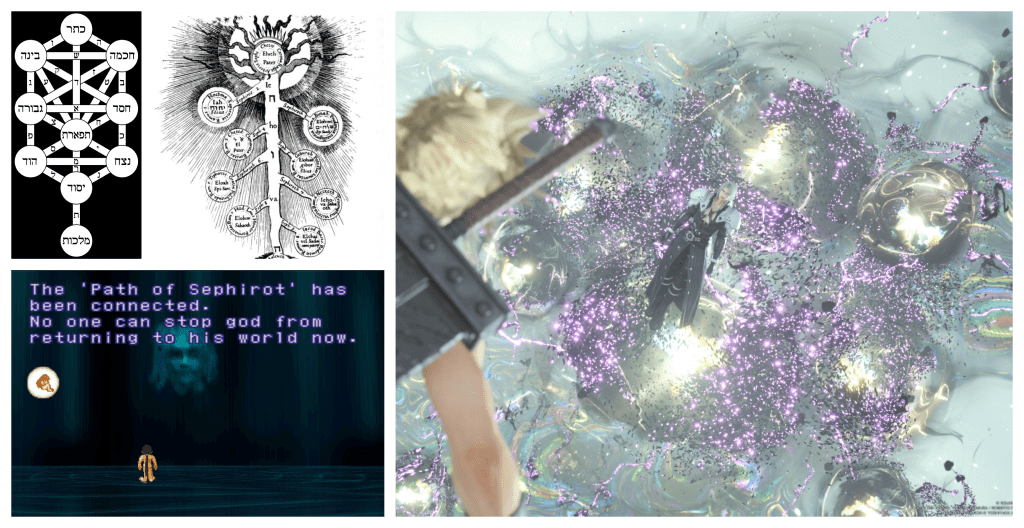
So within the franchise, it’s really widening the world. If we look beyond then it still remains true that Rebirth amplifies pretty much every one of Final Fantasy VII’s key intertextual inspirations in the way you would want it to. First order of business obviously being, as with most things in life, Xenogears. Something I’ve predicted within Remake was that introducing ‘fate’ into the mix would inevitably culminate in Final Fantasy VII reclaiming some of the more mystical elements which were lost when Takahashi’s concept draft was shelved and split off to become Xenogears instead. Here we see this. Sephiroth reveals to Cloud the way in which he traverses higher dimensions through a number of circular gates which resemble the Path of Sephirot, and burns potential timelines as a source of energy a la the Zohar’s simulation of event pathways. Sephiroth Reborn’s head is fought by itself at one point which resembles Krelian and Z, and with respects to Xenogears’ overall aesthetic Sephiroth’s divinity feels properly religious this time. The tree of life can be briefly spotted within Sephiroth Reborn’s materia core. These next two aren’t new, but I don’t think I’ve ever paid proper attention to the Jenova Doll and Deus having the same face before, or the small section of the party stuck on the Tiny Bronco at sea potentially being analogous to Fei and Elly’s time stranded.
The more interesting order of business, however, is that which pertains to FFVII’s filmic horror inspirations, and how Rebirth incorporates them better than ever. Using horror homage as the justification for committing to keeping Sephiroth ever present. I do get the initial aversion to Sephiroth being so abundant in the narrative. It’s brought up often how in the original his implementation was mentioned to have taken note from Jaws.
Firstly, the way we handled Sephiroth in the original FINAL FANTASY VII was to hide him – hold him back. You may not know this, but I was inspired by the movie Jaws which took a similar approach of teasing this powerful presence, but never fully showing you the shark until later in the story. We wanted to build him up as this really big, powerful character in people’s minds. By only referring to him indirectly, it created this feeling of fear and oppression – so when he makes his first appearance, it’s a big deal.
Yoshinori Kitase, The FINAL FANTASY VII REMAKE team discuss story, Sephiroth and more (2020)
He’s kept hidden away, only surfacing in those dangerous moments where he’s on the hunt and intending to kill. It’s a stark departure from the franchise’s prior villains. In the first Final Fantasy you’re set upon Garland almost immediately, Final Fantasy II begins with the Emperor waging a bloody global war, and Kefka has been met by the end of the opening sequence in Final Fantasy VI. Sephiroth’s presence is totally different, carrying an air of suspense and so turning the game into more of a thriller.
Sephiroth is depicted as weightless despite being a 7 foot tall, well-built man adorned in armour and a massive sword. Yet he can also send someone flying across an entire hallway with one flick of the wrist. His features don’t conventionally make sense. Occupying the abject, the uncanny valley, betraying the expected functioning of biology and physics to create the fear that this is something else in the shape of a human. Sephiroth is a creature of horror, yes, and if I have to point out only one thing that I really, really like in Remake and Rebirth, perhaps my favourite part of the whole production is that they make Sephiroth scary again. As a fan of the original, you obviously aren’t expecting to see Sephiroth in Midgar at all. Those first encounters come as a shock. In Cloud’s first flashback about the demon, the strings feel like spiders crawling over you or a chill running down your back. Then he relaxes, turns to leave and bam. A horror sting. You’ve just walked right into Sephiroth. Why is he here? How is he here? I don’t know, but now I’m caught off-guard. After Cloud chases him away, you turn the corner and finally see Aerith. It’s supposed to feel like a respite after that sudden jumpscare. You walk up to be comforted by the cute pink flower girl…and then Sephiroth suddenly looms over her from out of frame. These moments persist throughout. Remake’s dedication to restoring, or even amplifying, Sephiroth’s original intimidation is incredible. Listen to the xylophone in Mako Poisoning which makes it sound like traditional horror film soundtrack, or the drawn out march in Strength Through Suffering which exemplifies Cloud’s panic at the hallucination. All three renditions of Those Chosen By the Planet in the Nibelheim flashback are terrifying. That’s the core part of his presentation from the original which nearly all the extended content misses the point of. Sephiroth isn’t framed as just some edgy anime swordsman, he’s a monster. An abomination who crawled out of a scary movie. It’s totally okay to wish he was less prevalent for personal preference or to preserve his original narrative dignity. Finding the Midgar Zolom impaled as a mere indicator of his carnage is for sure much more awe-inspiring than being there during the exact moment in Rebirth. But here’s where I think focusing on that interview about Jaws and Final Fantasy VII as a means to discredit the new handling of its villain begins to fall apart. Yes it’s an influence for his direction in the original game, but the shark obviously doesn’t have any actual effect on the world or plot. Stumbling upon the trail of blood mirrors the foreboding mystery when the first body washes up or the violent red patches left in the sea, then masamune impaled into the back of President Shinra is somewhat analogous to witnessing the shark’s gigantic fin breaching the water’s surface, and the strings in Those Chosen By the Planet are channelling the stressful energy of Jaws’ Main Title. Beyond that however Sephiroth has nothing in common with a giant shark. And that’s where I consider the common statement that Remake’s Sephiroth misses the original point by not remaining hidden to be incomplete. What sets Sephiroth apart from Final Fantasy’s aforementioned usual suspects is that he isn’t a beastly monster, a powerlusted despot, ancient evil or literal underworld manifestation. He’s a good man. Sephiroth uses his power to protect those who struggle against violence from terrorists and fiends. He uses his position to show kindness to his subordinates, and he uses his fame to inspire those young men desperately needing a role model in the chaotic world of FFVII. Unlike Chaos, the Emperor, the Cloud of Darkness, Kefka and the like, Sephiroth was not intrinically aiming for something higher. He is not automatically a sinister man, hiding ambition to selfishly elevate himself about everyone else. It’s just this one unfortunate moment of reading difficult language while in an overtired state that pushes him into delirium, and he commits atrocities which cannot be undone. Sephiroth is a good man gone insane after contact with a malignant, shapeshifting extraterrestrial god. A cosmic horror, Final Fantasy VII is a cosmic horror story. Even in the original, and especially amplified in Remake.
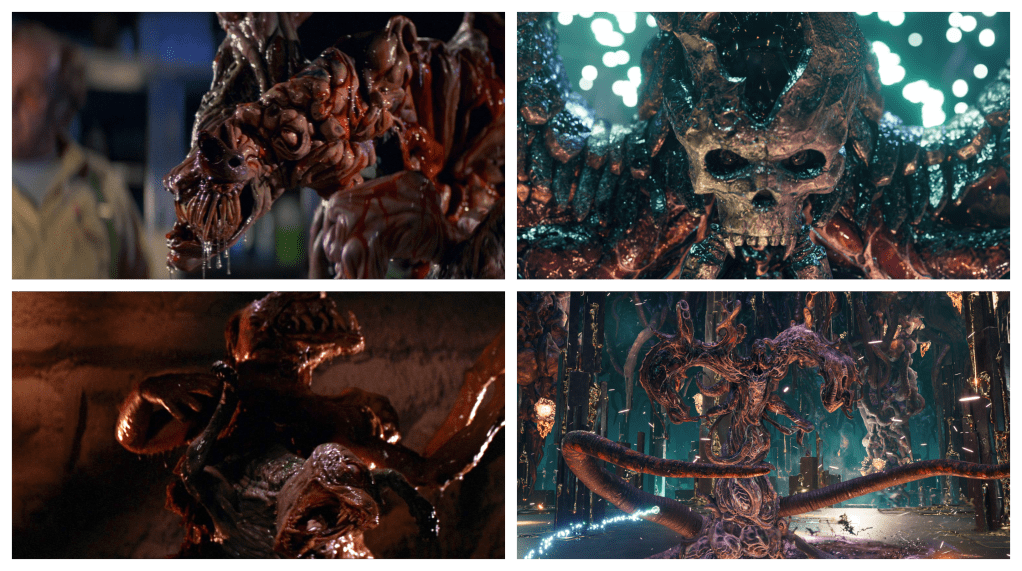
Specifically, the biggest filmic influence on Final Fantasy VII, the biggest horror influence on Final Fantasy VII, is not Jaws, it’s The Thing. From John Carpenter’s film in particular, as that matches Jenova’s grotesque, fleshy design most strongly. In the distant antarctic lands a group of scientists discover a crashed alien ship, which portends calamity as the shapeshifting invader makes its way to their base and begins crafting discord until the group collapses from within. At this point I’d almost consider it required watching to properly appreciate Final Fantasy VII.
You see, what we’re talkin’ about here is an organism that imitates other life-forms, and it imitates ’em perfectly. When this thing attacked our dogs it tried to digest them… absorb them, and in the process shape its own cells to imitate them. That thing wanted to be us! If a cell gets out, it could imitate everything on the face of the earth! And nothing could stop it!
Dr Blair, The Thing (1982)
This is what makes Sephiroth so amazing to me in the direction Remake has taken him. It’s not about the beast lurking in the darkness, it’s about the demon hiding in plain sight and breathing down your neck. In fact the Trail of Blood is still a good point to look at in order to understand how the horror representation has been reworked. The blood trail is now left glowing purple like a sci-fi film, and President Shinra is literally backstabbed by one of Jenova’s impostors. Yes I said impostor, because Chrono Trigger, Final Fantasy VII, Xenogears and Among Us are all inspired by one primary source. The Thing From Outer Space and its shape-shifting, cell-harvesting alien. Sephiroth may be faintly paying homage to Jaws. But Jenova, for all intents and purposes, is The Thing dropped straight onto Gaia, to where watching the film will actually give you a more meaningful way of contextualising the events in Final Fantasy VII and enhance your appreciation of its place in the media sphere. I’ve said it before and I’ll say it again: there is no time loop, reset or rebuild in Final Fantasy VII Remake. The surface narrative of changing fate and the somewhat awkward translation might mislead a player into thinking so, but look closer and you realise that no event or characterisation actually supports the claim. Nothing in the setting has ever displayed even remotely that much power, and nothing in the plotline demands such a thing. Aerith and Sephiroth had future knowledge, that much seems undeniable, but to try and move that into Remake being Advent Children’s sequel through timey-wimey stuff is a convoluted claim that I just still don’t think holds up even after three or four replays. This Sephiroth is nothing like the person he is in Advent Children. Here you still get some hints of his emotional response to being exiled from humanity and his desire to still find some pathway through which he can validate his existence. Whereas in Advent Children, he has absolutely zero humanity left. Case of Lifestream Black details how the Lifestream had stolen most of his memories and ego, so the only way he maintains existence is by parasitically attaching himself to Cloud’s strong feelings of hatred. This reflects in his performance, where he at that point only exists to hate and be hated by Cloud, whereas at the earlier time of FFVII and Remake you can read into his twisted expressions of love to the world and its people. That’s misdirection, deliberate or otherwise, and the Unknown Journey is largely just a marketing vehicle so that the immensely popular Zack Fair can have a way of claiming a spotlight in the saga. No time loop, rather these are just the modern definitions of each character. Not as any kind of supernatural continued existence, but simply that Final Fantasy VII is now being rewritten to accommodate the character depictions from the Compilation. All this to say, Jenova’s most recent starring role was in Turks Side Story: The Kids Are Alright, where they had finally given full accolades to The Thing. In that book Kadaj uses his shapeshifting to sow discord between Kyrie and the Turks, eventually setting the Icicle Inn ablaze as direct reference to the ending of The Thing.
She deceived people by approaching in the form of someone dear to them. Parents, siblings, friends and neighbours, the gamut. Sometimes people who had died. This was the nature of her powers. And then, once she’d gained her targets’ favour, she would manipulate them. ‘He hates you. She wants to kill you.’ She filled their heads with terror and paranoia until sooner or later fights would break out…and they engineered their own ruin.
Final Fantasy VII The Kids Are Alright: A Turks Side Story (2011)
Remake and Rebirth continue in trend, really throwing the character politics into disarray through the shapeshifters systemically attacking the trust between the party. Sephiroth whispers to Cloud of Tifa’s supposed death in the Nibel Reactor, brainwashing him to believe that the one here must therefore be Jenova impersonating his childhood friend. Whereas Tifa and Aerith are locked onto Cloud as they seek to uncover whether he’s really the man he claims to be or not. First Soldier’s Glenn Lodbrook suddenly manifesting to goad Rufus into declaring war on Wutai was an impostor chasing global destabilization too. Visually it was obvious that Glenn was an arm of Jenova since he had the miasma at his feet and the J-E-N-O-V-A synths were just barely audible at the very back of the soundtrack mix. This further leaves me wondering about whether Lucia and Matt, who were mentioned to be moving with Avalanche, have been compromised as well.
They say she’s a monster. That she can peer inside you, into the very depths of your soul. That she can become those you hate. Those you fear. Those you love. And they call her Jenova.
Sephiroth, Final Fantasy VII Rebirth (2024)
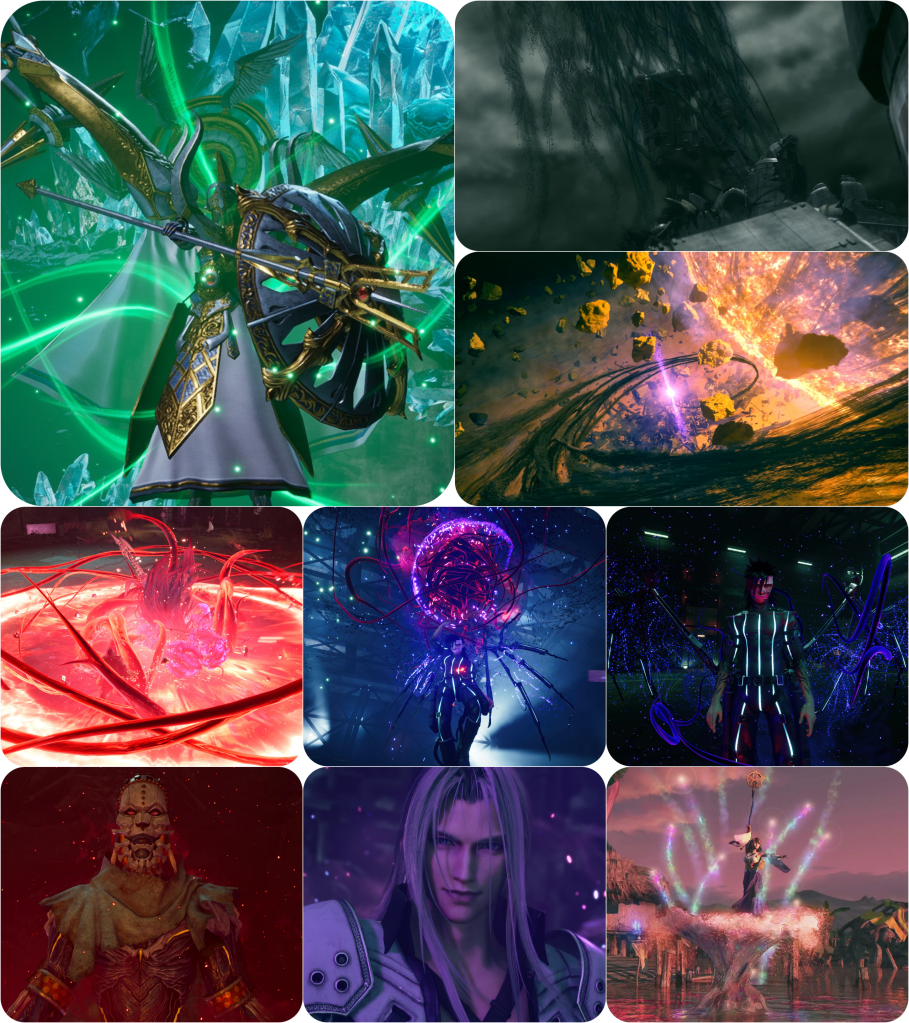
Sephiroth’s shapeshifting is more insidious than ever. To accompany it, Jenova is just as horrific. “The specimen, found in strata dating back two thousand years, smiled with what could only be desribed as ethereal grace”, the report reads. A chilling record to better highlight the eldritch call she imbues into Sephiroth and all those in the reunion. In this representation of events Jenova unlocks the reactor gate on her own to welcome her son in, displaying some psychic understanding of advanced technologies which elevates her extraterrestrial mystique, and therein explains how she was able to hijack Shinra’s VR experience in the Great Destroyer cutscene. Additionally, the spiky mountains a sreeen as a geographical feature not only in the Nibel region but also in the Land of the Gi, which might be a means of hinting that this is actually a relic of Jenova beginning to terraform the planet in the distant past. I’d have to say what they did with Jenova Lifeclinger is my favourite thing they’ve done with her though. A giant, disgusting creature sprouts glowing wings and then soars around shooting laser cannons, making the sense that she is an eldritch alien god more potent than ever.

I guess if I have one main complaint it’s that the world design feels very inorganic with random poles and boardwalks that make no sense for the actual town and are clearly only there for the video game. Or all of the seated Queen’s Blood desks hilariously coming equipped with a Buster Sword holder. Honestly speaking, fewer things annoy me in a game world more than cleanly-marked climbing ledges where they have no business being. Rebirth was pretty bad for that. Cloning chocobo rest stops around the map is a little clunky to justify as well, in my opinion the camps from Xenoblade 2 Torna and Xenoblade 3 are the JRPG gold standard for that mechanic. But that’s a very minor nitpick in the grand scheme of things. I probably would have appreciated some kind of a break point in the final two chapters as well, the way the story is paced after the point of no return it feels like it is indeed asking you to commit to the 9 hour grind. But even then, that can be a positive too. I love how large and drawn out the story’s scale is. It was even a bit funny since the last game I played was Tekken 8, and the final bosses in these two are both like 10 phases longer than you’d expect them to be. Anyway, that’s what I have to say about the game for now. Slap that 10/10 right on it. Final Fantasy VII Rebirth is incredible. Remake took them five years to make, yet this mammoth of a game only four? How does that math check out at all. In summation, this is a love letter to fans of Final Fantasy VII. Assuaging any lingering concerns I harboured regarding Remake’s unclear direction, while emphasizing that it does still understand the original plotline and its inspirations. I know that many will surely dispute this claim, say that it’s still a sequel, say that it’s still a time loop that invalidates the Compilation etcetera, but as a bigger fan of FFVII than they I simply refute them. Despite what the ending of Remake seems to have convinced everyone of, Rebirth is made with an adoration and respect for the content, storytelling and general achievements of the Compilation. As I said before, I will now say again. Because there’s just no better way to describe this. It’s a unified Final Fantasy VII.
 skapbadoa