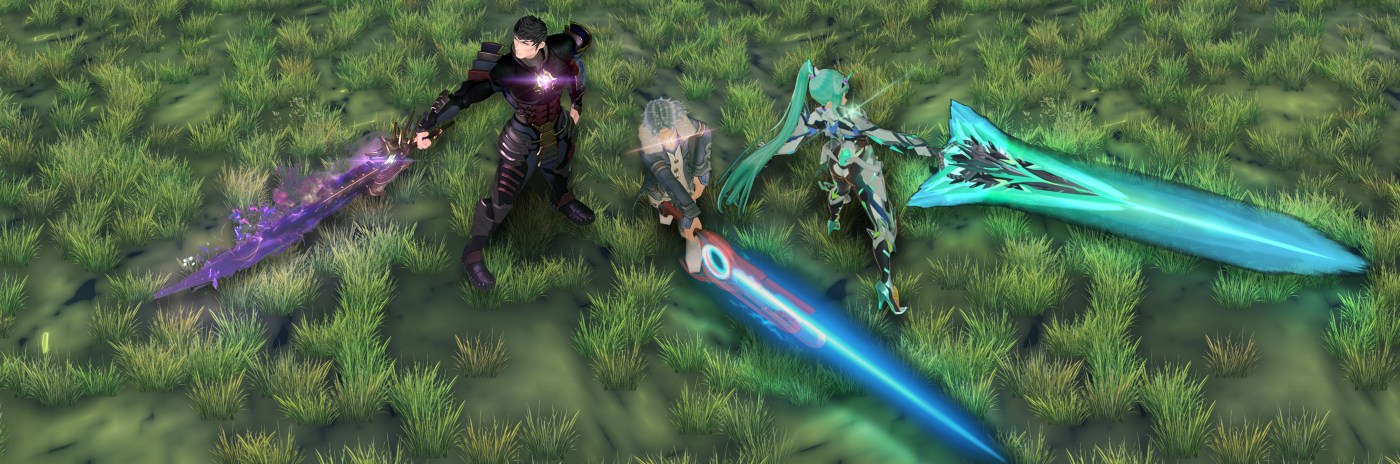
Hi there. This topic happens to be one where I feel its most suitable structure is to begin from the conclusion and work backward through my explanation. The core question I’ll be looking at is whether the Tertiary Sword in Xenoblade Chronicles 2 should be considered a Monado or not, and the answer I ultimately put forward is yeah, definitely. The iconography of it being a laser blade belonging to the Trinity Processor that has a clamshell design and ring in the middle is too iconic to the franchise to be anything else and there are so many interweaving lore elements that strictly depend on it being so.

Now then. In today’s episode of I took too many screenshots and have to use them somewhere, I figured I’d arrive about five years late to discuss the matter of Monado as present in Xenoblade 2. This is something that’s just been on my mind a lot lately thanks to a combination of Alvis reviving the divine sword during the XC3 Wave 4 teaser, and discovering a free camera mod for Xenoblade 1 & 2 which would let me get a proper, unrestricted look at Malos and Pneuma’s blades. Which is hilariously necessary, considering the Tertiary Sword is so comically massive it’s permanently cutting out of frame or clipping into the floor, and even when it does fit within the screen boundaries there’s so much bloom slapped onto it you can barely make out the details of the blade. Photo mode is something I really awakened to the potential of thanks to Blue Reflection Second Light. But the freecam mod only works with version 2.0 and under, which I didn’t have. Meaning I didn’t have the Event Theatre to easily rewatch cutscenes. Yet the prospect of getting to trawl through a Xenoblade world like that, well, let’s just say that unfortunately for me, I am exactly the person who would replay XC2’s entire main campaign solely to take a slightly zoomed out screenshot of Rex holding the inactive Monado up to Jin. As luck goes, it was only after I’d gone through this whole ordeal that I finally managed to stumble upon the correct update files to support freecam and the Event Theatre together. I don’t even want to think about how much time I’ve spent taking these screenshots over the past two months. After noticing how many pre-written comments and collages I’ve already lined up in the slim chance they were to ever become relevant in specific niches of analysis, that’s probably as good an indication as any that this topic might qualify for a more proper presentation. I suppose “brainrot” is the current fad term? Can’t stop thinking about the Xeno. In terms of my top JRPG franchises I do generally place Atelier above it as I find I enjoy each individual game more there, but once you start thinking about all the interlinking mechanics of the Xeno series it’s such a unique experience. Xenoblade 2 is my favourite of them. It’s a game that catches a lot of flak for its oversexualised female designs, which is something I do have my own particular thoughts on from the angle of genre convention and internal meta-series mechanics. But that’s not what I’m here to look at, as there is a specific point in the storyline where most everyone can agree the game gets good. Chapter 7 and all the madness that follows in its wake. Although you had been closely searching for links to the original game at the start, by this point you’ve well and truly come to accept that any similarities are only because of the Xenoblade brand and it’s otherwise unrelated to Shulk’s storyline. This is intentional, because the game is ever cognizant of its own design structure. To the point that, in some real sense, the potential 50+ hours of gameplay up to this point are all entirely serving to lull you into a false sense of security. XC2 is a JRPG that’ll run you at least 80 hours on a first playthrough, yet I daresay that its entire narrative is written for the sake of one single plot twist. You start chapter 7 thinking it’ll just be more of the same. But then the party enter a dungeon under a gravestone that kind of looks like the Zohar, and upon retrieving the Tertiary Sword you’re made to think “Hey, that ring on the sword sure does look familiar- wait…wasn’t that shot of Earth from the Klaus flashback? And hey, Malos, what’s that you’ve got right there in your hands?” Everything that the game was builds up to and gloriously explodes upon reaching the Cliffs of Morytha. With zero explanation Malos has a Monado, Pyra turned into KOS-MOS with Xenogears wings or somethin’, everything is an Omnigear now and the party are tossed into a functional equivalent of the Zeboim ruins. The fantasy layer begins peeling away to hint at the conspiratorial sci-fi constructs on which the setting is built. Welcome to Xenoblade 2. That slow-burn exploration of Alrest’s societies and history taking a sudden (and literal) dive off a cliff to drop you into all this apocalyptic modern imagery that wholly recontextualises the above world is what it’s all about. The game’s very deliberate about presenting itself as a more happy-go-lucky counterpart to XC1 as it works its way to this point, then mercilessly whacking you over the head with an abrupt Monado reveal.
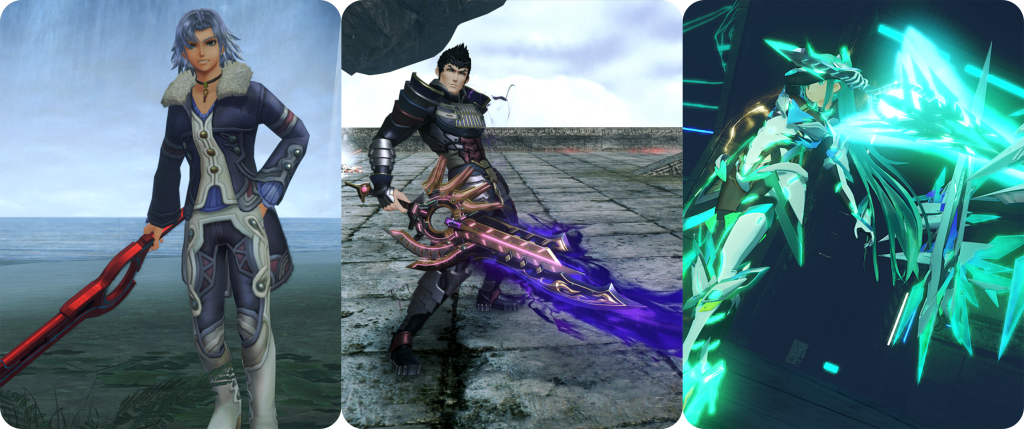
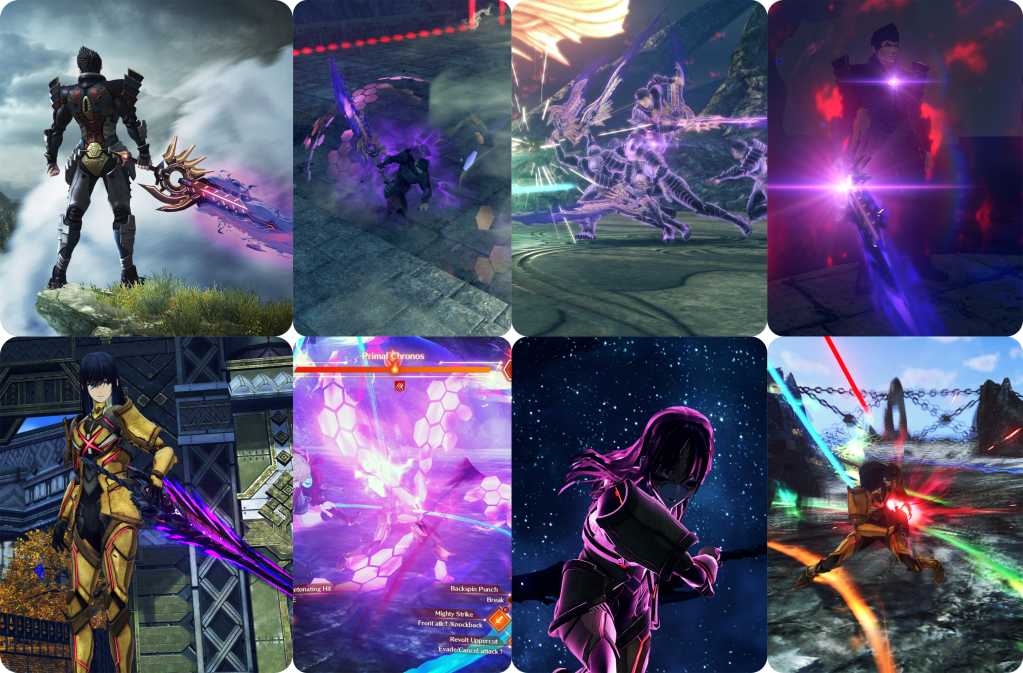
Malos’ black sword is well fascinating to think upon. The Monado finally appears in this game and it’s in the hands of its biggest anarchist. Such a bold move, predicated on an expectation that you will be recognising it and freaking out at every revelation from that point onward. With this one, there’s no room for confusion. Malos uses a bunch of Monado Arts, and the Alrest Record plainly states it to be so. Its counterpart in this chapter though is something which has been a constant source of discourse, whether the Tertiary Sword is to be considered a Monado or not. In my excessive amount of replays for these two games, and my understanding of the setting based on the outer context of Xenogears and Xenosaga which I looked through in a blog post, I would enter myself into this arena to say that it has to be. Were it not so then I’m not sure I actually understand how Xenoblade works. Originally I was of the stance that Malos received a Monado and Pneuma is granted Vision, with each core presumed subservient to Ontos in the original Trinity Processor scheme and therefore only having half the capacity of Alvis. And I do agree that is still the safe explanation, because it’s the one where you don’t have to spend half an hour justifying it by breaking the camera and pulling story examples from all corners of the franchise. That not one piece of documentation available calls the third sword a Monado is a hard wall to steer away from. But I also – personally – myself – think that is just a boring interpretation. Because what is Xeno if not a franchise built specifically for cross-referencing and aligning niche lore elements to reveal a hidden pathway within the setting. The storyline will offer you majority of the necessary information, but then it wants you to take responsibility for solving how these pieces slot together. And I want it to be a Monado. Xenoblade’s storytelling is simply a lot cooler to me that way.
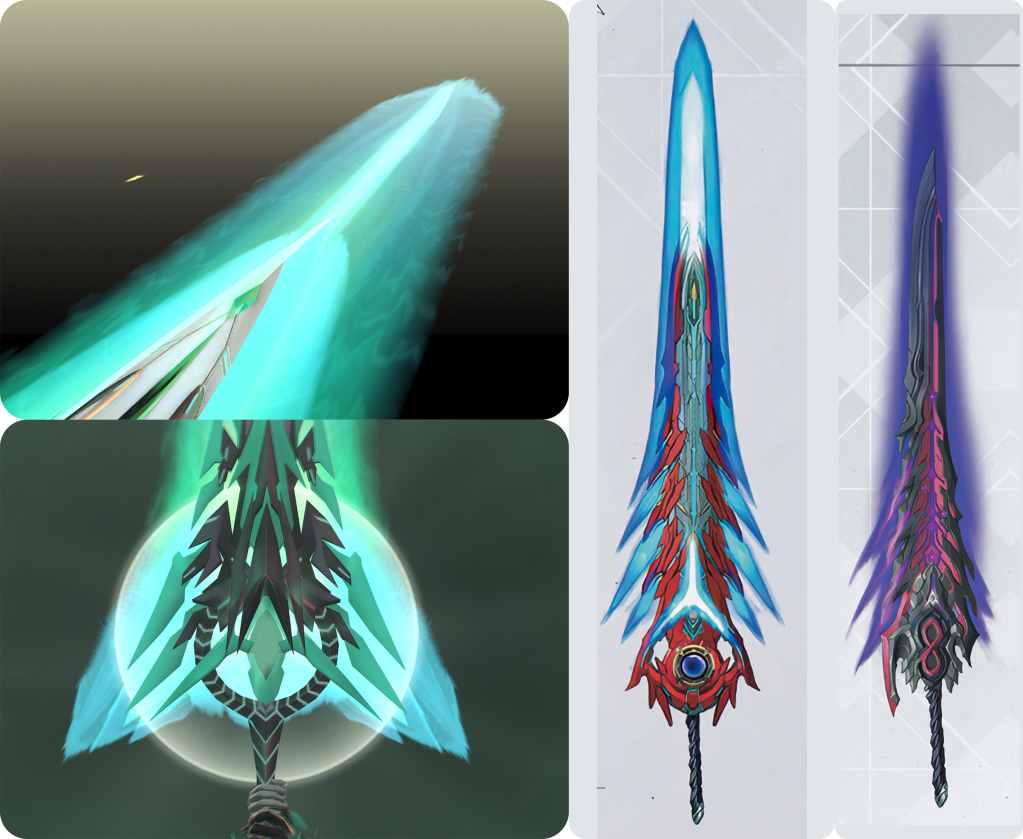
All three humanoid Trinity Processors have big overdesigned laser swords which hack reality by controlling the Conduit’s divine ether, all using an extendable clamshell design and ring-shaped guard, as well as having their relevant-coloured ether lines running along the metal. When two of those are referred to as such, it’s not a stretch to assume the third is as well. While at first glance Pneuma’s may look like it doesn’t match the base design of the other two, using mod tools to disable the excessive bloom effect covering it offers new insights. It has three layers of laser coating. The centremost layer has two prongs that form around the blade, creating a visual that resembles Shulk’s weapon. A thin stream of ether spills out from the middle, suggesting that the top segment of the clamshell blade is still clamped shut and only letting a fraction of its power escape. Note that in the finale this part does open fully ike the other Monado. I’ve always found it odd that the earlier two forms of the Aegis Sword have pointed sword tips which split when activated, yet the third sword remained sharp. As I’ve taken a better look at the blade’s profile with freecam and pondered more deeply upon the circumstances surrounding it for this script, I reckon that’s probably its real Monado form which only gets accessed once in the entire game. The second laser is a smooth blade that forms around the central shaft, and the third is the large, rough field that sweeps over the weapon and gives it the appearance of a giant broadsword. Cutting out the aura to look at the middle two streams makes it identical to how the Monado I and II are modelled in Definitive Edition.
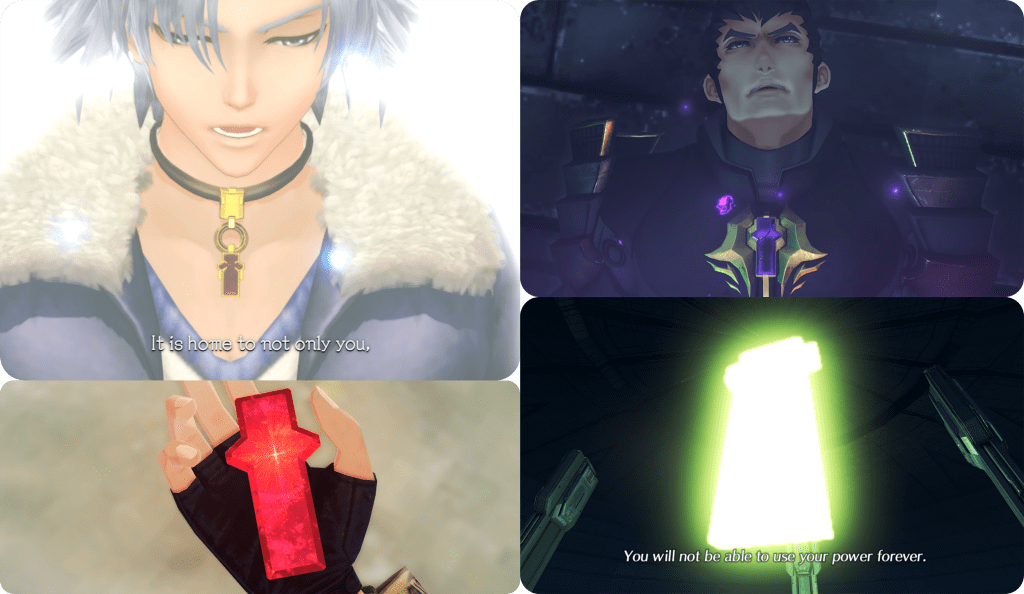
If it looks, sounds and tastes has the specific lore backing of a Monado, it’s probably a Monado. Especially in a series as lore-centric as this one. I would purport that these divine blades are signature of the instantiated Trinity Processor, and that there are only three genuine Monado, each aligned to the ether wavelength (colour) of one processing core. To explain my reasoning, the first order of business is to position Alvis as Ontos. Which doesn’t actually require much theory at all. For most people this discussion has already been and gone when Xenoblade 2 released in 2017. It’s never stated plain in writing that this is the case for Ontos, but from a storytelling perspective I’d suggest that’s because this is considered to be so obvious that there’d be no point. They’ve already set themselves up with the recurring imagery to the point of being beyond deniability. Klaus states that upon initializing the Conduit things went screwy which caused Ontos to spirit away his assistant Galea and half of his body. It’s shown on-screen that Galea is Meyneth and the absent half of Klaus is Zanza. They even feature Shulk’s line from the final battle. So the dimension Ontos connected to is, in no uncertain terms, XC1’s ether subspace. Of the two cores left behind, Pneuma conclusively has Foresight and a tentative Monado, while Logos is shown to have a definite Monado and tentative Foresight. Mythra even subtly acknowledges Ontos as the red Monado when Shulk shows up as a DLC Blade. Furthermore the conversation Pyra has with Rex when they first meet mirrors the dialogue in Alvis’ introduction, which is strengthened by both having access to a meta-space completely separate from the main world (referred to as Memory Space in the first game), which they pull the protagonist into after their death. It’s arguable the dark void where Malos chases Pyra may have even been his own. Then later in the Definitive Edition remake Alvis’ necklace is changed from his original key into a red Aegis core. All of which very clearly pointing to the conclusion that the “administrative computer” Alvis claims to be part of is now redefined as the Trinity Processor. And true to form, in the Wave 4 teaser for Xenoblade 3 it looks like the Ontos core has finally awoken and started generating light inside of it like the other two.
If Alvis is thus locked in as Ontos, a greater pool of knowledge is made available to begin unpacking the Monado system and Trinity Processor with. The processor was built to be a control interface for the Conduit’s divine ether. The Conduit is a meta-universe manifold which Aoidos, the organisation Klaus and Galea belonged to, were analysing with the hope of controlling its phase transition capacities. In Xenogears the original concept of “phenomenon phase shift” is where the Zohar calculates branching futures and then lets the Contact select what one to make real, which is essentially the same function of Xenoblade’s phase transition. Of seeing the future through visions and altering the passage of fate with a Monado. Said power being what Alvis unleashes in full at the end to transform the universe in accordance with Shulk’s wish, and which Pneuma implements for smaller scale reality-hacking. The way Malos’ Monado Eater skill deletes matter may also be an application. The Monado is a “divine sword” which can alter the composition of the world, and this capacity is shared between all three cores.
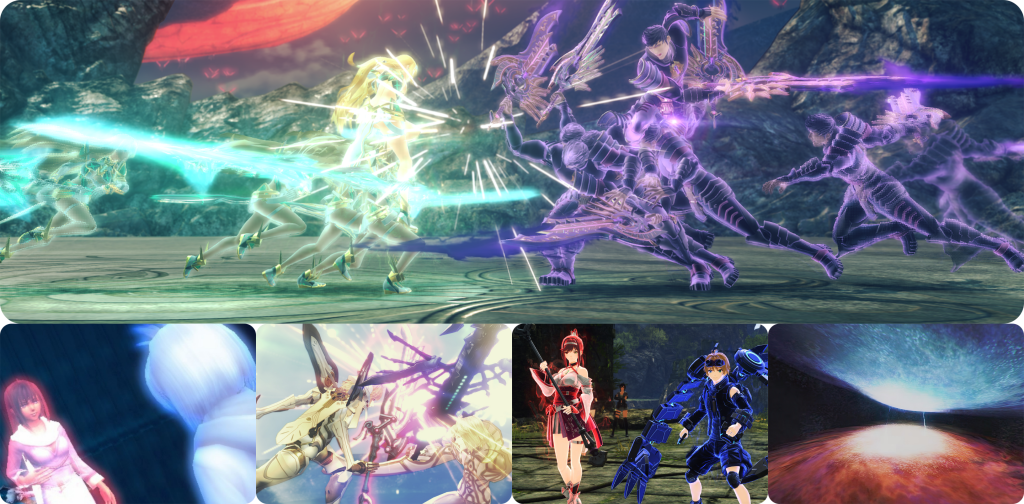
The biggest obstacle in classing Pneuma as one is the lack of any real Monado arts, where even Meyneth’s sword gains access to Monado Fear and a generic Buster skill in the hands of Zanza. However maybe the Arts aren’t even important since Shulk can use them with a replica, and when Rex wields the Monado I via DLC he still channels his own golden ether through it with an attack that looks identical to something he had done with Pneuma prior. Additionally neither Meyneth nor Zanza ever display any symbols on their blades either. It is true that within the game’s internal coding the only Monado weapon is Shulk’s, as the Tertiary Sword retains the Aegis Sword class and enemy weapons aren’t categorized so Malos’ isn’t detailed either way (in the game’s bdat tables that is, Alrest Record explicitly calls it the Monado on its concept page). But that is evidently just because Shulk’s sword is the only one you can actually view in a menu. Considering Pneuma’s abilities are explicitly described as ‘using the Conduit’s power to rewrite the physical laws of the surroundings and manifest what she imagines’, the lack of Arts becomes an increasingly small issue. Because that description is precisely what the whole story of Monado in Xenoblade 1 had centred on. Broadly speaking their abilities are the same. Looking over some scenes in freecam, I also noticed another quirk which I believe links the specific technique Infinity Blade back to the Monado III. Namely that a flat image is projected ahead of the sword when Shulk uses its god-slaying Buster. It can be spotted for a brief second when Zanza is sliced through, but that’s so quick freecam is the only viable way to glance over it. Such a projection attached to the third Monado makes me think about how images of Pyra and Mythra are presented alongside the physical Pneuma during Infinity Blade. They both display that trait. Additionally Rex’s final strike is something of an unannounced Monado Buster, which can be seen in a more familiar form after the green ether dissipates. With a golden blade and an ether cloud following it, the buster left behind looks somewhat similar to the last attack of the Monado III. The projected image even has the same mysterious texturing found on the Infinity Blade afterimage. Although the player ordinarily can’t make it out, I wonder if this is something Monolith did for themselves to link the timing of the two finales. Perhaps it’s a sign that the pillars of light for both Shulk and Rex’s final attack occur simultaneously, since their moves have these linking visual properties in place. Again illustrating the only obstacle in this discussion is that the term Monado never comes up, since her powers so obviously function in the same way.
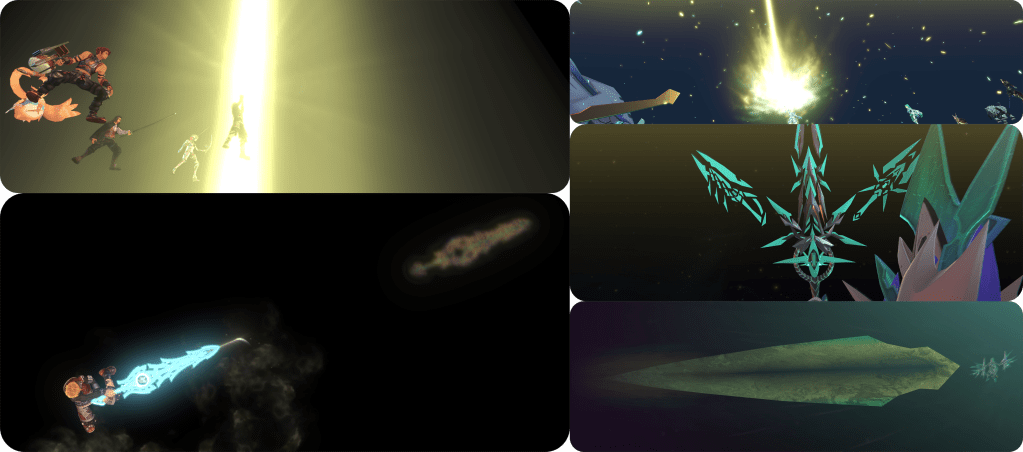
The swords themselves support this claim too. Zanza’s power is released in increments, causing the Monado to appear in three different forms. This is the same for the Aegis Sword. Whether the green-haired ascended state is Mythra’s true appearance or something new created by her fusion with Pyra is still up for debate. But at the very least we can tell that the true shape of the Pneuma Monado is the gigantic green sword, as evidenced by how Mythra forcibly unlocks it even before Pyra existed. Addam feared the power of the Aegis. His emotions influenced the summoning and caused Mythra to manifest in a shackled state, wielding a sword that evidently was not at full capacity. This is restricted even further when she partitions herself to create Pyra. Though it’s substantially weaker, the red Aegis Sword is still mentioned to be fuelled by the leftover ether from Mythra’s core. And if it’s running on Conduit ether, there’s leeway to treat even the first two forms of the Aegis Sword as a kind of shackled Monado, therein having it follow the same evolution of the weapon that Shulk was using for most of his game. Another moment of interest is that as Rex picks up the white Aegis he gets hit with a flashback of the Birth of a Universe event, perhaps understood as this Monado telling him of its origins in the same way Alvis told Shulk, and since the sword is semi-sentient we see Dunban, Shulk and Addam are all electrocuted when it chooses to reject their control.If the two games’ narratives were unrelated then obviously these would only be simple references. But they are deeply connected, and for comparison we do see this scenario in Xenoblade X, with the DARKGOD blade. This weapon belongs to the Vita, the so-called “vessel of the Great One”, and spends most of the game enshrined in Luxaar’s throne room. When not in use it’s equipped to the back of the mech, but once activated that smaller clamshell hilt opens and two prongs swing out to create the laser covering. Being mechanically identical to a Monado. But since Mira has dark matter in place of ether, it can only be a visual reference rather than anything to link X and the main games. Yes this segment is only jammed in here because I replayed the entire main campaign of X solely to try and screenshot the Vita’s second form holding the DARKGOD, which was itself then a multi-hour endeavour, however this contrast nonetheless serves to highlight the differences between a reference and something that is actually, unequivocally a setting-based Monado. Else we would have seen genuine Monado in XCX or XC3. The case of Xenoblade 3 further cements this. Technically the Sword of the End and Sword of Origin have a more clear parallel to Shulk’s Monado than the Tertiary Sword did. The ring opening on the guard is entirely unobstructed, Noah has kanji symbols on his Arts palette and understanding its link to Aionios and Origin reveals that its powers are implemented by hacking physical parameters to alter the passage of fate. It’s a dimension-ripper. However even with all that, the fact that it doesn’t have Ontos, Logos or Pneuma backing it leaves it completely unrelated to the Conduit Experiment and it therefore cannot be classified as a Monado. The Sword of the End is a phenomena produced by having Origin resonate with Melia’s memories of the Monado REX. It’s simply a Monado-adjacent sword, having a functionally identical relationship to Origin that the Monado did to the Conduit. Further substantiating the suggestion of Pneuma’s blade being a Monado.
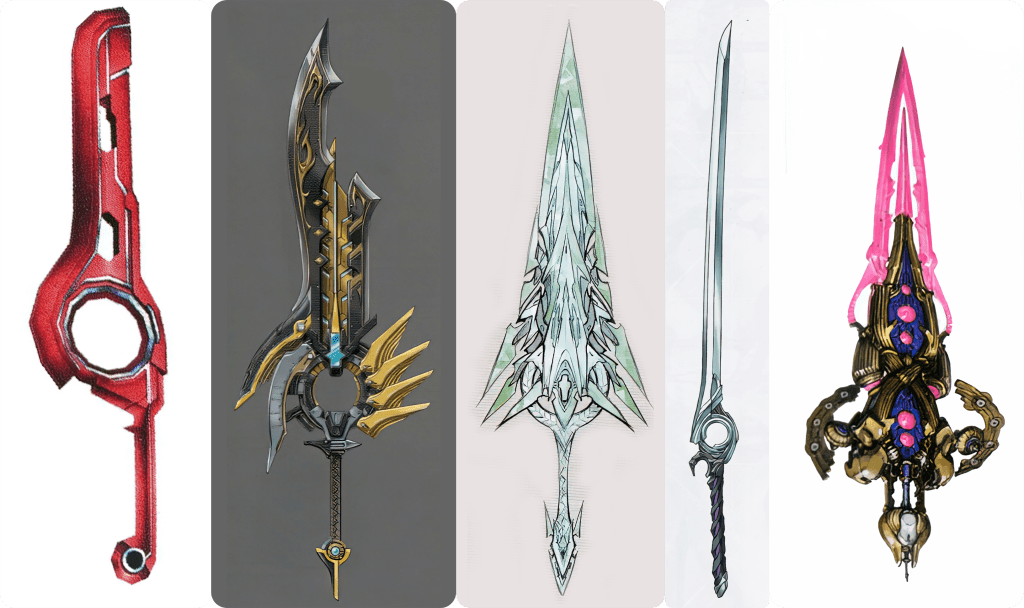
The iconography of it switching between its small and large mode is so similar that you surely are meant to look at it and think of Shulk’s Monado.
As one though, there are some definite peculiarities to its design I’ve noticed. The most obvious being that majority of the time the Tertiary Sword doesn’t seem to be a clamshell that opens and closes like Malos and Shulk’s Monado. I’m not entirely certain in this claim because we never actually see the Tertiary Sword being ignited, only ever swapped into from Mythra. But that seems to be how the blade is shaped. The smaller design when completely powered down is the central cut-out of its active state, and zooming into it I can’t see any hidden spikes which would unfold from that form. So I’m led to believe the green metal somehow generates and extends, instead of opening up. The one cutscene where we could potentially observe where this outer layer comes from is the lead-in to the Aion battle, since Rex has Pneuma engaged for that entire cutscene. This is the only scenario of that sort in the game from what I can remember, and it happens so far away from the camera that they didn’t bother making a unique animation for when Rex ignites it. Instead they simply use motion blur to hide that they’re swapping the models. It does, however, properly unfold and have the central shaft open up during Infinity Blade. Using xenomods’ ability to freely zoom in and disable bloom even lets us discover that, although it isn’t a symbol, there is an ether shape that forms in the ring to signify the technique. So it’s kinda like Rex only unleashes its real power during the final attack. Another oddity which sticks out to me in its animation is the inconsistent presence of the Aegis Crystal. The crystal is present in both the Tantal king’s legend and Torna’s depiction of the Aegis War, the sealed husk displays it clearly on the hilt, and the outline when Rex draws the sword shows a space for the core. But once the physical form appears the Aegis is then nowhere to be seen regardless of whether it’s on or off. I considered that maybe it was encased within the middle part, but other scenes clearly show that the core crystal should be sitting atop it. Similar to Malos’ Monado where the Aegis juts out a bit on both sides. So for most of the Tertiary Sword’s screentime the Aegis core is inexplicably gone, and there are a lot of shots where this section of the blade is in plain sight so I can’t imagine it being something the devs removed from cutscenes merely to save resources. It only reappears after the activation of Infinity Blade and then vanishes again immediately after. This all seems quite deliberate but I just don’t have any significant reading as to what implication we were meant to be taking from it. Every other Blade Weapon in the game has its core crystal clearly displayed, so maybe it’s something subtle like that it becomes a Monado in the hands of a chosen human and a Blade Weapon when in contact with Pneuma (based on the tidbit that one of her combat skills, which you have to hack the game to see, is called The Chosen One)? That’s the best I could do to hazard a guess, but we never see flashback of Amalthus wielding Malos for a conclusive answer.
Gaining access to his Monado is what Malos describes as reclaiming his full Aegis powers, and the Architect identifies that Pneuma’s power will run dry once Alvis sends away the Conduit and Monado to enact Shulk’s wish for a world without gods. Ergo, the Monado has ample ground to be considered the signature tool of a biologically-manifested Trinity Processor avatar. That checks out quite well for me. However this does leave open the question of Zanza and Meyneth’s swords. For this part of the discussion I believe that, like most things in the Xeno meta-series, we are best served by looking at its origin point in Xenogears. This franchise cannot be a multiverse due to the Wave Existence having a vastly different personality in each subseries. However it is true that each Xeno game is interpreting some section of the overhanging Perfect Works timeline. A large selection of story elements are repeated in the process, meaning that we can often look at the previous subseries in order to find clarification of any setting mechanics. In this case, I seek the computer brain Kadomony and what implication it carries when its design precepts are translated for the Xenoblade narrative. To put it simply, Kadomony is a triplet-AI supercomputer designed to let a bio-weapon called Deus channel power from the infinite energy engine Zohar. There are four main components of this machine. A bio-plant which can produce a humanoid as its embodiment if need be, and the three minds which comprise its “computer brain”. The basic command flow is that the overseer AI Persona passes a prompt to its selfish male mind Animus and its selfless female mind Anima (the especially astute may notice that these are thinly-masked rewordings for penis and vagina) to morally and logically debate. Once these two manage to reach a decision Persona authorises that instruction to be uploaded to the Zohar. Only then may its terrifying cosmic power may be invoked.

If that arrangement sounds familiar at all, it’s because this is more or less the exact functioning of the Trinity Processor. The neutral inquisitor Persona is represented by androgynous Ontos/Alvis, the destructive male mind Animus becomes the hyper-masculine Logos, and the motherly Anima is then hyper-feminine Pneuma. In order to cement this link in place, note that Malos’ personal battle theme in Torna: the Golden Country is called “Over Despair and Animus“, while Pyra and Mythra’s weapons are renamed the “Anima Sword” when Queen Nia wields them in Xenoblade 3. Of further interest may be that Deus from Xenogears, Omega from Xenosaga, the Vita from Xenoblade X and Artifice Aion from Xenoblade 2 are all interpretations of that same Zohar-fuelled god-weapon story concept, and the Conduit is likewise just a legally-distinct version of the classic Zohar; a giant golden monolith that acts as a perpetual motion machine by opening a path to the upper domain and ensnaring an existence which can commonly be considered God. Xeno is a deeply self-referential series where the intertextual links number to a far too overwhelming degree to ever attempt tackling in a video. Interestingly, this is a case where Kadomony honestly seems to matter more to Xenoblade than it did in Xenogears. Its trinity is so deeply ingrained to the core mythos that I feel this has to be the key in understanding the Aegis and their relationship with Monado. You have Persona/Ontos/Alvis with one Monado, which just seems disproportionately powerful since that universe has ether as the base element and its semi-simulated nature elevates his computer functions, Animus/Logos/Malos with another and Anima/Pneuma/Mythra with the last.
You’ll note that I’m hard committing to the idea of a Monado trinity, despite there being five distinct Monado in the series. There are a number of reasons for that. Although the first Xenoblade seems to have a multitude of Monado at first glance, it’s actually only three swords appearing in different shapes. Zanza’s Monado evolves through three stages, where it’s shackled, unshackled and then restored to its true form in the hands of a god. Since he and Bionis are considered two parts of the same body, its Monado is also to be considered an extension of his own rather than a unique instance. Zanza’s Guardians, which display skills such as Monado Eater and Monado Lock, are probably a similar case. Moving on to look at Meyneth, her Monado is first seen as the core in Fiora’s chest. After awakening it’s then shown in two configurations; she and Fiora use them as dual blades, whereas Zanza combines them into a single sword. I find it a bit strange that while the Bionis has a Monado, the Mechonis only uses a metallic sword. So I do have some speculation as to whether the distinctly Monado-shaped building in Agirnatha is meant to be her original Monado I moulded into a different shape. Egil powers the sword, Mechonis and Faces by melting Homs in Galahad Fortress, but Meyneth surely would have never done so when ruling. If the structure in Agirnatha was her Monado then that would instead be where she originally generated enough ether to power the entire Mechonis. It’s food for thought anyway. Lastly there’s the final sword, referred to as the Monado III despite actually being a totally separate weapon to the Monado I and II. The Monado progression is meant to loosely mirror Weltall, where it evolves through the berserk Weltall-Id and bulkier Weltall-2 so that it may end up becoming the titular Xenogears. Weltall, the Contact and Xenogears are all referred to as the “slayer of God”, and the Monado III’s musical theme is titled “The God-Slaying Sword”. The links are abundant and immediate. Conceptually, the Monado system is Weltall converted for a different setting.
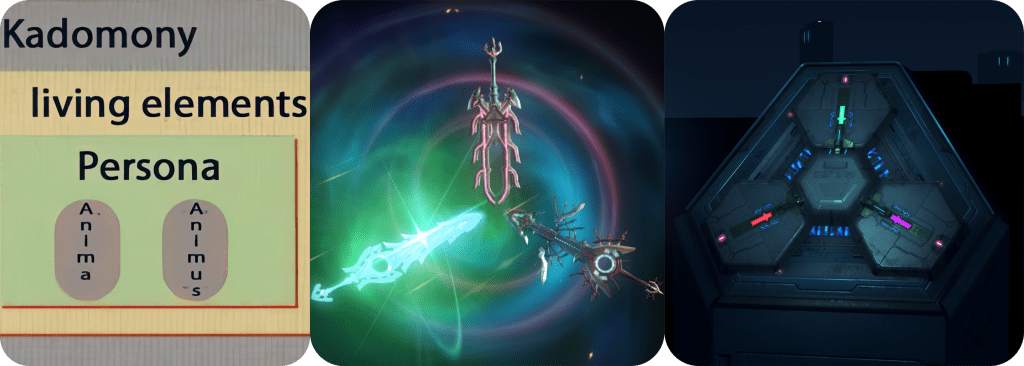
I went on a tangent there but basically: three flavours of Monado and a Xenogears parallel baked in. This is where Kadomony comes into play, because applying it as a lens permits the swords of Xenoblade to actually be the same trinity repeated. The relevance this framework carries for Zanza and Meyneth holding Monado is that both were already an implementation of the Animus-Anima concept. It’s one of the longest-standing Xeno setting mechanics, which is seen in every single title. So before any kind of franchising content was ever conceptualised, Takahashi had inadvertently placed a bunch of this Xenogears imagery into Xenoblade anyway. You have the destructive male force Zanza engaged in what amounts to religious warfare against the protective mother Meyneth who simply wishes to let the world grow. The pair borrow the same blue & red glow that was assigned to Yeshua and Mary in Xenosaga, since the purple/green of Malos and Mythra hadn’t been implemented yet.
Alvis’ incorporation into the Conduit Experiment being a retcon means that it comes with this implicit understanding that even back when Xenoblade was a standalone title he was already stand-in for Persona. I think this is a big part of why the stories of these two games are able to slot together so naturally despite displaying such major differences in style – the Kadomony structure was present in Xenoblade well before the Trinity Processor. So while the processor and its other two cores were a rewrite introduced by the sequel, they are still clear evolutions of the Monado triad imagery from Sentient Genesis. It was already apparent that with Persona, Animus and Anima united in the finale the requirements of Kadomony had been fulfilled, and Alvis was then contacting an unseen Zohar to instigate universal phase transition. Because the role of Animus is shared between Malos and Zanza, and the role of Anima shared between Pneuma and Meyneth, I conclude that the new explanation embedded into Xenoblade 2 is that those gods were using substitute Monado regenerated by Ontos in order to fulfil a pseudo-Trinity Processor construct.

Partitioning his power so that the offshoots are recognised as Pneuma and Logos, he completes Kadomony and regains capacity to send command to the Zohar. We joke about Alvis being a chaotic neutral ass who let Zanza rampage for eons, but it might genuinely be that he couldn’t do anything until all three Monado elements had been assembled under one will. Zanza wields a replica Logos, while Meyneth wields a replica Pneuma. Hence why the “True Monado” is the last one gifted by Alvis himself. It becomes understood as the actual Ontos Monado – what would probably be his Aegis Sword if he had ever been converted to the Blade system. This also adds an extra layer to the Aegis War in Torna: the Golden Country, since the imagery of Malos and Mythra flying around destroying everything with their Monado is a clear parallel to the fight when Zanza and Meyneth awaken in chapter 16 of Xenoblade. Kadomony is the key.
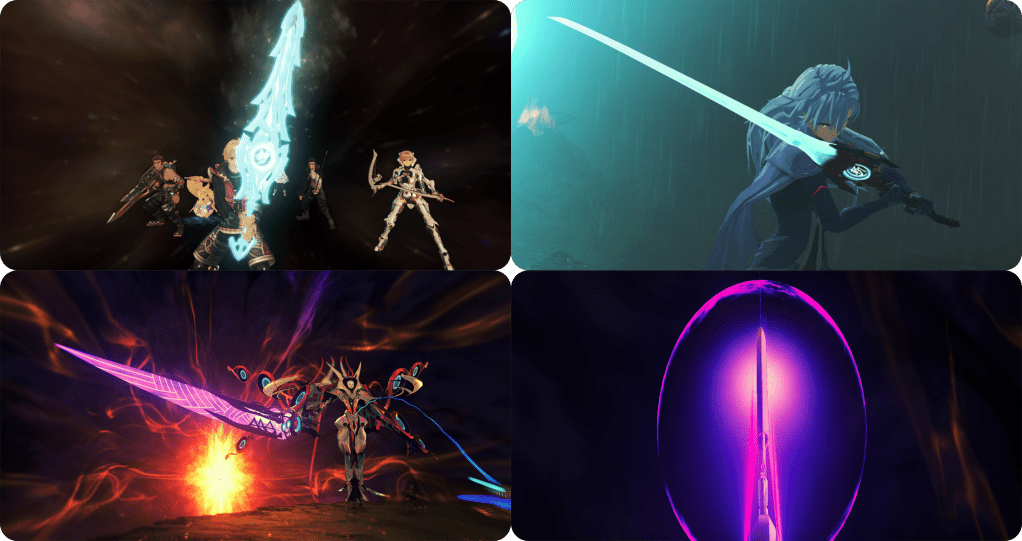
And so, this is my take on the Monado as shared between the divinity of Bionis and Alrest. It isn’t something so vague as the Monado being inside of us all along or there being infinite possibility to summon it if a character has strong enough willpower. That’s too easy for a series which describes the workings of its universe as meticulously as Xeno. No, three distinct swords with two substitutes created. To me this ties it up neatly. For the very blatant link to Alvis and Malos I think it’s more of a stretch to argue that Pneuma’s isn’t a Monado. The Trinity Processor-Conduit relationship, or at least as far as I’ve pieced it together, kind of necessitates it being so, and this is only compounded by the Kadomony homage.

Revising the Roles of Kadomony & the Trinity Processor
Hi lads. I’m just tuning in here with two brief sections of revision to the main post. My goals are as follows: Firstly, to amend how I presented the Trinity Processor’s cores in context of Kadomony since I have some slight shuffling of parallels based on a bettered reading of the lore, and of, y’know, the page. Though in my defense, the Perfect Works diagrams are sometimes more confusing than they are helpful. The main points still stand, I just wish to try and arrange the parallel in a more blatant, more clear manner. Then secondly, to discuss how my predictions weigh up to what was shown in Future Redeemed.
Kadomony
The Xenogears Perfect Works (the translated version I have at least) describes Kadomony’s judgement system working as follows:
- “With access to the Zohar, its main function was to supply the Deus System with energy. It would play the role of access gateway to the Zohar, which had no will of its own. When a query occurs, a question is submitted internally at the same time. With the use of the fluorine element for internal calculations, it also introduces groups of living elements for uncertain calculations. Their respective determinations are then processed and subsequent agreement is then decided upon.“
To my understanding, the male-coded Animus and female-coded Anima living elements have to reach a consensus before the fluorine elements will agree to let Kadomony pass the Zohar through to Deus.
Trinity Processor
Rex explains that Logos is the male persona and Pneuma is female, much like Elly explains that Animus is the male organic element and Anima is female. With that in mind, the Trinity Processor’s judgement system is described as follows:
- Xenoblade 2: “Ontos, Logos and Pneuma. The three cores of the Trinity Processor formed its cornerstone. However Ontos triggered a spacetime transition event and disappeared forever.”
- Artifice Siren model kit: “At this research facility, a governing artificial intelligence collective known as the Trinity Processor was raised to maintain the Conduit. The processor, using Biocomputer elements, was raised in a virtual reality to gain a personality, and this system would be used to govern the Conduit.”
- Future Redeemed: “Ontos was the arbiter and thus was predicated on the existence, or perhaps the opinions, of Logos and Pneuma. In short, without the two of them present Ontos was just a machine.”
Therefore, living elements Logos and Pneuma have to reach a consensus before logical element Ontos will agree to let the Trinity Processor access the Conduit.
I was being a bit overzealous or simplifying too much in calling both of them ‘trinity AI’ or ‘three-minded supercomputers’ since realistically neither of them are, and I don’t claim to know Xenogears as deeply as I know Xenoblade (I’ve only played XG once so far vs numerous replays for each XB), but the overall decision-making framework, accounting for minor lore and copyright differences, appears to be more or less same. While there’s no Deus System equivalent on Rhadamanthus and no Persona living synthesizer, the processor itself is alike; You have one supercomputer element (fluorine / Ontos) that can be tasked with logic-based queries, but more uncertain, multi-faceted or emotional queries have to be passed to the living elements (Animus and Anima / Logos and Pneuma) for debate. Only once they reach a consensus does the computer brain give its agreement and therefore a command is relayed the Zohar/Conduit. Plain as can be, no fluffing around with run-on sentences for half an hour, that’s how I read Kadomony and the Trinity Processor as being functionally equivalent.
Additionally, equating Ontos to Kadomony’s fluorine arbiter would indicate it had some capacity to execute calculative, logic-based commands without the need for input from Logos or Pneuma. Without them Ontos is “just a machine”, but said machine is still the world’s fastest supercomputer, right? In one fell swoop this would then restore Alvis’ original claim of being the main administrative computer, address how it triggered a spacetime shift without Pneuma and Logos vanishing alongside it, and explain how Alpha is still running in a deprecated state during Future Redeemed as opposed to outright stopping in absence of the supporting cores.
The other tidbits from the Siren model kit’s Conduit lore also align to Xenogears as well, with the Conduit being a reality-bending perpetual motion machine discovered in Africa that gets used for phase transition (phenomenon phase shift) and wirelessly charging super robots via Slave Generators.
Future Redeemed: Review, Addendum & Amendment
In this segment, I’ll now be quoting some pieces from the main post in order to review where they land with full context for where A, Fiora (imbued with Meyneth), Pneuma and Malos fit into the Sword of the End’s framework, among other things. Please note that although I am editing this post in February 2025 to clean it up a bit (previously I tried doing bad Oxford referencing with superscript numbers linked to interjecting paragraphs), the actual conclusions and speculations drawn were typed up only a week after Future Redeemed (April 2023). In the time since I’ve obviously transformed or clarified some concepts, but at this point would rather organise those into a proper new post if the desire arises.
“If the two games’ narratives were unrelated then obviously these would only be simple references. But they are deeply connected, and for comparison we do see this scenario in Xenoblade X, with the DARKGOD blade. This weapon belongs to the Vita, the so-called “vessel of the Great One”, and spends most of the game enshrined in Luxaar’s throne room. When not in use it’s equipped to the back of the mech, but once activated that smaller clamshell hilt opens and two prongs swing out to create the laser covering. Being mechanically identical to a Monado. But since Mira has dark matter in place of ether, it can only be a visual reference rather than anything to link X and the main games. Yes this segment is only jammed in here because I replayed the entire main campaign of X solely to try and screenshot the Vita’s second form holding the DARKGOD, which was itself then a multi-hour endeavour, however this contrast nonetheless serves to highlight the differences between a reference and something that is actually, unequivocally a setting-based Monado.”
However I have secretly had a “Connecting Xenoblade X and the Main Games” and “The Perfect Works as Completed in Xenoblade” early draft sitting in WordPress since last September, well before this Monado post started. In both I posited that, among other things, people were too quick to throw X out of canon even in spite of the blue explosion that consumed Earth clearly looking like the phase transition effect. Due to the circumstances of XCX discourse starting and ending before XC2 released, and also from a general lack of creativity in piecing together concepts to establish Xenoblade’s larger universal timeline. Or in essence, that yes Lin’s dumb unexplained Monado hairpin does actually carry complex lore implications. I feel so vindicated finally seeing them united through the exposition radio in Future Redeemed. Anyway, one idea I had toyed with (though not finalised, as the script still remains in WIP hell) is the possibility of the DARKGOD being some kind of ancient proto-Monado, in that maybe the Vita, Conduit, Divine Sword and power of Animus/Anima were all brought over by the Samaarians at the start of the universe in a similar fashion to Xenosaga’s ‘Relics of God’. Maybe I’ll revisit that eventually.
“You have the destructive male force Zanza engaged in what amounts to religious warfare against the protective mother Meyneth who simply wishes to let the world grow. The pair borrow the same blue & red glow that was assigned to Yeshua and Mary in Xenosaga, since the purple/green of Malos and Mythra hadn’t been implemented yet.”
Future Redeemed, in a pretty cool move, validates both the red/blue of the XC1 gods and the purple/green of the XC2 Aegis. Here I posited that Definitive Edition simply didn’t recolour Zanza and Meyneth’s ether as it would completely break that game’s aesthetic. But that claim was perhaps too centred on Pneuma and Logos being the norm rather than the exception. We’ve now seen that when interlinking Glimmer and Nikol glow with the same red and blue power. So a distinction to now note would be that Logos and Pneuma are not the source of Animus and Anima in Xenoblade’s setting, but just the foremost devices built to harness and refine that existing energy. This is to say nothing of the potential that Xenoblade now be linked in lore to Xenosaga, where this colour scheme of Animus and Anima was originally seen.
“Because the role of Animus is shared between Malos and Zanza, and the role of Anima shared between Pneuma and Meyneth, I conclude that the new explanation embedded into Xenoblade 2 is that those gods were using substitute Monado regenerated by Ontos in order to fulfil a pseudo-Trinity Processor construct.”
This suggestion of Zanza and Meyneth standing in for Logos and Pneuma is reaffirmed in Future Redeemed. The whole conflict there was that Alpha was Ontos acting alone, as anything that could possibly have been a mediating factor (Logos, Zanza, Shulk, Pneuma, Meyneth or Fiora) had its divinity stripped away, leaving only the cold calculations of computer brain Ontos. And A confirms that the original Alvis was being balanced by the regrets of Klaus, and presumably Galea as well. Therefore once Alpha is defeated we see that A takes Shulk and Rex with her when she disappears into Origin’s core; A (Ontos) once more using divine-touched humans Shulk (potential past vessel of Logos through Zanza) and Rex (bonded to Pneuma) as replacement factors for the missing two cores in a Trinity Processor construct.
“Zanza wields a replica Logos, while Meyneth wields a replica Pneuma. Hence why the “True Monado” is the last one gifted by Alvis himself. It becomes understood as the actual Ontos Monado – what would probably be his Aegis Sword if he had ever been converted to the Blade system.”
Future Redeemed, at least on the surface, seems to reject the notion of the Monado III being the real Ontos Sword. Which, like, I get it. For reasons of simple colour coding I wasn’t totally satisfied with the proposed real emblem of the red Trinity Core being a blue sword either, when there were two other red ones in the same game. Although this new piece of knowledge does potentially throw into question what was ‘true’ about the ‘true Monado’ in the first place then. It would technically be possible to look at the presented swords and say that Alpha in Xenoblade 3 is actually using the Zanza/Logos Monado since his boss theme is a pair with Zanza the Divine, and when he transforms the blade + Buster of that Monado are both purple. A’s Monado largely takes the same appearance since she was split from Alpha, but I do note that her weapon carries similarities to the Monado III. Although the cover does raise to access the ring for Monado arts this, like the III, is mostly a single sword rather than a clamshell, and that when she activates her Monado Arts the blade turns that same light blue. Since she is the conscience of Alvis – the actual essence of Ontos – it may be that her weapon and silver ether are more indicative of what Ontos’ pure Monado would be like.
Sword of the End
“Technically the Sword of the End and Sword of Origin have a more clear parallel to Shulk’s Monado than the Tertiary Sword did. The ring opening on the guard is entirely unobstructed, Noah has kanji symbols on his Arts palette and understanding its link to Aionios and Origin reveals that its powers are implemented by hacking physical parameters to alter the passage of fate. It’s a dimension-ripper. However even with all that, the fact that it doesn’t have Ontos, Logos or Pneuma backing it leaves it completely unrelated to the Conduit Experiment and it therefore cannot be classified as a Monado.”
As indicated, I next plan to revisit the Sword of the End and its relationship to the Monado through new confirmation of the Trinity Processors’ role in Origin, and particularly the Pneuma Core manifesting upon Matthew’s Fists of the End. Where to start? Well, it’s been literally like a week so although I’ve been thinking it over I won’t claim to have a solid answer yet, but I do have a pathway I’ve been following along. The Architect was quite clear that Pneuma’s power (or at least the part that makes her a Trinity Processor/Monado) should have vanished together with the Conduit, making the whole scenario surrounding its appearance in Future Redeemed fairly confusing. And I was pretty sure that the Logos core was lost since his Blade form dematerialises before Pneuma could restore his cracked processor (though that part has always been in contention, since it’s his voice that asks Pneuma “So, how was it being alive?” and the Aion UI displays both cores as actively powering it). So explaining the Sword of the End can’t be as simple as saying that Ghondor simply chanced upon the core on a beach like Shulk or Na’el did.
The dominant theory at the moment seems to be that Pneuma was always hidden in Matthew’s Fists of the End, and Logos in N’s Sword of the End. And while I really want that to be true, I’m not sure the dialogue actually supports it. N is the one that recognises Rex referring to the Aegis when saying “if only they were here” and then knows to tell Matthew “I will grant you the sword’s power, transfer it to your Fists of the End.” This reads more like N (who first stabs the ground and releases green energy) had the Pneuma core himself and merely shared its authorisation with Matthew.
So the dialogue in Future Redeemed sounds as it’s suggesting Pneuma. Yet on the other hand, N had that purple sword even before becoming Moebius, and he uses a lot Malos abilities like the purple glowing super speed, red ether lines and Tachyon Slash (matching Malos’ red aura + Artifice Aion’s red ether lines) and a guard resembling the purple Monado Armour. And Logos’ verse on the Trinity Processor – “Hatred stirs up conflict, but love covers over all wrongs” – suits N a lot more than Pneuma’s – “The path of the righteous is like the morning sun, shining ever brighter till the full light of day.” Dunno. Since he’s the Jin/Sephiroth/Krelian of this game Logos obviously matches his emotional design way more, and I personally just feel it’d be cooler if it was Logos, but that sentence about transferring the sword’s power to Matthew skews it more toward Pneuma for me. The spikes, central ether line and broadsword blade on both Veiled Sword do also quite resemble Pneuma, if that matters…but maybe it doesn’t though, since N’s green energy comes from the Sword of the End, not the Veiled Sword sheath.
With the presented information we can really only go off one ambiguous sentence and simple colour coordination to try and work the Sword of the End into the Trinity Processor situation. But I have tried. The verdict? Ultimately I still do feel that the End are only Monado-adjacent, but that reading comes with new context (and confusion) feeding into it. A divine sword, similar in function to but not exactly like a Monado. Lucky Seven is a nickname for the white Sword of the End, which Nia explains to be “a byproduct of the Keves queen (Melia)’s heart resonating with Origin.” Z further describes it as “that which denies fate and makes its essence mercurial.” My interpretation of the wording is that Melia used her memory of the Monado REX to produce the outer shell of two Monado but since the Conduit isn’t around anymore and Pneuma/Logos aren’t physically present in Aionios the white and black swords had Ouoroboros/Moebius cores in the ring to power them instead. Though when A appears she’s able to use that design frame in a working Monado form since the Ontos core is still active. First off, it seems quite concrete that after XC2 Logos (probably broken) and Pneuma (lost her divinity) cannot be acting as Trinity Processors anymore. This is why they don’t inadvertently fix Ontos’ programming when the worlds meet and form Aionios. Origin was designed to have its two halves fuse in the collision, so if they had all three Trinity Processor cores they could naturally have done the same. But this doesn’t happen. At one point A claims “That’s the gist of it. If Logos and Pneuma were here, I’m sure they’d say the same thing”, suggesting that she knows they’ve been rendered inert. Furthermore, both A (literally Ontos) and Rex (Pneuma’s husband) are shocked when Matthew somehow triggers the core’s power. Were the actual processor present then those two should have sensed it before anyone else. Therefore, the Aegis are not actually in Aionios, likely having something to do with the change that they are not divine blades anymore. Hence why A has to take Shulk and Rex with her to replace Logos and Pneuma as a new trinity that stabilises Origin.
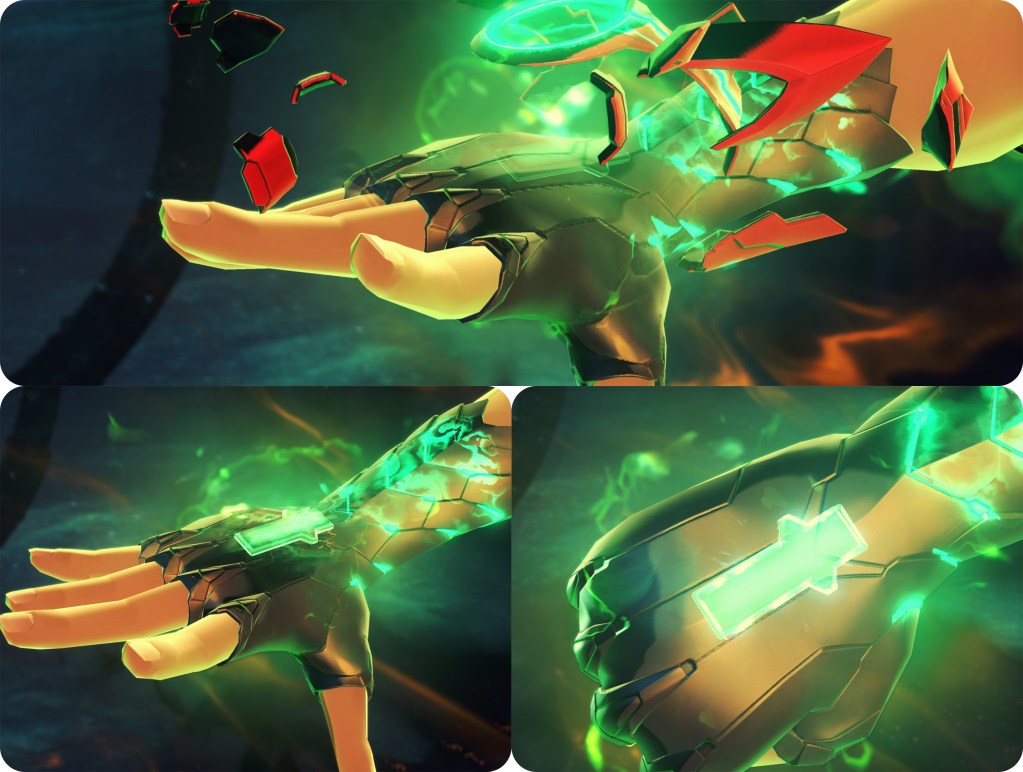
Matthew’s Pneuma core is translucent and seemingly loaded from within Origin. Since this is the only point of reference, I therefore am not convinced any of the End weapons are embedded with the genuine cores like an Aegis Sword. Rather that they can, under some unspecified circumstance, resonate with backups of Pneuma (and potentially Logos) seemingly stored within Origin. The Sword of the End is said to be a product of Melia’s heart resonating with Origin. They’re memory constructs, so perhaps this is why they have a mirage core instead of the real thing, and why there are two swords; one white and one black (noting that Malos’ Monado cutscene is titled “Malos’s Black Sword” and the Tantal King refers to Pneuma as “a white sword”).
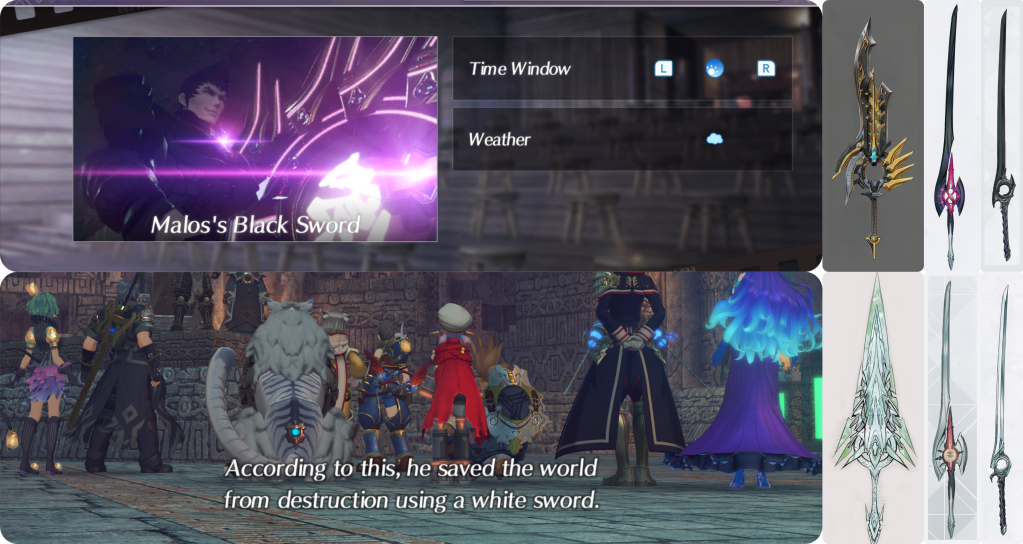
With the Conduit gone Melia would have had to engineer them specifically to work in the unique conditions of Aionios. Thus they have a Blade form (Veiled Sword), Aegis replica form (Sword of the End) and divine sword (Sword of Origin) configuration. A and Alpha’s Monado are both still functioning since the Ontos Core was never broken and the nature of Aionios (a closed space with finite ether) makes it similar to Bionis, allowing them to predict the movement of ether particles to achieve Foresight. But since the genuine Pneuma and Logos processors aren’t around, we see that the ‘third sword’ of XC3 (the Sword of Origin) is powered by Moebius for N and an Ouroboros core for Noah. So not Monado, but something with the same reality-rending mechanisms, except powered by Origin’s dominant powers instead of the Conduit. In fact the near-identical design of A’s Monado Fencer may be direct indication that the only thing holding the Swords of the End back from being Monado is the lack of genuine Aegis support. Ergo N’s Monado Armour never receives any particular denotation, and Noah uses nondescript attacks such as Dimension Ripper in place of something such as Monado Eater.
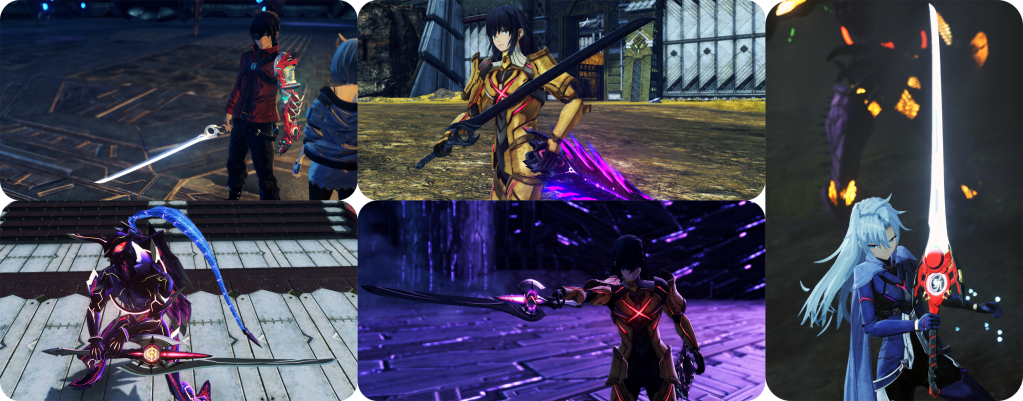
The scenario may unfold something like this: Keves Queen Melia first created a Sword of the End for Noah imbued with the memory of an Aegis (potentially Logos due to the black/purple colours, though his FR dialogue suggests Pneuma). Noah bonded with this Blade for all of his lives, but eventually gives in to Z’s temptation and becomes Moebius. Their ‘divine sword’ for Aionios has just been lost to the enemy, so Melia endeavours to create another Sword of the End to replace it. Riku is tasked with holding onto this, and presumably also takes ownership of the Pneuma-imbued Fists of the End after Matthew leaves. He integrates into Keves for a while, until one day he suddenly sees Noah reappear in the Flame Clock reincarnation cycle. Though the black sword has left him since it was linked to N, so he just has a generic Blade now instead. Riku realises that this must be fate and gifts both weapons to the new Noah. His Veiled Sword is amended with the Fists of the End (explaining why Noah randomly gets the gauntlet when drawing Lucky Seven). The Pneuma essence is thus transferred to him, addressing the green beam that very occasionally appears on the Veiled Sword, or some of his green ether attacks (also of note: Noah’s Tachyon Slash is green while N’s is red).
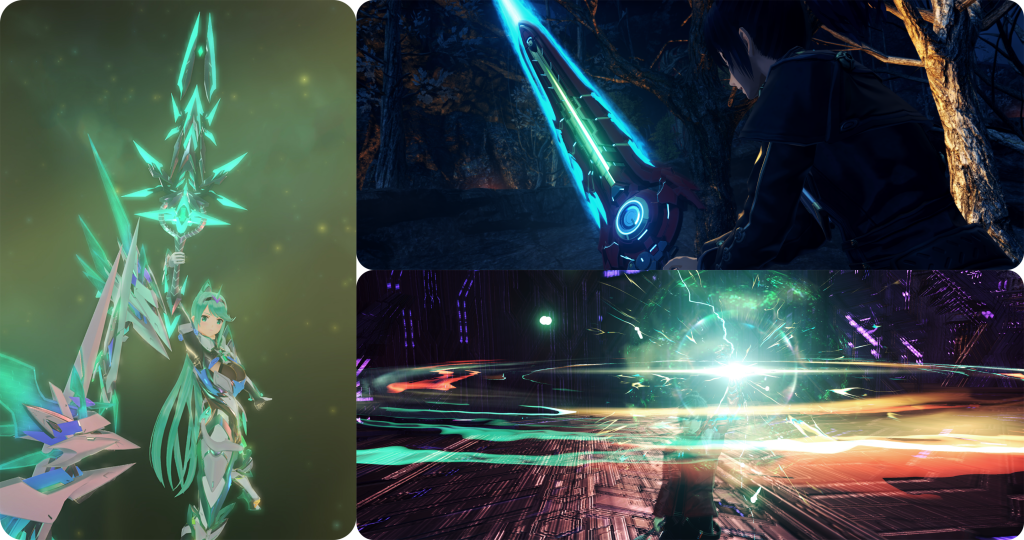
That sort of indicates the direction I’m headed with at the moment. That everything is more or less a replica phenomena created through Origin, because the information states that Pneuma (and probably Logos) should have lost their capacity to be Trinity Processors. I would think that the Pyra and Mythra left behind after XC2 most likely just reverted to normal Blades. So whatever’s in Origin was just the Aegis ether wavelength backed up…somehow. It’s a reading not at all concrete and there are plenty of empty spots in it. But it has only been one week so who knows how I’ll flesh this thought out later.
 skapbadoa
Well this is too great of a writeup not to leaves a comment. Kuddos to you friend. this is a far more in-depth analysis than anything I’ve seen on reddit. The idea of N having access to the Penuma core feels weird, but I have to keep in mind he was/eventually is again a good guy. Aonios functioning as a closed system in which events can be predicted also makes a lot of sense. The mechanics by which Origin affects reality are still mysterious to me, but it functioning like another Trinity processor without the Conduit makes sense. Thanks for clearing up some of my confusion and putting forward a solid Theory of Everything!
I was drawn in to this post by the thumbnail of the three Monado in grass, did you make that yourself? I would love if you’d post that image, would make an incredible wallpaper.
LikeLike
I put together the thumbnail by getting clear profile shots of Malos and Pneuma’s swords with freecam, cutting each of the frame in Photoshop and then putting them into the XC1 title screen. It doesn’t look as good blown up beyond thumbnail size, but here’s a gallery + alts I had made: https://imgur.com/a/oZp3PNo
LikeLiked by 1 person
oh shit you responded long ago! thanks so much!
LikeLike
it seems the artbook for xenoblade 3 that just released confirms that Logos core in N’s sword is Malos himself and the Pneuma Core on Matthew’s Fist weapon are Pyra and Mythra together.
LikeLike