
Love Live, I reckon, is a pretty fascinating series. It’s the one which I’ve spent the most time talking about by far, but also that which I feel like I still have the most left to say on. In some ways I honestly feel that even in all this time I still haven’t managed to articulate the whole shape of my response to it. Clearly, right? By and large all I’ve done thus far is to follow along the archetypal ‘monster’ and its associated symbolic phenomena, which, after I’m finished here today, swells to encompass about nine out of the fifty or so important idols (Honoka, Nico, Chika, Lanzhu, Shioriko, Mia, Penelope, Kanon, Wien). It all started with a simple contrasting of motivations between Nico and Chika, that accidentally put a spotlight upon a bunch of its linked thematic evolutions and had me realise that, hey, this is kind of a contemporary anime masterpiece ain’t it. But as I said, what I’ve done so far only really focuses on about a fifth of the important cast. As far as the complete image of the franchise is concerned, I’ve barely scratched its surface. That, I would say, is the true magic of Love Live. Wherever there is repetition, there is a natural invite to comparison. I’ve predominantly centred myself on the monster – on a force creating culture by rampaging against the mundane, but you could have entirely separate deep dives into repeating factors such as the link between Rin and Hanamaru as indicated through their yellow eyes, the link between Yoshiko and Kasumi as indicated through their pink eyes, technology signposting the setting timeline, transfer students and globalisation in the School Idol scene, etc. You can fixate upon any part of the setting because there is always more to discuss, whether in analysis, reflection or comparison. For the two seasons I’m discussing here, the actual content covers roughly nine hours. But that nine hours can then easily lead me to immerse myself in writing and editing a video response for over a month…multiple times throughout the year. I’m sure I’ve used the phrase “production harmony” on more than one occasion. On the surface it doesn’t seem too different from iDOLM@STER, Aikatsu or any other of your key idol franchises, but where it really pulls ahead for me is in the vast symbolic weight and the breadth of its thematic interactions. Love Live is a tale of creating culture through legacy and legacy through culture just as much as it is a singasong dance show. School Idol Project and Sunshine form a symbolic set where gods and monsters clash in order to manifest Love Live as a concept, paving the way for all school idols that follow to align either with μ’s song of love or Aqours’ song of life. In following this, I now find myself wanting to pen some kind of presentable answer in the question of how Nijigasaki and Superstar are steered to intersect through the upped artistic presence of their second season. I did say that I would wait until the end of Superstar’s storyline to revisit Wien, and you know what – I lied. Continuing off my previous discussion about Wien as ‘monster’, it does seem to be that she and the three ‘Monster Girls’ are set at the centre of each. Per Keke’s lecture, the “miracle of nine” is now treated as an established setting concept. The second seasons of Nijigasaki and Superstar then both set out to address it through the arrival of a solo idol who threatens the status quo: Lanzhu and Wien. Both arrive like a hurricane, immediately upping the performance standard and intimidating the competition with just how good they are. When you stop and look at it, both are actually borrowing a lot of imagery from Aqours and this signals to us that they will be the deciding factor in illustrating how each series has chosen to interpret the words of its prequel.
Lanzhu arrives out of nowhere, tells everyone that they’re pathetic and then struts off to do her own thing. Declaring “engrave the beginning of this legend into your hearts”, thusly she opens with a verbal challenge to the OST track “Densetsu ga Umareta Shunkan” (The Moment A Legend Was Born) from School Idol Movie, which had been used at the focal point where Honoka conceptualises the Sunny Day Song festa and at long last manifests symbolic powers into the scene. Lanzhu makes it immediately clear that she’s aiming for the highest skies, and her jaw-dropping performance of Eutopia convinces everyone that she could actually do it too. With such an overwhelming debut, she steals the light that is traditionally a symbol of μ’s overlooking their successors. First episode, pretty strong start. Later in the series she comes to be accompanied by Mia and Shioriko, forming a unit named R3BIRTH. There were some light instances of long-running franchise symbolism in season one via Shizuku and Ayumu’s feathers, but by and large R3BIRTH are the characters who really push it into focus for the adaptation. Because Love Live is a multimedia project there’s a significant time delay between when the group formed in late 2021 and finally receiving their anime storyline in 2022. During that gap I was left with a burning question regarding the names they’d chosen. Nijigasaki’s title and aesthetic treading on the toes of the rainbow theme of Sunshine already had me scratching my head a bit, but when this new trio’s debut single was called “Monster Girls” and Shioriko’s track titled “Aoi Canaria” this further caught my eye, as initially neither of the new series seemed to be all that concerned with directly addressing their predecessors. Nijigasaki’s first season favoured the “School Idol Project” more than the “Love Live”, and seemed to deliberately forego a lot of the usual stylistic conventions to fully focus on the episodic idol happenings. Yet as I was watching S2 I reached the episode where Shioriko nabs that blue feather and went “hey wait a second, Nijigasaki secretly was a Love Live series all along.” The idea of the mystical feather is first introduced at the very end of the School Idol Movie credits roll, and then grows to become Love Live’s most visible symbolic setpiece. The suggestion of coloured birds is not something one can easily overlook in Love Live, and I similarly believe that “monster” is not a term to be applied lightly. In this franchise labelling someone as a “monster” has heavy, very specific character implications – implications which I would suggest that Shioriko’s red eyes and fang reveal she does indeed carry, as oftentimes the role is visually signalled by their red or reddish-pink eyes. I’d go so far as to say the devil girl’s red eyes mark an open thread about how the pair in London will start upon their own journey toward the rainbow. Using such a small character design element to reinforce the continuing story. For Chika in particular, her eye colour can be interpreted as the antonym of Honoka’s sky blue eyes, as well as a character link to Nico since both their storylines are about chasing idol mania to escape the mundane. Chika recontextualises Nico as one herself, since she fits the aesthetic requirements of the archetype.
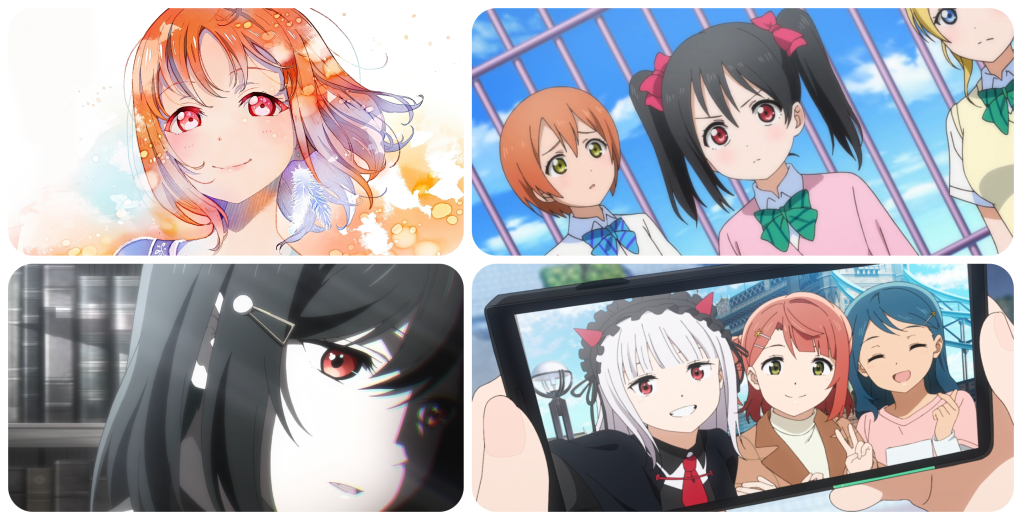
“The normal monster, Chika-chi. Everything about her is normal. She’s always watching the sparkling light from afar. The truth is that she’s got incredible power, and yet…she says she’s just normal and is always on the sidelines.”
To explain it most simply, Sunshine talks about Honoka as god and Chika as monster. As you follow through the shows it becomes apparent that they’re thematic opposites on nearly every level, so their design parameters comprise the core criteria of these two archetypes. If a character acts like Honoka they touch upon the realm of the holy, or if you look at them and think that their motivations, symbolism or storyline remind you of Chika then they can be probably be called beast in some form. Before I come in with any of my discussion, this is how the show lays it out. They’re labels applied to the two as a means of understanding certain characters. The ‘monster’ is usually the one tied most closely to the show’s symbolism. Not always, since Honoka was the one driving symbolic evolution in μ’s, but in the later series we do see it circling most visibly around Chika, R3BIRTH and Wien. As a character she begins in stagnation, fights through melancholy and then ultimately arrives at the ability to fly freely. Chika is obviously the most extreme example with how she turns to Riko and genuinely says “I have nothing”, but for Lanzhu it is still a case where everyone kept abandoning her until she saw within the ‘idol’ a possibility of making it so that they couldn’t look away. Whether soul searching, staving off loneliness or simply feeling stifled by the mundane; Nico, Chika and Lanzhu are all unified by the fact that they’re seeing a distant dream within the glamour of idol performances. Vanity as power; this may be the reasoning behind that shot of Lanzhu with the flowing curtains somewhat resembling a depressing moment of Nico’s. A ‘monster’s storyline is less about cementing the group’s place in idol history, and more about using the group to affirm their existence when they were otherwise empty. It’s the calling card of Aqours as they define themselves in critique of the ‘holy ground’ μ’s. What it seems to me is that Chika’s traits have been split among the trio. Shioriko shares some of her character design elements and gets main control over their symbolic bird and feathers, Lanzhu holds the same motivation of trying to use idol activities to strengthen her weak sense of self, and Mia presents the answer to both their arcs by successfully overcoming her cage and deciding to act upon her deepest-held dreams, which is signposted by Stars We Chase referencing a handful of key shots from Sunshine. Also in approximately half of its instances the ‘monster’ is a younger sister, though that doesn’t seem to be a particularly important link between them.
Ultimately, I do come to conclude that R3BIRTH’s “Monster Girls” was in reference to Chika’s “monster” after all, and this is the key to understanding the themes of both Nijigasaki and Superstar; μ’s are nine lonely girls who find love in each other’s company, so the message there is ultimately about coming together as one light. The group cannot exist without all of them, and a leader is never decided. They become idols so that they can stay together. Aqours are nine weak girls who use the group as a means of overcoming their personal doubts, so the message here is rather about nine colours running in tandem. Each member’s “most important person” is themselves, and Chika’s position as leader is never questioned. They join together predominantly so that they can succeed in becoming idols. They’re the two sides of this coin, and that friction carries forward to define the two paths a school idol can take from thereon. A song of love, or a song of life. Nijigasaki’s solo idols are more individualistic, desperate to shout their own love into the world, so the R3BIRTH trio are rewarded for acting in Aqours’ ideology of personal affirmation. When the series begins the Eutopia music video reveals that, despite her apparent dominance, Lanzhu has caged her bird. She uses a lot of Sunshine paraphernalia in her first performance, such as beaches and oceans, with one shot even being a specific analogue to Sunshine, but the bird cages reveal that Lanzhu isn’t being open with her own desires. It’s exactly what Chika warned of in Wonderful Stories, someone smothering their own shine. She remains standoffish for majority of the series, feeling some mix of pride and self-loathing since her idealised school idol was so different to everyone else. Lanzhu reaches to the sky in despair, repeating the same perspective shot that was so important for Honoka and Chika. It’s only the shock received from seeing the “miracle of nine” manifest through the association’s performance of Tokimeki Runners that she begins to doubt her capacities running solo. As she repeats this shot, Lanzhu mourns how things have run awry. She was so excited to come to Japan, but after transferring she’d accidentally widened that divide separating her and others. Having been held to higher and higher standards with each performance, and her reputation for arrogance also growing every time, Lanzhu believes that it is now a sky she can never reach since no one was like to ever join with her. When Mia calls her “perfect” that’s a damning praise. Relationships don’t come naturally to her, but she has been forced to see that without them she can never create miracle. It is painfully clear where the boundaries of her cage lie.
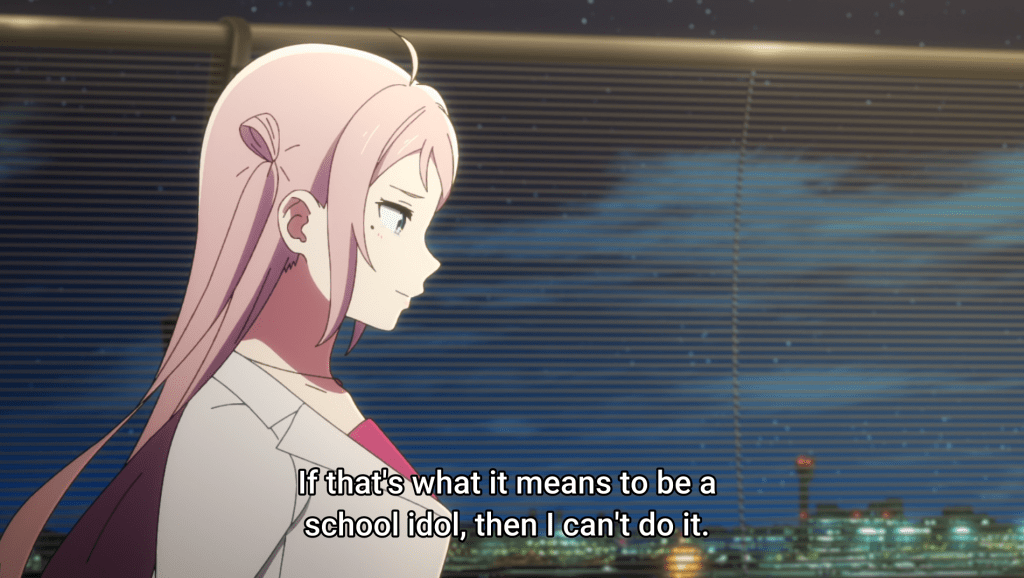
Her insecurities are compounded when her only friend Shioriko reveals her dream of being a school idol. It finally manages to crack Lanzhu’s mask, since she realises she’d never spoken with openly her enough to know. She goes, hey, hang on, that’s my lifelong friend there – the one that I have – and I didn’t even know this was important to her. It’s the same as my dream and I had not one clue. This is where something finally starts moving within Lanzhu, signified by the blue bird’s feather manifesting within Shioriko’s performance scene. The door of the bird cage is slowly inching open. Their group becomes complete a few episodes later when Mia finally realises that she wants to sing for herself, not for anyone else. Mia is the one to reach for the sky this time, and the force of her resolve manipulates the wind to rush out and overwhelm Lanzhu, as is seen multiple times in the other Love Live entries. When her future self performs this on Honoka, it sets in motion the events of them becoming enshrined. And for Chika, there are four main times she gets hit with wind. At the start of episode one when it scatters the flyers to guide her toward the plaza where she witnesses the clip of μ’s winning the second Love Live, when Dia angers over her flimsy knowledge of school idols, and then in the meeting with Saint Snow when she first encounters the truth that there are people so deeply invested in emerging victorious. The final time we see wind playing a symbolic role in Sunshine is right near the end, where Chika internalises the idea that she and Aqours can fly any time they want, and her shout then triggers the wind to rush past the flag. Generally the wind magically kicks up like this whenever a character moves toward the notion of “flying freely”, as was the key to unlocking Future Honoka’s prophecy. Mia tells her that she’d become a school idol even if the latter does leave the school, and thereafter successfully invokes the blue bird. This canary is pretty interesting in itself though. Both the feather in EMOTION and the actual bird in Stars We Chase are blue with a white underbelly. Such a feather does exist in the Dreamy Colour music video, but the anime visuals of the blue bird are never shown with this gradient. It’s usually a flat blue, where the only variation is that the saturation fluctuates depending on Aqours’ emotional state. And we never see it as clearly as the canary, it’s a much more mysterious force moving within the backdrop of the show. The closest we get to actually seeing the Aqours blue bird is one one of the School Idol Festival cards, since in the main series it’s glimpsed a mere three times in the film and always off on the horizon. The one on the card isn’t this canary though, so the mixed colouration may be showing that their individual strive to shine and Lanzhu’s longing for companionship will have their group thematically balance μ’s and Aqours. Because when Mia lets it free the next scene shows her in a wide open space surrounded by white doves. Not canaries, but the same doves seen in Superstar’s second opening. So R3BIRTH has engaged with birds of blue and white. Yet in the adjacent works, it’s shown quite clearly that Shioriko’s canary (which is now applied as a symbol of the entire group via its presence in multiple music videos) is a jade green. It’s not just a simple stylistic difference between the adaptations either since the feather on her desk is the right colour. They even have a shot of a green ocean in that performance, which means they clearly knew what they were doing in interacting with Aqours symbols and then still choosing to make the bird blue instead. So there has to be something written into it. It’s the same over in the game, where Aoi Canaria’s performance incorporates blue feathers despite having a green bird mural in the back. It almost seems to be that their motivations align with Aqours which first whistles the blue bird over to their side, and then it shows them the way to where Honoka’s doves are that they may find a spirit animal and dye it their own colour, becoming the one commonly seen in Shioriko’s promo art. On some meta level, this may represent the new series striking a balance between the idol project of the original and the complex drama that led its sequel to be so dividing. They work in tandem to create a new symbol. Since Lanzhu doesn’t receive a key like the other two members do it might genuinely just that the reason we never get to see a concert that manifests the canary in its correct green colour is due to runtime limitations, and that it’s presumed to happen offscreen.
R3BIRTH have brought the bird into discussion. It’s very cool to see. They also comment on another of Sunshine’s symbolic pillars: its guiding star. The credits roll in School Idol Movie has μ’s swallowed up by a white light which apparently steals them away from the setting, leaving only their outfits behind. Whenever we see them they manifest only through the symbolic presence of star, dove and light. Indeed even when they do finally make their grand return to animation in A Song For You, the dance opens with a curtain falling before a white void, indicating that the entire thing occurs within the segregated cinema space of the star concept. Chika’s journey is then bookended by her quest to summon a star of her own. In that case, since it’s centrally designed around such imagery the title “stars we chase” could be considered a reference to the two main stars which μ’s and Aqours symbolically take up residence within at the end of their storylines. This being its intended meaning is backed by the fact that Shioriko had also manifested the same kind of star seen sprinkled throughout Sunshine while performing EMOTION. If we look at it from that angle then it best highlights how School Idol Project and Sunshine were designed to present two branching paths. In Chika’s first episode she gazes at the white star of μ’s after being alerted to its presence by a glimmer that runs across the screen. μ’s unleash Chika upon the world, watching as she grows and eventually gifting the white feather once they’re confident she’ll be able to dye it in her own colour. Which she does, transforming it into a deep blue to coincide with Riko’s remark that “her strength may now rival a real monster”, and then continuing on to eventually become a star in the sky as counterpart to the originals. This is important to note here, because during Mia’s music video we see that same starry glimmer as the catalyst which stokes her desire and fills her with confidence. This time the glimmer is a light blue, however, and when it transitions to the next stage there are blue feathers falling from the sky in a way that really resembles Water Blue New World. In a conceptual sense, the hand that pushes Mia on the back may have been symbolic stand-in for Aqours. As Chika puts it in their film, the blue bird has soared to R3BIRTH from somewhere over the rainbow. Shioriko, Mia and Lanzhu’s “most important person” is directed inward, and that inner fire for being a school idol is what redeems them. That is the difference between μ’s and Aqours, and now the difference between Liella, Wien and the Nijigasaki girls. The ‘goddess’ is an idol so they they can be together, but the ‘monster’ is together so that they can be an idol. In fact the very point at which Sunshine breaks free of its μ’s imitation is when Chika is told that she doesn’t have to play peacekeeper because everyone joined Aqours for their own reasons. Family wasn’t what underpinned the group. Even when friction does happen between the members, such as the incident with You and Riko, it isn’t her core responsibility to try and resolve it. This is the opposite to School Idol Project, where Honoka is very much handed that role. The School Idol Movie has a point where Honoka says “I’m supposed to be our leader, yet I made you all worry like this.” Eli and Nozomi are both willing to push her because of it, responding with a challenge that she better be prepared to make up for it in their next performance. Over in Sunshine, Chika has a similar line after their catastrophic failure in the Tokyo show. But here, Riko reiterates that none of the members are depending on Chika to be their source of strength in the first place. That attitude is what Mia swoops in with, freeing Lanzhu of her restraints by reassuring her that it’s okay to be selfish.Although this event is used to unify them into a subunit it’s the personal drive that each member possesses which aligns R3BIRTH with the imagery set of Aqours. The ‘school idol’ is a means for them to overcome their personal inadequacies. This is how they become the ‘monster’. They once again inherit the will of those who came before, taking the blue bird and transforming it into a symbol of their own – R3BIRTH’s jade green canary.

So what does this mean for Wien? She was clearly designed as a response to R3BIRTH. In my reflection of Love Live Superstar’s recent season I fixated upon her sudden intrusion into the lineup finally providing a much-needed representative for Aqours’ paradigm, rejoicing at how she escalates the symbolic presence to more familiar levels. It’s a key step as Superstar evolves through the phases of a Love Live series, where the real interesting review points start to appear. After the events of School Idol Movie, the mechanics of Love Live change to where charisma is the main measure of power. The stronger an idol gets, the more they’re able to manifest – and subtly direct- symbolic elements in the scene composition. It’s a sort of self-aware production. Love Live is such where the amount of time you dedicate to engaging with it directly defines how much the story will reward you – and let me tell you, I felt very vindicated watching Wien in action.
I’ll be retreading my previous post a bit since I’d already made an attempt at defining her symbolic presence there, but that script was a bit of a mess. I knew it was a mess, but since that was the first thing I’d written in so long I’d lost all momentum to where fixing it seemed daunting. I decided to just publish it regardless in hopes that completing the process would be a stepping stone for my next piece to be written better again. And I do feel better about this one. Anyway, to offer a quick recap of its contents: Wien storms the stage wearing Aqours’ star and blue feather, as well as more or less inheriting the Next Sparkling outfit. In both its forms the feathers are shown to highlight blue at the end, even on the second stage where that goes against the golden colour temperature. She arrives commanding some of Sunshine’s key symbolic powers, entered into the production by response to a water spout and rainbow. These are two of the core symbols in Sunshine, in fact there’s even an SIF card called “Chika’s Latent Power” which depicts her with them in the idolised outfit. Wien receives the same magic. In particular she wields these mysterious butterflies that are functional equivalent to the fish which zooms by Riko or the green butterflies associated with Shioriko. If I may digress though, I don’t know that the butterfly is necessarily an important concept in itself as Shioriko and Mia have different keys, and the keys are mostly for unlocking Lanzhu’s cage. The butterflies do have an obvious meaning for R3BIRTH that Lanzhu, Shioriko and Mia have emerged from their cocoon to fly freely. But I can’t say I read the same element as being present in Wien’s character since her personal growth is likely held for season 3 instead, so the butterfly misses out on receiving a consistent definition (it doesn’t have any particularly interesting meaning in Kanata’s song Butterfly or the Miitaiken Horizon outfits either, for the record). The lyrics to Butterfly Wing do cite her as being awoken by some fluttering bird and put into motion by the roaring wind, but that’s the contradiction of her character, right? Despite engaging with the usual icon of the bird, Kanon can’t feel any warmth in her song. She is an aberration within Love Live. Her songs roar out into the world, but nobody can ascertain any shape of love within the musical haze. Kanon even attacks her for this, straight up banishing her from the competition. For the most part it just seems to be that sometimes the ‘monster’ receives a glowing animal associated with them and then later their bird, and that Wien has only been given the butterfly as a reference to R3BIRTH. The two do have different meanings since the animal is tied more closely to character. R3BIRTH’s butterflies were detailed prior, and the fish for Aqours embodies how they’re looking for light in a deep, dark ocean. That’s its meaning for the group on a personal level. The bird is then something put forward with respects to the idol culture, and the ever-evolving legacy μ’s created. Wien’s usage of the water blue new world theming comes predominantly in opposition to Kanon, whose symbolic presence is increasingly made to resemble Honoka. Since I’ve already committed to Chika’s eyes being antithetical to Honoka’s character design, then maybe I should be reading the same connection in Kanon’s hair colour. The “orange leader” is a character design staple of Love Live after all. Liella follows from μ’s more closely, so Kanon’s hair is a more vivid orange like Honoka. But since Nijigasaki follow on from Aqours, Ayumu’s hair takes the blood orange hair colour of Chika and further darkens it. Through her aesthetic Wien was interacting with the previous groups in a way that Liella themselves had at the time yet to do, summoning all these abstract forces in order to wage her own war. She is essentially a collection of Aqours’ imagery threads bundled together in the shape of a human and then weaponised against Liella. Wien aligns with Aqours’ desire to do something individualistic and unheard of, intending to once again springboard off the efforts of those who came before so that she can fly free of the limitations she’s been placed within. Like Lanzhu’s scene after Eutopia, she had made an attempt of stealing the light of blessing with Edelstein in the qualifiers. She even manages to force full birds to appears by only her second performance, which, as a reminder, are commonly treated as the penultimate symbolic image applied to any particular Love Live group, right before they disappear into an overhanging star.
So there are at current four main symbolic birds across the franchise, each spoken of in song. Firstly, given that it’s the first series, are the doves of μ’s, referred to as the “baby bird” or “chick”. Obviously at the time this was just a play on Kotori’s name because that’s how BokuHika was written, but for lack of a better term, and because the other birds are named in a similar lyrical fashion later, I’m happy to use that label for the dove. “Chick” being an applicable name is further enforced by School Idol Festival, where the Aqours card collection with white angel wings is named as such, even though the set that has blue wings are simply called “Angel”. Next is the blue bird belonging to Aqours, first mentioned in Wonderful Stories and then turned into a major thematic point in the immediately following film. Then aoi canaria summoned by R3BIRTH, and Wien’s crows. Liella haven’t done anything with the feather Kanon received at the beginning yet, but I’d imagine their bird will be golden to coincide with the colours from Chance Day Chance Way. Pink would be the next most likely option, but Saint Snow have actually already reserved that with their feather that was created through Believe Again. In most cases the bird comes about by the group first performing a kind of interpretive dance where they ‘flap their wings’ in the choreography, which then becomes reflected in the imagery and causes the birds to appear in response. This is true of BokuHika, A Song For You, Water Blue New World, Next Sparkling, Aoi Canaria, and now expands to include the Butterfly Wing – Edelstein pair.

Wien is doing so much on the symbolic level in so short a time. The way in which she seeming teleports + hijacks Kanon’s perception is even a feat of miracle that only Future Honoka herself had been shown capable of to this point, which is a pretty big deal because if you want to get deep into it then I would tell you that she was for all intents and purposes literal god within the setting, and even if you don’t read that far into it the encounter with this enigmatic being is still the key event which propels Honoka toward the exaltation of μ’s. She is the highest structural force whom transfers a franchise-defining level of power to Honoka. Her dream sequence is where “the light that can never be reached” first arises from, so the fact that Wien is even in the same plane of discussion is insane. Furthering that, I would suggest that six evil string hits at the start of Edelstein are an application of the Main Theme of Love Live Superstar motif. This wouldn’t be Love Live’s first time doing such a thing, as smile smile ship start also incorporates Sunshine’s main theme in its opening. School Idol Project and Nijigasaki have an actual name for their main theme on the tracklist, while Sunshine and Superstar just title theirs “Main Theme of Love Live”. So maybe there’s a connection to be made there. Although that was part of their post-anime discography, whereas I am suggesting that the same occurring in Edelstein is done with specific narrative intent. Wien is pretty unique in that unlike anyone else in the franchise she sings out of a deep hatred. She’s angry at being deported to Japan, viewing Love Live as her family punishing her by placing her around amateurs. Eli also hated school idols due to her prestige with figure skating back in Russia, but then changes to say, hey, this is pretty neat actually. Whereas Dia, Nana and Ren were all objecting to the club’s existence only because they believed it was in the school’s best interest. Once they see how it can benefit everyone they go full throttle. And most importantly for this discussion, Lanzhu didn’t hate school idols at all. She was a huge fan of the other girls. Her initial coldness was just frustration at discovering that not everyone was striving for the same grand ambition she held. To her the ‘school idol’ was something which had reached out to her when she was suffering alone. It was her one way out, leading her to hold a pretty warped idea of the ‘idol’ as some decadent creature which exists in a place of power. She’s actually a school idol fanatic on the same level as Nico, Keke and the Kurosawas, and over time she does slowly heal. This is the point where our girls of focus differ. Wien is the only instance where such a detractor still carries that initial dislike through to her performances. So since she’s kind of contrasted against Future Honoka, Wien, no matter how briefly, could be said to temporarily fill the role of ‘devil’ within Love Live. I mean, really, just look at the other girls and then look at her. I feel like that much kinda comes across in the character design. She collates so much of the past imagery so that she may sing in disdain.
However, it warrants admitting that when I was writing about Wien beforehand, I still hadn’t seen past the first episode of Nijigasaki 2. Which was silly of me, but I was writing blind in that regard. Revisiting her performance with knowledge of R3BIRTH’s imagery line in mind offers a stronger context for her own aesthetic. It furthers the awareness that Wien really is the individual symbolic peak of Love Live so far. Not only is Wien wearing much of Aqours’ imagery, but she merges it with Lanzhu’s sense of being overpowered, or wanting to conquer those below her (as spoken of in Queendom’s lyrics), and the stage aesthetic of the giant gears and magical butterflies from when Shioriko becomes an idol are also reused for Butterfly Wing. Mia and Wien are both 14 years old, far younger than the usual members, plus the storyline of both sees them sharing similar concerns over their family’s historic name. Aqours leave the blue bird behind when they leave, R3BIRTH inherit their will and then Wien sort of absorbs it all. As a bit of an update to my initial comments about Wien, the implication of this strengthens the breadth of her ‘villain’ role since she could now be considered an amalgamation of all the Love Live ‘monsters’ to now. Wien sees that “songs are power” while they exist within the frame and tries to capitalise on that to goad the writers into awarding her victory.
Unfortunately for her, even with all that goes on under its thematic hood this is still a Love Live idol series. So Wien can’t get off scot-free for insulting the integrity of its namesake. I mean – it’s just the point of the show really. Can’t do much about it. Yes it’s true that Lanzhu and Wien establish very similar presences in the beginning since their debut performances equally blow out the competition and their narcissistic behaviour only escalates from there. However Lanzhu’s initial antagonism arose out of personal frustrations with her own social circumstances and a desire to see school idols be better than they were. That line of thinking is dispelled once Lanzhu sees the “miracle of nine” in action at Tokimeki Runners though, since for her it’s a display of love and passion nonetheless. Her remark that idols should only give the fans dreams is subtly different from Wien desiring to wield her aura as a weapon. Wien too is hit by the brunt of the miracle, once the full group of Liella is assembled and abruptly start singing about heaven in Vitamin Summer. In this case however, she remains stagnant. Nothing that could be taken as loving is forced out of her in response. The clock gears in Shioriko’s performance are similar in that they indicate her finally starting upon her dreams. But in Wien’s those same gears are just a setpiece she’s pulled in as she unconsciously triggers symbolic forces in her attempt to rise above school idols. I’ve pondered upon it but I can really only see the recurring imagery in Wien’s concerts as window dressing to prop her up as the solo ‘monster’ for Superstar, because she isn’t evolving through her songs like the protagonists would. What she wants to accomplish through her performances is to win the Love Live and claim her right to return home, but because of her problematic character she does so while dismissing the quality of the competition. She isn’t inheriting anyone’s legacy and is rejecting the culture, which goes against the message of the franchise. In fact Kanon herself addresses this very thing, acting as protagonist and spokesperson. Since she herself burns with such fire for singing, she deeply believes that Wien has to have that same love of music in her somewhere. There’s simply no other explanation for her performing at the level she does. But she must have lost those feelings somewhere along the way, as the only emotion conveyed by Butterfly Wing was a cold desire for victory. The irony of which is not lost on Kanon, as Butterfly Wing’s lyrics speak of how Wien’s passion burns and roars. Her next song tells of a precarious path between blessing and curse. so I guess Wien just ended up falling prey to the latter. Despite being such a parallel to Lanzhu and co, Wien slaps away the hands that would help her, having become so obsessed with glory that she could now only equate kindness to pity. Or for a more convincing narrative reason, since Chika says “nobody makes a miracle from the start” pride therefore has to have a fall afterward. And since Wien had more pride than anyone, her fall has to be equally as grand. She doesn’t get the same cushioning as others. So much power is at hand, but she hasn’t actually earnt it within the show’s runtime. If she had undergone the appropriate character development prior to the qualifiers then it’s possible the show would have been accommodated her by permitting Wien to succeed and hold that victory over Liella until season 3. Yet since she would only begin scaling back after her loss, when she next appears her outfit is in tatters, as if she had been battling the show itself offscreen. With all she does to symbolically attack the school idol structure, let’s say that her intent of smashing Love Live may have been referring to more than just the in-universe contest. But it was a fight she was rapidly losing. The butterflies which she said she would use to overthrow the bird above. and which were a bridge for her to leech off R3BIRTH’s aura, have left her. Instead she creates her own crows during a scene transition and is therein ensnared by a more standard Love Live rival arrangement. That’s why she loses to Liella and is soon shuffled over to Yuigaoka. She tried to disobey the symbolic rules of the series and was pushed away because of it.

Even though the episode leaves it as a cliffhanger, reading the symbolic meanings of Edelstein vs Sing Shine Smile and the preceding episode is enough to highlight that Wien’s power has shattered. While it may be less ambitious than their song from the regionals, it makes total sense why Sing Shine Smile is what Liella believe will nullify Wien’s tracks. Where hers are full of trickery by injecting a dramatic new genre and instigating symbolic forces to try and succeed as a solo idol inside the mainline series, this competing track is just an honest group song. It’s fun, catchy and designed to be something the audience would clap along to. I suppose in that sense it comes to be understood as the culmination of Liella’s character friction with the new members in S2. Wien became Love Live’s enemy and sought to take the crown by pulling ahead on her own, but when stared down by the sinister strings of Edelstein we see Liella shoot back with something which conveys it’s okay if there’s a skill gap, just do what you can. This is further cemented by the fact that its lyrics are basically just a repetition of various staple concepts from the series like “hearts connected as one”, the star, kagayaki and choosing whether to exist within the past, present or future. Particularly of note on that last one, BokuHika says “the now is perfect”, because μ’s decide they don’t need a future. Water Blue New World then responds to that and says, well actually “today is today and it’s different from yesterday”, revealing that they’ll continue to cycle members forward into the future. Liella’s song here chooses to repeat the idea that “even if I could go anywhere, past or future, I’m sure I’d just stay here forever”. They value the current moment more than tomorrow, strengthening Kanon’s previously mentioned link to Honoka. Songs are power, that much is true. Sunny Day Song even incorporates “song power”, and that performance in particular is pretty much what every piece of sequel content is created from. But Kanon, the protagonist, ultimately denies Wien’s proposition on the “real meaning of song”. Her chances at succeeding in the storyline go down with it. Wien’s singing is described as “cold”, while Liella transition into the finals with a campfire. The fire thus establishes that they will counter her, while also serving as a subtle reference to the “honoo” (flame) in Honoka’s name, or her home bakery “Homura”. Nijigasaki is a story centred around solo idols and thus favours the generational element of Aqours, but since Superstar is the equivalent μ’s incarnation Wien, whom manifests Sunshine’s signature symbolic powers onto the scene, is ultimately punished by the setting for daring to try and run the Love Live while standing alone. Alone not just in that she is without partner, but in that she has not received the feelings left behind by those who once walked before her. Aqours find their final comfort in the realisation that they are never really starting from zero. Their past experiences stay within and inform who they are. The Nijigasaki association prefer performing solo, but they’re never alone. They fully immerse themselves in the shared mania of their community, and indeed the centre-most focus of their anime series is about establishing the School Idol Festival as a space for school idols to congregate like never before. Think about it – the School Idol Festival is a big era-defining event that can essentially be understood as a reinvention of Sunny Day Song. So although they’re counterpart to Wien, R3BIRTH are dyed in their own anime’s colour, not trying to blot it out. If we fixate on the storyline of the bird cage that progresses across their performances, we see that when Lanzhu announces herself with Eutopia the cage is only full of seawater. There’s not even a glimpse of the actual blue bird. So when the water is shown to spill out of the cage and rejuvenate her, that can be interpreted as a sign that at first Lanzhu is merely adopting the aesthetic left behind by Aqours, but not yet embracing the actual feelings. This puts her in the exact same position as Wien. If left unchecked Lanzhu surely would have collapsed in the same manner. However she comes to be joined by Shioriko and Mia, who receive the symbolic prompt from Eutopia and steadily evolve it toward summoning the feather and then aoi canaria. They aren’t alone. During the one time that the episodes interact with the Love Live qualifiers the track “Dare mo Hitori ja nai” (Nobody is Alone) used as an answer to “Dare mo Inai” (Nobody is Here) from μ’s lonely first performance, really hammering in how they and the School Idol Festival are all working together as one greater whole. Moreover, the Kiseki Hikaru motif briefly plays in one of the last songs on the soundtrack titled Ameagari Sasu Hikari to complete the process of linking the Aqours and Nijigasaki rainbows. Kiseki Hikaru was already a musical line in Sunshine that began with Okoso Kiseki O, evolved through various BGM and then culminated in the full insert track’s usage during the film. So I won’t accept this as mere coincidence. Everything and everyone is connected. Wien, in Superstar, had chosen to spit in the face of that sentiment. For as much visual flair as she carries with her, as dramatically as she struck at the show’s very foundations, she had no one pushing her back. Thus her chains bind her to the ground.
Yu had attracted Lanzhu’s scorn because the latter felt that playing friends would impair her ability to pull ahead of any competition. She grows out of this thinking. Wien chastises Kanon to a similar degree, recognising that song creates magic and so someone bearing as much talent as Kanon should be performing at much higher places than she currently is. She remains stuck in her ways. I digress here, but this one introduces an interesting point of discussion. Why is Wien so fixated on Kanon? I think that’s because her character concept recognises a kindred power in Kanon. I did mention earlier that Liella, and Kanon in particular, are increasingly coming to embody Honoka’s set of imagery through their magical flowers and the suggestion of the group not having a centre. Wien serves to further this association by herself adopting so much of Aqours as the means of becoming their enemy. This comes to a head at the end of Superstar 2. When Kanon is about to leave for abroad, Chisato declares that they’ve talked it over and believe that it would be best for Liella to disband. Like μ’s. However, in a shock twist, Kanon doesn’t hesitate in shutting down their suggestion. “I get that you all feel like the nine of us are Liella and that we can’t have anyone missing. But I don’t want you to stop.” This line here, I would say, is the sentiment that Wien had been responding to inside of Kanon. What she spends the whole show calling to. She isn’t the ‘monster’, but her story origins do lie with its prototype Nico. Both had the childhood dream of becoming a musician, but were unable to realise it and spent the next years plagued by failure. Believing that this would be as good as it gets for someone like her, until a miracle finally visits in the form of the group. Refuting the sacrifice is the same act that Nico had done both times μ’s was threatened. The difference is just that this time people actually listened to Kanon since she’s the leader. She and Wien were designed as definite counterpart characters. If we return to Mirai Yohou Hallelujah from the first episode of Superstar, the dip before the final chorus has her saying “no matter how high the wall, I’ll surpass it (donna ni takai kabe mo, koete yuku yo)”. It should not be overlooked then, that one of the soundtracks associated with Wien is called “high wall (takai kabe)”. They’re natural enemies. An existing love of music that outweighs anyone else in the franchise is used to pit them against each other. But in this moment, Kanon figures out how to rampage from within the show’s structure. Unlike Wien who loses in her battle against Love Live. When Liella comes to this climax of the standard Love Live formula Kanon explicitly references the dialogue from School Idol Project, but then refuses to conform. Kanon had suffered too much to see the group end. By turning down their attempt at an emotional farewell Kanon, in this moment, is looking to the future of the group in a manner more resembling Sunshine. A character throughline is then established from Nico to Chika to Kanon. So with this understanding we could put the reason why Wien pops up so randomly, says “Shibuya Kanon” and then leaves without elaborating as being because she saw the potential of ‘monster’, of one who stands solo, within her. She’s acknowledging Shibuya Kanon in isolation, not mentioning “Liella” as a group at all. Because Wien could maybe tell that when the moment came she’d be the one who rejects the group’s emotional unity. And in fairness maybe there is a justifiable precedent for that. Prior to the anime’s storyline the Nijigasaki girls were a full group that had since disbanded, and it’s only by exploring a solo endeavour that they get moving again. On a thematic level though I think she underestimated Kanon. When we reach the Love Live finals it’s immediately visible that the stage is mixing the flower and water imagery themes of μ’s and Aqours, which had already been running in friction throughout Superstar. By blending together both Honoka and Chika’s lines of thinking when prompted here, Kanon becomes the one best suited to stand on that stage. This is how she defeats Wien. She mixes School Idol Project and Sunshine, using a selfish drive to be the cement keeping the group together as one. Just like the Nijigasaki girls who create the School Idol Festival despite not being a formal group. By looking at where Kanon is in the end, the character contrasts between Wien and Lanzhu are led to their culmination. Love Live’s setting selects Kanon as its new champion instead.
If I can just squeeze my crazy, bold theory here for futureproofing purposes, I’m low-key expecting R3BIRTH to make their way over to Superstar as the final bosses for when its story reaches the end in either S3 or its movie. Wien was modelled as such a “what-if” on Lanzhu in many ways, and because their airing overlaps Niji and Superstar have had a far more concurrent identity than SIP and its clear sequel Sunshine. Anyway:
Looking to the future of the franchise, Nijigasaki illustrates that being a solo idol is totally fine so long as they are still shouting their love skyward, while Superstar warns of what happens when someone walks the opposite path by seeking only the authority that comes with being beneath the spotlight. That, in my opinion, is a glimpse into how Lanzhu and Wien are used to open the conversation on inheriting and establishing new legacies in the post-Sunshine series. The two have very similar auras within their show, smashing into the stage with all the force of a shooting star. They’re overpowered in a way no idol had been before, which permits us to link their narrative function with each show. The imagery tied to them is similar too, as in both cases it’s a borrowing of the symbols Aqours entrusted to the future when their blue bird flew over the rainbow. In character however, they’re taken in vastly different directions. Lanzhu is a lonesome girl who triggers the arrival of the blue bird as a means of steering her story arc toward emotional stability, but when Wien invokes Aqours it isn’t able to quell her anger any and she’s eventually met with destruction. Lanzhu intrinsically links her idol fanaticism into her search for a place to belong, mixing the two original groups and being blessed because of it. Whereas since Wien only takes up the symbolic prowess of Aqours, her footing crumbles once Kanon fulfills the proper prophecy by blurring the lines between the philosophies of Honoka and Chika in the final episodes. We’re now set at yet another evolution of the idol culture, and so this intertextual character friction is implemented to establish them as another pair of branching paths. One that whispers of love, and one that roars with life. Each entry’s second season subsequently become understood as a thematic battle between μ’s and Aqours, as well as establishing Superstar to be a counterpart series to Nijigasaki in the same manner that the originals were. It finally hits home the realisation that we’re in the next phase of the Love Live storyline, and that they are continuing to build forward from the message in the prequels. R3BIRTH and Wien summon the all-important bird onto the scene, and there begins a new legacy.

 skapbadoa
Leave a comment