
Hello again. I’m not sure what happened last year that lead to me being as active as I was, but clearly that has rectified itself and I think it’s best if we just pretend it was some strange accident or something. Very odd. But anyway wow look at the time, it’s regularly-scheduled Love Live o’clock. And so here I am. I just felt like I might do a bit of a gush over Love Live Superstar’s second season. A review, as it is so called. Because I have things to say. They are things which I probably should be holding off until the end of the narrative to say, but that’d be at least one more year. Maybe even two, depending on whether the third cour is replacing the usual movie or not. So I’ve decided I’ll just say it here and probably find some way to reiterate myself with more specificity later. Season 2’s sharp increase in headcount intrudes upon the straightforwardness that was Superstar’s initial appeal against the others, and places a degree of stress upon the show’s pacing to the extent that the audience is predominantly left feeling like a third is owed. However even though the structure becomes bloated by adding too much in too little a time, what that new content actually is leads me to say that this recent season has eclipsed the first in my personal enjoyment. And it is all because of one, single character and what effect her presence has on the show.
The first season of Love Live Superstar was probably the most accessible entry in the series, if not the most consistent. Cutting down the core cast means the episodes can have a newfound stability – who’d have thought? Superstar hadn’t done anything as ambitious as Sunshine’s, well its whole design really, or been deeply transformative like Nijigasaki injecting harem undertones to the character relationships. However while not being as experimental, Superstar had made a case for itself by simply being solid. Its character content really is great and the lower register that the five Liella sung in was a pretty fresh sound for the series. But for my purposes there was no particular need to address it. Superstar lightly touched upon the core iconography of its predecessors by giving Kanon the dove feather in her debut performance, but within the confines of season one that symbol is not made to go anywhere of interest. It introduces itself with the dove to clearly denote its position as a mainline series in the post-μ’s world, but then transitions into more standard School Idol Project antics. The developments seen in second season, however, significantly change the game. Margaret Wien, this season’s antagonist, is the character who initiates that transformation in the setting. The Love Live anime all have this undercurrent of miracle and magic to them where idol charisma directly translates into a character’s ability to influence the scene composition and therein distort the setting. Like Honoka’s weather manipulation and sending the doves out of Donna Toki mo Zutto into Love Live Sunshine, Aqours parting the clouds at the mountain summit and warping feathers through the screen in Water Blue New World, or Setsuna giving Yuu that fiery vision. When a character is sufficiently powerful the show itself responds by letting the kind of intensely symbolic interactions which would usually be exclusive to ED animations instead start bleeding into the main presentation. The performative is made real. True to form, in Superstar we have begun to see that Kanon’s determination is now capable of making natural objects like flowers and autumn leaves radiate wherever she walks. But nobody has ever displayed such a direct grasp on it as Margaret. This character is seemingly the crystallisation of all the mad rambling I’ve ever done for Love Live. Margaret has inevitably mellowed out after her defeat and I imagine this will become the key to contextualising her when I revisit this topic at the end of Superstar’s narrative, but her debut performances – that initial animosity – were expertly crafted to hit every point for her to be understood as Love Live’s ‘final boss’ up to this point. Someone who threatens even Lanzhu and Setsuna’s individual idol aura, and whom may perhaps be the final form of Chika’s ‘monster’; a solo idol weaponising all Sunshine’s past imagery to genuinely terrify the competition. Margaret also seems to be the sole character aside from Future Honoka that touches upon divinity, effected through omnipresence. Most of her early screentime has Margaret flitting in and out of Kanon’s perception, and she performs feats of disembodiment such as vanishing from the playground in their first meeting, or knocking on the cafe’s door despite being all the way up the stairs. The symbolic power congregates most strongly around the season’s new antagonist, restoring a layer of artistic depth that Superstar had previously pushed to the side.
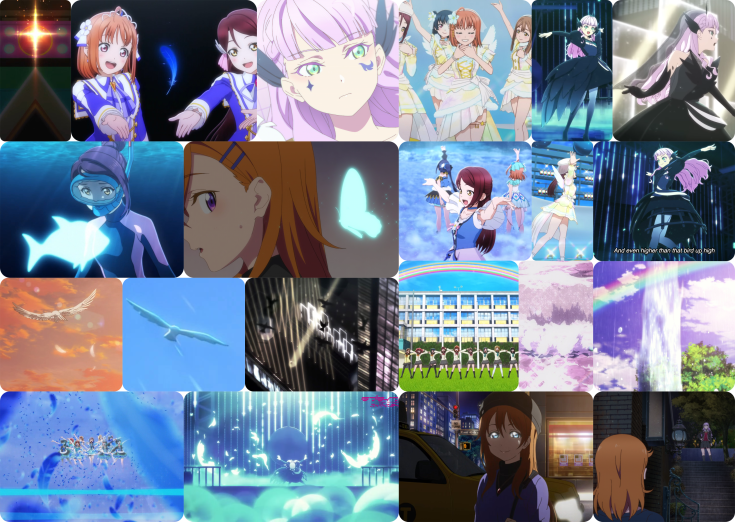
Love Live receives an actual villain, and it is awesome. She arrives to the show simultaneously with Kinako’s induction into Liella, and immediately begins escalating the symbolic presence. This event in the second episode sees the two dominant symbols of μ’s and Aqours positioned against each other, signifying Superstar’s shift into a tale of school idol succession. Kinako wasn’t confident about forcing her way into such a close group, but the other girls set those worries to rest. When she then rushes over to participate in the roll-call the wind suddenly sets a storm of flower petals into the air. Kanon has been capable of this since the very beginning as seen in Mirai Youhou Hallelujah, but that line of imagery has steadily evolved to the point where in season 2 she’s now activating these flowers much more deliberately. The significance of which is revealed when we remember how a glowing red flower had been the final symbol applied to Honoka in School Idol Movie. It marks the point at which she becomes thematically enshrined and μ’s is promoted to head of the school idol society. As such, Liella’s own main imagery currently being a similar set of glowing flowers reveals them to be operating under the μ’s doctrine. An honest, straightforward song of love leading them to success. They haven’t particularly twisted the narrative structure or had to stave off failure to the degree that happened in Sunshine, so they’re assigned the role of μ’s descendants. The progenitors have been invoked, but Superstar doesn’t simply leave it at that. At the end of this scene a water fountain shoots up with a rainbow refracting off its droplets, and thus Margaret sets foot in the show. A mysterious sound effect is played when the rainbow forms to signal its importance. These are Aqours’ two main symbols, suddenly manifesting to welcome Margaret into the cast. Since Superstar was first announced I had been theorising that we would eventually run into the Next Aqours as the main rival group. At this stage I’m not sure that’s going to happen anymore, but in terms of how she’s implemented into the show we can see Margaret as fulfilling the conditions to be Aqours’ representative. She’s introduced with the Aqours’ rainbow, and is shown to have direct control over the symbolic forces in many ways. For the most obvious example, she leads Kanon to witness her stage using a mysterious blue butterfly. Sunshine had an equivalent line of imagery with the glowing blue fish and bird, which Margaret’s magic is clearly referring back to. Her debut performance begins by turning her scarf into them, which is something peak Aqours was also shown to be capable of when their coats are transformed into feathers during their Love Live. By her second performance Margaret’s dress has further evolved with the veil to more closely resemble its inspiration, and during the choreography she summons birds in her signature black colour, which tend to be a group’s penultimate symbol. While not hugely significant, I do also note how the visuals during Edelstein really focus on the spotlight by placing it against a dark background, debatably conforming to Sunshine’s own spotlights that are peppered throughout its theatrical shot compositions. Additionally In both of her performances so far Margaret has clothed herself in what appears to be a demonic version of the Next Sparkling accord. She wears a blue star and feather as her stage makeup, and her song lyrics have revealed her desire to “soar higher than the birds”, therein knowingly engaging with the previous group at a level that Liella themselves have not yet displayed.
As her main counterpart, Kanon this season was largely devoted to undoing the the skill gap, refining the whole group instead of being individualistic like Margaret. The pacing slows rather dramatically as they focus on alleviating the first-years feelings that they’re intruding or unwelcome – even going so far as to mimic Honoka’s idea of having a group without a centre, which is a discussion that had never come up during Sunshine. This breaking down of the usual senpai-kouhai hierarchy, in conjunction with their prior reenacting of Snow Halation, is enough to prompt the ethereal flower that had been the mark of Honoka’s deification to come to them. In doing so, they conceptually resurrect μ’s. They are the selfless. Whereas Margaret is then the opposite. The selfish. The monstrous. She’s the thematic manifestation of Aqours that was missing in the first season of Superstar, summoned onto the scene by their signature symbolic powers. With μ’s nine parts become a unified whole, so the introduction of the first years in Superstar’s second season is done to facilitate Liella’s evolution toward that state. Aqours was a more individualistic group where, even if there were nine of them, each member had a personal truth that they wished to grasp within the ‘idol’. Zero becomes one. Margaret is finally this successor that has been presented as strong enough to stand alone. In a sense this becomes a more literal representation of that gods & monsters friction that was written into Chika’s dynamic with the overhanging Honoka, since the titans have now clashed with a sense of physicality that was not possible inside Sunshine’s more artistic direction. The introduction of the new characters starts a shift in style, where the production begins to conform to School Idol Movie & Sunshine’s more magical symbolic conventions. The miracle of nine, and she who stands against the tide. She’s able to control the show so deeply that her summoning of the butterflies is to be considered intentional, and she effortlessly performs symbolic feats on the level of the legendary groups as soon as she steps onscreen. The way in which Margaret toys with it seems so deliberate, so knowledgeable about the show’s mechanics. She is prophecy made flesh. And that’s pretty cool I think. I like it when Love Live does the thing.
 skapbadoa