Just a bit of a short thing here since it’s been on my mind for a while now that in both Of Gods and Monsters and my top 12 anime list, there was something I perhaps forgot to do in my introductions of Love Live Sunshine. Defining my terms, and whatnot. Specifically in regards to that tagline of it being the “Serial Experiments Lain of idol anime”. I understand what I mean by saying that, but in review it turns out that I never really dedicated a satisfactory portion to explaining what I actually mean by that. Essentially I’m talking about what the interaction of their storytelling and presentation causes the show to turn into; where the imagery forms the very ground the characters stand upon, and any character development or major narrative event that gets reflected in the symbolic evolution thus also shakes the foundation of their reality. A world with malleable physical limits that do get disrupted throughout the course of the show.
Comparing Love Live Sunshine to such a mysterious god as that of Serial Experiments Lain, I would personally suggest that they aren’t as far off as one may think. It adorns itself in the “School Idol Project” moniker but the storytelling is vastly different to anything you’d see in the original, Superstar or Nijigasaki, which is why it caused such a harsh community divide at the time of release. These two shows tell their stories in a similar fashion. Decorated with symbols as abundant as they are abstract, and keeping the true scale of the story hidden behind interlocking walls of imagery. Both projects place a certain level of expectation on the viewer, since the amount of effort one is willing to put into engaging with them directly defines how much the story will reward you. The surface narrative of Aqours is obviously a lot easier to make headway in than Lain’s journey is at any point, and its symbolic arsenal is likewise a lot more straightforward. Linking the two series together like I do, I’m not necessarily making the claim that Love Live Sunshine is as confusing or difficult to decode. Because it isn’t. Anything it does with its imagery synchronizes with other surrounding symbolism to flesh out its artistic side, but they’re still mostly things you can look at and immediately understand their meaning and usage within the show. Which is far more than can be said of Serial Experiments Lain. Man that show is confusing. Every time I start up a rewatch I always think to myself that it should be an easy watch since I’ve already got so many of my own answers, and then am immediately humbled by how dense and difficult it is. It’s mentally exhausting. Love Live Sunshine is nowhere near that tough to watch. But it’s the storytelling which makes it to where I feel like these two properties that would first seem to be polar opposites actually have a shocking amount in common. Serial Experiments Lain is a perception horror. Love Live Sunshine cocoons itself within a theatrical stage and is thus to be understood as something of an interpretive dance, production or musical. None of the other Love Live entries seem to do this, but for Sunshine the fact that it’s a musical is just a touch more deliberate. They are actors and everything they do is performative. The meeting point between the idea of perception horror and a musical is surprisingly close, since both treat physical space as a stage set that can be freely altered. The reason I like to link the way these series are designed is that in both of them the characters inhabit a malleable physical space that distorts and contorts according to the evolution of its imagery threads. Neither of these treat reality as being a permanent construct. The limits of what is possible in the show is constantly shifting according to the mood swings of the protagonist. The stories are almost like that told by an unreliable narrator, except that the narrator in this case is actually god presiding over it, and the protagonist is constantly trying to steal their seat.
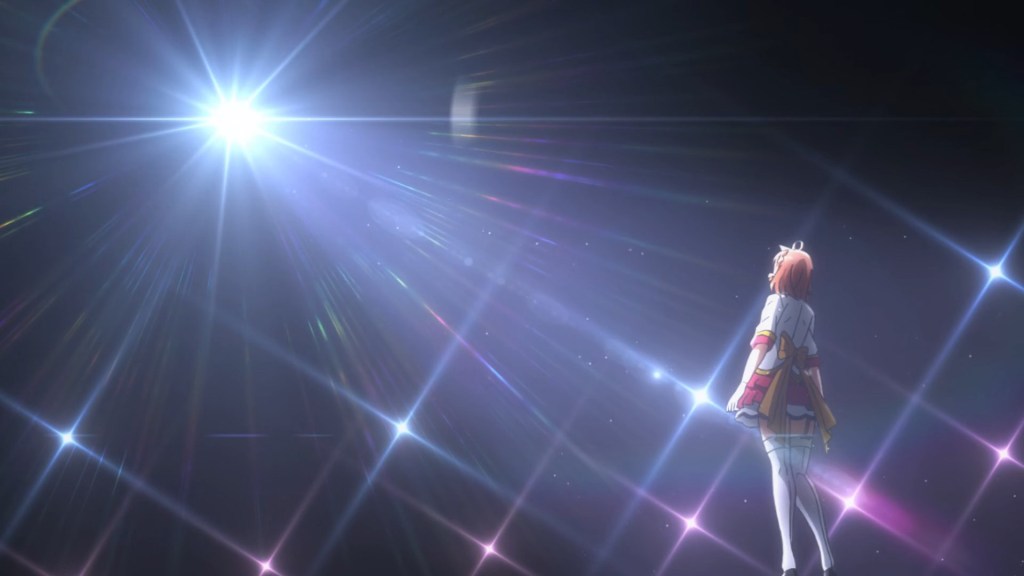
The thing about Love Live Sunshine is that the entire production is enveloped in the divine. Within the symbolic terminology of the series μ’s have been elevated into fully-fledged gods. They don’t just represent a philosophical ideal, but genuinely touch the setting with an invisible hand and exert influence from an unseen place. They get used as deities and interact with the world just as properly as any Lain, Haruhi or Madoka does. Aqours is likewise presented as one gazing up at the heavenly star and thirsting for its power, doing all it can to take that magic for its own. The language used in the introductory episodes wastes no time in setting up this conflict. μ’s is the origin of life that school idols pray to, and Chika is constantly spoken of as a monster. She has the physical attributes denoting this too, with her red eyes and frequent roaring. Because of the anime’s art style her eyes often tend to look pink because the highlight is the largest part, but that’s quite a misnomer in my opinion since it misses the point of such an integral thematic point. Look at any of the other promotional material and it’s more apparent that they’re the same red colour as Ruby’s hair or the ribbon on their uniform. Chika is designed to be a counter to Honoka’s blessing. At every step of their journey the thing that the characters are chasing most is the ability to create miracles. They hunger for it. The miracle consistently eludes them for one reason or another, but there are just a few moments where they tap into its power and we see that the narrative itself bends to their desires. In episode 16 they run from one venue to the next in a time that had been deemed fully impossible. This miracle leads to an incredible shift in the imagery, where the usual shot of the lens flare rainbow and Chika reaching forward are transformed to signify its importance. The rainbow, as a clashing of light and water, serves to indicate the tug-of-war between μ’s and Aqours. The group begins as part of the congregation that Sunny Day Song attracted and they spend the series heading toward Water Blue New World, with the rainbow formed in the interim. When they make their first miracle it temporarily upsets the balance of power. The scale tips in Aqours’ favour and the rainbow is turned into a bubble. That is the first miracle, and the first display of the things they will eventually become capable of within the transient reality they occupy. In episode 23 the group comes together, threatens to usurp god and makes a wish. In some sense, yes, overthrowing god in that moment due to accomplishing a feat had previously been an act of μ’s in the aftermath of their first Tokyo performance. The nine of them together directly cause a stormy sky to become clear, performing an otherworldly magic that this time interacts with the tangible mise en scene rather than just the encoded symbols.

Most particularly I would want to point to Water Blue New World, since there’s a specific moment in that performance which embodies everything I ramble about in the show. Chika and her friends unite under the banner of Aqours and become the monster. The monster whose roar shatters the earth and shakes heaven. Sunshine is, in many ways, about retroactively giving definition to μ’s. They’re depersonalised and deified, and the focus of the show then becomes about how Aqours define themselves in critique. The whole point of the first season, really, is establishing the insurmountable divide between them. Honoka is revealed to be something of a god in how effortlessly she pulled μ’s to the heights they did, and when Chika tries to imitate them she’s immediately and repeatedly met with failure. Because Chika is just normal. There is a beast slumbering somewhere inside of her, but awakening its power is not so simple a ritual. Sunshine is, effectively, exploring what happens to the group when leadership is left to someone emotionally vulnerable. Chika is like Nico more than anything. A girl suffocated by the mundane, desperately clawing at radiance in the hopes that it will help patch over her inner emptiness. Any similarities she has with Honoka are only hair-deep. Because unlike Honoka, Chika is weak. Because unlike Kanon, Chika is weak. Chika struggled for 12 episodes to first become worthy of the feather, while Kanon grabbed that biz in her only her first, and Shizuku nabs it after a single performance. Sunshine is a story about constantly battling against insurmountable odds – loss after loss, wave after wave – and eventually growing so strong as to snatch life from the jaws of death.

And they just get stronger and stronger. Burning brighter, more ferocious, with each passing day. Uranohoshi’s bonfire was the sacrificial lamb and its student body singing as church, to invoke the divine upon them. This is something that has to be done in order to permit Aqours to accrue that much force. Because unlike the lonely god that had found power in the love of those around them, the monster is suffocating and simply thrashing about as it searches for the one path left it has for life. Chika is honestly just a very dumb girl that easily gets distracted or overwhelmed when she has too many options, so it’s only when they’ve been punished aplenty and when all other avenues are eliminated that the single way forward is revealed. There is no elegance, no finesse. Just a genuine desire to learn what it means to live.
When they perform at the Love Live finals, they step into the realm above. An endless expanse of cloud sits at their feet and there’s nothing but space visible above them. Standing at the highest of heights, at the climax of a long-fought journey upward and at the most powerful they will surely ever be; for just a second, just one brief second, Aqours’ power temporarily disrupts the setting and they literally break reality.
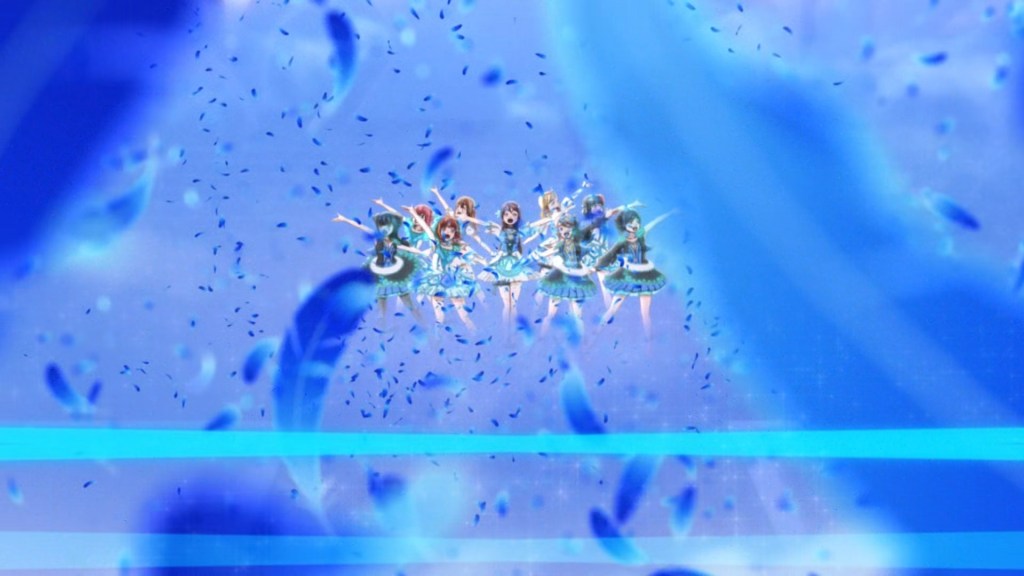
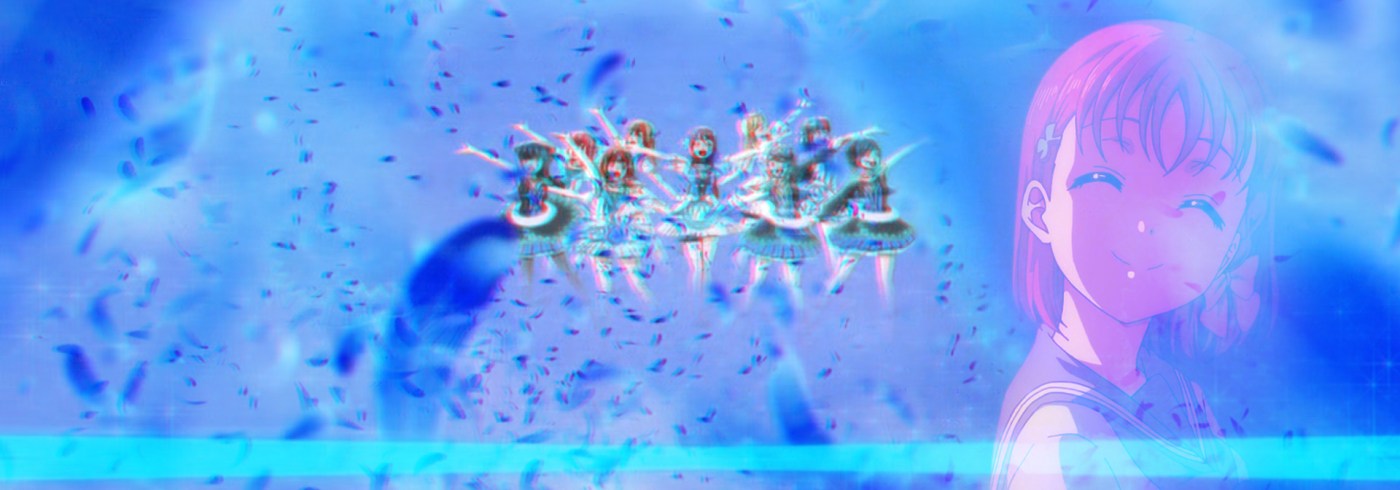
They overwhelm physical space and tear at the seams. At the start of the first chorus the jackets are discarded, and they then transform into the blue bird’s feather. Its image is invoked through the way they flap their wings at the start, and then thrust into reality. This act shakes the foundation of their world. Their song rumbles with such an intensity that the feathers slip through a hole in reality and warp through the screen into the audience. This is essentially a moment equivalent to when Lain incites her control over Protocol 7 to burn down the school gym, that quick burst of emotion from a being of godlike status which temporarily overlays an unreal power into real space. The feathers teleporting through the screen carries much the same meaning for its own setting. It’s not purely performative flair either, as next episode we see Chika reflecting on the event as a proper memory.
That’s why I’ve become so taken with this phrase, and what I actually mean when I say that Love Live Sunshine is on the same playing field. An otherwise straightforward story, whose imagery clues us into a more thematically complex subnarrative. μ’s becomes the god that governs, and Aqours the monster which bites its hand. Everything about this shows production, taken in tandem, makes it into this deceptively deep saga where the principles of reality aren’t that unlike the fragile Wired world.
 skapbadoa
Leave a comment