Sonic the Hedgehog (Archie) – where does one even begin in discussing this behemoth. It’s a common story but my initial encounter with these comics comes from a lot of time spent looking at the covers in Mega Collection+’s extra menu, dreaming of what madness could possibly be behind those crazy artworks. Given that Sonic has been my favourite media franchise for literally as far as my memory stretches, this has always kept the comics at the edge of my mind. Admittedly it took a long time before I would actually read them, since for a long time I had no way to find it. I would often go to comic shops with my brother but had no luck, and so would mostly watch a few scattered stories here and there in the videos that people upload to Youtube, and was enamoured by mr recolour man Scourge and his evil super form. But it was only in the debut of the episodic Sonic Universe series that I would say I hopped on, though again without a way to access any of the backlog. After orbiting the series with random issues and osmotic knowledge for all my life, and after several attempts to tackle it that never made it beyond the initial slapstick era, the 30th anniversary celebrations kind of, I dunno, put me in a Sonic mood and I figured it was finally time to sit down and do a full, comprehensive read of the Archie-published Sonic the Hedgehog comic series. Such a wild journey this is. It was a downright struggle to get through its early years and despite finding the lore intriguing I don’t think I had ever actually thought to myself that it was enjoyable as anything more than an observational experiment until the tail-end of the Adventure adaptation. Which is a long time, by the way. That’s at issue 80, and you might be thinking “dang man 80 issues is a long time to be forcing yourself to read something”. But no. The Sonic comics are densely packed and constantly weaving in and out of various subseries. #80 is actually around 150 issues into the reading order. That’s a long time to be putting up with something where my primary reaction was “in 200 chapters this plot thread is going to be so awesome”. It was very much a labour of love. But it’s certainly been a worthwhile read to get here. This story and setting are so captivating. Its cast is convoluted and with the whole series in view the only consistency to be found is in how inconsistent it all is. It’s an extremely fascinating universe of excessive character definition. It is a mess eventually made magic. As a lifelong franchise fan and someone who had been curious about these in some form or another all that time, it’s rewarding to go back to it. Rewarding – but that doesn’t automatically mean it’s a good time. Because for a huge chunk of its run the comic is an absolute slog. The writing can be pretty atrocious in the early half and a lot of the art is straight up gross to look at, making the promise of eventual gold seem so distant. The leap in quality at #160 when Flynn and Yardley are swapped in is radical and immediate. Would I recommend reading Archie Sonic? Yes, but it’s not an easy sell. It’s not like the IDW comic where you can pick it up, immediately understand the context and have a good time with its bubbly characters and great art – Archie Sonic is a challenge. Heck even just reading it is an ordeal in and of itself since it’s something you need an actual supplementary guide to navigate it’s scattered storyline, and those 480 or so issues of the comic are long-since out of print. Right from the decision to read it you have to wrestle with this comic and that bout will last for a long time before you start to see it give way, because everything about the early comic will be punching right back at you. It is rough at the start. But if you’re a serious fan of the franchise or particularly experimental media it’s very good. It’s absolutely not perfect, not even in Flynn’s run. This comic is fraught with problems. The only all-encompassing descriptor one dare apply to it is problematic. But it is by far the most fleshed out you will ever see its world. The comparatively absurd length of this thing turns it into the weightiest depiction of Sonic and co ever. Eventually everything snaps into place. But it takes the long way in order to arrive there.
The Archie-published Sonic comics began all the way back in 1992, only a year after the initial game. To really put that into perspective: this comic first released the day after Sonic 2 did and very nearly missed out on making it all the way to Sonic Forces. It debuted in a time that we refer to as “Early Sonic Canon” where the series had not yet been given any consistent direction. Amongst drastically different interpretations such as Adventures of Sonic the Hedgehog or the Sonic OVA is where Archie Sonic first finds itself, in fact it was originally framed as a sequel to the SatAM cartoon. The difference you’ll find between all of these, is that most of them were short-lived. Archie Sonic, however, was anything but. That legacy it has as the longest-running monthly comic for a licensed property isn’t just for show. It began so early into the series life and ran for 24 years before finally being cancelled with only one reboot along the way. There are multiple distinct stylistic eras and major arcs dividing the story, but it is still one narrative continuously building for decades. What that means for the comic is that by the time Sega had finally decided on a proper image for their mascot and begun unifying all character depictions and setting variants to be consistent with one another, Archie’s comic was already too far-gone. There was no way it could have been swerved back in line with the main series. This is what makes Archie Sonic so good and so bad – it was totally unhinged. There really were no limits to this thing. Not even its connection to a children’s video game series ever seemed to constrain it.
Why is Knuckles not the last echidna, but instead the messiah for a whole cyber-civilisation? Why is he a Chaos god? Why did they never see the need to actually give Shadow any substantial introduction? He’s traditionally the most complex and convoluted character in the cast, so one would expect a series like Archie Sonic to really dive into him. But nah, he just shows up like 180 issues into the reading order and everyone pretends they already met him offscreen in SA2. Why does Sonic have 16 girlfriends? Like man, people rag on the Sega mandates for the IDW comic but buried beneath all the needless rules I will admit that I’m glad they’ve said romance can’t take place in it. It’s always been out of place in this franchise and honestly is the biggest roadblock I have recommending the comic in good faith. Why will they not stop drawing these disgusting fur monsters kissing each other? Why did someone think Geoffrey St John was a character that needed to exist? Why did it take them 10 years to finally hire someone who knows how to draw Sonic? Why is Bunnie drawn like that? Why does Bunnie keep being drawn like that? Why does a Sonic the Hedgehog comic book show children getting murdered as part of a war conspiracy? Why are there multiple plotlines about domestic violence in a Sonic comic? Why did someone believe that it was okay to show two teenagers trying to get it on in a public park in this franchise? Why did they think that the most coherent way of getting Robotnik to change his clothes was to kill the original and then replace him with a second, robotic version from an alternate universe? Who knows. Archie Sonic is just weird like that.
Unlike Sonic X or Sonic Boom which are spinoffs for the established conventions of the series, the sheer scale of Archie Sonic means that it’s best understood as a second franchise. One that doesn’t always resemble the first, in fact in a lot of ways I think that one would be better served to compare it to Adventure Time before any Sonic game. Experimental and psychedelic, even down to sharing its origin story of nuclear apocalypse. I actually do think it becomes a lot easier to stomach if you mentally approach its oddities from the same angle you would Adventure Time. It’s such an abstract piece of media. To see the history it had spent so long cultivating then wiped out in the Super Genesis Wave is troubling. The story is at the scale that when you watch it happen, yeah, it’s genuinely painful.

In the end, Eggman wins this timeline. Having finally come to realise that the hedgehog is a factor that simply can’t be accounted for, he moves to eliminate the problem at its source. Sonic shouldn’t be treated as a mortal conquest but a logic puzzle that completely defies understanding. He is the chaos in the equation whom destiny itself seems to favour. So the only way to overcome him is to respond in kind. Coming off of a growing frustration and a brief stint of insanity, the madman has opened his eyes to the truth. Eggman cannot win. He literally can’t. There is some cosmic equaliser or grand narrative rule at play across the entire multiverse of Zones that no matter the situation Robotnik will be made to lose to Sonic. So any counterplay requires thinking outside the box. The only way he will ever have a chance at realising his ambitions is to reach behind the curtains and rewrite that rule. No amount of military force or industrial might will be able to make up the divide between them. He will have to bend and break reality in order to arrive at what he believes will finally be checkmate. Between the Freedom Fighters, the Chaotix and the plentiful political factions the planet Mobius is certainly not lacking in heavy-hitters. But every other force in the world is simply powerless before the Genesis. Calamity is realised at last. They can do nothing but kneel as the deranged dictator of the Eggman Empire finally resorts to destroying everything.

When it comes to storytelling, the Archie Sonic comics are something constantly expanding upon itself. The main focus of this comic is less on its overarching story, but about giving an increasing amount of context to the history and geopolitics of its citizenship. The world feels lived in and its people alive. They seem to foremost want that the reader can be able to appropriately situate themselves within it. All narrative development spreads outward. It starts out as a simple gag series about Sonic and the gang kicking some Robuttnik and laughing all the way, but by the end there it’s a very dense story with a massive amount of lore and legacy. Characters introduced early into the comic’s life will still be actively relevant decades later to the point that one of the main criticisms leveraged against preboot Archie Sonic was that it was positively cramped. The cast was far more bloated than the video game side of the franchise had already been under fire for, and a lot of them were written in such a way that you wouldn’t really be able to appreciate them unless you went back and read hundreds of issues to get their full backgrounds. These comics are hard to break into. With its difficult way of telling a story there are so many characters that get used in important ways. The Sonic the Hedgehog Complete Comic Encyclopedia that attempts to chronicle every single character, organisation and event in the storyline is 191 pages long, separated into 17 different categories. It’s great. The comic reaches the point where you seriously cannot seem to go more than 2 pages without seeing footnotes pointing back to stories from the past. Legitimately, every little thing is important. Every small interaction or throwaway event will most likely be dug up again later. You can count on that.
So when Eggman initiates the Super Genesis Wave and sets that timeline ablaze you have to understand that it is a big deal. It’s an event of actual consequence. Lots of it, even. When you think about the true scale of the narrative wipe, how many beloved characters have been carelessly eliminated, how many battles have been undone, it’s a bit insane. It’s brutal. Ultimately I do think capping off this epic with such an unceremonious end is awe-inspiring and terrifying. This is such a mad comic, cut down in the most mad way. But it’s just yeah, it’s crazy to watch unfold. The fact that they didn’t just do a clean sweep but instead worked this in as an in-universe apocalypse honestly makes this one of the most powerful, most emotional things I’ve ever seen a story do. Issue 252 hits in 2013 so you’re looking at 20 years and roughly 400 chapters of worldbuilding and character exploration that has just been knocked down. These are comics too so it’s not like the minimal scripts in the games, that’s hundreds of issues where the main content is the dialogue. All that convoluted and overly-detailed, yet ultimately fascinating echidna mythology: Albion, The Brotherhood of Guardians, the Dark Legion, Enerjak, Chaos Knuckles, Finitevus and the like? The words are unwritten before your very eyes. Like don’t get me wrong I disavow Penders as much as the next guy for his seemingly predatory lawsuit causing the death of this entire universe and very likely neutering the storytelling potential of the franchise at large going forward, but with the art separated from the artist his Echidnaopolis pet project was at the very least fairly intriguing and I think it’s one of the most potent examples to point to in order to showcase the magnitude of what has just transpired.
Imagine the MCU. Except twice as old, five times as many characters and ten times as many stories. What if when Thanos snapped 70% of the cast out of existence they stayed erased. That’s kinda clues you into what the Genesis Wave has wrought. Probably. Actually I haven’t watched a Marvel movie since the first Avengers but I think my allegory of the snap is perhaps probably sort of maybe correct. A very substantial history is purged.
Scourge? Never happened. The Destructix? Gone. The ambiguous pursuit of democracy when the recovered King Maximillian turns out to be almost as much of a warlord as Robotnik? That entire saga is erased and he’s replaced by a generic good king. Max was quite interesting for being one of the most flawed characters on the Mobian side. He’s just a bad father constantly trying to restrict his daughter’s freedoms because royalty and societal obligation has somewhat robbed him of his ability to empathize. Max is then responsible for one of the most important moments in the entire storyline to me: That bit near the end where Naugus tries to manipulate him into becoming his new vessel. By this point he was little more than a decrepit old man, his mind half-gone and his body barely functioning. But he still summons the will to reject the wizard’s advances, and then thanks his wife for standing up for him. You have literally watched this man across multiple years as his bad attitude tears his family apart and his failing health slowly drags him toward to ruin, but then there’s just this one, singular positive moment for him at the end of it all. It’s like watching someone with Alzheimer’s briefly become cognizant. I don’t care who knows, that damn near made me cry.
And that’s to say nothing of the upcoming plotlines that were tragically cut short. Especially in the current era of the Phantom Ruby and Warp Topaz, that we never got to fully explore the mystery of the Ancient Onyx stings quite a bit. We really only see it twice but the first time it was significant enough to take place of the Master Emerald in the Adventure adaptation, and that’s why I am so curious where Ian Flynn was going to take that. It’s one of the oldest artifacts in the story and throughout his run it came across that Flynn seemed to be just as much of a fan and lore-buff of this comic as the readers were. In the end of its arc Sonic mentions that whatever it is, it sure as heck ain’t a Chaos Emerald. That’s actually a massive deal considering the Chaos Force is the backbone for pretty much everything else in the narrative. It was malign and enigmatic, and in that last shot of it we can spot hellfire raging within. I’m sad that never got the chance to develop because I’m sure it would have made for a bunch of really awesome arcs. The Genesis Wave hits at a very inconvenient place in Sonic Universe too. In some regards it’s ironic to like Scourge so much since his entire story is about his inability to be as cool as Sonic, but nevertheless that edgy green mess has always been the most iconic part of the comic to me. Now that I’ve finally gone back and read it proper he’s a surprisingly small presence that definitely blends into the rest of its other big players, but I still like him a lot. The Scourge: Lockdown arc of Sonic Universe ends on a cliffhanger where the madlad successfully shoves off the Zone Cops to escape interdimensional prison. Once the dust settles he promises that he has an ambitious revenge scheme already planned. But the reboot hits the world almost immediately after that so his counterattack is over before it even started.
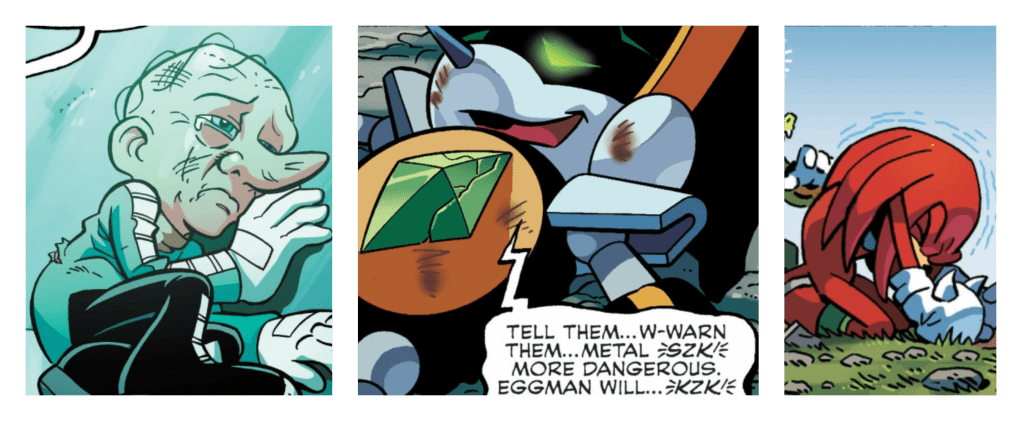
Snively never recovers from the vicious beating Eggman gave him. He’s imprisoned in a capsule and left for dead. Like for real, when Dr Light is also captured during Worlds Collide you can glimpse Snively in the pod beside him, and at that point it might genuinely be his corpse. Neither does Shard get to see any repair after Metal Sonic tore right through him. There’s a very real chance he wasn’t going to make it with his cracked Power Gem, and we’re offered no clarification or comfort before the wave. Sally sacrifices herself and becomes roboticized. Nicole blames herself and becomes depressed, and spends most of her time hiding away from the citizens out for her head. Antoine falls into a coma after throwing himself on Metal Sonic’s kamikazee attempt. And caught in the middle of it all Sonic is doing all he can to not just lash out. Everything rapidly collapses in on itself. Casualties are flung about with reckless abandon, signifying the inevitable end of all things. One that I find particularly upsetting is how Knuckles will never find out the fate of his people after Thrash kidnapped everyone he loved and threw them into an unknown pocket dimension. That chapter is so dramatic as you watch Knux battling him through every new Zone they warp to. Knuckles is more ferocious than he’s ever been, and Thrash is just running scared. Eventually Thrash succeeds in giving him the slip. He’s left with no way of finding his family. It hurts to see, honestly. It’s just one last gut punch for the guy that had already endured so many trials. Even though everyone else seems to hate them I did come to quite like Julie-Su and Dimitri, and thought the Dark Legion was a much-needed breather from the oversaturation of the Eggman Empire. Enerjak and Finitevus should be self-explanatory for how fun they were as villains. But as a fan you just have to watch as their safety is thrown into total question and there are no answers to be found before they are ultimately annihilated in a reality-wipe.

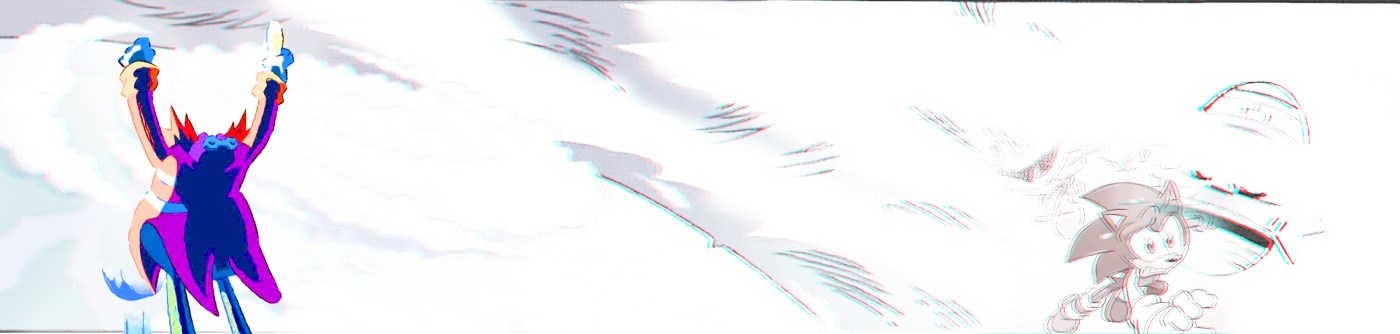
Ever since the timeskip around issue #130, really, the story had just been focusing on a slow but steady build up in tension, that is then kicked into overdrive when Eggman’s sanity snaps in #200. The war escalates again and again, civil unrest runs rampant and the body count continues to climb – until that narrative bubble eventually does burst and the mad doctor deprives that entire dimension of any chance at a happy ending. In many regards I do preach artistic merit in how undeterred the Genesis Wave is by any hanging plots, since it makes it feel like a truly global event that affects all pockets of people in an equal way, but that doesn’t mean I don’t mourn what could have been. With how hard this comic had to work in order to establish the immense quality it eventually reached, how many characters we had been led to love and the cultures that they call home, it is genuinely heartbreaking to watch it all fall apart. The heroes have lost. The slate is wiped clean and a world – a living, breathing world – fades to white.
 skapbadoa
Leave a comment