
Ah, okay so first off you gotta just pretend I uploaded this last year when I actually had all these thoughts and when it was relevant.
I guess I just have some opinions to voice regarding Final Fantasy VII Remake and the direction it took, because to me at least I look around and I seem to see everyone misunderstanding it. That probably means I’m the one in the wrong here, but still I dunno, no matter how many times I look at it the plot doesn’t read the way that everyone claims it does in regards to the ending. I do not believe that Final Fantasy VII Remake is a sequel to the original in any way. No Rebuild of Evangelion-style time-loops or continued instances of the characters, but simply a reimagining centred on the modern stylings of the franchise. I think that is a trap that everyone has so easily fallen into based on a misinterpretation of the Arbiter battle and a lack of awareness for the extended media.
During the penultimate boss fight against the Arbiter of Destiny, there’s that sequence with the flash-forward to various visions of the future, using footage explicitly lifted from Compilation titles such as Advent Children and Crisis Core. This seems to be the main thing responsible for that perception, since at a glance it appears to be the characters acknowledging the old timeline and attempting to denounce it. But I believe this was never its intention, and that it has misled a lot of people, since if you look again the only shots selected are those which were recreating events from the original chapter. You do not see Genesis, Angeal or anyone else indicative or that controversial extended saga, and since these scenes really only last a couple seconds at best I think it’s more likely that this was little more than a cost-saving measure, and a rewarding reference for those familiar with them. Like, seriously, the Arbiter visions are so minor that I think there’s no reason to not simply reach for the existing high-budget footage they already had available. To me that’s all it seems to be.
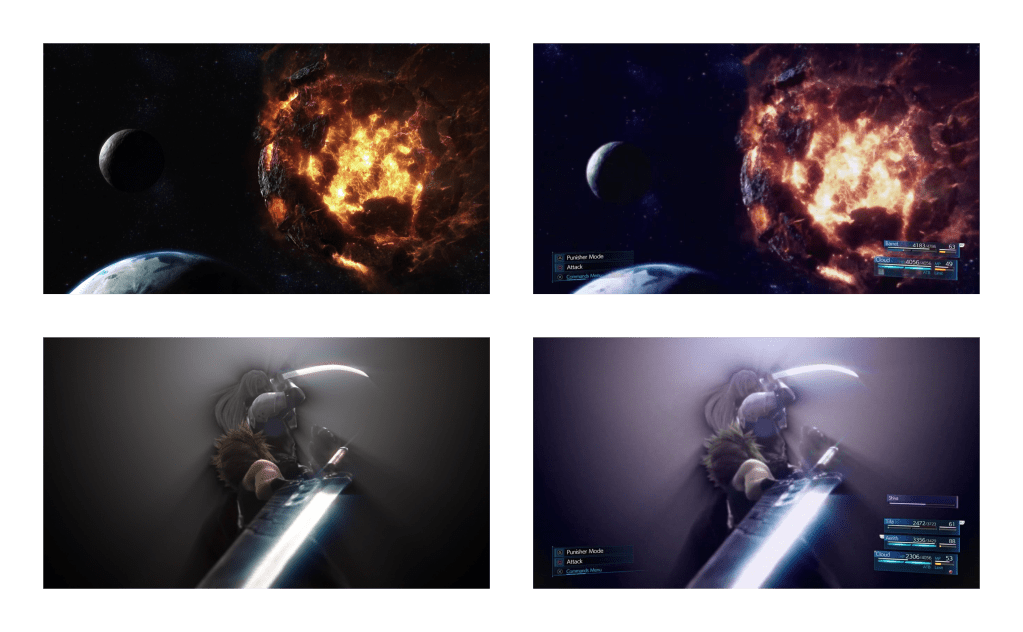
Regarding another highly-raised point of, well, expectational dread: within this sequence it’s also worth pointing out that the footage of Aerith’s death seems to be new, rather than using the equivalent scene in Advent Children’s opening. So I don’t think there’s any doubt that she is still going to die either.

In that sense I do want to praise Remake in how, despite being perhaps the most radical transformation of any supplementary material, it still feels like it comes as a love letter for that which it is based on. Unlike Crisis Core or Dirge which feel like projects trying and failing to imitate Final Fantasy VII, Remake does still come across as having an understanding and respect for it. They can alter and rearrange things all they want, but to undo Aerith’s death would not be something that could be called Final Fantasy VII anymore. The Whispers and their fascination with destiny could be pointing toward some form of sequel theory – but they could also just as easily be a surface-level narrative, or simply a meta-narrative commentary, since they are that. As a player, peering in from an external standpoint, there is a message encoded there regarding the integrity of the original plot, but in-universe there is nothing that demands such a connotation. The Whispers are little more than plot contrivances, and this obsession with destiny or inevitability has kind of always been Sephiroth’s thing even in his debut form.
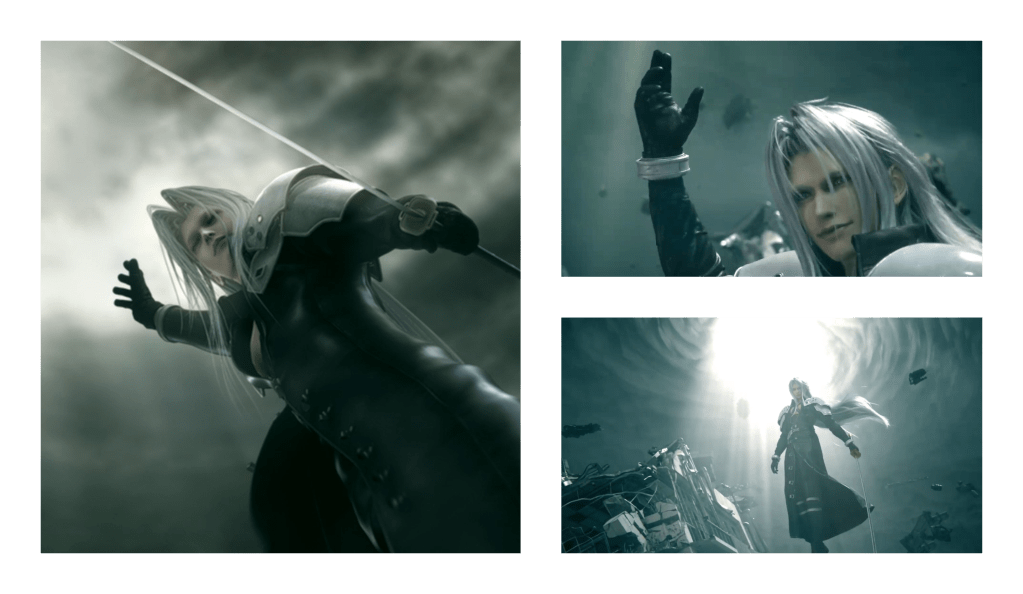
Otherwise speaking, the main point that always seems to be raised is in the characterisation of Sephiroth. Compared to the original he’s a touch more sympathetic, even seductive toward Cloud, in a way that immediately calls to mind Dissidia and Advent Children. It’s not so much present in the original, but nowadays it’s very visible that he seems to have these almost homoerotic suggestions laced beneath his interactions with Cloud. He also has his one-winged nonsense present in the final battle, whose introductory animation and stadium are set to replicate the film’s final battle. And I can see why this would lead people toward the conclusion that this is a Rebuild, but I’m not sold. That’s not necessarily a point in the theory’s favour, but rather because this is the Sephiroth from those games. Not in the sense of any direct timeline shenanigans, but because that’s simply who he is as a character now. These are the modern interpretations of the cast, applied through the context of where they are today. Even in the way the fight scenes are choreographed here you can observe that, actually, the original has always been the black sheep in its series. We always decry the sequels for missing the thematic heart, but at a certain point I think it has to be admitted that Final Fantasy VII was the odd one out. Regardless of their rapidly deviating quality, everything that came after has had a rather consistent vision for the franchise that makes it feel as though the original game was an incomplete version of what they wanted it to look like. Sephiroth is not the one from 1997, but the one from 2007 onwards. Due to Dissidia in particular he’s known to be this overseer constantly taunting Cloud with his knowledge of the narrative’s mechanics, and seeming to beg him over to his side for reasons yet undisclosed. Aerith is no longer the same girl from 1997 who could do little aside from hearing disembodied voices, but instead the version her semiotic core (or character definition) has transformed into through things such as The Maiden Who Travels the Planet, where she is seen to be far more advanced in Lifestream magic and directly positioned as the counterforce to Sephiroth’s evils. Those two, due to their connection to higher existence, both know where the story is headed within the confines of Remake itself because that is what their abilities, as defined in their internal character settings, have become capable of. Sephiroth gazes straight through people and there is a truth far greater reflected in his eyes, this is in no way a trait exclusive to his Remake depiction.
That idea of transformative definition and respect of the original runs all throughout the game. From what I can see, what Final Fantasy VII Remake seems to be doing is to sever the original’s connection to the Compilation. It’s a meeting point between the two, set to replace the game from 1997 within its saga. Final Fantasy VII’s extended universe has always been considered tone-deaf to the story that they’re supposedly branching off of, and Remake looks like it was designed to rectify this. With the flashy combat and movie-level theatrics, this version ends up feeling like what FFVII would be like if it was envisioned more in line with the wider Compilation from the start. Losing some subtlety along the way as it becomes less politically ambiguous, but supplementing it with a hammier and more action-packed aesthetic, full of ridiculous anime-esque fights as Cloud flash-steps around and leaps incredible heights with ease. I think this is ultimately the best thing that Remake could have been, too. Sure I would have preferred a story more in-line with the original game since the Whispers don’t seem to accomplish much except muddy the plot, and some of the stuff they pulled like having Wedge survive his original death only to die again later are so badly-written they feel insulting, but as far as the presentation is concerned I think this is simultaneously the most obvious and genius direction to take it. They have claimed that Remake won’t be compatible with the Compilation in its current form but based on what’s been displayed thus far I honestly think that was just flavour text on their part to fill time in an interview, since yes I do believe that looking at its construction this is something set to slot in place of the original within the Compilation’s universe and story. Unifying the characters and presentation, while finally freeing the 1997 classic from its controversial contemporary shackles.
 skapbadoa
Leave a comment