Back when I accidentally made that Xenoblade video I mentioned having some predictions about Xenogears, but that I wouldn’t commit to anything yet due to not having finished it. Well, now I have. I can easily slot this addendum into the blog post, but it’s kind of difficult to figure out how to worm this into a visual format when that upload was already finalized long ago. Ordinarily in this situation I’d have simply decided it wasn’t worth the effort of publishing. But I suppose any kind of forward-facing consistency or quality has never been something I’ve concerned myself with, and above all I simply have some words to say about Xenogears. As stated in that video, yes, the obvious links to Megazone and Evangelion remain obvious all throughout. That much was never really a question given how blatant the inspirations were, and rather the part that I was leaving open was about what other homage would inevitably rear its head. Xenogears may well be rather unique in the JRPG field, but when you look beyond that gaming context it’s a fairly standard mecha story all things considered. Much of its DNA is borrowed from other prominent psycho-religious sci-fi anime including Evangelion, Ideon and Devilman, then situated atop a setting created by fusing elements of Megazone 23 into the relics of Final Fantasy VII still left over in its script.
Xenogears originating from an early draft of FFVII gets mentioned so frequently that it’s effectively as important to its reputation as the game itself. But nevertheless it really was surprising how many narrative elements and visual setpieces still remained in it.

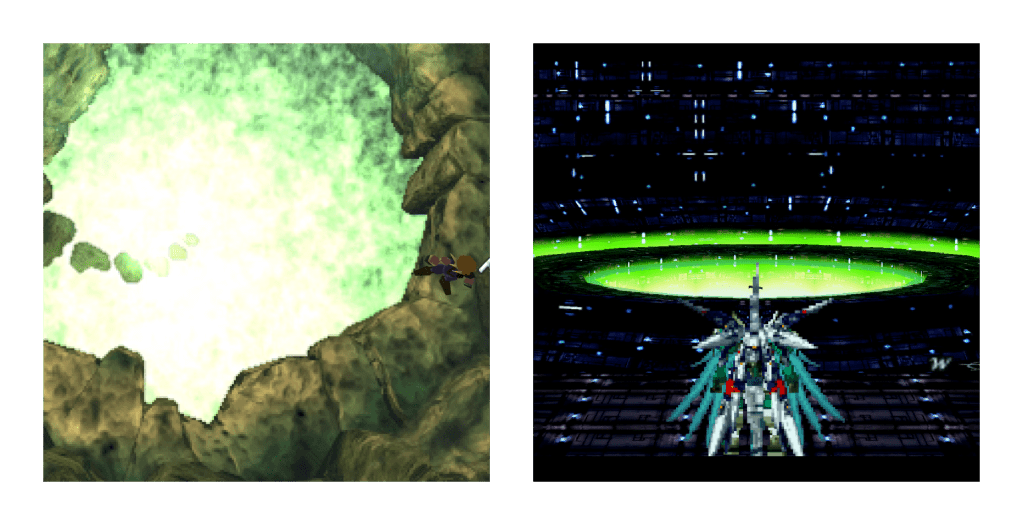
It seemed like you’d encounter a reskinned FFVII monument at every turn: The borrowed imagery of the subconscious stage and multiple personality manifestations whom inhabit it. Solaris acting upon the inescapable governing role and corporate greed of Shinra, and their genetic abominations receiving a similar focus when infiltrating the Soylent System. Climbing Babel Tower was a bit like the stairs to get into Shinra HQ as I recall, and the game frequently utilizes green pods equivalent to those seen in the Nibelheim Manor’s basement. Across the game the protagonist is unknowingly called toward a Reunion, with Cloud bringing the black materia to Sephiroth and Fei bringing the Anima Relics to Krelian. The icy northern lands hide a similar landmark in that of the glowing Northern Crater where Sephiroth and the Zohar Modifier both sleep. Likewise you approach each final boss by descending into a glowing green cavern, and the inside is some weird void with a pulsing red orb in the middle.
The true hidden villain is the grotesque The Thing (1982)-esque alien god Jenova/Deus, and likewise the terms each game’s story is built upon frequently create mention of a mysterious ‘mother’ held in a containment tube. The way in which Elly’s destiny links into Miang and subsequently the extra-terrestrial bio-weapon Deus somewhat creates a similar narrative role to Aerith as the last representative Cetra, and thus her cursed history with Jenova. There are false memory story beats forming the basis of the Zack-Cloud and Lacan-Fei story arcs. The character sprites looked like 2D versions of the FFVII character model style too, which was cool to see. In fact the titular Xenogears does share colours with Cloud’s Ultima Weapon, but that one is more like to be coincidence than anything. Fei also has access to the excessively theatrical Big Bang space magic, visually reminiscent of Sephiroth’s Supernova. Etc, etc, etc. I am in no way pretending I actually took enough notes over my five month playthrough to make any decisive showcase, but even on a summary there’s still so much Final Fantasy VII in there. I do also wonder if Grahf’s name, armour and the Lacan/Fei shared face then went on to be the inspiration for Gabranth in Final Fantasy XII.

As far as that previously raised discussion of anime comparisons is concerned, the story was largely an amalgamation of Megazone 23’s third part, Evangelion and Final Fantasy VII. Last time I had suggested it was leaning toward a Megazone-esque colonisation story through the intro cutscene and a remark about humans not existing on that planet earlier than 10,000 years ago. Those parallels rang true. A massive colony ship near the orbit of Earth is attacked by a weapon belonging to its own species, tearing it apart and making it crash upon the planet’s surface. From there the conspiracy of colonisation begins. The Deus bio-weapon itself is somewhat designed to resemble Lilith from Evangelion, and subsequently it manufactures humanity for the sake of becoming its own nourishment in the distant future. The rest of the berserk robots adorned by terrifying wings of light, illuminati stand-ins and childhood flashback sequences speak Evangelion for themselves. The ways in which Fei resembles Shinji’s own persona instabilities and piloting hesitancies are conveyed simply by playing the game, but I did take particular note that there was a closeup shot of Fei in his childhood standing amidst a ruined lab which referenced Shinji in the event of his mother’s disappearance. Furthermore it can be humorous to note how the experimental and deeply psychological climax is again wrought with production issues. Whether Be Invoked, End of Evangelion or Xenogears, I guess that’s just a fate such things can’t escape.

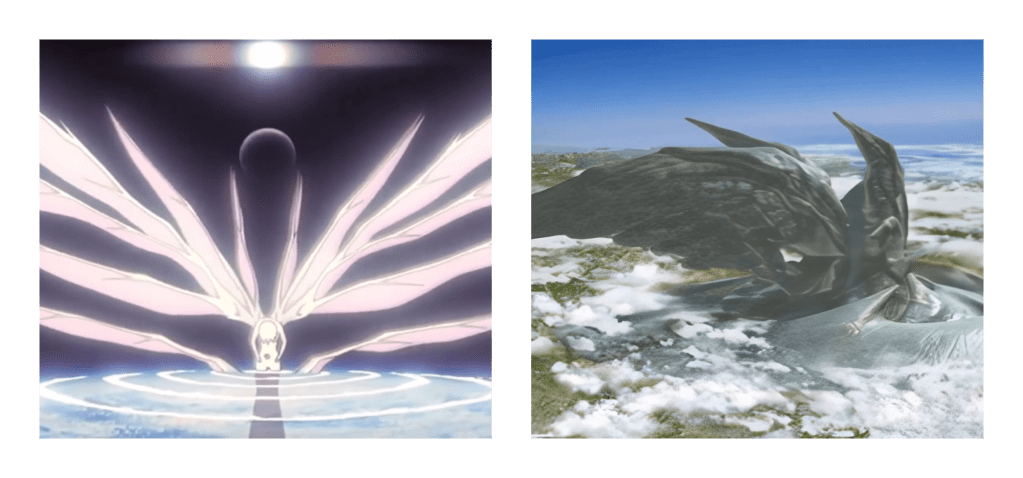
This final chapter’s catastrophic mutation of humanity channels Eva’s Third Impact and thus naturally pulls in story setpieces straight out of Devilman’s apocalypse. Their riots are like many grotesque scenes I would rather not remember from the OVAs. When the Eldridge bio-weapon that forms the final dungeon of the game reawakens it sprouts gargantuan white wings reminiscent of Giant Naked Rei and quickly terraforms the planet.
Krelian’s ultimate ambition of returning to the genesis to reclaim the original group unconscious is your standard Instrumentality, which was itself a readaptation of Ideon: Be Invoked’s ego cataclysm. The image of Fei and Elly’s naked souls floating around in that blue space makes no attempt at hiding its Ideon inspirations, and the mystic choir of The Beginning and the End is unapologetically channelling Cantata Orbis from the same scene. Generally speaking those are story elements which inform Xenogears on the level of narrative homage. They’re transformed and adapted into its own thematic lexicon, but still clearly visible when you’re equipped to notice them. For something more explicit I did also greatly appreciate the Super Dimensional Fortress Macross I and GaoGaiGar references in the Super Dimensional Gear Yggdrasil IV and G-Elements mech events.
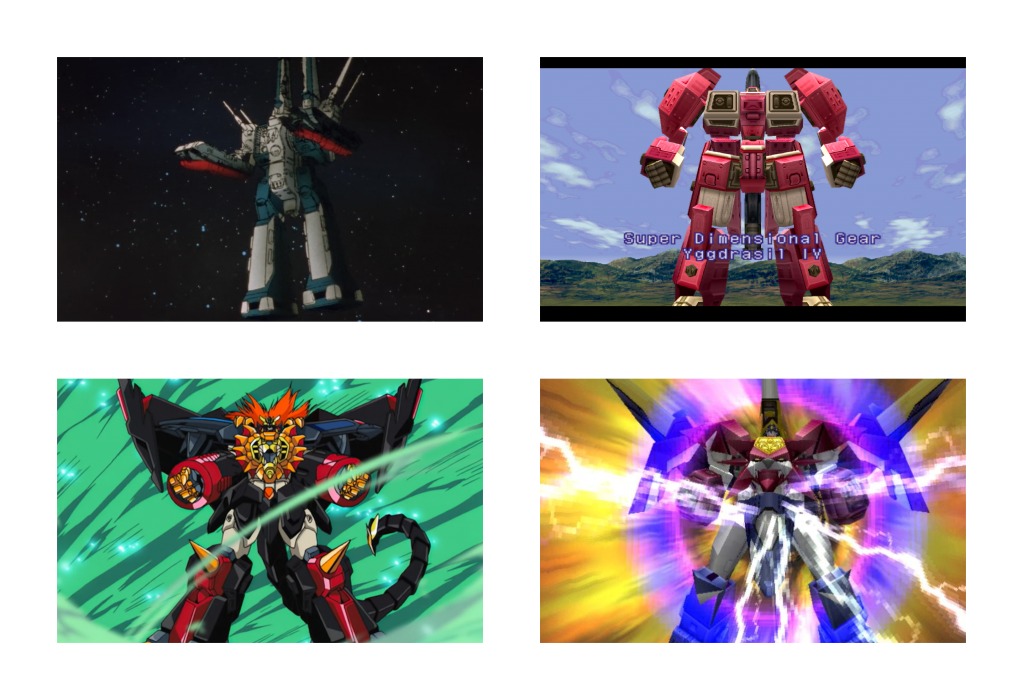
Right from the first time visiting Kislev I had been thinking that the thing in the middle clearly looked to be imitating the SDF Macross sitting in the middle of its city, so it was vindicating to see such fanservice. The transformation sequence and self-titled cannon did not go unnoticed either. Apart from of course having seen the series myself, I’ve obviously been made aware of this referenced in Gurren Lagann before so the imagery easily sticks out. The G-Elements name is referring to the G-Stone, Triple G or all other manner of G-centric names seen in GaoGaiGar, and its combination is a near shot-for-shot remake of that mech’s Final Fusion sequence. Though I am very interested to know how it managed to use the Genesic animals despite the game seemingly being released a whole two years before the GaoGaiGar Final OVA actually did.
Given its reverence as a mecha exemplar, finding bits and pieces of Ideon or Megazone baked into Xenogears is hardly a surprise. But that’s not to say there isn’t anything unexpected in the mix. Like the odd visual correlation I mentioned in the previous video between the Macademi Wasshoi laser sword and Shulk’s Monado, Xenogears turns out to have a very strange amount of the 1995 series Saber Marionette present in its aesthetic framework. It’s such a weird connection given how different in tone and presentation the two stories are, yet all the same I will make the claim that Xenogears is deliberately referencing from it. The Saber Marionette series is a sci-fi harem set on a distant planet named Terra II, which its original pioneers had been forced to settle upon when their colony ship, the Mesopotamia, malfunctioned. The main computer had gone berserk and utilized the ship’s internal wiring as serpentine appendages to kill nearly everyone aboard, much like ADAM in Megazone and Deus in Xenogears.
However since the only six scientists to successfully reach the escape shuttle were male, they end up forced to utilize a combination of cloning and genetic manipulation in order to create a population. So in both stories the humans are actually artificial constructions. The absent role of woman is then eventually recreated through rudimentary androids known as Marionettes. After several generations have passed most of the men don’t even remember what a woman is. However that is soon to change. In the first episode protagonist Otaru Mamiya attempts to elude some pursuers by fleeing into the abandoned Pioneer Museum. While worming his way through the various passageways he somehow arrives in a hall, and at the other side he discovers a large painting of an orange-haired lady in a wedding dress. Someone he obviously doesn’t recognize, but who stimulates a reaction encoded deep in his genetics. This image becomes central to both works mentioned here. It’s very obviously adapted into Lacan’s painting of Elhaim that rests in the Nisan church. Lorelei herself influences Elly’s design. Both have long orange hair, blue eyes and wore a white jumpsuit with black stripes on it. Lorelei’s presence in the original spaceship incident that at the beginning of the series’ timeline places her in a somewhat similar narrative role to Elhaim’s creation in the crash of the Eldridge. Likewise, given that the Maiden Circuit was a last-ditch effort to reconstruct the human female based on her own personality data, Lime occasionally comes into contact with the consciousness of Lorelei buried somewhere deep within her. This is a bit like Elly’s awakening to the many lives Elhaim has lived through.

Otaru also shares key visual traits with Fei. They both have olive skin and wear their hair in a ponytail. Their clothing is a similar loose-fitting shirt with thick coloured stripes on the neck and sleeves. Once again we frequently see flashback scenes showing the role his progenitor played on the original spaceship. This dichotomy between Otaru and someone else wearing his face leads to similarities with Fei and the many reincarnations of Abel. The “maiden circuit” which allows the androids to replicate a true female personality and the show’s subsequent quest to teach the men how to love once more, potentially influences how in Xenogears it’s the moment of intercourse between Fei and Elly that becomes the key to achieving “spiritual unity” and therein defeating Krelian. The other male lead is a blonde friend who’s thrown away his nobility. Though that’s about as far as the similarities between Hanagata and Bart go. They are both quite affectionate toward the protagonist in their own way, but the form it manifests in is entirely different since Hanagata is the big gay for Otaru. The antagonist Faust retains his original memories in each incarnation much like Miang. He has his own adoration of Lorelei that leads to a centuries-long conflict with Ieyasu, somewhat reminiscent of the troubled history between Krelian and Lacan. Miang’s design is something of a mix between Tiger and Luch’s, and Panther’s giant wavy fringe sitting atop the eyepatch on their right eye can be seen used again in Sig. The Chuchus can be considered equivalent to these little monkey gerbil things that appear on Terra II. Saber Marionette also places a great deal of importance on the sprawling underground caverns that connect each nation, which are a locale highlighted with equal significance in Xenogears.
With the proposed relationship between the imagery seen in Megazone, Saber Marionette, Xenogears and Xenoblade it’s also of note that in moments of particular emotional distress the Maiden Circuits of the marionette trio are able to establish contact with the Mesopotamia still hanging in orbit, which then bombards the planet with a devastating laser blast. This ability is similar to the Pneuma trio’s connection with Seiren and Aeon. It has its own experimental main computer controlled by three digitized parts of Lorelei’s personality, not unlike that of the Trinity Processor and its three Aegis cores. They even share the same red, purple and green colours that would later be seen in Ontos, Logos and Pneuma. If Fei and Elly are found within, then perhaps the Marionette trio had an effect on the Xeno franchise’s forthcoming fascination with its numerous robot girlfriends.

Each of them are awoken from the same kind of capsule that Pyra is, though that’s hardly a unique suggestion. At the end of both Xenoblade 2 and Saber Marionette J we see the female leads tricking the protagonist into boarding an escape shuttle. This being the one lie they ever tell him since they know he’d get in the way of the sacrifice they were about to make, as well as using this as the chance for their proper confession. These scenes are arranged to have the main characters standing straight at one another with a large abyss between them. Otaru and Rex begrudgingly come to accept this decision. They’ll probably never be happy about it, but if that’s the form their love took then I suppose it couldn’t be helped. The two left behind will hold the memory of the lover deep in their heart as they come to live in the new world that their sacrifice created. Or…not, since without warning or explanation the girls somehow manage to kick the narrative in its metaphorical shin and return anyway. Really I should have mentioned this in the previous video but I hadn’t seen Saber Marionette yet to be honest. Rather I just apparently possess an affinity for stumbling into these kinds of lineages that I see running all throughout anime-style media.
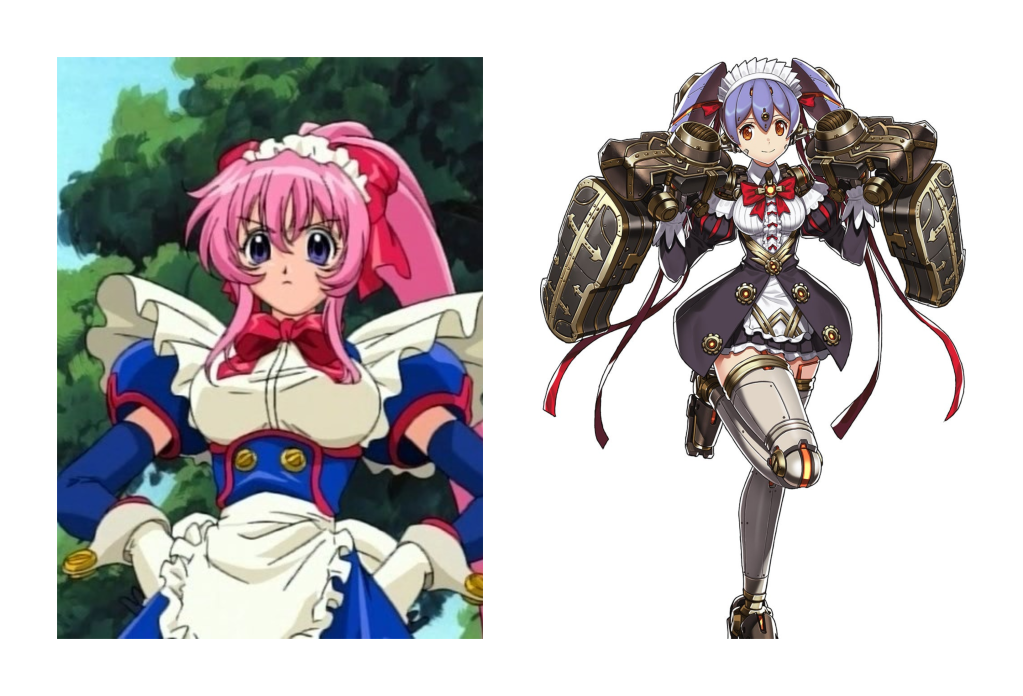
Continuing down that line Saber Marionette itself paved the way for another robot romcom series named Steel Angel Kurumi. I’ll highlight that link in my Romantic Invader video whenever that script eventually gets finalized, but the reason I cite it here is that, at least in my own viewing (which is a lot), Kurumi is the earliest maid robo I have on my list, and therefore I believe this is the one to point at as the design inspiration for Xenoblade 2’s own maid-centric robots. Mind you that the game also has rather unabashed references to Mazinger and Getter Robo present in the Poppi QT segments so the scene was already primed for these kinds of visual links. Kurumi’s generally excitable and pampered personality can be seen reflected in Poppi, but in particular her maid outfit seems to possess notable design elements being carried forward. They both share the puffy shoulders with red lines on them, the apron is layered beneath the skirt instead of being the front-most piece of clothing like most anime maids, and they’re decorated with oversized gold buttons. Poppi’s sister Kiku also shares immediate design similarities with Kurumi’s sister Saki, both of their hairstyles being that brown bob and wearing a blue and white maid outfit.
On its own self-referential merits too, it’s real neat seeing all the ways in which Gears influenced the Xenoblades. Not just the obvious of the Zohar and its ether forming the basis that everything revolves around, but deeper design decisions like its ability to peer into future phenomena and actualize it as a form of limitless energy being that which inspires Alvis’ Foresight, or the slumbering personality dynamics of Fei/Lacan and Fei/Id/Coward later informing Shulk/Zanza and Pyra/Mythra/Pneuma respectively. The name of the High Entia’s Kallian appears to be a combination of Krelian and his original name Karellen, and they feature similar designs. The Weltall-II and Monado-II implement the same naming scheme as well, and there is shared imagery presented by the flying Seraph and Telesia hordes in the penultimate assault. Krelian creates what is tantamount to XB1’s Faces, and there’s even one that looks near-identical to Metal Face. There are tons of small things like that. Or bigger narrative centrepieces like trying to destroy the Zohar Modifier (Monado) and create a world without ether (a world without gods), or descending below the surface and discovering the ruins of the Zeboim civilization, which is repeated in XC2’s Land of Morytha. The rebellion that brought the Zeboim era to its knees and the jaded scientist leaving behind a single deus ex machina before being killed by the oncoming army are images obviously echoed in both the Saviorite Rebellion & Conduit Incident of XC1/2 and the Ganglion destroying Earth in XCX. Klaus even shares the K from Kim’s name to point toward this.

Xenoblade 1 is basically just a facelift for the time-tested tale of Ideon’s sword of light and the demon held within. Xenoblade X specifically imitates not just the backstory and setting of Megazone 23 but also its transforming motorbike mech the Garland. Xenoblade 2 borrows so, so much from the aesthetic direction of Expelled From Paradise and the design evolution carried down from Angela. And now sitting down to finally reflect on Xenogears (since the truth is that I actually started writing this three months ago) there are four different anime series that I see tangibly echoed within the visual terminology of Xenogears. This franchise has always been anime as hell. The Xeno series is one of the most direct anime-esque JRPG series I’ve ever played and this is not anything new. It began this way. Heck, despite the neverending flak it catches Xenoblade 2 is actually the game in the series that seems to borrow the least from existing anime stories. It’s not like anything I’ve brought up is even that obscure so I guess it just goes to show that a lot of people have not seen a lot of anime.
in conclusion what is a xenosaga i’ve never heard of it bye
 skapbadoa
Leave a comment