The temptation to title this “love lives is srs business ok” was too real.
Admittedly, this is a topic I have already breached before. But following along with the recent Love Live Rewatch on the anime subreddit was a good chance to reaffirm that my prior discussion was woefully incomplete. It feels like I’ve been looking for an excuse to expand upon this for a while now. There is still so much more that I have to say about it. It’s inevitable that portions of this will be poached from the past since it is a continuation on the same subject, but bear with me. Nobody even watched those other things in the first place, and nobody will watch this one either so I’m sure I can be afforded some lenience. In truth my original plan was to just make another garbage AMV because I like that and it’s fun as a form of nonverbal creative reflection. You pore over it from a different angle than that of a written piece. Instead of telling one to “read this through my words” you get to say “see this through my eyes”. It’s quite an interesting avenue of engagement. But then it was only cool in the conceptual stage and as one would expect Lantis happened, so I’m just repurposing the bridge sections from that into this video. At the end of the day I think I probably still have to place it in this form if I want to be satisfied, since I have so much affection for this story that needs to be expressed in my main format. Or at least to make an attempt at doing so.
Love Live School Idol Project and its sequel Sunshine. They might wear the same mask, but the two titles are incredibly different shows and this leap in style is so striking that it can often lead to innate enmity between the two camps. One of the main ways they differ is that the original, while having a lot of heart, frankly isn’t that interesting on its own. From a writing perspective. The characters are endearing, the soundtrack is surprisingly killer considering one would expect them to skimp on that in favour of the insert tracks, and the entire thing – save for one bout of ham-fisted drama that we, the overhanging narrative and the writers all try to pretend didn’t happen – is just fun. Against all odds. It stumbles and stumbles, and it absolutely pales in comparison to the beast that Sunshine is about to become, but it’s good. There’s so much heart in it and this forms a meta-story within, as the writers and production quality of the show fumble to find their footing in the world of anime just like μ’s in both fiction and reality. There’s a roughness to it refined over the course of the show that makes you want to root for not just μ’s as a cast but for Love Live itself. But it’s not a very complex series. They opted to be a bit more of a straightforward idol show while searching for their anime footing. I greatly enjoy it and have rated it rather favourably so do not mistake me as talking down upon it. I do like it. But it isn’t interesting. That is not one of the numerous positive qualities I would ascribe to it. The mere act of reading the title will already tell you everything encompassed within the series by itself. That’s not to say that it’s completely devoid of discussion since the School Idol Movie in particular laid a decent amount of stylistic groundwork for what I am going to spend the next hour raving about, but that within the first story said examples are for the most part restricted solely to the second act of the movie. Rather the most interesting thing that one can say of School Idol Project is Sunshine. When surrounded by the quality of writing seen in School Idol Project, School Idol Festival and Nijigasaki, we can observe that Sunshine’s television series is something of a black sheep within the franchise in that it’s designed to be an actual good story, rather than prioritizing the gacha fanservice component. Even in the radio dramas and their visual novel segments in the Festival games you tend to get Aqours as caricatures of themselves. It’s really only this part of the project that for some reason decided they wanted to take it all to the next level. The second Love Live anime is a story about taking bad events in stride, rather than simply about creating good outcomes. It’s a story about loss and not necessarily one about any ensuing victory. Everything that can go wrong does and it’s all about how they let that frustration fuel them, or how they redefine themselves in situations that seem impossible to reconcile. Aqours are met with destruction time and time again, and it’s only through these ashes that they eventually evolve into something capable of striking back at the world. They’re forced to trudge through the melancholy until they become capable of offering a bittersweet smile when they tell Saint Snow the school will be gone soon. The inspirational monologue as they run together before the closing concert in the film is about how they failed to make a miracle and “my biggest dream did not come true”. People always wanna write off idol anime as uninspired merch advertisements, but for as much as the term gets thrown around in the community Love Live Sunshine is genuinely the first deconstruction that I can call to mind offhand. It’s a critical response to how stereotypically idol anime everything-is-great the first Love Live was.
I have always wanted to refer to this as “the Serial Experiments Lain of idol anime” and I’m tired of pretending it isn’t. It’s the type to only reveal its true scope in hindsight, since its heart is encased within no less than 20 different interwoven symbolic walls. It’s a story iceberg where although the surface experience may be easily understood as Love Live! School idol Project: Sunshine, taken purely on a moment-to-moment basis, looking even a little past that reveals a mass extending to the deep. It is of course not at the same level of abstraction, but even still Sunshine is something that resembles such imagery-centric works as Lain, Lum the Forever or Gurren Lagann, in the sense that the more you put into it, the more you are going to get out of it. It’s the kind of piece where delving into it defines how much the story will reward you, since there is that much to be read between its plot lines. It’s unreal to think how something as straightforward as that could evolve into a behemoth such as this. How the sequel transforms it and incorporates it for its own thematic backbone. Even as far as the title is concerned, the reason that this is “Love Live Sunshine” stems from repeated shots of Honoka clutching the sun, and because the thing that finally manages to establish them as overseers of the eternal contest is the aptly titled Sunny Day Song. μ’s have become the sun, and we’re now left chasing their ephemeral rays of light. It totally repurposes School Idol Project through its rich imagery set and deep thematic interplay. Superficially mimicking the original’s episode structure for its narrative friction but having so many layers moving beneath the surface. Love Live becomes a tale of deification and the pain of all those unable to measure up. Sunshine is honestly as much about substantiating μ’s as it is the new group. Aqours and ‘the light that can never be reached’. The gods above, and the monsters that crawl below. The war between the idealized sky and the tumultuous ocean. It’s specifically presented as a response to the striking lack of substance in the original and recontextualises that simplicity as an unattainable golden age. Taking place when μ’s have long since graduated, becoming depersonalized within their legacy and their final concert so powerful, so exalted, that it creates an entire new world of idols akin to the breath of life. Muse, the nine goddesses of music, and the trial of all those who chase their radiance; on its own School Idol Project is just fairly unremarkable SoL fare, endearing as that may be, but it becomes far more meaningful when retroactively applied within the symbolic set of Sunshine.
I will obviously be walking through each as I go, but for for the sake of establishing a proper lens throughout my ramblings I’ll bare it all in preface. The key bits of imagery we’re looking out for in Sunshine are μ’s as a shining white light (a connection obviously established through their final song in the series BokuHika), Aqours similarly understood to be the “water blue new world”, and the rainbow created when these forces of light and water bash into each other. That’s on more of a hidden aesthetic level since it hinges on colour correlation and shot decoration. In the narrative scope there is dialogue or thematic interaction deifying μ’s as “goddesses” equivalent to scripture, and the subsequent interplay with Aqours as “monsters”. In fact all of this is so interwoven that we could legitimately even suggest that this is the reason as to why Honoka has clear blue eyes yet Chika comes with a surprising soft red (well, that and an intertextual tie with Nico due to their deliberately linked character motivations). Or why she frequently roars into the sky. μ’s gives and Aqours takes, so the beast looks out at the world with a ravenous gaze. Sunshine is a lot more exaggerated than the original and there are many happenings that can only be described as if the actors were self-aware, which in fact does point toward a specific theatrical framing we can observe through spotlights, stage right and curtain calls. Then there are the central symbols of the feathers that float down from heaven (which itself associates μ’s with the sky) as well as the entire bird in certain instances, and the perspective shots of Chika reaching toward something higher. All three of which are extensions of School Idol Project’s second ending animation. There is the star, first encompassed within Uranohoshi’s name which (based on my limited ability to search japanese) appears to translate to something along the line of “bayside star”. And of note when discussing ‘feathers floating from heaven’ or stars, there is of course another separate astronomy-based visual which I suppose I’ll call heaven, encompassing starry skies and shooting stars viewed at the height of humanity. Then also a recurring shot of the sun over a mountain, or rather ‘the light at the summit’, and there are two recurrences of bubbles that are specific enough a repetition to be taken note of. There are other minor things such as that of the glowing fish within the water blue new world set, a noticeable amount of events utilising a dramatic gust of wind, balloons and confetti arguably shared between Sunny Day Song and the rebirth of Aqours, and the camera shutter transition replicated a couple times between the two series, but these are primarily what I will be using to steer this piece.
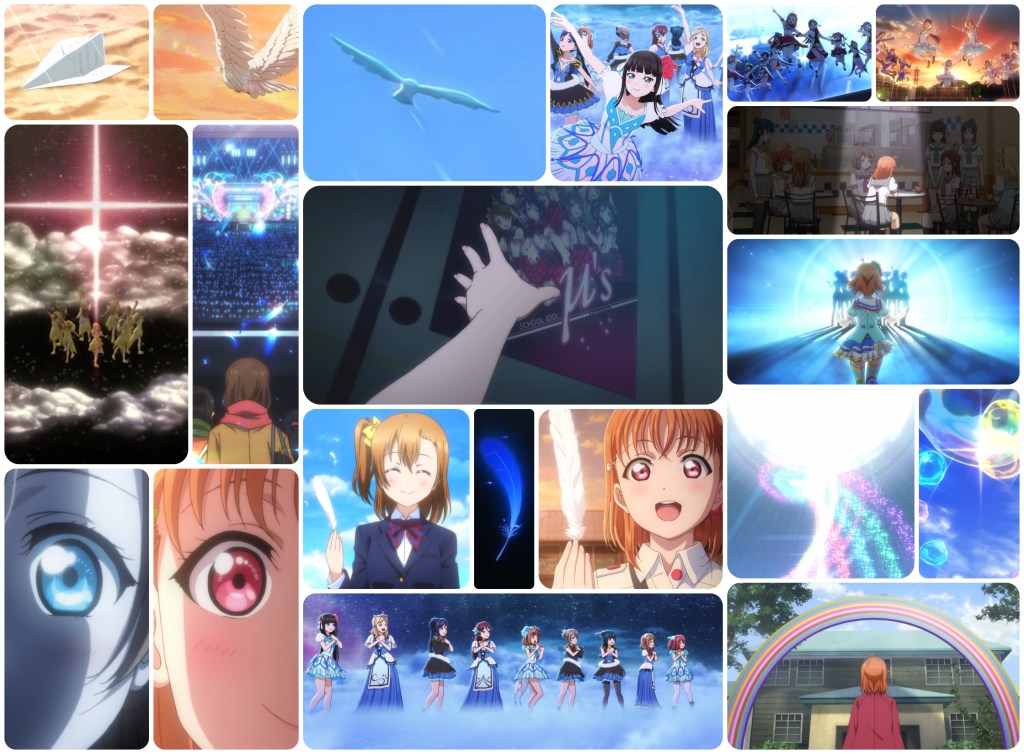
While I’m sort of still on the topic of feathers a colour every which and way, I’ll also interject here to point out that Yohane’s black ones carry no particular message. They’re exclusively part of her fallen angel character setting. In episode 17 we do get a nice production joke where they play the opening piano piece when her scattered feathers inspire a vaguely poetic line, but nah when the black feather appears in her or the other first years’ outfits it’s purely visual flair.
The story of Love Live Sunshine begins five years after the original series. Though it’s moreso five years after the original cast, since the matter of all events happening across a single year establishes some major time discrepancies within the School Idol Movie’s structure. We see Hanamaru reading a magazine about the competition’s fifth anniversary, so it’s as straightforward as that. Five years have passed since μ’s became equivalent to the Big Bang. On one fateful day late in her first year of high school Chika had stumbled upon something that would set her careening down a path she couldn’t have imagined. Through the whim of the wandering wind she had happened upon μ’s, seated upon the screen in what was likely an annual festivity honouring each winner in the leadup to the competition. In that video Chika sees a world spreading out before her that she’d never known before. Nine seemingly ordinary girls burning a brilliant white flame. See how they shine! The mundane has suffocated her for as long as she’d been alive, but something had at long last begun to move within. Is this something she could do? She thinks it might be, actually. The lifelong dream of escaping the stagnation seems like a real possibility now, and that entices her beyond belief. Her immediate attempts at gathering members, however, are met with little success. Or perhaps it’d be more accurate to say much failure. It’s within this frustration that the symbolic terms which will repeat throughout the story are first christened. Basically everything is developed here, right in episode 1. Sunshine wastes no time because the real magic of this show is as a nexus of shockingly inspired metaphorical musings. This show is an essay written to critique the original, and so the beginning paragraph is of course that which iterates its prompts.

Chika has finally found this big super smart girl genius idea to make a school idol group and it’ll be fun and everything will be great and they’ll be just like her heroes – u’s. Fantastic. But as expected from episode 1 of a Love Live series nobody will lend her a hand, so she wanders home feeling defeated. Unfortunately before she has the time to flop into bed and wallow about the day’s events she’s set out together with You to deliver the neighbourhood circular to Kanan over on Awashima. Stepping onto the ferry, our still disheartened protagonist resumes her moping and at one point rolls over to stare at the sky. This moment marks the beginning of the imagery discussions. The first point of interest here is the lens flare surrounding the seagull. As previously mentioned one of the major bits within the imagery are these rainbows that permeate the aesthetic. Though there are times when they burst into reality, they are generally implemented through these lens flares that appear in key moments of introspection. The important thing to note here is not yet the structural significance of the rainbow which I will later get to, but what the rainbow itself actually is. A rainbow is something created through light and water and as we are aware these two things are the calling cards of the respective group. Any time the ideologies of μ’s and Aqours clash, conflict or directly come into contact you will always find these lens flares decorating the frame. In this scene the reasoning behind its appearance is to be revealed through its incorporation with the next symbol.
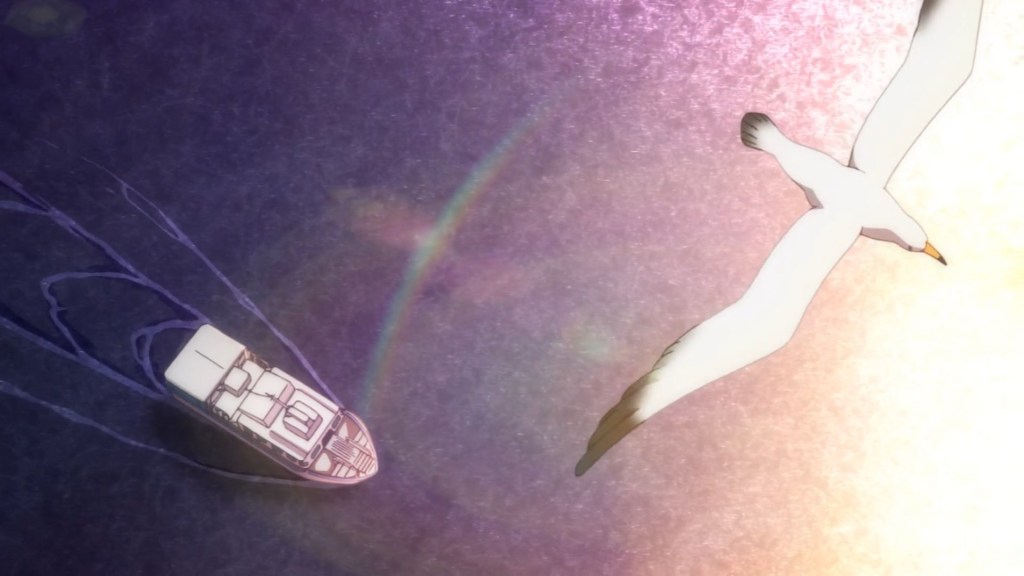
In the same instance, we are of course also seeing the seagull. A bird. Now, the most prominent image within the show are of course the individual feathers that float around at major milestones, but it’s worth drawing attention to the whole seagull itself here since birds themselves are a lesser symbolic mainstay too. Doves, gulls and the blue bird, in particular and in that specific order. There is some minor variance in that the current Aqours created by Chika uses a generic seagull while the old Aqours trio over on Awashima often get the black-tailed gull which has a more gruff appearance, but that distinction means little beyond painting those girls in a more seasoned light. Next, she watches it gently swaying in the sky and raises a longing hand toward it. This is of course the next point, and one which is massively significant. These perspective shots of Chika raising her arm toward something higher are so, so important in Love Live Sunshine. The reason being that this shot actually originates from School Idol Project’s second ending “Donna Toki mo Zutto”. In fact much of Sunshine’s imagery is following on from that second ending animation. They’re depersonalised into this legendary age, and greatly re-examined through the imagery of Donna Toki mo Zutto, the final scene of the Movie and Moment Ring. The feathers, the feathers, the feathers. Sunshine gets so much mileage out of the deified ‘muse’ and all aesthetic implication contained wherein. Burning out upon the stage like the most brilliant supernova; nine goddesses a single white light suspended in heaven. That which creates an entire new world of idols. So deeply revered as to serve as the guiding star for all who will one day inherit their will. Shining for truly only the shortest of moments, but so powerful that this fragment in time will never be forgotten. My word, how they roar. Yet beyond all that, obscured behind the cry of its glamour, was simple love. It was their precious little secret, belonging to them and no one else. So powerful that a whole new era was borne unto their final performance, yet eclipsed within that blinding light were just nine ordinary girls. And that moment, that group, it was theirs alone. Running straight through a place that had nothing, and leaving nothing behind. Like a shooting star that bursts upon the empty night and vanishes as suddenly as it appears, yet in that brief moment how brilliant doth it shine. Even when that glorious streak has long since faded the ground still looks to it, mesmerized in its afterglow.

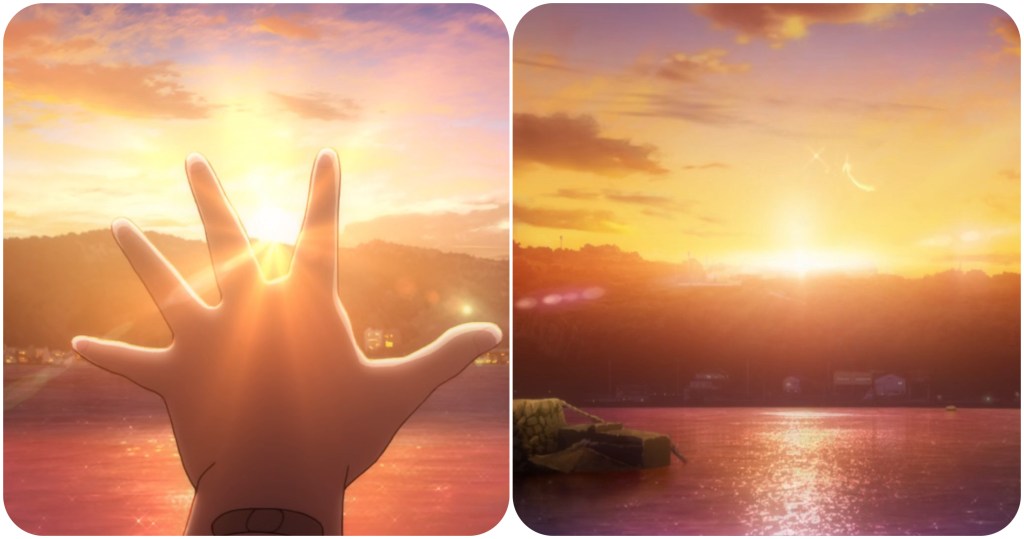
Honoka raises her hand toward the horizon and grasps the sun within, since μ’s are soon to become akin to the life-giving light themselves. Upon doing so her doves storm out, carrying the scripture to all the land below, of which I don’t really believe I have to waste any time explaining its implicit religious connotations. This yet happens again in the School Idol Movie. After Honoka finds her answer to the inner truth of the group we’re led directly into the sound of birds chirping and the sky mimicking ED2. Then once more before the Sunny Day Song performance. The inter-series repetition of this shot places central significance upon it. Watching what Chika is reaching for and how she interacts with it is telling of her arc throughout the story. To introduce the visual connection and affirm to the viewer that they should be taking note of these, the first thing she reaches for is the seagull. Later on she’ll mostly be reaching toward abstract lights or summits, but this first one signposts the meaning through the recurring bird. She’s meekly pleading with the sky, begging the seabird to at least let her enter the same area that school idols inhabit. We’re far too early to be discussing things like identity, suffering or success, but before any of that she just wants to be allowed in.
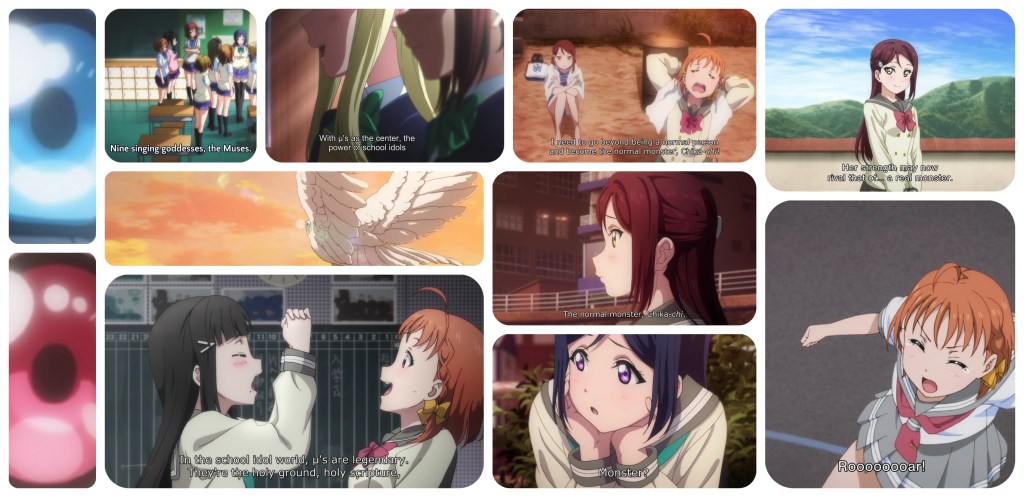
The notice has been delivered, unwanted pleasantries have been exchanged, and Chika is now back to the mainland walking home. Suddenly something sings out to her. She senses something is up, and a small, white nebula races across the screen. This is the first visual rumblings of the star imagery that will only rear its head a mere handful of times, but is in some regards the most important of them all. The star appears at the beginning, the middle and the end. Chika glances over to where that subtle twinge had come from and spots a girl clad in Otonokizaka’s robes, and with these two schools running headfirst into each other the rainbow once again flares to life. This introduction is briefly interrupted, and interjected with the next thematic stop. A prelude to set the oncoming stage, so to speak. I’ve been talking for a while now with the aesthetic assumption of μ’s as gods, but this moment is where that doctrine first actually stems from. With Chika introducing her quest to exceed the mundane and become a “normal monster”, it creates a friction between her and those who will next episode come to be referred to as the holy ground. O Love Live Sunshine, of gods, monsters and kagayaki memes. What splendour adorns you. If that previously mentioned shooting star had been the light flickering on, then next is where it shines. While explaining the μ’s legend to her newfound audience, Chika gazes out at the evening sky. To the guiding star overheard, which represents μ’s. The single white light above all. μ’s are as gods in the sky and this star first denotes their presence.
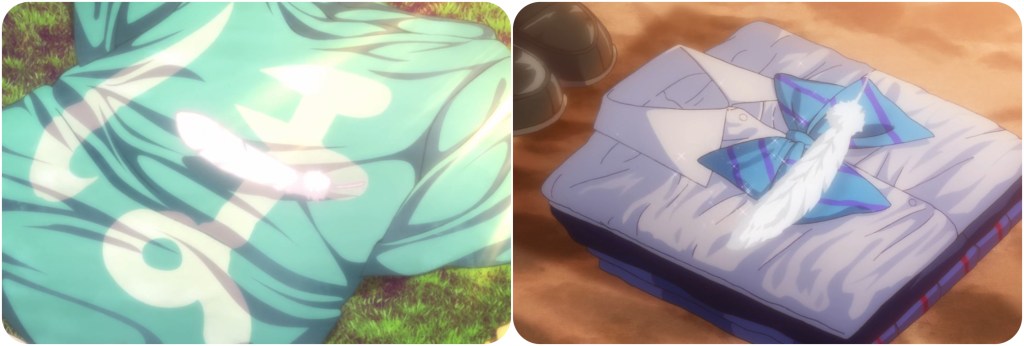
Once her flashback ceases we spot white birds soaring to the horizon together with our first instance of the sun sitting atop some kind of mountain summit. These sights will become emblematic of Chika looking toward the metaphorical place that μ’s once occupied, or the heavenly heights of the Love Live dome that they seek. Riko finally introduces herself as a student of their alma mater and beneath that bright rainbow the ethereal feather, that which will before long become Sunshine’s most visible symbolic setpiece, is brought into being. It flutters down and settles upon Riko’s uniform the same as it had done for Honoka’s in the School Idol Movie’s credits. Prayers have been answered, and the miracle is set in motion. And all that was only episode 1. This is what Love Live Sunshine does to School Idol Project. Using its lexicon of praise and angelic imagery to totally transform our understanding of μ’s. It’s not like such a backtracking is even necessarily that unique, unheard of or unexpected for a sequel (though it certainly is so when the previous work was School Idol Project), but it’s delivered with such potency that it becomes something damn special.
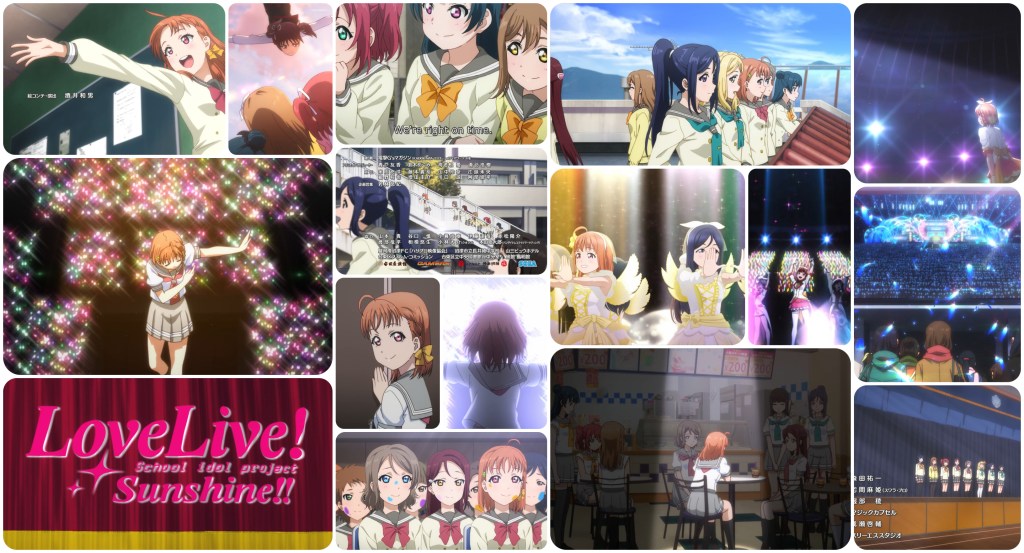
Even further on that note: Unlike the previous series where you could liken the shaky beginning and staggered improvements of μ’s to that of the very writers themselves, Sunshine is a series with a striking amount of creative vision informing it. One that I think is particularly interesting to highlight is the theatrical undercurrent from which its presentation is based. There are many moments of dramatic tension which would probably be best described as feeling especially rehearsed, such as when they all say their parting lines before exiting stage right, or how the girls just so happen to match the right timing cue to run to the Love Live together as if the director had been instructing them offscreen. Could this be called anything but acting? The visual of Chika opening the stage doors to lead into their literal theatre before Mirai Ticket is an especially potent one. She has no problem leaping to her feet and reaching out for the exasperated Riko right in the middle of class, and Leah likewise somehow believes that the natural way of intimidating them is by leaping straight over the first years. It’s constructed with such a sense of performative excess. It isn’t uncommon to find Chika narrating toward the audience seat either, and there are instances of the girls directly conversing through the narration rather than words. Taking an idol show and becoming a tale of gods and monsters, there is much in Sunshine that almost feels like a stage play. It’s exaggerated to a degree that can only be a deliberate aesthetic touch. Every single person in Uchiura catching the bus for their ultimate stage or everyone but Chika once more exhibiting their impeccable timing when they sneak back into the school for Wonderful Stories is a bit farfetched even for the original anime. But because Sunshine is styled like this it’s made to work. Though this is largely something existing within the field of direction, there are also times where it’s specifically signposted in the visual presentation. Examples include the occasional spotlights, or the very end of the final episode closing out with an actual curtain call. Yet of perhaps utmost importance here is that Chika, as the protagonist who both embodies and defines the series’ direction, has both of her solo tracks styled after Broadway numbers. It’s a neat little framing.
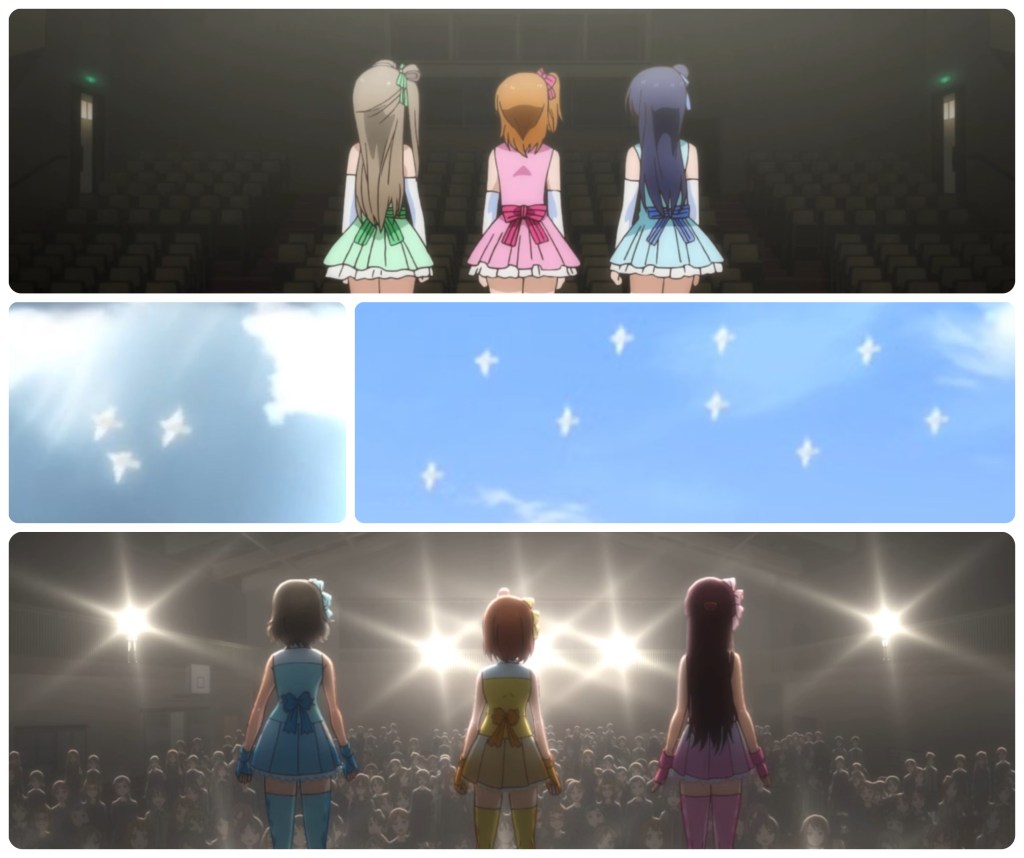
A few episodic hurdles later and Aqours have formed, I suppose. Dia had held her arms in prayer and spurned our little heathen for mistaking the gods’ name and Mari rebuked their attempts as wretched and empty, but even these third years end up unable to resist the allure. Things do seem to be going well enough. The first concert looked like it was heading south for a bit but the community had come together to support them, and something that could have easily become a storm was allowed to dissipate. When this happens we see some suspiciously familiar birds flying the gale of light in the aftermath. This is the first appearance of Honoka’s doves in the Sunshine story. They may be barely visible, but this distant shot is something which will be specifically repeated later in the season, informing us that it’s important enough to pause upon. They show up as a trio here, but when this shot happens again in episode 12 we see all nine of them flying above Otonokizaka. The doves represent μ’s, not Aqours. In fact this particular shot had been seen in the School Idol Movie. The nine doves are spotted in the sky when μ’s are heading out to gather members for Sunny Day Song, which is the stage of religious scale. So rather than interpreting this to be some celebratory symbol of Chika, You and Riko’s first success, we are rather led to read its contextual relations and see that this is sign of the original trio watching over them. μ’s act through doves, wind, light and all other heavenly effects, so we can see that the shots of the light flickering on after the power outage are exactly when Aqours catches their eye. Honoka, Kotori and Umi have taken notice of their debut live out of a concern that it could have gone as terribly as their own, and when they see its success they rejoice from inside the sun.
They’re following μ’s’ footsteps, gathering members and having a modicum of success. Enough that they’re extended an invitation to an event in Tokyo. To the sacred land full of their spirit. After the pain of creating the group this was to be their first real challenge and they had no intention of shying away. The problem that the girls are either failing to recognise or refusing to address, however: Honoka had wished for school idols to continue to grow in the future, but not like this. Chika and the girls had stepped into the same arena without understanding what it actually entailed. Leap without looking and one cannot be surprised when they fall to the ground. For those who had spent their life locked away at the far ends of the Uchiura peninsula, this was their first time truly discovering that there is a world out there. Full of people, all with their own thoughts, memories, passions and feelings. It’s their first time properly running up against the school idol realm and it exposes just how insignificant their efforts had been. The performance goes, well, good. Comparatively. But through the earth-shaking power of μ’s’ last concert there are now ten times as many groups vying for the title. Good just isn’t enough anymore. They’re unable to procure even a single vote and Saint Snow basically warns them to get lost. All they’ve accomplished here was to insult the other performers and that hallowed stage μ’s had fought to preserve. Sing and dance because that’s what μ’s did. Go to Tokyo because that’s where μ’s was. Their efforts thus far were little more than treating Love Live like a game, and Chika’s leadership was itself shallow fangirling. Can you imagine how offended μ’s would have been to see that Chika’s reaction upon hearing of the school’s impending closure was “hooray we’re like Otonokizaka”? Ridiculous. They had forced their way onto the stage from the audience seat. Simple fanatics bathing in someone else’s light and so they are punished. However this is a necessary loss in order to set her straight. Her empty ambitions had been neutering the group’s potential. As much as she wanted to shut her out, someone as driven as Leah had easily seen through the façade. Cutting right to the core with words like a well-sharpened blade. Chika reaches toward her μ’s poster but the zero haunts her and she instinctively pulls back.
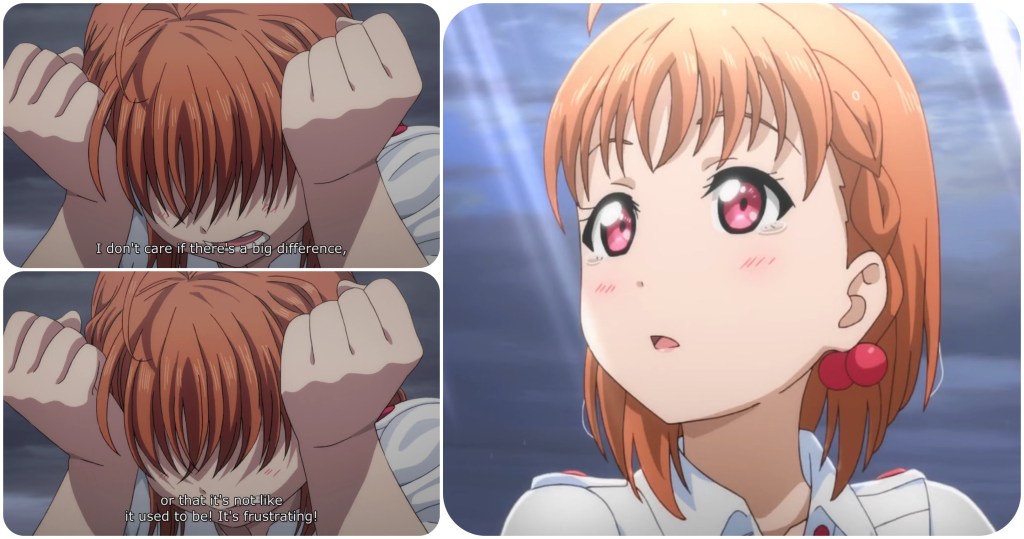
This trial marks their first real step toward becoming an honest group worthy of the Sunny Day Song’s promise and so the gods refuse to coddle her. Aqours will have no purpose if she can’t stand up by herself. Their existence had been denied, or rather whatever of it was contained within their falsified perception. She doesn’t know what to do or where to go from this. She’s trying to think it through but struggles to find much in the way of answers since honestly Chika is just a bit dumb. But she recognises her own frustration. It doesn’t matter if things aren’t as detached as they were before or if she compromises her apathetic coping mechanisms, she just doesn’t want to give up. Although she spends the episode trying to maintain her mask she still can’t stop herself from breaking down. The usual distance wasn’t enough anymore. Chika has been humbled through this destruction, discovering that she cares enough to cry. That girl who had always been too frightened to commit to anything, using her stated lack of dreams for the future as a stronghold to hide from pain, has for the first time managed to avoid running away. The foremost judgement of the gods has been survived and in response to this growth that vicious grey sky lets just a tiny bit of warmth shine upon her (with us remembering that both the sky and the light are descriptors of μ’s’ touch). They’re still a world away from the truth but the pathway has opened before them. Intruders upon the battlefield no more, but authorized combatants chasing the glory they crave enough that they would weep for it.
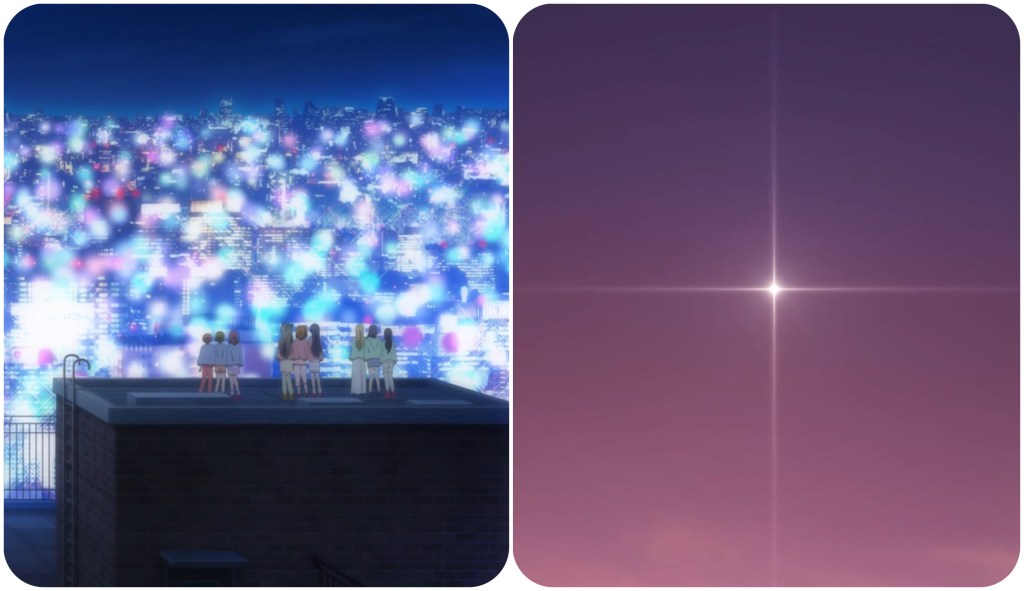
The next few episodes then are spent pondering what went wrong. The legacy of the nine goddesses and the trial of those who chase their radiance. Like μ’s, like μ’s, like μ’s! …But what about Aqours? Where do they actually find themselves within all the shallow pep talk and distracting amount of jumping. Beating her head against the wall had seen no results, so they once more journey to the sacred land themselves in search of an answer, and upon seeing that child’s peerless joy Chika finally realises that she had been misguided from the start. How deep the rot runs. She had been reaching for it but her actions thus far had barely amounted to more than fandom. She was unable to refute Leah when their efforts were labelled a mockery of the competition’s prestige, and by talking to them this late in the season she’s only now managing to properly internalise the fact that everyone there wants to win. For their own sake. Not just because they’re chasing the light, but because of their own personal investment. In seeing that little girl so exuberant while resembling Honoka’s guise it hits her just how much the desperation deep in their group had chained them. Nine doves are once again seen in the sky, signifying that Chika has glimpsed some meaning. Just a little bit, she thinks she sees a word sparkling within. What was good about μ’s? That they ran straight through a place that was empty. That it was never quite about blitzing the competition but about seeing how far they could take each other. Nine lonely girls coming to love one another in that brief fragment of time. Not looking up, but looking forward. That’s what was good about μ’s. It was a song of love. They saw the open skies before them and flew freely. What this “place that had nothing” phrase actually means can be hard to nail down but I think it’s likely to be taken together with Chika’s own situation. There are two lines within the show that mention it. Chika says both “all my life I’ve been calling out from within, ‘help me, there’s nothing here'” and “surely what was good about μ’s is that they ran straight through a place that had nothing”, and therefore these can easily slot together to form a story set. The emptiness they refer to is the normal, the mundane. Everyone in both groups were terrified of earnestly stepping out into an unknown field. How could they not be? They were all weak on their own. Yet while Chika had spent a large part of this season trying to maintain enough distance to protect herself, μ’s were able to be brave and put their everything forward with along with Honoka. Running through a place that had nothing, and leaving nothing behind. Certainly they loved the world and wished to nurture its developing culture, but the latter tells us they never desired the fixation that Chika had placed upon them. A lighthouse does not call ships to crash into itself after all, but guides them toward the dock. The post-μ’s society that Aqours inhabit had been looking up at the star with adoration, but connecting it to the rooftop shot from School Idol Project’s penultimate episode shows us how those girls inside it were staring straight back into the sea of lights below them. The true acceptance of the will passed down by god would be to blow right past them and say, “Dear Honoka. I love μ’s. But I will find my own place.”
It of course runs all throughout the show but given the massive metaphorical weight of this particular episode it’s the place to glimpse μ’s’ presence most overtly. Unlike all the other instances of μ’s gently nudging the world from behind the scenes, this event of Aqours visiting that same fabled beach and Chika catching the dove’s feather as it slowly descends to her from heaven are impossible to overlook. So as you may surmise this is Sunshine’s most vocal episode for its μ’s imagery. The group have finally found their individual beginning as they move into the second season so it makes sense that episode 12 is positioned to be μ’s’ main finale within the narrative, put in a place that you can’t miss them. They will certainly continue to carry huge presence within the writing and shot composition, don’t get me wrong, but this is the big climax of that chapter where Honoka and Chika for the first and only time actually interact with one another. Recall that I’d highlighted the doves in sets of three and nine as indicating the presence of both the second years and the complete group respectively. This time it’s only a single dove that shows up, and through this juxtaposition we can tell that this one is specific stand-in for the leader of μ’s herself. Chika calls out to her and she actually responds. It’s a conversation occurring somewhere through the halls of time and space, but the deified Honoka extends an open hand to her from the stairs she once stood upon and Chika is more than happy to take it up. She whispers her of things she can see and places she can go. What passion could stir her frozen soul if they would just let Honoka’s infinite love share it with them. To unite as a complete whole their own group had ultimately sealed themselves off in the folds of time, but before deigning this end the festival of sun and song was a message dedicated to people exactly like Chika, if she would only let the bird carrying the envelope reach her. Honoka tells her that she has been watching them; their pain, their pleading and their potential, so please do accept these words. Become honest, make your own happiness and embrace the future as children of the sunny day. Discard the self-inflicted pressure and let yourself feel the soft heartbeats radiating from the world she wove into being. That freedom is the legacy she left behind, and it is a promise eternal. With renewed clarity, Chika accepts the feather.
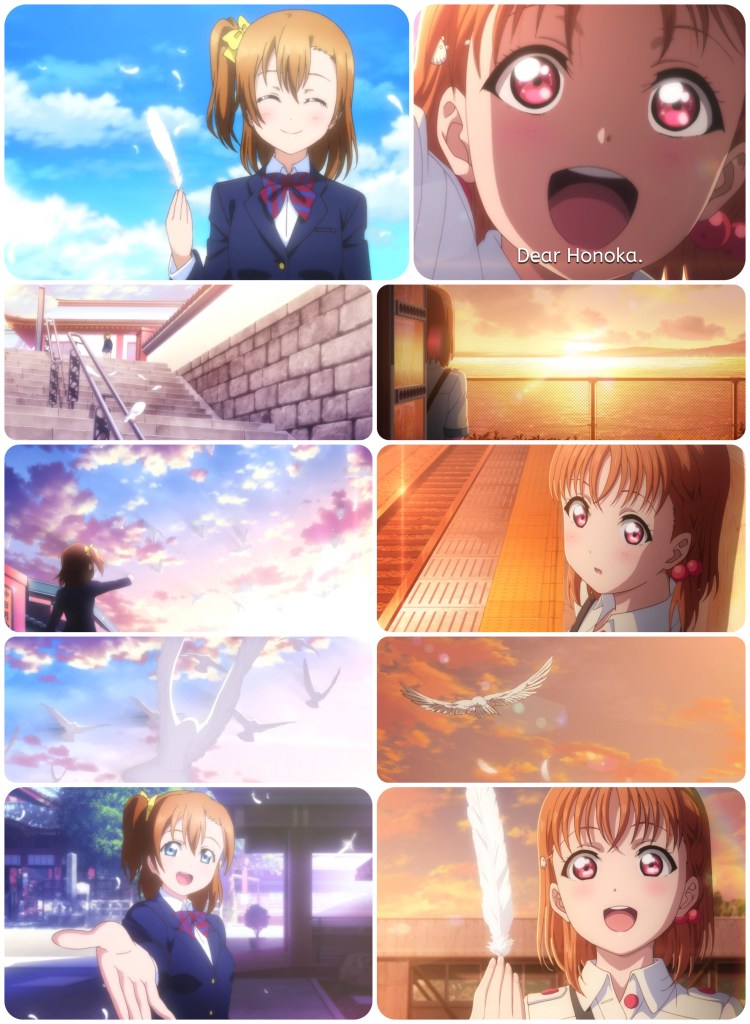
It follows that Chika’s monologue at the end where she starts speaking to Honoka is perhaps the point to best indicate how Sunshine’s first season substantiates μ’s so effectively, since this is accomplished through the comparison of the two leaders. Dial it back and explore what would happen if the position of leader was left to someone as vulnerable and introspective as Nico after all? This is the part that really dictates Sunshine. It changes everything. Seira does at one point confess that as far as the pursuit goes the performative level of the genesis had been reached a long time ago. To be completely frank you could just use yours eyes and ears to tell this. The top level is still the top level. Yet nobody feels that they’re equal. There’s some kind of hidden inner quality that external groups can’t tease out of the legacy. μ’s was a power created through the precarious balance of Honoka’s recklessness and idiocy. Though steered by Nozomi behind the scenes and permitted to run wild through the collaborative efforts of everyone else, she was the one to pull in each member and the one always charging headfirst into turbulent skies. It shows through in the ‘no centre’ debacle that even if Honoka herself failed to recognise what a force she was, the others certainly saw it, and they would do all they could to ensure she was provided with the right environment to rampage. Eli antagonizes their efforts for an entire season and then when she finally falters for a moment she is greeted not with the fang that lay in wait, but a helping hand. Honoka had not even seen this outburst, she simply felt that she wanted her on their side after all. It’s because she had that kind of personality that Nozomi could sense she would be the one. Through letting themselves be influenced by her the group was able to unite with such unrivalled fervour. Honoka took them by the hand, and she ran straight through an empty place. She created light where there was once void. The legendary school idol. The goddess of the new world. And so most of Sunshine’s story is underpinned with Chika’s inability to measure up to her. She desperately struggles all she can to try and imitate her heroes, yet things never work out the way she wants. Chika is no god, after all. Try as she might, she just isn’t strong enough for that. If her unironic plan to have every student sing on stage in the regional prelims was any indication perhaps she is equally as scatterbrained, at least, but she certainly does not have the same emotional resilience or charisma that drove Honoka. Any similarities we can ascribe to them would only be skin deep. Observing the insurmountable divide between them in this way leads us to appreciate just how fearsome the affection of that original leader was. Such is the interaction Sunshine has with its predecessor. Not shining as one per se, but shining together. The nuance between them slightly different. Chika’s position as Aqours’ leader is never questioned, and there are visible cliques within the group. The decision to drop naming formalities happens naturally instead of being forced by the third years, with a lot more personalised chemistry links contained inside their relationship web. You get a perception that these girls are nine friends who just like each other, unlike the previous cast who functioned as nine members that needed to become one in order to persist. There was no highway to success dashing through a place that had never been explored, but wave upon wave crashing down into these girls as they desperately claw at dry ground. μ’s were the right people in the right place at the right time. They may have had a rough first concert, but beyond that any stray point of drama carries no threat because it only ever lasts an episode at most, and we know that the plot will be nice to them. μ’s go up and up and up, and they just aren’t really made to come back down. The world responds to their efforts. But Aqours are faced with roadblocks at every turn, and these conflicts are what define Love Live Sunshine. Honoka was something else, but Chika is just normal. She’s weak. She’s easily hurt, and even easier to discourage. So actually, why even try? Take a step back and ponder why she was ever even aiming for that idealisation to begin with. Chasing ‘the light that can never be reached’ would never bear fruit, but on second thought why were they even bothering to chase it in the first place? The gods above smite her in order to cast her eyes away from heaven. They tell her to look at all these smiling faces around her, listen to their laughing voices and remember all the times they had shared. She takes a deep breath, embraces the friends within her reach, and just lets it all go as she promises that she will find her own ‘place’ (in apostrophes since Sunshine frequently highlights ‘place’ as a metaphorical concept). Here at the peak of μ’s’ heavenly interference she realises that this is okay, because frankly who could ever hope to measure up to the progenitor. They’re as gods in the sky. Yet all the same who even needs to? The light that can never be reached is of course a light that need not be reached. In that regard it might be worth taking notice of how although the latter half of this episode was prime material for it the reaching arm shot does not show up, Chika instead keeping her arms firmly at her side or folded behind her back, as if preventing herself from reaching toward μ’s. She’ll run down her own path, carve out her own place and dye the world in her own colour. Which, as discussed, was the original will of the goddesses anyway. When they chose to become legends together in their final concert, μ’s did so in order to ensure the prosperity of the growing school idol world, in a wish that individuality would explode in their wake. They didn’t want followers, they wanted fellows. Suspended somewhere sometime in some ethereal second Honoka smiles upon her, and the seat of successor is passed down upon the new generation. She finally becomes worthy to carry the white feather that denotes those ‘blessed by the goddess’, and will begin to give Aqours the belated push into its own, tearing down her bedroom poster in order to be freed from her ‘worship’. After being carried this far simply by the motion of the drifting waves, at long, long last Aqours arrives at the start line.
These feelings lead them into the next episode’s regional qualifiers. Although they don’t manage to take the victory they’ve properly aligned with μ’s’ wishes for the first time. And so during a particular moment of harmony within that recurring shot of Chika reaching forward, we see her cusp the light in her hand. Attempting to take the sun for herself like Honoka had always wished they would. Who knows whether it will last, but she temporarily grabs hold of the truth. This movement then leads into the first resurfacing of the star. It rings for only a moment before burning out, but it was there. For a brief second Chika had seen something within that radiance. As the dance reaches its climax the girls leap up in a desaturated, high contrast slow-mo shot which parallels that of BokuHika’s ending. But I’d point out that in this case it’s important to note that while μ’s had been arranged in a closed circle, Aqours are set as an arrow pointing forward. It’s a little touch but considering how Sunshine is all about this juxtaposition between they who chose to become the past and the new group aiming for the future, I’d say it’s intended to be highlighted that way. This is a deliberate callback so we’re obviously being expected to extract some meaning from of it.
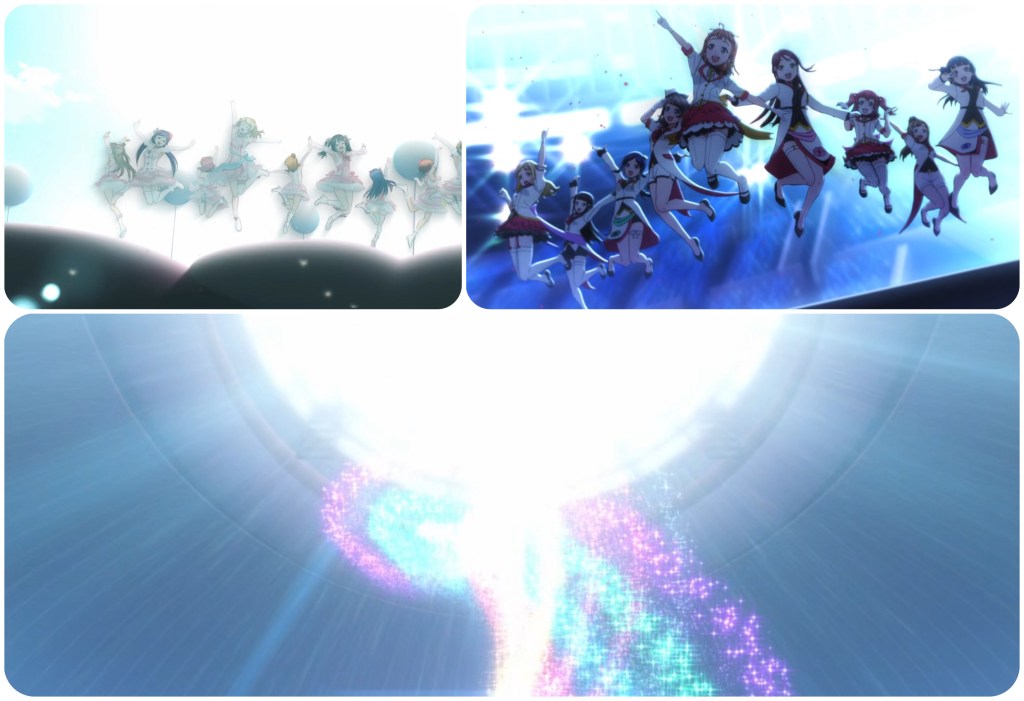
A rainbow comprised of many little stars radiates out from the group. There’s a small visual consistency contained within this where the red, green and purple will eventually be seen left on the ground in the film’s last performance as their respective hosts depart. Additionally because of the fact that its towering toward the overhead light, the Mirai Ticket performance is the first point at which I’ll return to what I mentioned at the start, with regards to the secondary component of the rainbow theme. Its structural significance: the Aqours Rainbow. In a nutshell it’s to do with the difference in group dynamic between the two series. μ’s was something that had to be the nine of them, whereas Aqours has already been seen swapping around members through its multiple incarnations. If School Idol Project was about nine lonely girls coming together to form a group that could only ever have been the nine of them, learning to love one another and dyeing each other in a uniform white light, then Sunshine is about the nine vulnerable finding a means to break out of their shell and start loving themselves, smashing their conflicting individualities into each other until it eventually forms a rainbow. Chika seeing a way to exceed the normal, Hanamaru finally taken out of her tomb or Mari fighting for her friendship. Things like that. Rather than nine becoming the single white light, you get nine becoming a rainbow. The rainbow is mostly seen as a side effect in the debate between the two groups (of which this is still an application), but there are also these instances where it’s to be read with a slightly different nuance as a manifestation of each group’s differing motivation. The lens flares are the two groups talking to one another, while the Aqours Rainbow is a personification of this one’s underlying motto.
The season ends ambiguously on the girls all huddling together for some after-production cast photo, occurring outside the narrative in a disconnected timespace. An interlude between the two acts of this performance.
But the miracle is not made. Not yet. Chika reaches for the light but is thrown to the darkness. Second Season rolls around and we see that the girls, as inspired as they may have been in that seemingly ultimate battle, still failed to qualify. Which is understandable considering that was effectively their first time performing as Aqours in any honest capacity. The leader is still weak, but you can see hints of her growth. In the first section of the story, we see You frequently taunting her about whether she’s going to give up, and this repetition is used to lead into a powerful moment in episode 8 where she walks off without answering. In the same line of thinking: we see that back then she herself had tried to pass off their failure as satisfactory, but now when her beloved Riko provokes her with those exact lines Chika goes so far as to say that she would turn against her were her words true.
Fret not however, for as it seems to go with these things the next Love Live is announced almost immediately, and they have every intention of winning this one. Smoldering with the desire to fight once more, the restless monster runs to the school and roars toward the heavens. Only to find the rest of the group already there waiting for her, since it turns out they must have just been on the same wavelength, or that the school itself called them there. Not forgetting that Uranohoshi is an agent of the star subplot. They vow to struggle for as long as they can, and set their sights on a proper goal. They’ve already moved on from their simple desire to be like μ’s, but the lack of a true footing had seen the ground collapsing beneath them at the qualifiers. But they have a goal now. They will struggle all they can, reclaim the radiance they had seen within that star on the stage, and make a miracle. Literally the first line in this show is about it and they had previously cited their respect for how μ’s performed a miracle in saving their school, but for the character motivations themselves this is the first outward declaration of the Kiseki Hikaru (or Shining Miracle) plotline seen not only in the dialogue but within the soundtrack as a nonverbal narrative, and which is an artifact of divine stylings. Likewise, note that this act of them unanimously syncing their feelings and running to the oval and the scene where every single member gets a closeup and repeats the line “kiseki o” are clear examples of what I speak of when I mention things feeling rehearsed as part of its theatrical presentation. Responding to their ambitions, the hilltop sunrise – that which usually represents μ’s suspended in glory as the ‘light at the summit’ – briefly echoes the star they had touched upon. They will fight as hard as they can, and then maybe something miraculous will be waiting for them at the other side.
But that is of course easier said than done. The next trial descends. Uranohoshi’s life wears thin. They don’t have much longer left to save the school at all. They’re really gonna have to kick themselves into overdrive if they want to have any hope of defeating their demon, so with the first stage of the next prelims rolling around they decide it’d serve them well to split off into two groups to work on tracks, in the hope of doubling their output. The second years have a pretty easy time of it since they’ve been crafting the performances since the beginning, but the other six really struggle to see eye to eye. They try a bunch of things to find unity but that just ends up emphasizing their clashing tastes more. It takes them a while to arrive at the conclusion that Aqours is about all these separate sounds harmonizing into a beautiful chorus. The zeroes bash into each other until they eventually become a one. In one of these ever so poetic moments that run all throughout the show, the falling raindrops just so happen to form the melody of My Mai Tonight. Now if I really wanted to I could joke about the whimsical water here being an agent of the apparent weather god Honoka, but that’d be little more than a communal gag. They now have two songs, but the astute may realise that this indicates the small problem of also having two events. Both of which occupy the same day, and considering the sparse rural region they live in getting to each is going to be no easy feat.
The only realistic option is to once more split down the middle and have the separate groups cover both locations. The realistic option. But just as they’re setting position for five the missing members step out anyway and although one would ordinarily have seen this as them accepting their fate as soon as the concert ends they all head for the hills. Today Aqours plans to do something unrealistic. Will a miracle appear? Not if they don’t search for it. The rainbow will surely show its face if they believe hard enough. They’re just gonna fight their way through the orchard and run there, probability be damned. They will reach that second stage no matter what. Despite thinking it impossible they’ve managed to perform at both locations, their fingertips just grazing the miracle they seek. The stage’s main centrepiece is the Aqours Rainbow, but more of interest here are the bubbles blown during the concert. This is an imagery thread that only rears its head a minimal amount of times. Their colouration reveals that they’re a subset of the existing rainbow imagery, and as such we can discern them meant as counterpart to the lens flare, but displaying a balance where Aqours is more in control than μ’s. The usual rainbow is an intangible phenomena hanging in the air, but bubbles are a bit more corporeal, and most importantly they’re made of liquid. Not quite water, but tantamount. At a glance that’s the way I’d contextualise them. Why this episode in particular? That’d be since this double-concert is the first time Aqours makes a miracle, and may or may not be the first time Chika’s own efforts summon a physical rainbow. My Mai Tonight is in many regards their Snow Halation. It’s the embodiment of the previously mentioned ‘many sounds forming a harmony’ theme, which is itself an extension of their defining Aqours Rainbow that in turn then also contrasts with how Snow Halation is developed as a love song for each member. Its episode centres on a similar sequence of running to the venue, as well as being the first major performance to really convince the audience that they could contest the final stage. If there were any point to say that the sea has swallowed the sun, this would be it. This is likewise illustrated in this being one of the few moments where Chika reaches upward from a third-person perspective, so the alteration of these two established symbolic centrepieces helps us to glimpse the gravity of what has just transpired. That would be why you get the liquid bubbles instead of the light-distortion lens flare here. The bubbles don’t completely replace the lens flare from here on out and Aqours’ brief success will surely be thrown to the whirlpool once more, in fact as I recall this specific icon actually only happens twice – here in episode 16 and then again at the very end of the film. But with each step Aqours gets a little closer to finding their own truth, and that’s what the bubbles let us know.

The miracle doesn’t last long before judgement is once again wrought. It’s in these conflicts that Love Live Sunshine finds its meaning. The feathers in Sunshine are symbolic of the μ’s legacy, or specifically they denote ‘those who inherit their will’. Chika spends the first season chasing their shadow and desperately doing all she can to be even a little more like Honoka. Sing and dance without aim, and rush ahead without thought because that’s what μ’s did. But that’s not what μ’s is. Not even close. That’s a surface-level understanding from someone who, in truth, was acting the fangirl more than anything. And so it’s only when she realises that they can’t simply be μ’s wannabes that the feather falls to her from on high. That’s all well and good, but times are tough nowadays. The school idol scene isn’t even remotely recognisable from its small beginnings, and our backwater group are at an immediate disadvantage from their location. It’s a far cry from the wonder zone μ’s was borne of. They’ve managed to force themselves this far, but there are some things that just can’t be defeated. Maybe Honoka could have done it, but she was a force unlike any other. They struggled all they could, but it simply wasn’t enough. Gods they are not. There are limits to what they could do. The school’s fate is sealed and the feather slips from their hands, recalled by the light at the summit opposite to their home beach. I emphasize this specifically because that shot imitates the previous episode when Chika had reached toward the same thing, and so by using an equivalent shot it illustrates the severity of their defeat. Aqours have no clue how they’re supposed to survive this, or whether they even have the right to. With their light smothered beneath the rain of tears, they forsake the predecessor’s principles and the blessing therefore rejects them. They’ve bloody well been shipwrecked and left for dead within that voracious ocean.
Yet somewhere inside that suffering they finally discover their true purpose. Little did they know that their chat would end up being the last mention of the mundane monster Chikacchii, for Aqours is finally about to find its meaning as a group. Chika is rapidly outgrowing her cage and just itching to evolve, and once she does the normal will no longer be needed. It took them 12 episodes to properly arrive at the school idol start line, and now another 8 to fully come into their own. What is Aqours? It is a song of life. Nine dying monsters come together in a desolate land, and they sing to live. They will embrace the pain and regret of those who so cherished this place and ignite those murky feelings as the fuel with which to shine more fiercely than ever before. As she stands before the stadium, Chika even manages to find it within herself to thank the zero for everything it’s done for them. She looks back at that horrific first trial god had given them and she expresses gratitude to it for setting them on the right path. If anyone or anything should be scared now, it certainly is not them. Not anymore. They’re gonna crush the competition and all that which has tortured them by engraving their name in the annals of school idol history forever. Maybe they can’t call people to Uranohoshi anymore, but they refuse to simply let it fade away either. Its swan song shall be a power overwhelming. In response to this righteous anger, that all important white feather – that which signifies inheritance from their predecessors – is dyed their signature blue shade. This is something Sunshine’s own second ending had been hinting at for a while. Chika emerges from the sea in a shot probably framed to parallel Honoka gazing out in her counterpart, and the seagull’s feathers are so bright the only thing visible is the blue glow outlining them. The bird that was once the symbol of their denial has now offered feathers unique to their home. First promising to find her own place in episode 12, and now finding a new group definition that successfully manages to dye the feather blue.

There is quite a mix of feathers to be found. Even the Love Live All Stars game decorates itself with rainbow feathers since these have long been the core of the franchise’s deeper discussions. Sunshine celebrates the white dove that is the hand of god on high, and the blue bird that gives flight to those left on the surface. In the movie we briefly see Saint Snow tap into their own pink feather too, since Believe Again is just a really cool song. There are Yohane’s black feathers which admittedly do little beyond expand the palette, and in this second ED we see a representative shot of Chika mourning amidst a wave of orange feathers. The orange being indicative of Honoka here. The school is headed for the gallows and their last shot at god eludes them, so all she can do is cry at what could have been. But following on from this scene Chika is abruptly dropped, much like when her footing had shattered chasing the light in Second Season’s opening dream. But this time the ocean catches her and she starts to sense the blue world all around. Once she surfaces we get those aforementioned gull feathers. These three cuts are a dramatic imagining of episode 20’s ending scene when the Uranohoshi students pull Aqours out of their funk.

Much like the feather finally becoming blue, the monster imagery thread has now evolved. Through trial the prophecy has been fulfilled. Finding truth within their struggles and gaining a strength beyond anything they’d exhibited before, Riko muses that their leader’s power might even rival a real monster now – no diminishing qualifiers of normality attached. Aqours are now the blessed beasts they were always meant to become. Divinity may have escaped their hands, but damn it they will snatch away the immortal regardless! On a special night the girls climb to the top of one of those mountains they’re always looking at from below. The night was a stormy one, but frankly that means little to these monsters anymore. Through force of will alone they can now wrench open the locked heavens to summon a shooting star. If god continues to test them, they’ll very well disown her.
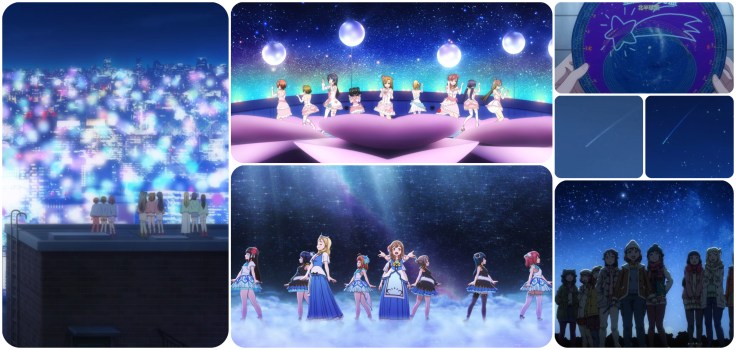
The awakened Aqours tackles each passing day with an increasing ferocity and as they are now they can certainly drag the miracle from its den with their talons themselves. Not one thing has gone totally right for them in this entire story, every positive laced with poison, but through this constant battle their scales have been hardened, their fangs sharpened and all distraction removed until the only thing left reflected in their burning eyes is the final prey itself. The stage, the summit, the seat of god! The defeated shall defeat defeat itself, reaching deep within the body of death and gouging out the life hidden within. They will live. Nobody could hope to oppose them now. These monstrous feathers run wild as Aqours grows strong enough to eclipse the Love Live, even going so far as to symbolically warp through the screen into the stunned masses. The world these girls inhabit is a transient perceptual space where the imagery forms the very ether, and at the height of their power Aqours will tear reality asunder. Leading into the final battle we’re greeted with another rare instance of the star. They have realized their purpose. Not as that which creates the world, but that which claims the world for itself and paints it in their own blue colour. μ’s had created an endless choir for all school idols and those who will support them, but the beastly Aqours sings only for themselves. Through the clouds at their feet and vibrant galaxy decorating the sky, the set design in the first act of the stage lets us see that as they are now Aqours will very well just make their own heaven. They don’t need – or even want – the one belonging to μ’s anymore. The world may have aimed for their life at every turn, but they still clawed their way up there with determination alone. In the closing moments of their performance we get a shot starting at Chika’s hand, then swooping up to the roof to reveal the group’s full lineup as they stand atop the rainbow. Traditionally this is where we’d have seen the Donna Toki mo Zutto arm, but instead we get the inverse. The camera is firmly focused on Aqours now since the need to reach at the light above has been overcome. They double down on this reversal with the encore performance of the first opening. Aqours have grown tremendously since season 1 so they obviously overwrite the parts that had been representative of their initial weaknesses. The third years are now standing in harmony, and the shot of Chika chasing μ’s’ shadow – as cool as that image may be – is entirely erased. At last fulfilling μ’s parting promise through the very act of utterly refusing to become μ’s at all. Slam close the gates and mourn the bayside star as it fades to black. The funeral piano begins to play. A calamitous wind of water, a raging flood of light; with the unstoppable momentum of a tsunami Aqours storm the Love Live and bid their dying home farewell through a legend of its very own.

Now hang on a tick. Second Season has finished and we’ve just had the resolution of their wonderful ‘water blue’ story, but rest assured that the rainbows have not been forgotten. As if the title Love Live Sunshine: Over the Rainbow was not enough to discern that in itself.
During the final episode’s victory lap we get to see the most complete projection of the Aqours Rainbow yet. Wonderful Stories cycles through every costume set and stage to reinforce each member’s unique character moments, and then uses all those experiences to feed into the rainbow as they paint it across the sky. I also have strong suspicions that the faded layer above it is representing μ’s. Then the stage curtain falls and Love Live Sunshine ends. But neither of those things stay sealed for long, since the curtain is once again raised during this entry’s opening performance of Bokura no Hashittekita no Michi wa. Aqours have finally reached the summit, but there is still a discussion of legacy to be had and that is where these which represent close engagement with μ’s will fully mature. Queries around Aqours’ future and potential disbandment never played a major role in the show. The extent of the discussion, or at least the direct dialogue since there are thematic and metaphorical remarks on it running all throughout, is Chika stating she doesn’t feel ready to decide anything yet. That’s it. They gloss over it and then the season ends without reopening talks. Prior to the film many always saw this as a missing plot thread, but like…I didn’t? Sunshine was a magical experience for me in that it seemed like me and the writers were always fundamentally on the same page for how the narrative should proceed and what the show should mean, so I just never really saw it as a question that Aqours would continue. These girls love being idols just as much as they love one another, and it’d been a generational group to begin with (albeit accidentally). It never really needed to be raised in the main show, nor does it require any more attention than it gets at the start of the film when Riko throws their decision out in the absence of any particular fanfare. To begin with Sunshine would make zero sense if the group didn’t sail into the future since it’s basically a story about making the opposite choice to School Idol Project at every turn. Whether Aqours will continue was never a talking point, that much was already decided as soon as the writers endeavoured to make the story what it is. But rather the part left up in the air is what the next Aqours will look like. What form will they take and what meaning will they apply as their foundation. That is what Over the Rainbow sets out to explore.
The “water blue new world” imagery thread has resolved with their victory in the Love Live, so now what’s left to address in order to close out this story are those which pertain to legacy – the rainbows, feathers, and that star which I said marked the beginning, middle and end. However alongside all these Over the Rainbow does put a new prominent piece into play with the paper planes often being thrown around. Though this actually first appeared in the season 2 pilot and finale, bordering the cour but not being particularly relevant within it. I don’t believe there’s a whole lot to unpack for this one. Its usage in that season is simply to bait out the line “you can fly it as many times as it takes”. This is a comment on, firstly Chika’s established inability to commit to things because she was scared of failure, but more significantly the future of the group. Losing the third years will be a big blow, but unlike μ’s these girls are not gods. There isn’t that same degree of expectation, elegance or finality enveloping their actions. That inequality which has always been the thorn in their side is now the key that will open their gates forward. Aqours is the monster and its instincts tell it to struggle for as long as life sits in its bones. They have the lenience to try over and over again, following each and every next rainbow just to see where it goes, repeating the cycle and passing the title down for as long as history will allow it.
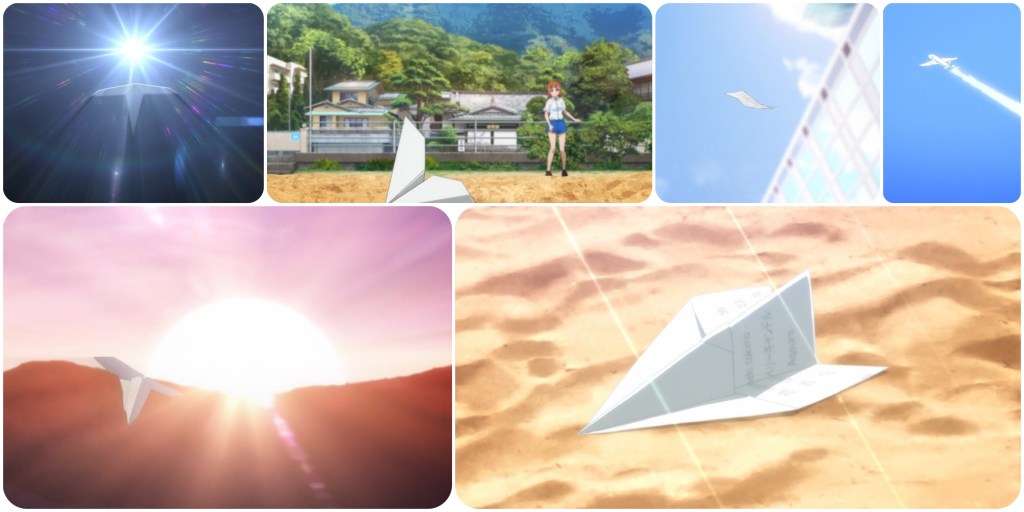
So that’s the introductory association of the paper plane. Over the Rainbow retools it a bit, but it is still largely defined by that notion. For example at the end of the first performance we see it thrown into the sky where it transforms into a real aeroplane as the the graduating students head abroad. This serves to galvanise the link between the paper plane, the members who move on and the future of Aqours. Complementing this during the final act, it reveals that the paper with which the metaphysical symbol had been constructed is that same accursed results sheet from their first failure in Tokyo’s qualifiers, which had itself been returned to the sky before their Love Live performance. What was once the thing that nearly destroyed their group is now a sign of their freedom.
Side note: As for why that scene showed them as children, it’s just another affirmation that the normal has been defeated. The visuals link to the beginning of the story where it was the flashback sequence which introduces Chika as a ‘normal person from planet normal’.
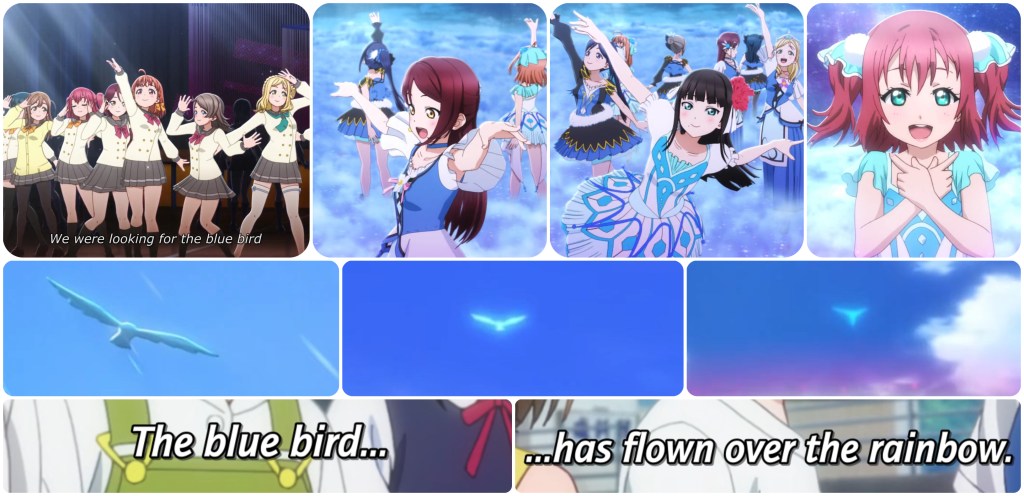
And then with all this in mind, the most important addition the film applies to the existing imagery is that we get a couple of scenes showing the paper plane transforming into a glowing blue bird. Near the start I mentioned that there was a particular evolution in the bird imagery. From Honoka’s doves into Uchiura’s seagulls and then into the blue bird which symbolizes Aqours made whole. Though much like the paper plane, the blue bird itself actually originates from season 2’s last episode. It doesn’t visually manifest yet but there’s a particular lyric in Wonderful Stories mentioning the “aoi tori sagashiteta” or “blue bird we were searching for”. Or rather that is the first indisputable introduction of it. But to take it a step further I would argue that the show even wants you to read the way Riko, Dia and Ruby ‘flap their wings’ in the cloudy beginning of Water Blue New World’s choreography as an interpretive image of that bird. You have the existing bird imagery, that movement and the “my new world” lyrics all combining in order to give rise to the blue bird within their Love Live performance as a symbol of the blue Aqours’ greatest power. This is supported by the fact that we had effectively seen Leah do the same thing during her own introduction at the shrine, with the visual of her sailing through the air with outstretched arms meant to parallel the doves in Donna Toki mo Zutto. Her action of course being prefixed with the lens flare, and considering this whole ‘sun and sea’ idea we could potentially even tie together how when she mimics Honoka’s dove she soars through the clouds in the sky, yet when Aqours create the blue bird the sea of cloud is at their feet. We actually see a similar notion in the film when the third years’ feathers are resting upon the river.
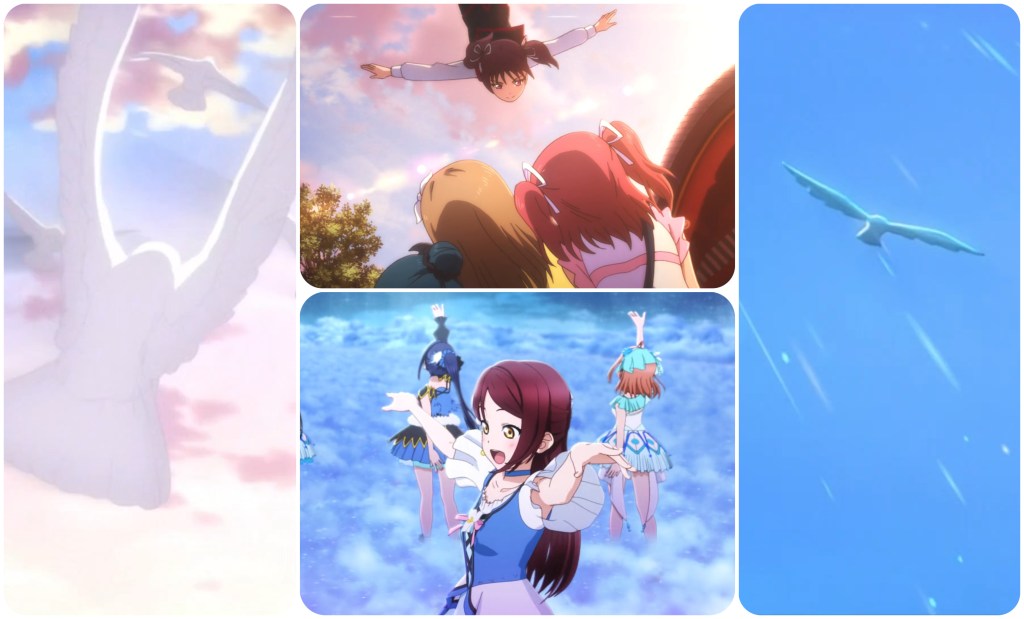
Having finally reached this stage of the story where the blue bird is given form, and not myself being a believer in such offerings as coherent paragraph structure, this will become the launchpad to leap all the way back to episode 2 in order to prod at the weakest link. When the girls go diving to help Riko get a better image of her song, thinking that she might “see something” within the waves, a glowing blue fish appears before her. On an immediate level it is something that guides her toward the light or inspires warm feelings for the seaside town within her. Drowning in self-loathing, the soon to be born Aqours nudges her toward the water’s surface. It isn’t difficult to come up with such things so there is certainly no absence of ways to make sense of the fish. But that’s really only within the context of its own scene, and looking at it from that secular brand of analysis isn’t enough. All the imagery discussed here is intrinsically inter-linked at every level, constantly weaving in and out of the presentation and built into the very ground the character concepts are standing upon. It is the fabric of their world. Previously I had called the bubbles the most obfuscated symbol set but in their defense at least they have a not-insignificant degree of interlinked threads establishing their position. The rainbow of water ties it to the rest of the rainbow imagery, and the idea that the lens flare has temporarily been replaced with the bubbles is a suggestion solidified through other imagery sets supporting its placement. We see the boundaries of the POV arm shot broken which points us toward the lens flares also being damaged by the group’s newfound strength too, and that occurrence is preceded by the sunrise shot. In that episode Aqours temporarily grow more powerful than they’d ever been through making their own miracle and so we can interpret those aforementioned as deliberate evolutions. The dialogue in that ending run is then understood to not be throwaway idolspeak but specifically pointing toward the established religious overhead.
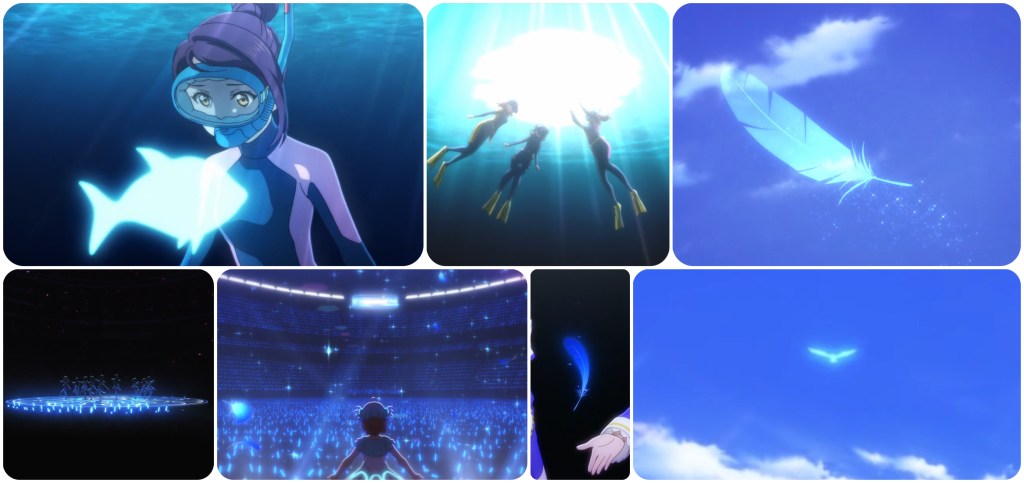
Therefore even as one of the weaker incidences the bubbles still have at least four separate storylines informing them. But the fish doesn’t get much. The only real connection it possesses is as a luminescent animal similar to the blue bird seen at the end. Functionally it just stands in for the whispering nebula that had caught Chika’s attention in episode 1, and only appears this way because the song Riko is trying to write is named “Those Who Return to the Sea”. Without much of a metaphorical leg to stand on the fish cannot become something of its own, but simply gets chucked in as the trumpet that sounds the beginning of the water blue new world thematic journey and eventually primes the ground for thought of the blue bird to develop. That’s about as much as I can give it. The blue fish offers effectively nothing, while the blue bird is the ultimate form the first Aqours takes. As all plot threads begin moving toward closure in this last movie, all images naturally reach their final destination. The blue bird soars toward the horizon, assuring us that Aqours have finally become complete within this ideological realization. From zero to one to something greater.
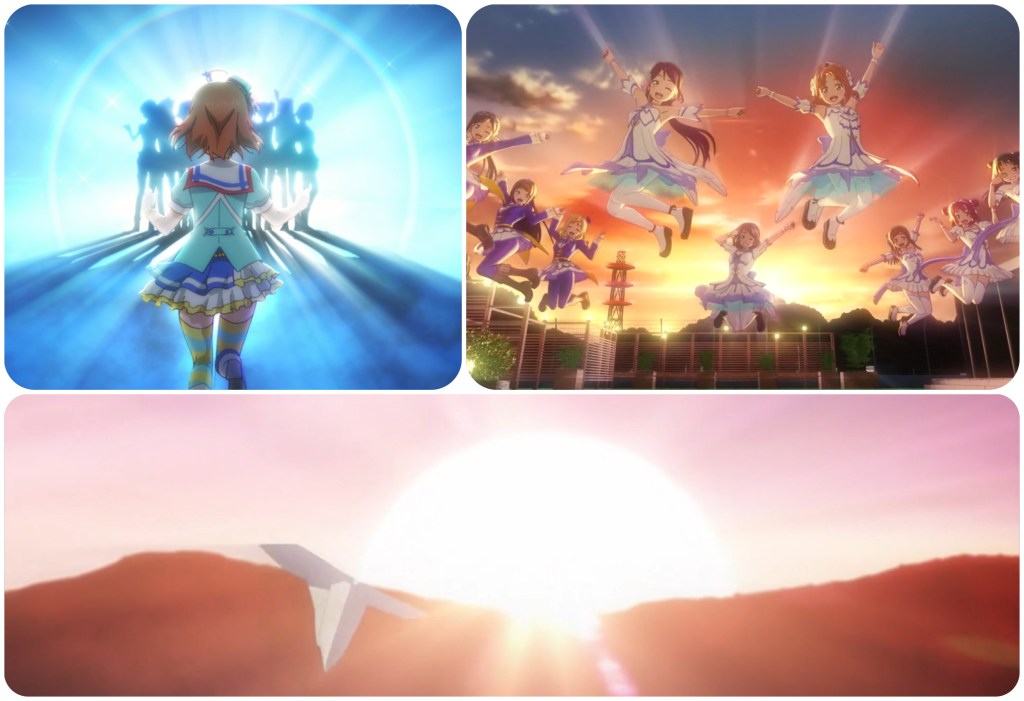
As the Aqours nine sing their last, we’re given the strongest instance for that recurring shot of the hilltop sunrise. It happens again and again through the story but this is the point at which it shows through in a most real frame. The shot composition places great importance on their shadows to help us recognise the actual implication contained within the song’s title Brightest Melody. They’re immersed in the sunshine more than ever before. Most of the time they’re being comforted by it. Chika will often be found sunbathing on either the beach or her roof to absorb its rays for motivation. So in a sense this is vindication for Aqours after their long struggles, because the sight of them eclipsed by the light behind presents a visual tie together with Chika running at μ’s back in Sunshine’s first opening. Specifically we should be noting how although the shadows in this performance had previously been black, when they leap up it creates white rays of light much like the aforementioned shot. In their last performance as nine they have successfully become a kindred power to μ’s. Not equal since they’re them and we’re us, but equivalent. The things they’ve accomplished and the heights they’ve reached will not lose to anyone else, not even the gods. The paper plane containing the zero is carried to the sun as it rests atop the summit because their radiance has been made whole. The answer has begun to form.
Colour of one, star of white. Colour of nine, shine of ours. μ’s the ‘single light’ and Aqours the ‘next rainbow’ – at this point it has at last been fully revealed that this is how the stories interact. μ’s save their ‘place’ and then burn out like a supernova, while in Sunshine their ‘place’ burns out and this is exactly the furnace that ignites the immortality of Aqours; The title is continued to be passed down even through to those two in the after credits scene however many years later, whom metaphorically stand in for Uranohoshi’s two missing students at the time applications were closed and thereby inform us that Chika’s quest to keep their spirit alive had been successful.
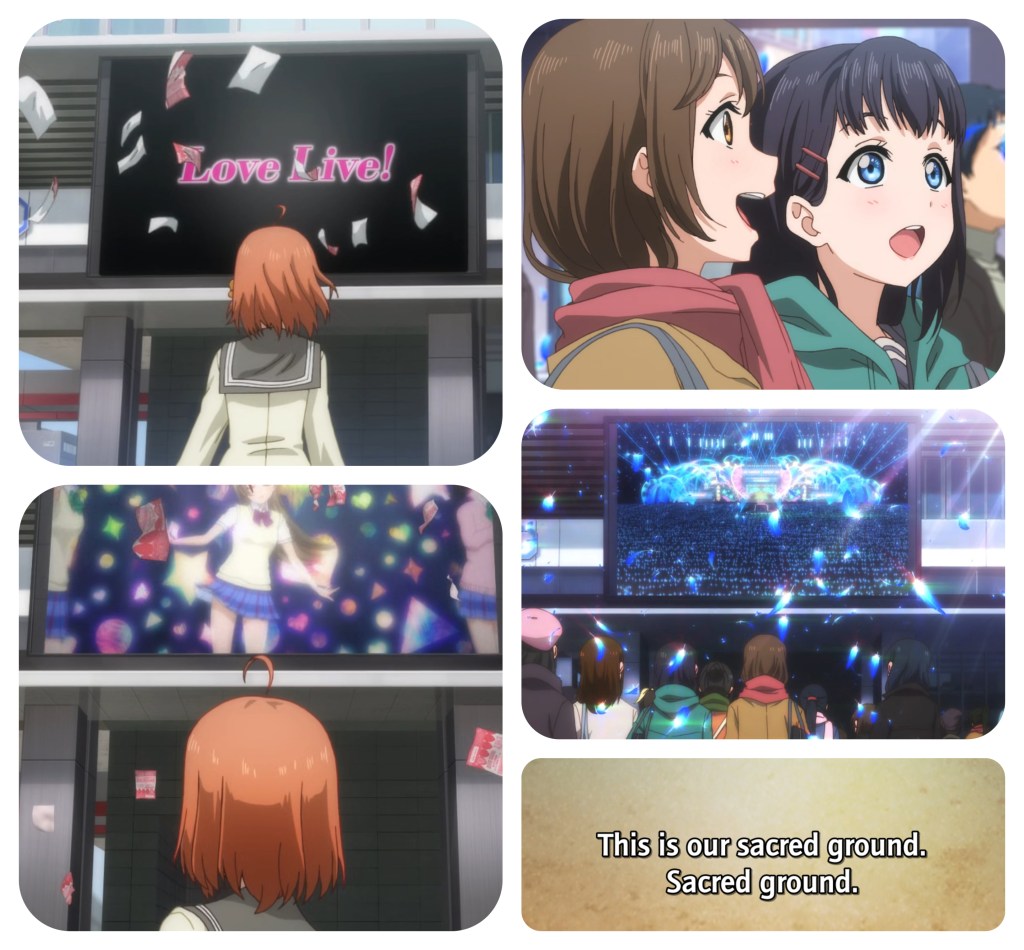
These girls, by the way, I would strongly suggest are the pair seen watching Water Blue New World, since they’re admiring them in a similar frame to how Chika had first encountered μ’s. The “sacred ground” inheritance speech in the film’s end then lets those two fill the previously empty narrative role of Yukiho and Arisa counterparts, so if we thus assume them to be middle school students during the episode 25 scene then I think the timeline fits for them to be inheriting Aqours after Ruby, Maru and Yohane have graduated.
μ’s were ‘shining as bright as we can in the limited time we have’. Past the “single light” stuff, the most significant section of lyric within BokuHika is that “ima ga saikou” or “now is the greatest” line. That moment there was all they had because if it weren’t all nine of them then it was not μ’s. It only carried meaning, only carried power, was only the embodiment of love itself, when those nine forces melted into unison. But Aqours continue on. After all it’s only during the farewell festival that we see the true Aqours Rainbow, with its image colours arranged to match the order of the pre-concert roll call, finally become manifest. I had mentioned that the purpose of Over the Rainbow as a film is in exploring the definition of the continued group. What form will they take and what meaning will the apply as their foundation. That question has been answered. The innermost essence of Aqours as a school idol group will be in how they engage with the Next. They learn that this is their core message as a group. It isn’t necessarily going to be easy and we do see this fact acknowledged in the Next Aqours’ messy debut when the lens flare is stripped of its usual kaleidoscope and instead left a boring yellow (which is, to be honest, perhaps the single most striking transmuting of any symbol in this entire saga). But it will be worth fighting for. This is no longer something that causes them pain, but a gentle nostalgia. Everything that has happened will stay within them. It won’t disappear. The girls willingly close the Uranohoshi gate, and Chika delivers the last of these rehearsed recitals by talking through the affection point of each particular girl. The theatrical imagery line has ended.
The insecure girls have had their concerns quelled and the way forward has been revealed. So now there’s only one thing left to do. One ‘place’ left to go. Together with their new schoolmates they work to build their very own stage for the first time. The original Aqours and its dependency on the world have been laid to rest, yet it’s within this revival that it reaches its own truth as a group continually reborn with each new set of members. They aren’t set back to zero but rather they take all the experience they had gained and use it to start from a one, ten or even hundred this time. Aqours will not be bullied by circumstance anymore. Which is an interesting comparison on a meta level since it’s specifically because of all the rough groundwork School Idol Project had battled to lay out that Sunshine was able to dance out the gates so sturdy. The waves will push them no longer. Instead they will swim freely, taking it upon themselves to craft their own stage and any corresponding miracle. The soundtrack responds to this by finally letting Kiseki Hikaru play in full as an insert song, finishing off the miracle plotline.
The third years are gone, but their feelings still reverberate within them. So the Next Aqours are taking this chance to really relish in being born anew. More than anything they’re excited that they still have the opportunity to set out on new journeys. Hence the closing live’s song being titled Next Sparkling. This track is very important because it puts the underlying narrative differences into practice. Where BokuHika very clearly conveys the ultimate crystallisation of everything μ’s had ever been, Next Sparkling accordingly feels a bit more like an entry-level Aqours song on an entry-level stage. It’s the last μ’s song vs the first song for the new Aqours. There’s a specific story running through Bokutachi wa Hitotsu no Hikari, Water Blue New World and this last track. “The blue bird has flown over the rainbow”, as in the old Aqours has flown the coop and left a rainbow in its wake. The last mention of the Water Blue New World blue bird happens in the scene immediately prior to the closing stage. But surprisingly, that is not quite the end for that section. Sunshine still has one magnificent final surprise up its sleeve.
Every single narrative thread – whether overt in the dialogue or buried within multiple layers of symbolic cover – has been leading up to this one decisive emergence of Aqours’ true rainbow. This performance’s visual design is all about that aesthetic. Aside from the obvious ones splattered all over the place, the costume design this time around has the skirts designed after bird tails, and each girl possessing a single wing. Though less pronounced than Water Blue New World there is also one particular moment that could be taken as Hanamaru flapping her wings. It’s something of a rainbow bird which, rather than fusing into a full whole like μ’s would do or flying to distant skies like the original Aqours trio, only has the ability to soar freely when they support each other as a path in the sky. Shoulder to shoulder as dying beasts that find life within each others’ support. The single light and the blue new world refract off each other to create the next rainbow. Note how their outfits faintly maintain the flower aesthetic that had been seen in the ascension of μ’s (also in mentioning this it’s a bit funny to note that Chika gives a cheeky wink before the choreography does the same criss-crossing and camera angle seen in BokuHika). Though this time it is not in the ground they tread, but applied directly to the body of each girl. μ’s sing for the world, but to be Aqours is to sing for oneself. The white dove and the blue bird fuse to give rise to a phoenix of rainbow. This is the monster Chika always had sleeping somewhere deep inside her.

μ’s, Aqours, the light, the water, the feathers, the sea, the sky, the wind, the star and the angels in heaven. Even the bubbles finally resurface within that mystical ‘place’ the concert takes them to. Every single narrative, symbolic, thematic and musical force within Love Live Sunshine and its genius adaptation of School Idol Project has been building up to this one climactic celebration where Aqours rise from the ashes as a bird clothed in all colours within the light spectrum. With this revealed, we can point out how each entry in the story is building to a bird as its final comment. The dove in season 1, the blue bird in the second and now a phoenix in the film. This is the final form not just of the obvious bird imagery, but of Aqours, the μ’s legacy, Love Live and the school idol itself. It’s simultaneously one of the most extravagant and understated finales I have ever seen in my many many days of anime, and something I believe deserves to be praised incessantly since my goodness is Love Live Sunshine such a cool story. How does School Idol Project end up evolving into something like this? It’s exceedingly ambitious and unbelievably inspired. Now just ignore the fact that they for some reason didn’t play Over the Next Rainbow in the film called Over the Rainbow, even though the CD tracklist suggests it was supposed to and literally every single subplot and thematic evolution was headed toward it as the Aqours BokuHika.
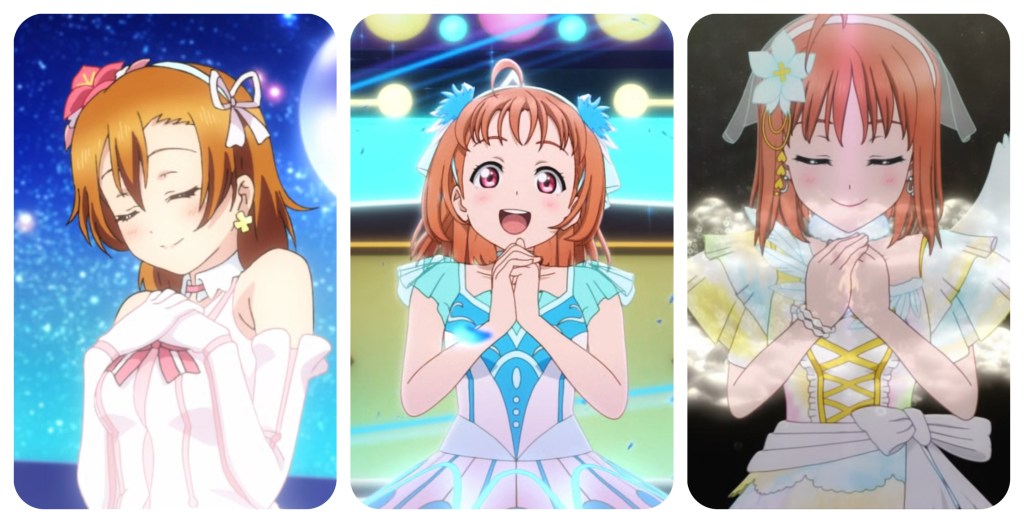
From zero to one to something greater. From start to finish to the future beyond. The feelings they had and the things they did while they were together will not fade away. They will not forget them. Aqours will carry those eternal in their hearts as they march ever forward.
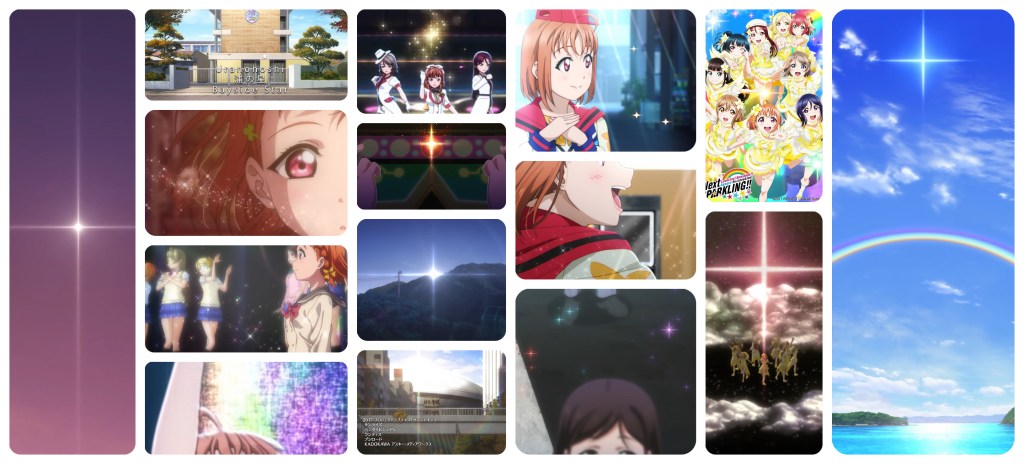
The opening and ending of this film are bookended by the same symbol. We’re treated to three particular star shots within the first song. First is when Chika reflects upon the events of the series and brings her hand to her chest. The orange star seen in the second season OP animation can be spotted surrounding her. The rest of the members run past her, and she is quick to follow. This next offers a similar sweeping white trail as seen in the first episode when she first encounters this symbol. Those two are the main focus points for this imagery line in that performance. There is one more, but it’s less significant. Once she catches up with them they restart the main choreography, leaping into the air and summoning an entire rain of confetti. The light reflecting off of these presents a star, but they are not actually the enigmatic star itself. Plot things happen, and I pretend there was a segue to the finale since I am not a good writer. The Next Aqours has reached its truth and the graduates promise that once their concert proves to them that the members will be fine, they’ll head out. Dia, Kanan and Mari depart for their own individual futures, leaving behind naught but the glittering echoes of that which once shone bright. Here at the very end we finally return to the star in full. Though they were once content to gaze longingly at the single white light in heaven, the inadequacy festers inside them until they see no possible remedy for their pain beyond that of fighting through the tumultuous ocean in order to create their own light. Even if only for a second, their fledgling star had first been glimpsed all the way back in Mirai Ticket during a particular moment of harmony with Honoka’s wish for that of idol individuality. Yet they failed the qualifiers and “the shine I glimpsed back then” flickers out almost as suddenly as it appeared. The trial of the gods is passed down upon them through the following season, and it’s only by smelting themselves in those holy flames that Aqours actualizes its complete form, and at long last creates its own iridescent star, softly pulsating with the colour of each individual member. Unlike μ’s who were way the heck up there in space, Aqours hang low in the sky. Inviting all who see it to run the rainbow road and see what treasures await them at the end. It’s also worth taking note of how the star has been refined with each step Aqours took closer toward it. The first few appearances had been little more than a kindling suffocated within an overload of particles, but by now their star appears as a clean cross. Within the rainbow, Aqours and the Next have taken hold of their personal message. The bubbles now reflect the same. The many symbols within Love Live Sunshine’s deceptively rich imagery set have now reached thematic completion, and this brilliant little saga calls its curtains. Chika finds a radiance all her own, for the blue bird – all personal growth and symbolic evolution held within – has flown over the rainbow.
So ends Love Live Sunshine. Resembling School Idol Project’s outer shell, yet with so many more densely-constructed thematic layers operating beneath the hood. μ’s are stripped of persona and deified as the “light that can never be reached”, and surprisingly Aqours are repeatedly punished for pursuing it. The entire story is drenched in an all-pervading melancholy. Aqours is beaten down, and then once they finally manage to piece things back together, well they just get beaten down again. Things are lost that can never be regained, and emotional turmoil sits around every corner. Yet somewhere past the pain, this is ultimately the trial that permits them to find their own place and grasp a way to the future – not as the light suspended in heaven, but as that which leads on. School Idol Project gives the world, and Sunshine takes it. μ’s a single white light shining as bright as it can in the limited time it had, Aqours a name that will travel over each and every next rainbow. The selfless and the selfish. A gentle god and a raging monster. A song of love, and a song of life. Henceforth, Love Live.
 skapbadoa
