Seriously, for as much as this discussion has come up in the wake of the sequel and the remake, I’m just so baffled that there seems to be effectively no overlap within the audience for those who have both played the game and seen the failed – yet hugely influential – 1980 mecha series Space Runaway Ideon. Because although we can chuck parallels with certain anime at other Xeno entries too, and complain about Xenoblade 2 being too stereotypically shounen every day of the week, the first Xenoblade in particular is actually the most blatant of them all. This is almost beat for beat a modern readaptation of the Ideon epic.
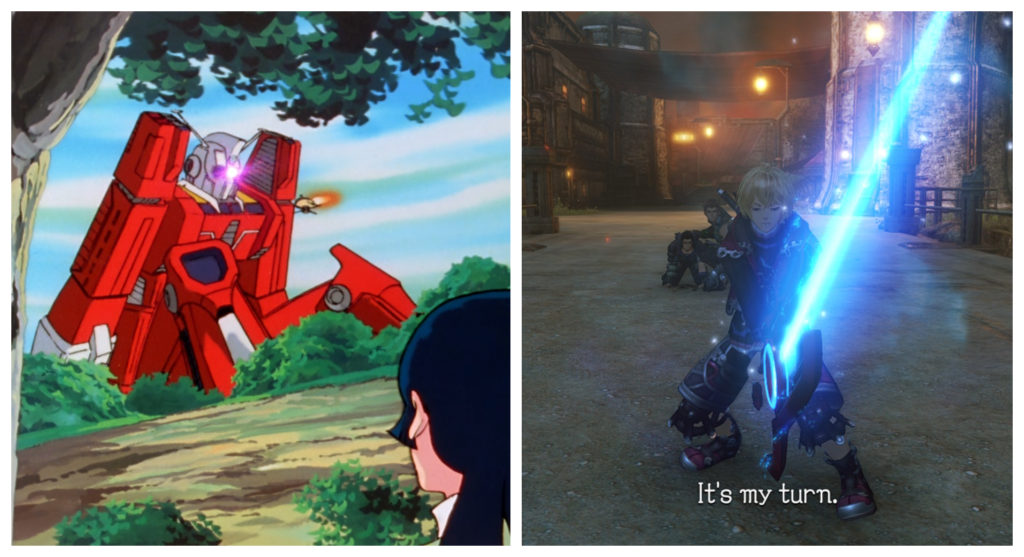
The story begins with the protagonist’s colony in the middle of researching an ancient weapon. The weapon has been used once before so they’re vaguely familiar with it, but they’re still nowhere close to comprehending the secrets of its design. There must be something more to it, but it’ll still take quite some time before they can draw anything out. However out of nowhere the spark of war is lit, and the colony instantly becomes a battlefield. In a desperate bid to repel the forces rapidly setting their town ablaze, the colonists are forced to tear it from its restraints and put it into immediate use. Although they’re unable to save everyone, the powerful arms make short work of their adversaries, and so the tale of temptation begins. With the colonies in ruin the cast are left as vagrants. Shulk sets out inspired by feelings of revenge that he believes are his own, while the humans from Logo Dau are essentially kidnapped by the Solo Ship. If there’s any silver lining to be found in all this, it’s the fact that they at least now have the powerful macguffin to protect them in the future in whatever battles may await them – and battle they do. The clashes only escalate in scale the longer the journey goes on, so their quest for knowledge has to be put on hold in the face of the continuing danger, and as a result they almost end up forgetting about it. Out of sight, out of mind. Though they were once majorly invested in their quest to understand the weapon, these feelings become silenced by the cry of its power. Questions about its origin do still quietly nag at the back of their minds, but become increasingly less important with each battle won.
The fearsome, all-powerful ancient mechanical weapon’s appearance…does not actually match up to its military legacy, looking like a mere toy instead. The Monado a big dumb lightsaber with a goofy looking handle, and the Giant God Ideon a sacred combination of three different construction trucks that may or may not be unapologetically designed to sell merch to children. Both brightly coloured, and running off a circular energy gauge. Its power is immense, being able to directly grapple with the fabric of reality, and giving the users perception beyond their wildest dreams. The Monado provides Shulk the ability to look through time, while hooking the Ideon’s power source into their space radar lets that crew map out the entire universe. Though for as overwhelming as they are, the power of each seems to ebb and flow at its own whims, never truly submitting to those who wield them. It often feels like the weapon is using its pilot, not the other way around.
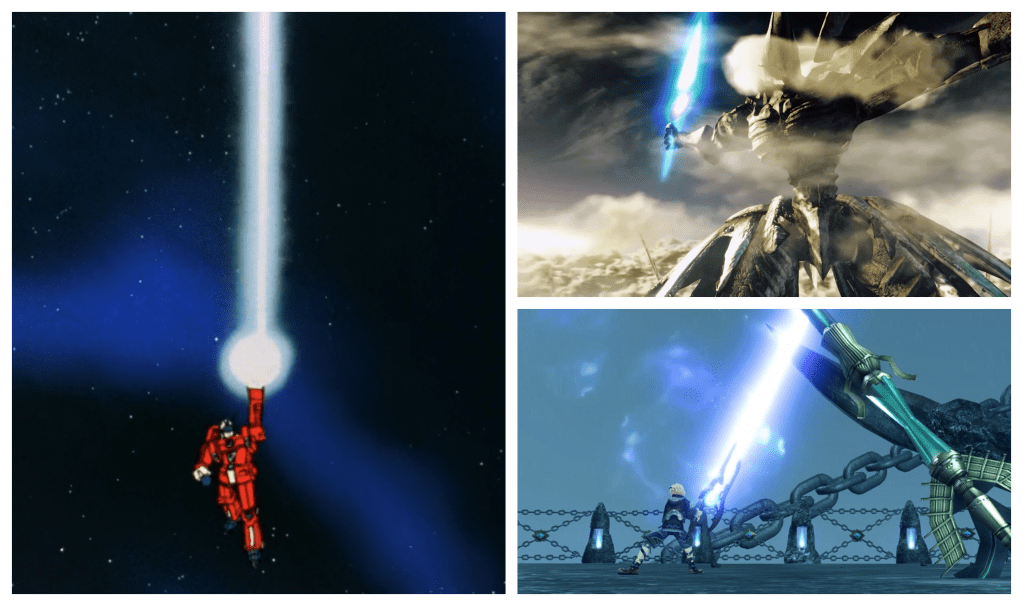
Likewise when it goes berserk for the first time the Monado unleashes a giant white blade of light, much akin to the Ideon Swords that appear when the mech first breaks free, and while yes the Monado may be a laser sword to begin with the way this slots in with the rest of the parallels makes me willing to read it as directly in reference. And both things seem to have a knack for protecting their users, the Monado initially refusing to cut Homs flesh, and the Ide going so far as to offer internal barriers with which to neutralise the bombs that had been planted all throughout the ship.
But as we soon discover, this is nothing but façade and a very optimistic misinterpretation of its true nature. Their initial suspicions that had been swept under the rug in that first violent distraction had now been confirmed. They didn’t understand the weapon at all, A symbol of hope? A guiding light? The key to the future? No. They were so, so wrong to ever think of it that way. The trump card is far more sinister than it lets on – in fact it’s their biggest enemy.
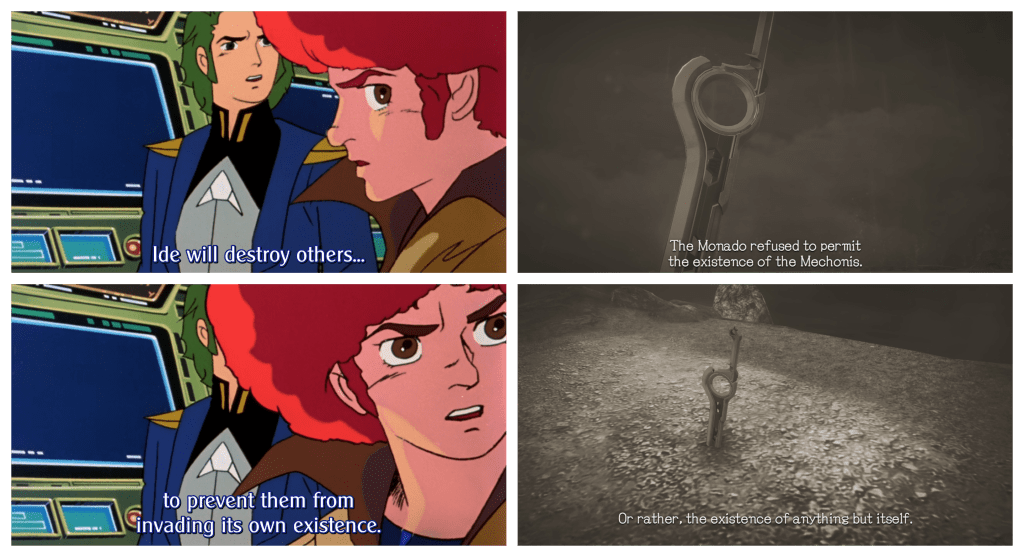
Whether it be the Ide or Zanza, the weapon has long housed its own selfish consciousness, and frequently channels its will into their preferred host to direct them toward a future of its own design. Its solipsistic wish is nothing less than the complete elimination of everything but itself, consuming all and letting its mind swell until it takes over, or effectively ‘becomes’ the universe itself. The weapon had never been protecting its people at all, but simply preserving them as cattle – herding them towards its ultimate goal of destroying and recreating life in its own image. Yet even still, even despite witnessing its malicious touch firsthand, the undeniable truth is that they just aren’t able to give up its power yet. They need it, and there doesn’t appear to be any way around that. So regardless of any revelations they may have now gained, of the horrific truths that have revealed themselves, they simply have no choice but to continue as its prisoner, struggling only as much as their shackles will permit. And while the Xenoblade crew do manage to wrestle free of its control, invoke the god-slaying sword and create a world where they can be free, the Ide ultimately ends up destroying its passengers: stripping them of their flesh, overwriting their ego, and assimilating them into its own personality complex. Like the Getter before it, and yes despite Getter Robo beginning in the 70s the Getter is an Ide clone considering prior to the series’ release it was again just a clone of Mazinger’s miraculous photon energy without any rampant consciousness connotations, Zanza and the Monado are functionally just Ide and the Ideon with a different name, and it follows that the story of Xenoblade is basically just an altered retelling of that which it originates from.
As far as the setting is concerned, the two titans are positioned to parallel Earth and the Buff Clan home. Space Runaway Ideon begins on a mysterious planet called Logo Dau, which is spatially situated smack in the middle of the two species. This imagery is channelled into the Bionis and Mechonis, two continents of such similar design each housing different origins of life, and intersecting only by the Sword Valley that runs perfectly between them. Like the earthlings encountering the seemingly identical Buff Clan aliens, upon infiltrating Mechonis the travellers are shocked to discover the hidden race of Machina so heavily resembling their own humanoid forms.
That is, in essence, a summary of the ways in which Ideon underpins Xenoblade Chronicles.
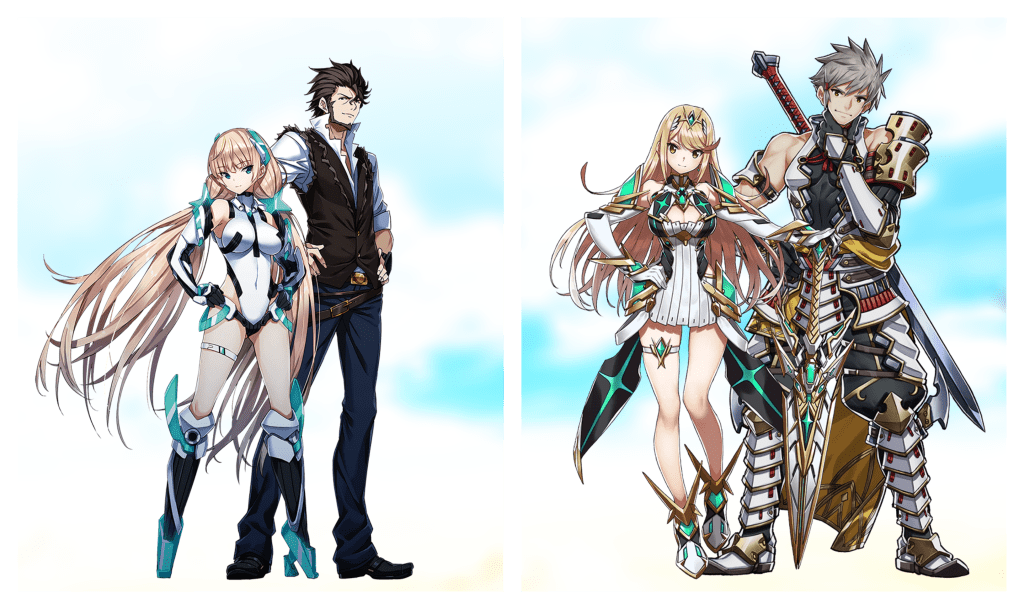
And then alongside that, although it makes no real sense because like why would there be any aesthetic interplay between these two, the Monado’s design is for whatever reason suspiciously close to this mechanical sword prominently featured in the Macademi Wasshoi multimedia franchise. The IP, encompassing light novels, animanga and games, debuted in 2003, and its most recent entry was about a year and a half before the release of Xenoblade Chronicles. It’s a magic-oriented ecchi harem series, not any kind of sci-fi saga. I’m sure it’s just a coincidence since I cannot fathom the two being deliberately linked in the way that it is to Ideon, but like man what a coincidence it is.

But, Xenoblade 2 is also anime, believe it or not. Who could have seen this coming? While it’s nowhere near as significant as what was borrowed from Ideon, a large portion of Xenoblade 2’s aesthetic identity appears to be heavily inspired by the 2014 sci-fi film Expelled From Paradise, or Rakuen Tsuihou. If reverse image searching a screenshot that ended me up at a reddit comment section is any indication, this is apparently the more well-known anime comparison, despite me firmly believing that even in this day and age Ideon would be considered the more iconic and relevant work.

The most immediate link you’ll find between the two of them is of course that Angela’s design has obviously inspired Hikari, Pneuma and prototype Homura. Hikari is pretty self-explanatory: blonde, wearing a short white dress with black details on it, and having the glowing green highlights all over. The crosses that show up over her outfit parallel Angela’s X-shaped hairbands, and she also features the gem on both her chest and garter. Pneuma more specifically shares the hollow green loops that appear on Angela’s design, as well as the black tips on her white forearm guards, and rectangular high-heels. And the prototype design has both the same headgear and the giant twintails. These are the things that first beat you over the head and make you go “hey, wait just a second, that’s a xenoblade 2”, to the point of just barely avoiding plagiarism – if you even give it that much lenience. However it’d be more accurately acknowledged as self-plagiarism, since this design consistency actually stems from all four being designed by Masatsugu Saito, one of the many artists brought onto the project to help realise its smorgasbord of styles.

Additionally each girl arrives linked together with her mech, and as part of their high-octane aerial combat the pilot’s both have instances of their consciousness melting into the robot. But the similarities do also extend beyond just the appearance, as their particular ‘loose cannon’ brand of tsundere is very similar. The two are outwardly abrasive to hide how sensitive they are. They act hostile because that’s what’s socially ingrained after considering themselves a higher existence for such a long time, so although they do want to be friendly with everyone they struggle to reconcile it with the harsh image they’ve created, and tend to end up standoffish once their uncharacteristic attempts at being nice are pointed out instead. It’s not like such a tsundere is particularly unique or unheard of, but in the context of everything else does come across as the earlier character deliberately informing the latter.
The male companion Dingo has some similar upward spiky hair as Addam too, though it’s far less auspicious than that shared between the two girls. Regardless it does lend itself to a similar silhouette when the pairs stand together. Furthermore, so too does he have a dynamic with her somewhat like Addam and Hikari in the Torna prequel. They both deeply wish for the girl to learn what it means to live amongst humans, and so often use their seemingly aloof nature to try and tease her out of her shell. He might just seem like a dork most of the time, but has given his own serious considerations to the situation. Although easily qualifying for the digital heaven Dingo considers living under the governance of DEVA to be selling away his freedom, and firmly rejects it. The vagabond prince also rejects his claim to the throne because he believed it wasn’t suitable for someone like him. This underpins Addams character, really, since most of his conflicts are about knowing his own limits. He refuses the throne in such a manner, and often apologises to Hikari that he isn’t strong enough to be the Driver she truly needs.
The stories centre on both a digitized human personality and AI construct who descend to the physical plane from a space station in orbit commonly referred to as “rakuen”. Now, of course Xenoblade’s first low orbit station is something established in the original 2010 game, I’m definitely not trying to suggest that it was inspired by this film which came afterwards, but in the context of everything else the imagery is at least interesting enough to warrant mentioning. Further on that note I’ll also point out the film’s Genesis Ark lining up with Abel’s Ark and the Samaarian ships from the Xeno franchise, so perhaps the DEVA space server resembling the low orbit station so heavily is an intentional homage on the anime side after all, that then ended up catching the eye of someone at Monolith and leading to the similarities.
So anyway the sassy blonde avatar makes her way down from heaven, and when the pod lands on the planet, she takes her first, nervous steps into the wide world of the old frontier, finding herself presented with a devastated surface barely clinging to life. This barren setting paves way for a hefty narrative focus on environmental and social decline as the titans steadily fall to ruin, and the post-apocalyptic cityscapes left in the wake of the Nano Hazard and Conduit Incident create important imagery shared between Expelled From Paradise’s desert planet, the decrepit corpse of Morytha, and the dusty remnants of what was once the flourishing colony of Elysium.
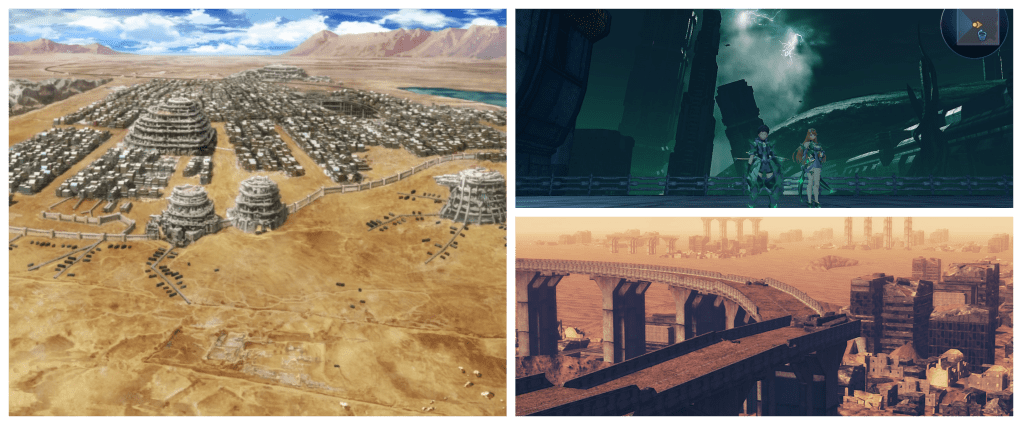
It’s certainly not that much when compared to the breadth of parallels to be found in the first game’s Ideon homages, and they’re mainly aesthetic links rather than having hugely substantial plot implications, but it’s enough to be worth discussing at least a little bit beyond just how Angela and Hikari look at least.
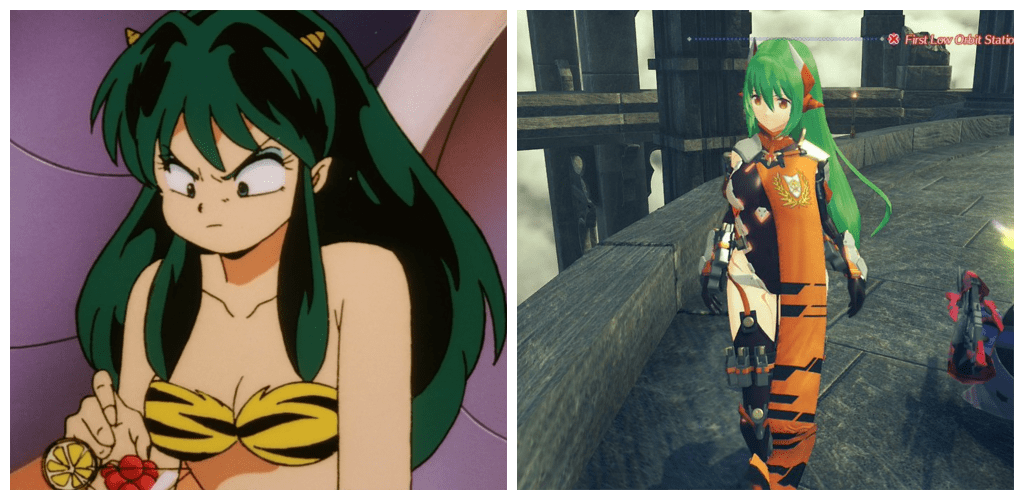
And also: Considering Tora is an otaku this is a Lum, probably
And also: Xenogears obviously has much in common with Evangelion with all the religious conspiracies, berserk robots, and ‘mustn’t run away’ moments that Fei has, as well as the shared imagery between SEELE and the Gazel Ministry.

But it also seems to be channelling setting components of Megazone 23. Though I’m only, say, 15 hours in, so it’s too early to say in any definitive manner, but as of this moment I believe that the intro cutscene showing the colony ship collapsing onto what is presumably the planet we play on, and the remark about human bones not existing in the fossil record prior to 10,000 years earlier, are hinting at origins similar to the second Megazone episode where their colony ship crashes on Earth and the survivors eventually manage to re-establish society, which we see in the massive timeskip of the third episode. Though I suppose that kind of space Ark story isn’t hugely unique itself. But again, I’m presumably nowhere even close to beating the game yet so I can’t commit to anything that isn’t super obvious yet, and am simply taking the liberty of rambling.
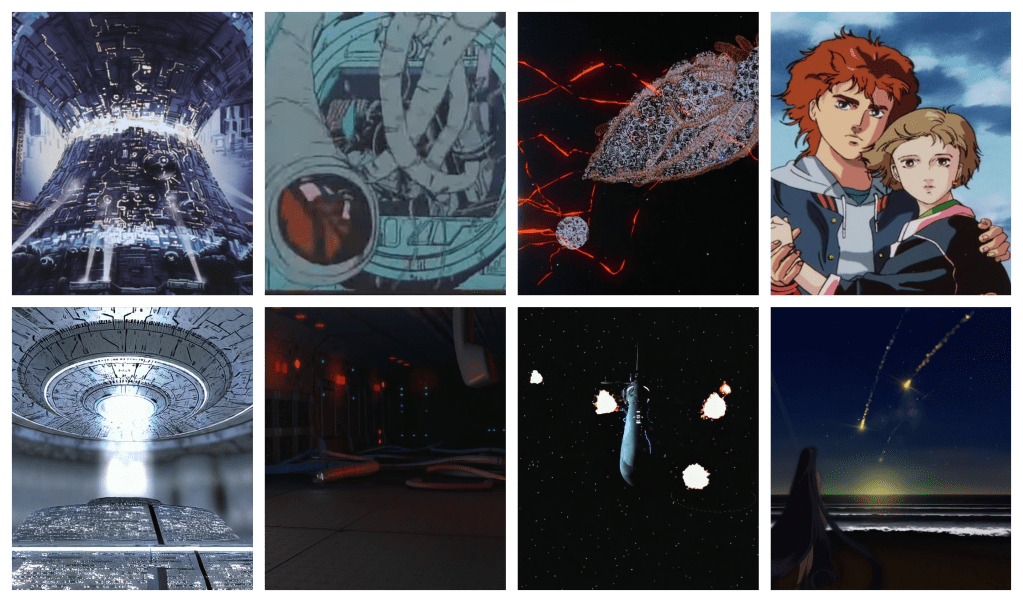
And also: I’ve never played Xenosaga because it was never available in Australia so I can’t comment on that, but now that I have a good PC I want to considering how much of a legacy KOS MOS has, and it’s interesting to see her design lineage that runs throughout the franchise. If this piece (or any of the rest from my blog that I never update) were any indication, I love looking at those kinds of media lineages.

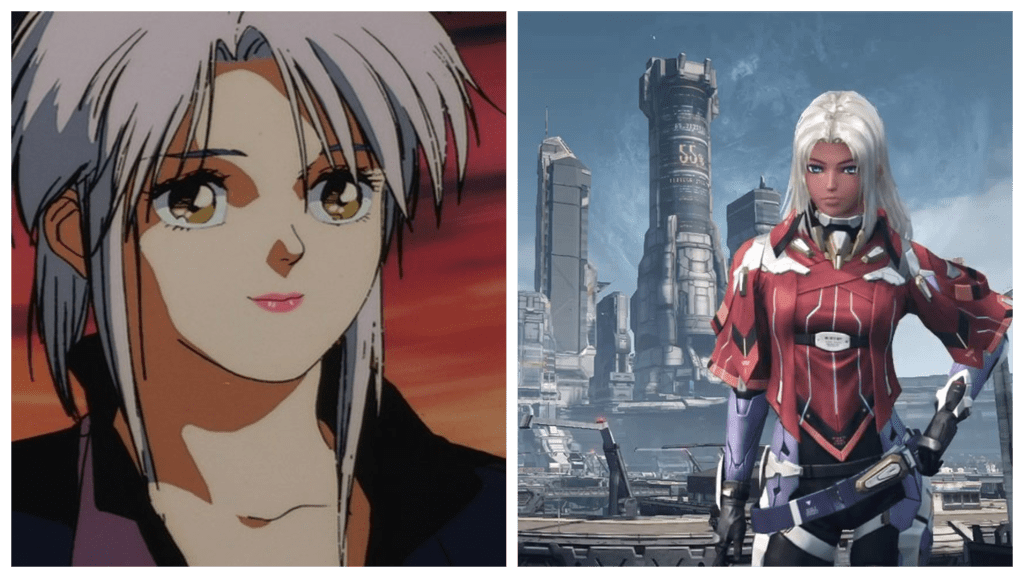
And also: I don’t really know that there’s anything to say about Xenoblade X here, and if there is it’s probably nothing I’ve seen since it isn’t immediately leaping out at me like the other two. I will say that if there is anything my guess is that it’ll probably centre on the connection between the military focus, colonisation on a new planet, and Elma’s hidden xeno identity. You could somewhat say Megazone again what with the white whale colonisation aspect and subsequent focus on virtual or digital reality. The recurring motif of the mech transforming into a super sci-fi motorbike (resembling each other quite heavily might I add) is hard to ignore.
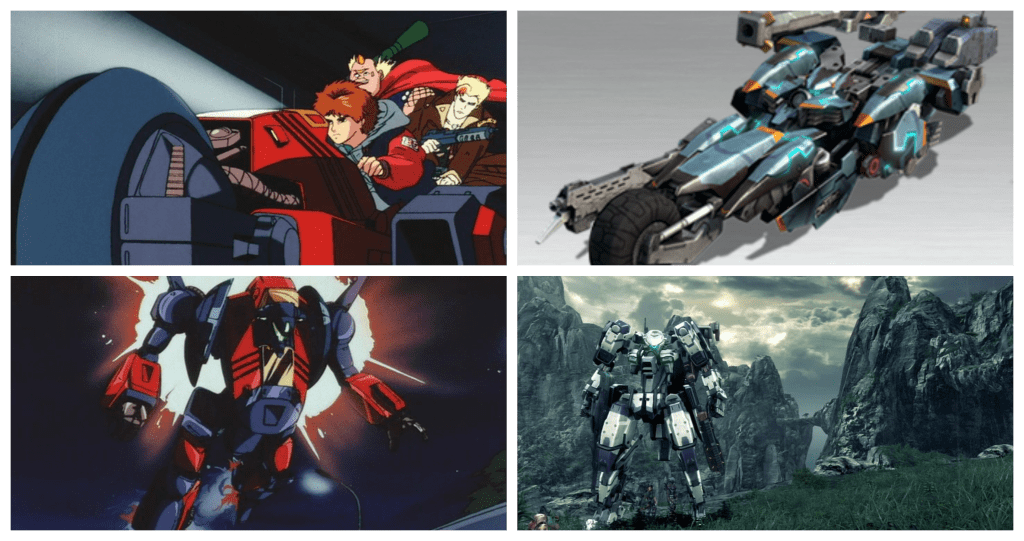
But there’s a good chance that many of its structural components are just carrying over from narrative conventions the Megazone-based Xenogears established for the franchise, and regardless of any shared silver hair or the true body being locked away elsewhere, I hesitate to fully commit to it since Elma isn’t quite the equivalent to Megazone’s Eve that I believe she would need to be.
Anyway the video this script got used in was originally just supposed to be a 2 minute long meme and I don’t know how it ended up like this sorry. Like it was genuinely an accident. I was just writing my two paragraphs and then when I looked back at that point it was already 1700 words long.
 skapbadoa
Leave a comment