I wasn’t sure whether it was fair to post this, but it’s not like there are any rules. This is an edited version of a segment in my prior Re: Hugtto Precure that I’d been meaning to rework into a video script for a long time, and as the video is now done I require a link to the individual script too.
2018’s Hugtto Precure is a troublesome show. The first 24 episodes are some of the strongest mahou shoujo you can get. Right from the beginning it’s pulling out all the stops with its insane fight choreography and impact-frame sakuga, then episode 4 was a masterclass of shot composition. There were breathtaking dramatic setpieces like Homare failing her first attempt at becoming Precure, Hana panicking and rejecting the Melody Sword mid-swing, or Lulu being brutally blasted with Pupple’s energy pillar – which hit especially hard in conjunction with the previous episode that displayed how goofy she could be in the right company. As the season continued on this was something that showed no signs of stopping. The production values were supreme, and this extreme degree of quality made it incredibly engaging. However even with all that aesthetic flair, I think the writing was where early Hugtto shone the brightest. At a glance Hugtto may appear like your standard magical girl fare, but when you read into it there are some very skillfully written emotional arcs toiling away beneath the surface, and I believe this is where the true appeal of the series is found. This is what special. Its protagonist unsurprisingly finds herself at the centre of this. Built up through subtle background details and questionable character motivations, the complex writing of Hana’s hidden emotional turmoil was its crowning jewel.
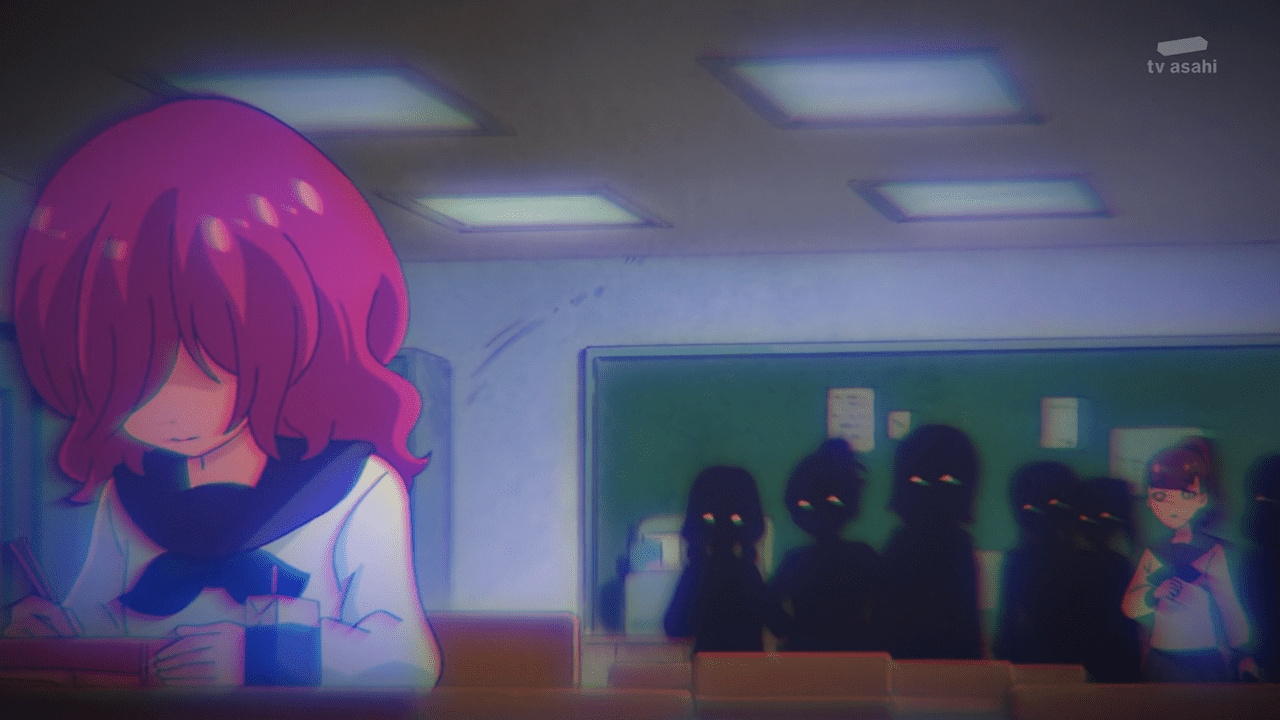
We don’t know the full extent of it at first, but one of the most immediate things we learn of Hana is that she’s just transferred after her first year of middle school. This isn’t cause for concern by itself, but in the early series I very distinctly got the feeling that there was something hidden behind her happiness. Rather than simply being energetic and optimistic, it was more like she was running herself ragged. She was constantly putting herself out for others without ever taking a moment’s rest for herself, in a way that vaguely came across as calculated. Additionally it always seemed like she took the villains’ talk about stopping time to prevent suffering a little too personally, as if every time they brought it up she had to try and convince herself that she didn’t actually agree with them. She’s written in such a way that very early on you’re able to clue into the fact she’s forcing her smiles, always wanting to be moving in order to avoid being left alone with her thoughts. This feeling continues to nag at the viewer until we eventually learn about her history with being bullied, and it all retroactively falls into place – those little insecurities of hers you thought you were noticing were real after all. Hana had been fiercely bullied at her old school, and she’s still reeling from the effects of it. It was merely a year ago, after all. She viewed happiness as something infinitely fragile. This serves as the central underlying motivation informing all of her actions, as the despair she felt back then was constantly waiting to consume her the moment she let her guard down.
It messed her up bad, and frankly being a Precure may have only exacerbated this problem. Despite chasing the illustrious “Nono Hana I want to be” there wasn’t actually anything she dreamed of, leading her to use her Precure obligations as a vice in order to avoid thinking about it – fighting to support the dreams of her friends so she didn’t have time to confront herself about the fact that she was empty inside. She could say she was trying her best, because duh she was a Precure. It was her own way of avoiding the future. There’s a brilliant emotional complexity to Hana’s character that you can trace through to tangibly see how her troubled history has influenced her current personality, forcing happiness to try and keep the bad memories at bay and cheering for herself because no one else would do it for her in the past.
This all comes to a head in episode 24’s night pool – a brilliantly intimate and understated little piece where we at last get to peer inside of her. The usually spastic Hana quietly wades around the warm pool, talking to people and contemplating the things they say to her. She had greatly admired and trusted George, so the shock of discovering that he was actually her biggest enemy let loose unpleasant memories of being betrayed the year before. When she finds herself left alone for a moment she can’t stop his words from flashing up in her mind, and she attempts to distract herself with a “hooray, hooray me” as she meekly cries into the waves.
While the others were all chasing extravagant dreams of becoming actors and athletes, being a Precure was all that Hana had. Yell was the Cure of genki, and not much else. Throughout the episode she spends more time looking around to make sure everyone else is smiling than she does actually enjoying the pool herself. Their happiness was how she judged her own merit, unhealthy as that may be. This behaviour obviously stems from her trauma. Episode 23’s flashback shows her mother comforting the depressed Hana by saying “It’s okay Hana! You weren’t wrong!“, with this being the first small glimpse into what form her bullying actually took. It’s later in episode 31 where we finally learn the nature of her torment. Her best friend Eri was frequently brought to tears as a target of ridicule by the clique of popular girls, so Hana stuck up for her. Then the perpetrators set their sights on Hana instead and completely isolated her, with Eri becoming too scared to associate with her any longer. This isolation continued up until she eventually transferred away to escape it.
Despite coming from a place of love, her mother commending her self-sacrifice might not have been the best thing for her vulnerable mind. She ends up developing a bit of a toxic relationship with heroism as a result. Defending others is part of her nature, sure, but doing so brings up bad feelings within her. Her mother had reassured her that sticking up for Eri wasn’t the wrong thing to do, but was that really what Hana needed to hear? It may have backfired. She wasn’t necessarily feeling the joy of helping others, but that it was something she had to do in order to validate her existence. Her actions were always about stopping Criasu from stealing their futures, never about her own. She didn’t have a clear-cut passion like the others, so the only path she saw before her was to be a stepping stone by protecting them as Precure. From her isolation Hana knew how painful it was to feel as if time was frozen, so she wanted to ensure nobody within her reach had ever had to go through that – acting out of fear and desperation if nothing else. It was the only thing she could do, even if she was spreading herself thin to do it. But if being a Precure was all she had, then where did it leave her when the others were just as adept while also having ambitions elsewhere? Was there really any point to her being around? Did they really need her? She finally gets the answer to that question: Yes. There is a reason for Hana to be there. It may have come from a damaging place, but her friends reveal they are incredibly thankful to Hana for her constant support – that they could only pursue their passion because of her. It’s only here where Hana has briefly let down her emotional walls that the others are truly able to intervene and help her to realise that she wasn’t fighting alone, that “their smiles also give us strength”. Despite being born from her most vulnerable feelings, there was meaning in the support she had given. To love and protect was not a mistake. This bout of introspection isn’t some miracle cure for her trauma, but at the very least it helps her to realise that her actions as Precure weren’t hollow after all. For the first time since the bullying incidents Hana feels like she can trust others, and as a result she lets out her first genuine smile in ages.
It’s a phenomenal little storyline and I can only hope I’ve illustrated how much I adore it, because consequently it also becomes the biggest mark against Hugtto to me. A spectacular character meticulously built up through carefully crafted subtleties, only for this arc to be completely and utterly squandered. If she was gem adorning the show at its best, then so too does she become emblematic of the show as it mysteriously falters in the second half. By all means this was the single most important component of the most important character, and one would expect the show itself to treat it as such. Unfortunately this isn’t the case. If 24 is my favourite episode for how it handled Hana’s inner turmoil, then episode 31 is my least favourite for the exact same reason. If 24 is the first time I’ve ever watched an episode twice in a row just for how much I loved it, then 31 is the first time I’ve been angry at an episode to this degree.
Episode 31 sees Hana encountering Eri on the street one day, and suddenly all of her suppressed memories of being bullied are dredged back up. As much as she was trying to avoid thinking about them, Hana’s wounds were still fresh. She tries to play it off with a forced smile but Hana was not okay to see Eri again. Yet rather than the previously displayed subtlety and emotional complexity, the episode treats it brusquely – making it feel low-stake just like any of the other surrounding episodic events, and nonchalantly handwaving away her entire trauma with the power of friendship. All wrapped up in what ended up being Hugtto’s worst showing for art and animation, of course. Not only was it the conclusion to this integral chapter of Hana’s story, but it was also the episode introducing the form upgrades. No matter how you look at it the episode was clearly poised to be a big deal. What kind of unprecedented production mishap had to have occurred in order for episode 31 to end up like this? It was by all means supposed to be the big conclusion that closes out the bullying arc, but it was handled so poorly that it directly soured my opinion on the overall show. They spent 31 episodes building up this long-running narrative about Hana’s deep-seated trauma from her history with bullying, only to unsatisfyingly fix it over the course of a single episode. This by all means should have been the defining episode of the show, yet it ends up as its worst. It’s just baffling. And no, I don’t think you can simply dismiss this as me expecting too much of a children’s show. Not when the first half of the series has already displayed how far they were willing to take her. Not when Heartcatch Precure already exists with even darker themes and a protagonist arguably even more complex. There is a precedent established not just within the broader franchise, but within this entry itself. What this arc deserved was a two-episode conclusion displaying the same degree of introspection as 24, but instead it was a production mess where the extent of the drama was just the other main characters telling Hana to be brave and face her fears. It felt hollow, and frankly quite insulting to the rest of the plot thread that came beforehand. Then the show simply meanders through the next subpar cour, right to its ending mini-arc where it, at the very least, finally makes good on the Hana and George subplot that had been brewing through their interactions ever since they first met. Ultimately I never found it in myself to forgive Hugtto Precure for what it had done.
 skapbadoa
Leave a comment