
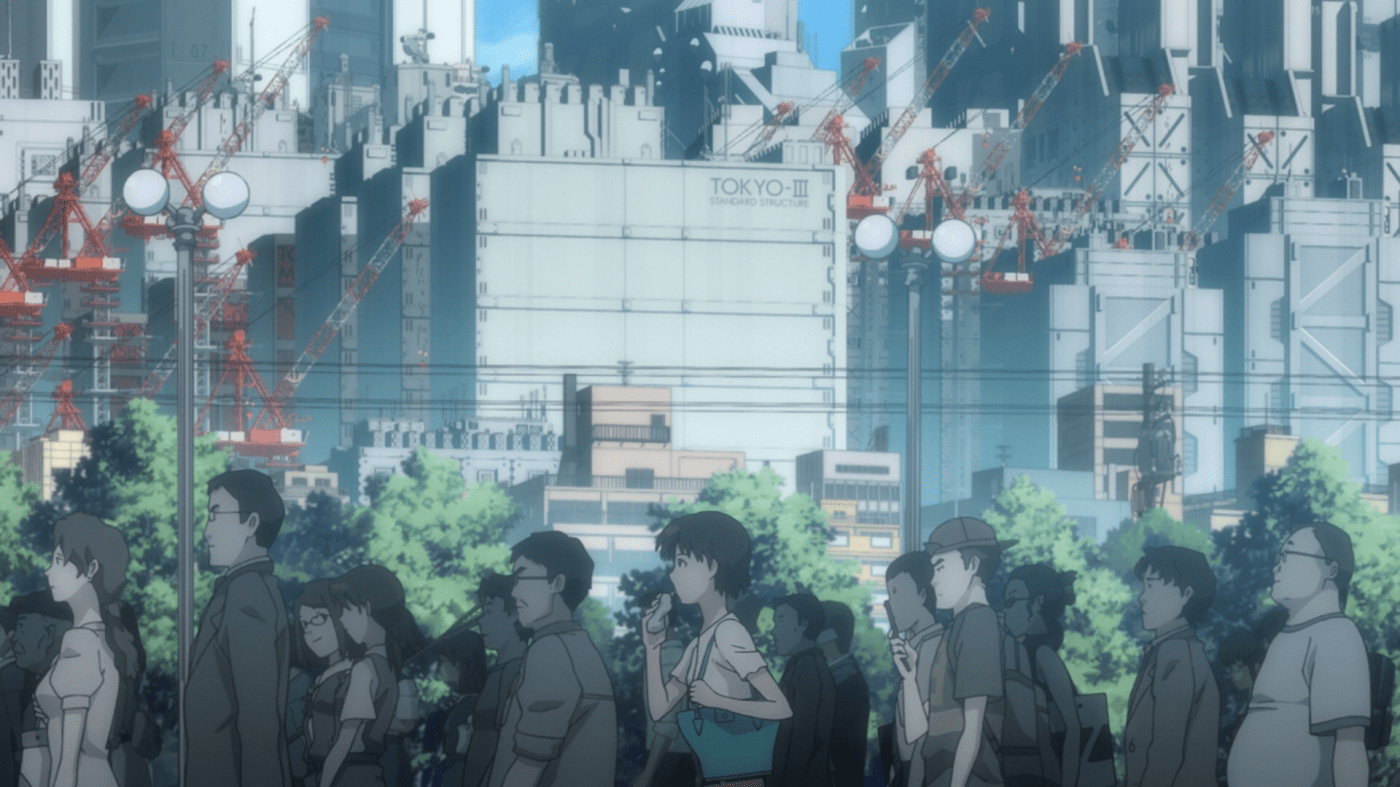
The Evangelion: New Theatrical Edition, more colloquially known as the Rebuild of Evangelion, is a series forlorn with controversy from dedicated fans who saw it as a piece of sacrilege against the original Neon Genesis Evangelion. The Rebuilds start out as a rather straight upgrade of NGE but quickly diverge on their own unique paths, which invited criticism from many. However I believe this is a critically flawed way of thinking, in that one would be attempting to judge the Rebuild of Evangelion for its ability to be Neon Genesis Evangelion, when in reality it’s a whole new behemoth entirely. Even with that distinction addressed, there is still more to unpack. In its more famous latter half Neon Genesis Evangelion serves as a heavily psychological and philosophical character study of its pilots – so then why was Evangelion 2.0 suddenly a romcom? What were they thinking when they made Evangelion 3.0? The surprisingly straightforward answer to that requires an awareness of Evangelion’s heart and soul, its director and original creator, Hideaki Anno.
When you have have the context to properly observe its homages in action, it becomes apparent that the ‘Rebuild of Evangelion’ would be more accurately described as a ‘Rebuild of Hideaki Anno’. They’re a tribute to Anno’s highly decorated portfolio told through the lens of his most famous work Evangelion. Throughout his anime career Anno has lent his art and animation talents to many a project, but has only been the main director for a handful of prominent shows – these being Gunbuster, Nadia, Evangelion and KareKano. It’s entirely speculation on my part, but to me it reads that the likely situation is with Anno finding his new beginnings in Studio Khara in 2006, the Rebuild of Evangelion series was originally planned to be a project celebrating his past efforts. In the initial project plan the film saga was only ever intended to occupy a mere two years (Anime News Service 2006, ‘FURTHER EVANGELION SHIN GEKIJOU BAN DETAILS’), but as time went by production schedules unfortunately began to slip away, until we reach the current point where it’s now over a decade past when they originally planned to finish production and yet 3.0+1.0 is still off the cards. Although this should come as no surprise, since the original plan of ‘1.0 in 2007, 2.0 in early 2008 and 3.0+1.0 in late 2008’ was clearly an impossible endeavour from the get-go. In any case, regardless of what actually ended up happening with the severe delays, the original aim of the Rebuild of Evangelion was to be the opening fanfare for Hideaki Anno’s new studio and the next stage of his career.
So then:


Evangelion 1.0, aside from some lore changes that I personally think tie into the sequel theory (franchise spoilers), is effectively just the first six episodes of Neon Genesis with updated visuals and sound. There’s not a whole lot more to say about it in the context of this piece. The Rebuild of Evangelion is a commemoration of Anno’s history through the Evangelion aesthetic, and so it’s to be expected that the first chapter will indeed be Neon Genesis Evangelion itself.
![[2D4U-Bloat] Neon Genesis Evangelion 02.mkv_snapshot_19.05_[2019.03.29_20.56.30]](https://skapbadoa.com/wp-content/uploads/2019/03/2d4u-bloat-neon-genesis-evangelion-02.mkv_snapshot_19.05_2019.03.29_20.56.30.png?w=736)
![[Coalgirls]_Evangelion_1.11_You_Are_(Not)_Alone_(1920x1080_Blu-ray_FLAC)_[A73E31DA].mkv_snapshot_00.20.34_[2019.03.29_20.55.36]](https://skapbadoa.com/wp-content/uploads/2019/03/coalgirls_evangelion_1.11_you_are_not_alone_1920x1080_blu-ray_flac_a73e31da.mkv_snapshot_00.20.34_2019.03.29_20.55.36.png?w=736)
Immediately following this however, Evangelion 2.0’s release began to see movement from within the audience. It caused a stir because instead of simply being Neon Genesis Evangelion again a la 1.0 its tone and events were more slice of life and romcom based, insofar as one of the characters’ backstory and personality being so significantly rewritten that she was considered entirely separate, with Asuka Langley Sohryu nowhere to be found and Asuka Langley Shikinami in her place instead. The majority of the fanbase attributed this change in identity to shoddy writing and a lack of skill from the creators, but in fact this was actually a carefully calculated throwback to a prior directorial exploit titled Kareshi to Kanojo no Jijou, commonly referred to as KareKano.


After pouring everything he had into Neon Genesis Evangelion, Anno was understandably very mentally exhausted and spiritually drained when he came out the other side. As a result he wanted something more light-hearted to work on as a kind of therapeutic method to recover from the stress of making Evangelion. His next directing job then, was on the adaptation of the KareKano manga. Yet even while generally more relaxed than Evangelion due to its primary focus on Yukino and Arima’s blossoming young love, KareKano was not without its own dense psychoanalytical components either. It dedicated an appropriate amount of its runtime to deconstructing deep-seated neuroses such as Tsubasa’s abandonment complex or Arima’s inability to truly love and be loved due to his history of abuse and family strife.


In homage to this the second Rebuild film completely changes genre into a form reminiscent of KareKano – a psychological romcom. The Evangelion aesthetic and psychosis are the same as they’ve ever been, but it abruptly introduces this central love-triangle drama surrounding Shinji, Rei and Asuka. For example, Evangelion 2.0 features Rei trying to facilitate reconnection between Shinji and Gendo through her cooking, and in response Asuka also takes up the challenge of cooking for Shinji in order to compete for his affections. This is a very distinct difference in tone from Neon Genesis Evangelion where Rei II’s life is cut short before her personality can flourish that far, and Asuka never wants to see Shinji as anything more than an inferior to make herself look good. People are all too quick to decry these departures as the producers forgetting what made Neon Genesis Evangelion, well, Neon Genesis Evangelion. But this is a short-sighted claim. Rather, this stylistic shift is a very deliberate way of cleverly calling back to KareKano as the second step in the ‘Rebuild of Hideaki Anno’. They didn’t accidentally change Evangelion’s entire genre, after all.


As a signpost to clue you into this similarity being an intentional throwback, one of the main bgm themes from KareKano titled Peace Reigns in the Land is prominently incorporated into Evangelion 2.0’s slice of life soundtracks such as Des Cordes Opus 1, 2 and 3, as well as Mellow 2009.
Playlist showcasing the aforementioned leitmotif
Cut to Evangelion 3.0 and we’re met with yet another radical jump in tone as every perception we thought we had of the story violently collapses around us, and we (alongside Shinji) are thrust into a tumultuous and totally unfamiliar world. Fourteen years have advanced since the time Shinji and Rei got sucked into Unit 01’s core, and in that time that characters and setting have warped so drastically that it’s not immediately clear how this new work connects to the last ones. Now, of course, I love the third film a lot and think it even rivals End of Evangelion for the best entry in the franchise, but that is far from a popular opinion. Due to its puzzling nature you don’t have to look far to find people bashing it online. Or offline, for that matter. In 2017 I went to Madman’s Rebuild marathon event, and after the third film finished there was a lot of audible confusion and “you really want to take it there?” remarks from people in the theatre. And while I personally believe that since Kaworu explicitly expositions the backstory around the midpoint much of this response is simply viewers failing to properly pay attention to the film, that doesn’t negate the fact that it has a very large negative reputation stemming primarily from its alleged aversion to comprehension. But once again, I think this negativity is precipitated on a lack of understanding in where Evangelion 3.0 situates itself within the ‘Rebuild of Hideaki Anno’.


Evangelion 3.0 functions as a parallel to the ending run of Nadia: The Secret of Blue Water. In the beginning of the series when deuteragonists Jean and Nadia are accidentally thrown overboard a government ship during armed conflict and left deserted, they have a run-in with a band of refugees hailing from the fallen city of Atlantis. The crew takes them aboard to prevent the kids from drowning, and the ensuing days are chock full of laughter, romance and the occasional thrills as they journey across the islands and cities in their path.
![Nadia - The Secret of Blue Water - 12 (BD 720p) (THORA) (NakamaSub).mkv_snapshot_09.03_[2019.03.29_20.39.15]](https://skapbadoa.com/wp-content/uploads/2019/03/nadia-the-secret-of-blue-water-12-bd-720p-thora-nakamasub.mkv_snapshot_09.03_2019.03.29_20.39.15.png?w=736)
In episode 22 the two groups are dramatically torn apart when Captain Nemo forcibly ejects the kids from the sinking Nautilus, believing that as outsiders to the Atlantean conflict they shouldn’t have to share their fate. A rather notorious filler arc goes by with no sign of them returning, and then in episode 36 is where the Atlanteans finally make their reappearance, albeit in a radically different regime to that of when we last saw them. Their previously soft personalities are battle-hardened, their resolve to enact revenge for the destruction of Atlantis is sharpened to razor’s edge, and their lost submarine has instead been replaced by the aerial warship Nautilus II.


Before you even have time to blink the stakes are heightened to an immense level, with their rather casual romp to this point being eclipsed by the upcoming battle of deified proportions that threatened the fate of the entire planet – much like the aforementioned plot setup of Evangelion 3.0. The change in personality undergone by the Atlanteans from generally welcoming and friendly people to a troop of soldiers whose main purpose is vengeance is the same way in which the members of WILLE have changed during Shinji’s 14 year slumber inside of Unit 01. NERV was always a cruel organisation at heart, but at least the staff responsible for the Children attempted to be as accommodating as circumstantially possible. In particular Misato’s change from an openly caring older-sister figure to a cold, stern commander directly parallels the personality shift Electra undergoes when she reappears. Although unlike Misato who remains stoic Electra opens back up to Jean and Nadia almost immediately.


The raised collars and captain’s hat on the new outfit Misato wears are paying design homage to Captain Nemo, only exacerbated by Ritsuko cutting her long hair short to more closely resemble endgame Electra (both of whom serve as the captain’s right hand man).


And once again to indicate this tonal callback being an intentional stylistic decision the soundtrack directly appropriates its progenitor, with Evangelion 3.0’s main opening track titled God’s Message being a reimagining of Nadia’s Light of Babel in composer Shiro Sagisu’s modern orchestral flair.
I guess it’s also worth mentioning that at current I’m unsure whether I think the final film will continue this tradition and adopt a Gunbuster-esque style or not. Gendo and Fuyutsuki slipping beyond the Gates of Guf into that strange pocket dimension at the end of Evangelion 3.0 has the capacity to set up a similar stage to Gunbuster’s deep-space final battle, and at the very least the preview from the end of the movie makes the fourth film appear action-oriented (though we all know how unreliable the Rebuild’s previews are). From the way I’ve interpreted the Rebuilds it seems as though the Rebuild incarnation of the Human Instrumentality Project is aiming to create a true god by combining all of mankind’s souls into a planet-sized Evangelion (taking the place of End of Evangelion’s Sea of LCL). Sure enough, one of my biggest fanfictiony wishes for the last entry is a bombastic action sequence between the four awakened Survivor of Adams and the planetary Evangelion using Cruel Angel’s Thesis (2009 ver.) as a parallel to Gunbuster’s Aim For the Top ~Fly High~ sequence. Yet the fact the movie is numbered as Evangelion 3.0+1.0 rather than Evangelion 4.0 potentially suggests to me that rather than continuing the ‘Rebuild of Hideaki Anno’ trend and leaning into Gunbuster, it will instead be continuing on from the style established in 3.0. Only time will tell which route they’ll take.
Far too frequently do I see people dismissing the Rebuild of Evangelion as something that is poorly-made due to the tonal leaps between each entry, but that is simply not the case. There is a very clear artistic vision informing these rapid shifts in style. It was a project intended to highlight the history of Hideaki Anno and promise a glorious new future, but unfortunate production delays have instead transformed it into Khara’s biggest vice. Yet even with its troubled release schedule, the heart of the films has remained focused. The suggestion that the Rebuild of Evangelion franchise is a fool’s errand inspired by a gross misunderstanding of Neon Genesis Evangelion’s spirit is frankly a misunderstanding in and of itself. Not only do they properly work off Evangelion’s psychoanalytical manifesto and abstract mysticism, but they reach beyond – pulling in an understanding of not only Neon Genesis Evangelion, but also Kareshi to Kanojo no Jijou, Nadia: The Secret of Blue Water, and perhaps even Gunbuster. Truly, a Rebuild of Hideaki Anno.
 skapbadoa
Leave a comment